The Clearly Filtered Water Pitcher has built a reputation as the water filter pitcher that serious filtration shoppers eventually land on. With claims of removing over 232 contaminants and a price tag that sits well above most grocery store pitchers, the obvious question is whether the performance justifies the cost.
We put the Clearly Filtered pitcher through extended real-world testing, compared it head-to-head with competing pitchers, and dug into the third-party test data to give you a clear picture of what this pitcher actually delivers. The short answer is that the Clearly Filtered pitcher removes contaminants that most other pitchers do not even claim to address. The longer answer involves some important nuances about filter life, flow rate, and whether the contaminant removal profile matches your specific water quality concerns.
What the Clearly Filtered Pitcher Removes
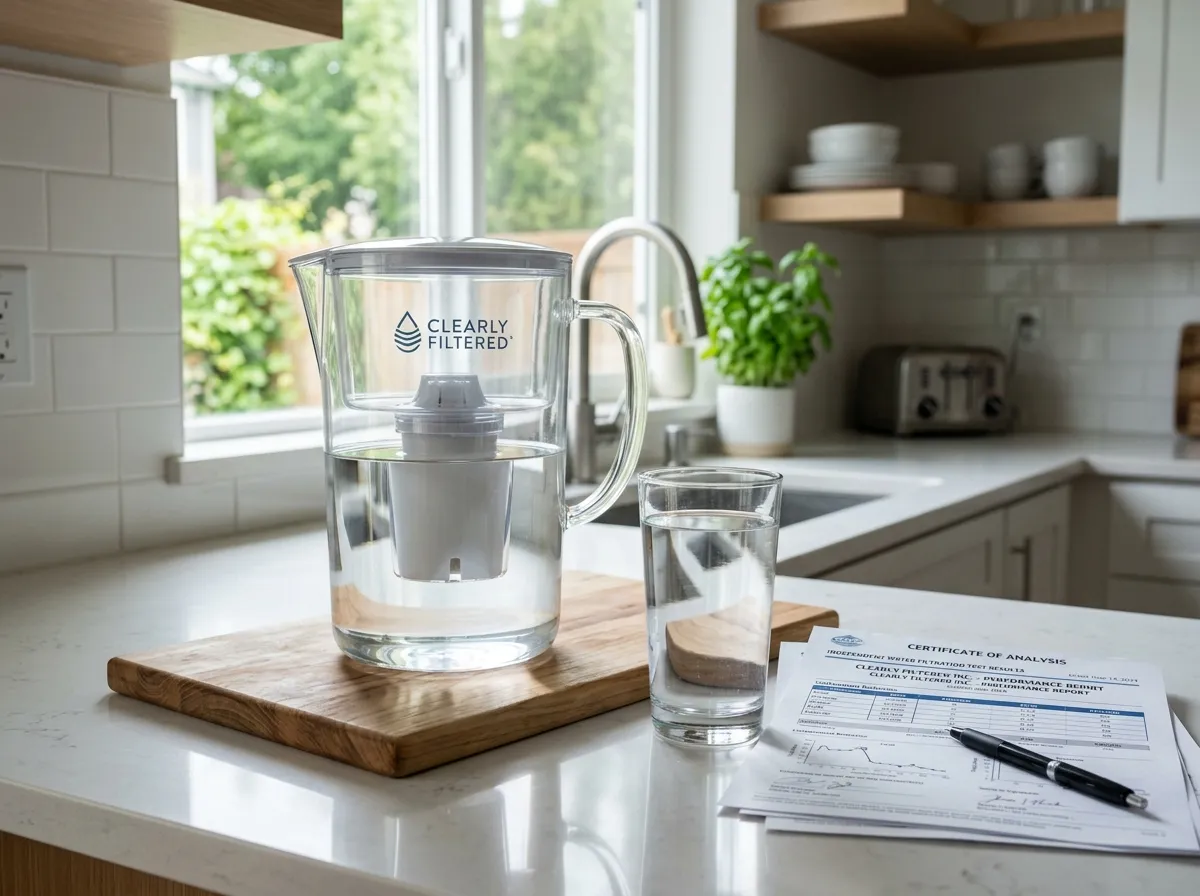
The headline number is 232+ contaminants, which Clearly Filtered backs with third-party test data from independent EPA-certified laboratories. This is not a number plucked from marketing materials. The company publishes its test results, and the contaminants covered include categories that separate it from most pitcher-style filters.
PFAS (forever chemicals): The Clearly Filtered pitcher is tested and certified to remove PFOA, PFOS, GenX, and other PFAS compounds to below detectable levels (99.7%+ removal). This is a major differentiator. Most standard pitcher filters are not tested for PFAS removal at all. Given the growing understanding of PFAS health effects, which Dr. Philip Landrigan has called one of the most significant environmental health threats of our time, PFAS removal capability is increasingly important for any water filter.
Lead: Removal tested at 99.5%+. Lead in drinking water remains a real concern for millions of American households, particularly those with older plumbing or lead service lines.
Fluoride: Removal tested at 98%+. Fluoride removal is unusual in pitcher filters and typically requires reverse osmosis or specialized media. For households looking to reduce fluoride, this is one of very few pitcher options.
Chromium-6: Removal tested at 99.7%+. Made famous by the Erin Brockovich case, hexavalent chromium is present in tap water systems serving over 200 million Americans, according to EWG’s tap water database.
Pharmaceuticals and hormones: The filter is tested for removal of prescription drug residues, synthetic hormones, and over-the-counter medications that pass through wastewater treatment and end up in tap water.
Pesticides and herbicides: Including glyphosate, atrazine, chlordane, and others.
Chlorine, chloramine, and disinfection byproducts: Including THMs and HAAs, which are among the most common contaminants in municipal water supplies.
Heavy metals: Mercury, arsenic, cadmium, copper, and others beyond just lead.
Microplastics: While not a headline claim, the filter media density is sufficient to capture microplastic particles.
NSF Certifications
The Clearly Filtered pitcher holds certifications to NSF/ANSI Standards 42 (aesthetic effects like taste and odor), 53 (health-related contaminants including lead), and 401 (emerging contaminants including pharmaceuticals). These certifications are verified by IAPMO, an independent testing body.
NSF 53 and NSF 401 certifications are meaningful because they require demonstrated removal of specific health-related contaminants under standardized test conditions. Many competing pitchers only hold NSF 42, which covers taste and chlorine reduction but not health contaminants. Our water filtration complete guide explains NSF standards in detail.
How It Works
The Clearly Filtered pitcher uses a proprietary Affinity Filtration Technology that combines multiple filter media in a single cartridge. While the company does not disclose the exact media composition (this is common for proprietary filters), the performance data suggests it uses a combination of activated carbon, ion exchange resin, and additional media targeted at specific contaminant classes.
The filter cartridge connects to the top reservoir and water flows through by gravity. There is no electricity, no plumbing connection, and no water waste, which are advantages over reverse osmosis and under-sink systems for people who want simplicity.
The pitcher body is made from Tritan plastic, which is BPA-free and does not contain other bisphenol compounds. The reservoir holds approximately 10 cups of filtered water, and the total pitcher capacity (including the upper reservoir) is about 14 cups.
Real-World Performance
Flow Rate
This is where the conversation gets honest. The Clearly Filtered pitcher is slow. Noticeably slower than Brita, PUR, or most standard pitchers.
A full reservoir takes approximately 15 to 20 minutes to filter through when the filter is new, and this time increases as the filter ages. Toward the end of a filter’s life, you may be waiting 25 to 35 minutes for a full fill to complete.
The slow flow rate is a direct consequence of the dense filter media. More media and finer filtration means better contaminant removal but also means water takes longer to pass through. There is a fundamental tradeoff between filtration performance and speed, and Clearly Filtered has prioritized performance.
For our household testing, we found that the flow rate was manageable if you refill the reservoir after pouring rather than waiting until it is empty. Running it consistently keeps filtered water available. But if you reach for the pitcher and it is empty, you are going to wait.
Taste
The taste improvement from the Clearly Filtered pitcher is substantial. We tested it with municipal tap water that had a noticeable chlorine taste and mild metallic notes. After filtering, the chlorine taste was completely eliminated and the water tasted clean and neutral.
In a blind taste test with four household members comparing Clearly Filtered, Brita, ZeroWater, and unfiltered tap water, every tester ranked Clearly Filtered first or second. ZeroWater was often ranked similarly for taste (it removes virtually all total dissolved solids), while Brita was consistently rated as better than tap but below the other two.
Filter Lifespan
Clearly Filtered rates the filter for approximately 100 gallons or about four months of use for a typical household. This is comparable to Brita’s longevity claim but shorter than some competitors.
In practice, we found that the filter maintained good performance through roughly 80 to 90 gallons before flow rate slowed to the point of frustration. The last 10 to 20 gallons of rated life pushed filtration times that tested our patience.
There is no filter life indicator on the pitcher. You track replacement based on time or flow rate degradation. A simple solution is to mark the date on the filter when you install it and replace at the four-month mark, or sooner if the flow rate becomes unacceptably slow.
Cost Analysis
The cost calculation is where many shoppers hesitate, so let us lay it out clearly.
Pitcher cost: Approximately $80 to $90. This is three to four times the price of a Brita or PUR pitcher.
Replacement filter cost: Approximately $50 to $60 per filter (prices vary with subscription discounts and multi-pack purchases).
Filters per year: Three to four, depending on household water consumption.
Annual filter cost: $150 to $240 per year.
Cost per gallon of filtered water: Approximately $0.50 to $0.60 per gallon.
For comparison:
| Pitcher | Filter Cost | Filter Life | Cost Per Gallon |
|---|---|---|---|
| Clearly Filtered | $50-60 | ~100 gallons | $0.50-0.60 |
| Brita Standard | $7-10 | ~40 gallons | $0.18-0.25 |
| Brita Longlast | $15-18 | ~120 gallons | $0.13-0.15 |
| ZeroWater | $12-15 | ~20-40 gallons | $0.30-0.75 |
At first glance, Clearly Filtered costs roughly two to three times more per gallon than Brita. But this comparison ignores what each filter actually removes. The Brita Standard filter is certified to reduce chlorine taste and a handful of contaminants. It is not certified for PFAS, lead, fluoride, chromium-6, pharmaceuticals, or most of the contaminant categories that Clearly Filtered addresses.
A fairer comparison is Clearly Filtered versus a reverse osmosis system, which offers comparable contaminant removal. Under-sink RO systems cost $200 to $500 upfront plus $50 to $100 per year in filter replacements, but they also waste 3 to 4 gallons of water for every gallon filtered. If water waste concerns you or you rent and cannot install under-sink equipment, the Clearly Filtered pitcher is a competitive alternative.
According to NonToxicLab, the cost-per-gallon number should be weighed against what you are actually filtering out. If your water contains PFAS, lead, or other health-related contaminants, the Clearly Filtered pitcher provides removal capability that a $30 Brita pitcher simply does not offer.
How It Compares to the Competition
Clearly Filtered vs. Brita
Brita is the default pitcher filter for most American households, and for basic chlorine taste reduction, it works fine. The Brita Standard filter is NSF 42 certified (taste and odor) and reduces a limited set of contaminants. The Brita Elite (formerly Longlast) filter adds NSF 53 certification for lead and some other contaminants.
Neither Brita filter is tested or certified for PFAS removal, fluoride removal, pharmaceutical removal, or most of the 232+ contaminants the Clearly Filtered addresses. If your water quality concern is limited to taste improvement, a Brita works and costs less. If you want broad contaminant removal in a pitcher format, Brita does not compare.
For a full breakdown, see our Brita vs Clearly Filtered comparison.
Clearly Filtered vs. ZeroWater
ZeroWater takes a different approach, using a five-stage ion exchange filter that removes virtually all total dissolved solids (TDS). The result is water that reads close to zero on a TDS meter, which ZeroWater includes with its pitchers.
ZeroWater does an excellent job at TDS removal and is NSF 53 certified for lead and chromium-6. However, its filter lifespan is shorter than Clearly Filtered, often lasting only 20 to 40 gallons depending on source water TDS levels. In areas with hard water, ZeroWater filters can need replacement every two to three weeks, which drives the per-gallon cost well above Clearly Filtered.
ZeroWater is also not certified for PFAS removal to the same degree as Clearly Filtered, and its approach of stripping all dissolved solids means it removes beneficial minerals along with contaminants. Some users find the resulting water tastes flat.
For a detailed comparison, see our Clearly Filtered vs ZeroWater analysis.
Pros and Cons
What We Like
Contaminant removal is outstanding for a pitcher. The 232+ contaminant removal claim is backed by third-party data, and the range of contaminants covered (especially PFAS, fluoride, and pharmaceuticals) is unmatched in the pitcher category.
NSF 42, 53, and 401 certifications provide independent verification of performance claims. The certifications are current and verified through IAPMO.
Transparent testing data. Clearly Filtered publishes detailed contaminant removal percentages for each substance, which is more transparent than most competitors.
Simple gravity-fed design. No installation, no electricity, no water waste. It just sits on your counter or in your fridge.
BPA-free Tritan construction. The pitcher material itself does not introduce chemical concerns.
What Could Be Better
Slow flow rate. This is the most common complaint, and it is legitimate. If you are used to a Brita that filters in minutes, the 15 to 30 minute wait for a full reservoir will require an adjustment to your routine.
No filter life indicator. You have to track replacement timing manually. A simple LED indicator or mechanical timer would be a welcome addition.
Premium price point. The pitcher and replacement filter costs are significantly higher than mass-market alternatives. While the cost is justified by performance, it puts the pitcher out of reach for some budgets.
Pitcher capacity could be larger. At 10 cups of filtered water in the lower reservoir, larger households may find themselves refilling frequently.
Filter availability. Replacement filters are primarily available through the Clearly Filtered website and Amazon. They are not typically stocked at brick-and-mortar retailers, which means you need to plan ahead.
Who Should Buy the Clearly Filtered Pitcher
This pitcher is ideal for households concerned about specific contaminants like PFAS, lead, fluoride, or pharmaceuticals in their tap water. If you have tested your water (see our how to test water quality guide) and identified contaminants that standard filters do not address, the Clearly Filtered pitcher is one of the most effective pitcher-format solutions available.
It is also a good fit for renters who cannot install under-sink filtration systems, and for people who want near-RO-level contaminant removal without the water waste and installation requirements of reverse osmosis.
This pitcher is not ideal for households that primarily want to improve taste and are satisfied with basic chlorine reduction. If your tap water tests clean for health contaminants and your concern is purely taste, a Brita or similar filter provides adequate performance at a lower cost.
It is also not ideal for large households with high water consumption. The slow flow rate and 100-gallon filter life mean that a family of five or more will burn through filters quickly and may find themselves constantly waiting for water to filter. In those cases, an under-sink system or whole-house filter may be more practical.
Dr. Rhonda Patrick has emphasized the importance of water quality for overall health, noting that chronic low-level contaminant exposure through drinking water represents one of the most consistent and controllable daily exposures. For households that want to take water quality seriously in a convenient format, the Clearly Filtered pitcher delivers.
According to NonToxicLab, the Clearly Filtered pitcher is the best-performing pitcher filter we have tested for broad contaminant removal. The premium price is the tradeoff for that performance, and for households with identified water quality concerns, it is a tradeoff worth making.
How to Get the Best Performance
A few practical tips from our testing:
Always pre-soak new filters. Follow the manufacturer’s instructions to flush the filter before first use. This removes loose carbon particles and primes the media for optimal performance.
Keep the reservoir full. Refill immediately after pouring rather than waiting until the pitcher is empty. This ensures you always have filtered water available and reduces the perceived impact of the slow flow rate.
Store in the refrigerator. Cold filtered water tastes better and inhibits bacterial growth in the reservoir.
Replace filters on schedule. Do not push filters past their rated life. Performance degrades as the media becomes saturated, and an exhausted filter may release captured contaminants back into the water.
Consider buying filters in bulk. Clearly Filtered offers discounts on multi-packs, and subscribing to auto-delivery reduces the per-filter cost. Given that you will need three to four filters per year, planning ahead saves money.
For more on building a full water filtration strategy, our best water filters for PFAS removal roundup covers pitchers, under-sink systems, and whole-house options across every budget.
Quick Answers
Does the Clearly Filtered pitcher remove fluoride?
Yes. The pitcher is tested and shows 98%+ fluoride removal, which is unusual for a gravity-fed pitcher filter. Most pitcher filters do not address fluoride, and those that do (like ZeroWater) achieve it through a less targeted TDS removal approach.
How often do I really need to replace the filter?
Clearly Filtered recommends every 100 gallons or approximately four months. In our testing, performance remained strong through about 80 gallons, after which flow rate degraded noticeably. For a household of two adults drinking typical amounts of water, the four-month estimate is reasonable. Larger households will need to replace sooner.
Is the Clearly Filtered pitcher dishwasher safe?
The pitcher body is top-rack dishwasher safe. The filter cartridge should never be placed in the dishwasher. Hand-washing with mild soap is recommended for routine cleaning.
Can I use the Clearly Filtered pitcher with well water?
The pitcher is designed and tested for use with municipally treated water. Well water may contain contaminants at higher concentrations than the filter is tested to handle, and sediment can clog the filter prematurely. If you are on well water, have it tested first, and consider a multi-stage filtration system rather than relying solely on a pitcher.
Does the filter remove beneficial minerals?
The Clearly Filtered pitcher uses targeted filtration rather than the total-dissolved-solids removal approach of ZeroWater. This means it retains more beneficial minerals (calcium, magnesium, potassium) while removing harmful contaminants. The result is water that tastes more natural than ZeroWater’s mineral-stripped output.
Is the Clearly Filtered pitcher better than a faucet-mount filter?
For contaminant removal scope, yes. The Clearly Filtered pitcher addresses a wider range of contaminants than most faucet-mount filters, which typically focus on chlorine, lead, and a limited set of other substances. Faucet-mount filters have the advantage of on-demand filtered water without waiting, but they generally cannot match the contaminant removal breadth of the Clearly Filtered pitcher.
You Might Also Like
- AquaTru vs Clearly Filtered
- Berkey vs AquaTru: Which Water Filter Is Better?
- Berkey Water Filter Review
Sources
- Clearly Filtered. “Pitcher Performance Data.” Third-party laboratory testing reports. 2024.
- IAPMO. “NSF/ANSI Standards 42, 53, and 401 Certification Records.”
- EWG. “Chromium-6 in U.S. Tap Water.” Environmental Working Group.
- Landrigan PJ, et al. “The Lancet Commission on pollution and health.” The Lancet. 2018.
- NSF International. “NSF/ANSI Drinking Water Treatment Standards Overview.” 2024.
- EPA. “National Primary Drinking Water Regulations.” 2024.
- Qian N, et al. “Rapid single-particle chemical imaging of nanoplastics by SRS microscopy.” Proceedings of the National Academy of Sciences. 2024.