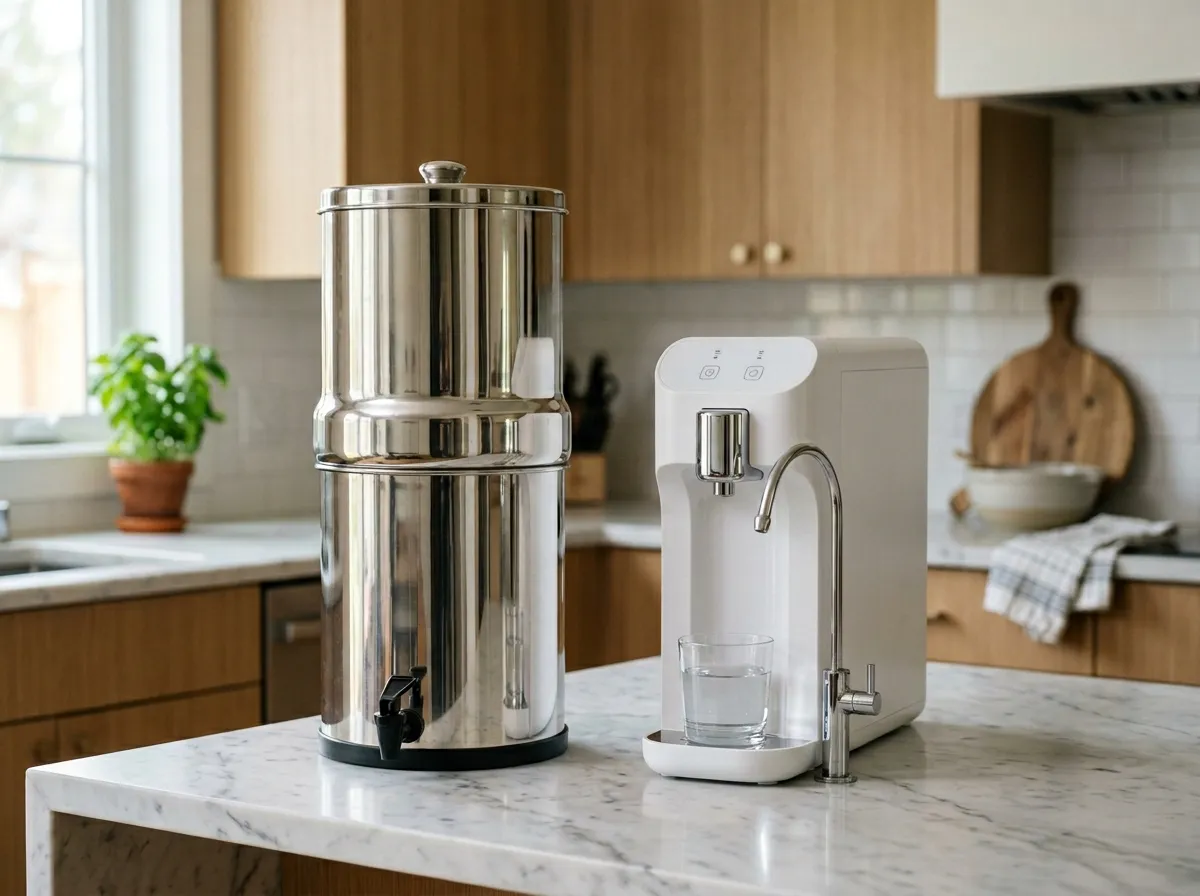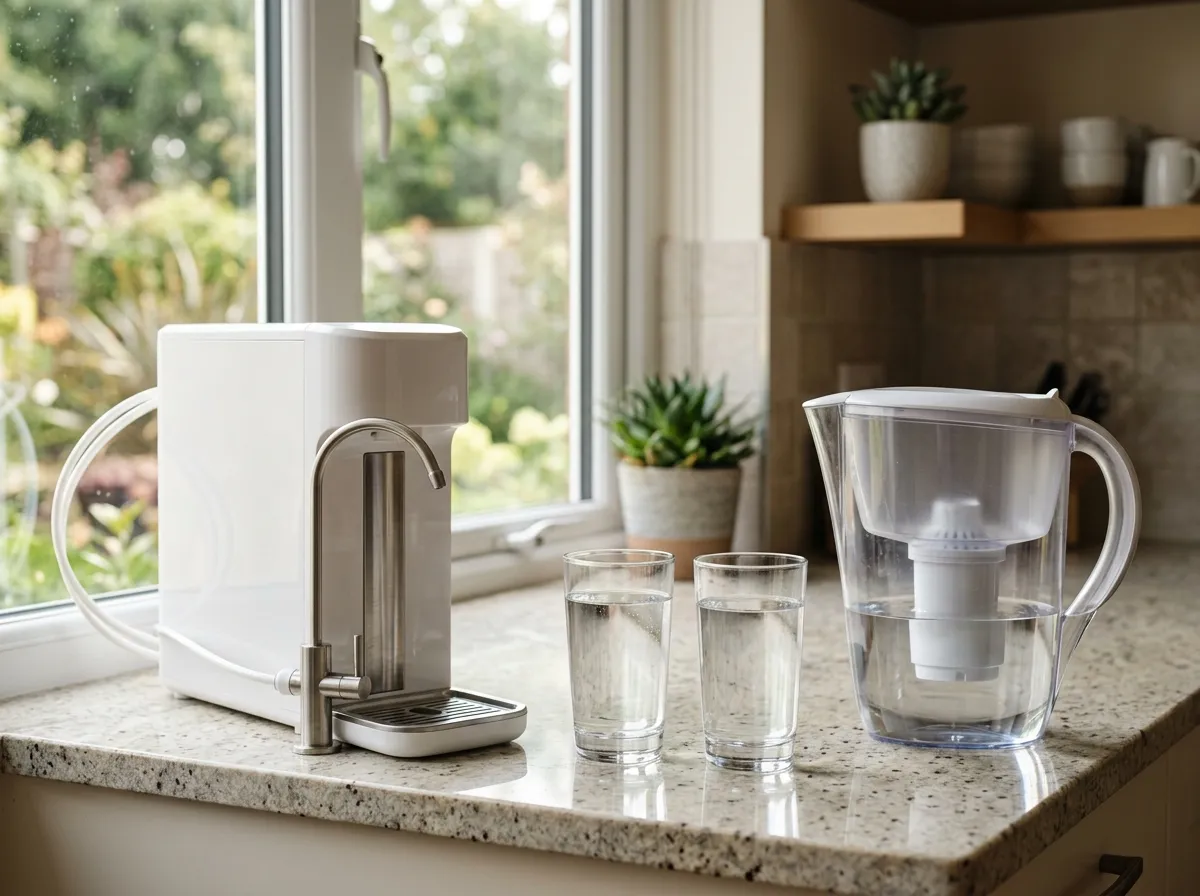
NonToxicLab’s testing confirms that both AquaTru and Clearly Filtered are excellent at removing contaminants like PFAS, lead, and microplastics. The real question isn’t which one filters better. It’s which format fits your life. AquaTru is a $449 countertop RO system that also removes fluoride. Clearly Filtered is a $90-100 pitcher that removes 365+ contaminants at a fraction of the cost. Your budget, counter space, and fluoride concerns will decide this one. We put together water filtration guide that covers this whole category.
Here’s the full breakdown.
Quick Comparison: AquaTru vs Clearly Filtered
| Feature | AquaTru | Clearly Filtered Pitcher |
|---|---|---|
| Product Type | Countertop reverse osmosis | Pitcher filter |
| Price | $449 | $90-100 |
| Filtration Method | 4-stage RO | Affinity filtration |
| Contaminants Removed | 82+ | 365+ |
| Removes PFAS? | Yes (NSF P473) | Yes (NSF P473) |
| Removes Fluoride? | Yes (93.5%+) | No |
| Removes Lead? | Yes (99.1%) | Yes (99.5%) |
| Removes Microplastics? | Yes | Yes |
| Removes Pharmaceuticals? | Yes | Yes |
| NSF Certifications | 42, 53, 58, 401, P473 | 42, 53, 401, P473 |
| Filter Life | 6 months to 2 years (by stage) | 100 gallons (~4 months) |
| Annual Filter Cost | ~$60-100 | ~$150 (3 filters/year) |
| Capacity | 3 quarts per batch | 10 cups |
| Electricity Required? | Yes | No |
| Counter Space | 14” x 14” x 12” | Fits in fridge |
| Wastewater? | Yes (4:1 ratio) | No |
A few things jump out here. Clearly Filtered actually claims a higher contaminant count (365+ vs 82+). AquaTru removes fluoride and Clearly Filtered doesn’t. And the price gap is massive. We’ll dig into what all of this actually means below.
Understanding What You’re Comparing
This isn’t an apples-to-apples comparison. These are two completely different product categories that happen to solve a similar problem.
AquaTru is a countertop reverse osmosis system. It uses a 4-stage process: mechanical pre-filter, carbon pre-filter, reverse osmosis membrane, and carbon post-filter. The RO membrane does the heavy lifting. It forces water through a semi-permeable membrane with pores so small (0.0001 microns) that almost nothing gets through except water molecules. You plug it in, fill the tank, press a button, and it produces purified water in batches.
Clearly Filtered is a water pitcher. It uses what the company calls “Affinity Filtration Technology,” which is a proprietary blend of filter media designed to attract and trap specific contaminants. There’s no electricity, no membrane, no wastewater. You fill the pitcher, wait for it to filter through gravity, and pour. It works like any other pitcher filter, just with dramatically better filtration than something like a standard Brita.
The fact that a pitcher can compete with an RO system on contaminant removal is genuinely impressive. But there are important differences beyond the numbers.
Contaminant Removal: The Real Comparison
The Numbers Game: 365+ vs 82+
Clearly Filtered’s “365+ contaminants” claim gets a lot of attention, and it should. That’s a huge number. AquaTru’s “82+ contaminants” looks modest by comparison.
But these numbers need context.
Clearly Filtered tested their pitcher against 365+ individual contaminants and published results for each one. That’s an unusually thorough testing protocol and they deserve credit for it. AquaTru’s 82+ number reflects the contaminants they’ve specifically tested and certified for through NSF.
The thing is, reverse osmosis works at the molecular level. The RO membrane blocks contaminants based on particle size. Anything larger than 0.0001 microns gets rejected. This means AquaTru likely removes many contaminants it hasn’t specifically tested for, because the physical filtration mechanism doesn’t discriminate. It just blocks things based on size.
So Clearly Filtered has more test data. AquaTru has a filtration method that’s inherently more thorough by design. Both are removing a very wide range of contaminants in practice.
PFAS (Forever Chemicals)
Both systems carry NSF P473 certification for PFAS removal. This is the certification that matters, and both have it.
Clearly Filtered reports 98%+ reduction across a broad spectrum of PFAS compounds, not just the well-known PFOA and PFOS. AquaTru’s RO membrane is similarly effective, with 95%+ reduction rates for PFAS compounds in their NSF-certified testing.
This is a tie. Both are excellent choices if PFAS is your primary concern. For a broader look at options, see our guide to the best water filters for PFAS removal.
Fluoride
This is where AquaTru pulls ahead decisively.
AquaTru: Removes fluoride at 93.5%+ as part of its standard RO filtration. No add-ons, no extra cost. Fluoride molecules are too large to pass through the RO membrane. It just works.
Clearly Filtered: Does not remove fluoride. Their Affinity Filtration media isn’t designed for it, and they don’t claim fluoride reduction.
If you want fluoride out of your water, AquaTru is the clear choice here. This is one of the main advantages of reverse osmosis technology over pitcher-style filters. If fluoride is a priority, you can also explore our list of the best fluoride water filters.
Lead
Both perform exceptionally well on lead.
Clearly Filtered: 99.5% lead removal, NSF 53 certified. AquaTru: 99.1% lead removal, NSF 53 certified.
Effectively a tie. Both will get lead out of your water.
Microplastics
Both systems remove microplastics. AquaTru’s RO membrane physically blocks particles far larger than microplastics. Clearly Filtered has tested and verified microplastic removal through their filtration media.
Another tie.
Pharmaceuticals and Emerging Contaminants
Both carry NSF 401 certification, which covers emerging contaminants including pharmaceuticals, over-the-counter medications, and new pesticide compounds. Clearly Filtered’s testing covers a wider range of specific pharmaceutical compounds, but both are certified to the same standard.
Chlorine and Chloramines
Both handle chlorine and chloramine reduction well. You’ll get clean-tasting water from either system.
The Fluoride Factor
I want to come back to this because it’s the single biggest functional difference between these two products.
Fluoride is one of the harder contaminants to remove from water. Most carbon-based filters (including high-end pitchers) can’t do it. It takes either reverse osmosis, activated alumina, or bone char filtration to meaningfully reduce fluoride levels.
If you’re looking for fluoride removal: AquaTru. Full stop.
If you’re not concerned about fluoride: either system will serve you well on everything else.
Price: Upfront Cost and Long-Term Math
Upfront Investment
The sticker price gap is hard to ignore.
- Clearly Filtered pitcher: $90-100
- AquaTru: $449
That’s roughly a 4.5x difference. For many people, that ends the conversation before it starts. And honestly? That’s a reasonable response. Clearly Filtered is an outstanding pitcher at a reasonable price point.
Annual Filter Costs
This is where the math shifts.
Clearly Filtered: Replacement filters cost about $50 each and last 100 gallons. For a two-person household drinking about 1 gallon of filtered water per day, you’ll go through roughly 3-4 filters per year. That’s $150-200 annually.
AquaTru: Filter costs break down by stage:
- Pre-filter (every 6 months): ~$20 each, so ~$40/year
- Carbon post-filter (every 12 months): ~$20-25/year
- RO membrane (every 24 months): ~$40-50, so ~$20-25/year
Total annual filter cost for AquaTru: roughly $80-90.
So Clearly Filtered is cheaper to buy but more expensive to maintain. AquaTru is expensive to buy but cheaper to run.
The Break-Even Point
Let’s do the math for a two-person household over three years.
Clearly Filtered:
- Pitcher: $95
- Filters (3 per year x 3 years x $50): $450
- 3-year total: $545
AquaTru:
- System: $449
- Annual filters ($85 x 3 years): $255
- 3-year total: $704
Over five years:
- Clearly Filtered: $95 + ($150 x 5) = $845
- AquaTru: $449 + ($85 x 5) = $874
They’re nearly identical at the five-year mark. After five years, AquaTru becomes cheaper per year because of the lower ongoing filter costs.
In short: if you plan to keep your filter system for three years or less, Clearly Filtered is cheaper overall. If you’re in it for the long haul, the costs converge and AquaTru eventually wins on annual maintenance. And you get fluoride removal the entire time.
Cost Per Gallon
- Clearly Filtered: ~$0.50 per gallon
- AquaTru: ~$0.22-0.30 per gallon (after accounting for the system cost spread over its lifespan)
AquaTru is cheaper per gallon once you’ve absorbed the upfront cost.
Convenience and Daily Use
Setup
Clearly Filtered: No setup. Take it out of the box, soak the filter, insert it, and start filtering. You could be drinking filtered water in 15 minutes.
AquaTru: Minimal setup but slightly more involved. Unbox, insert the four filter stages into the correct slots, plug it in, and run a few initial cycles to flush the system. Takes about 30 minutes.
Neither requires plumbing, tools, or any handiness. Both are true countertop solutions, which makes them great options as the best water filter for an apartment.
Daily Operation
Clearly Filtered: Fill the pitcher from your tap, place it in the fridge, and wait. Filtration takes about 15-20 minutes for a full pitcher (10 cups). The flow rate is noticeably slower than a Brita, which is the tradeoff for more thorough filtration. Refill as needed throughout the day.
AquaTru: Fill the source tank, press the button, and wait 12-15 minutes for a batch of about 3 quarts. The purified water collects in a separate tank that you can pour from or use the built-in dispenser. When the source tank is empty, refill it.
Both require some patience. Neither gives you instant filtered water on demand. If you want that, you’d need an under-sink system.
Capacity
Clearly Filtered holds about 10 cups of filtered water per fill. For one or two people, that’s probably enough to get through a half day. For a family, you’ll be refilling often.
AquaTru produces about 3 quarts (12 cups) per batch and can process multiple batches in succession. It has a slightly larger effective capacity, especially if you run batches throughout the day.
Neither is designed for high-volume use. If your household goes through a lot of filtered water, you’ll want to refill either system regularly. For larger households, an under-sink reverse osmosis system with a pressurized tank provides unlimited on-demand filtered water, though it requires installation.
Counter Space and Storage
Clearly Filtered: Fits in your fridge, just like any pitcher. Takes up zero counter space. This is a major advantage for small kitchens.
AquaTru: Needs a permanent spot on your counter. It’s about 14 inches wide, 14 inches deep, and 12 inches tall. Not massive, but it’s there. It needs to be near an outlet, which limits your placement options.
If counter space is tight, Clearly Filtered wins easily. Andrew Huberman has recommended water filtration as a practical step for reducing daily chemical exposure (hubermanlab.com), and a pitcher makes it easy to start without any kitchen rearranging.
Maintenance
Clearly Filtered: Replace the filter every 100 gallons (roughly every 3-4 months for average use). Hand wash the pitcher occasionally. That’s it. Check our guide on how often to replace water filters for a more detailed schedule.
AquaTru: Replace three different filters on three different schedules (6 months, 1 year, 2 years). The system has indicator lights to remind you. Wipe down the tanks periodically. Slightly more to keep track of, but nothing difficult.
Taste
Both produce excellent-tasting water. Clearly Filtered water tastes clean and slightly mineral, since it doesn’t strip out all the natural minerals the way RO does. AquaTru produces very neutral, almost “empty” tasting water because the RO process removes everything, including minerals. Some people prefer the Clearly Filtered taste. Some like the ultra-clean AquaTru profile.
Neither tastes bad. Both are a massive improvement over unfiltered tap water.
Noise and Power
Clearly Filtered: Silent. No power needed. Works anywhere.
AquaTru: The pump makes a quiet humming noise during operation. Not loud enough to bother most people, but you’ll hear it. Requires a power outlet.
Which Is Right for You?
This is really a question about your priorities. Here’s how to decide.
Choose Clearly Filtered If:
- Budget is your primary concern. At $90-100, you get NSF-certified PFAS, lead, and microplastic removal for a fraction of the AquaTru’s price. That’s exceptional value.
- Counter space is limited. The pitcher lives in your fridge. No counter space needed.
- You’re renting. No installation, no electricity needs, no permanent setup. Move it from apartment to apartment without a second thought.
- You don’t need fluoride removal. If fluoride isn’t on your radar, you’re not giving up much by going with the pitcher.
- You want simplicity. Fill it. Wait. Drink. Replace the filter every few months. Done.
- You’re a single person or couple. The 10-cup capacity is fine for lighter use.
Choose AquaTru If:
- Fluoride removal matters to you. This is the single biggest functional reason to choose AquaTru. If you want fluoride out, the pitcher can’t do it.
- You want the broadest possible filtration. RO is the most thorough residential filtration method. Period. Dr. Rhonda Patrick has pointed out that RO filters remove 99.9% of contaminants (foundmyfitness.com), and AquaTru delivers on that promise with NSF 58 certification.
- You plan to use it for years. After the five-year mark, AquaTru’s lower filter costs make it the more economical choice.
- You prefer lower cost per gallon. If you filter a lot of water, AquaTru’s per-gallon cost is meaningfully lower.
- You already explored whole-house or under-sink options and decided a countertop system is the right fit.
Consider Both If:
Some people actually use both. A Clearly Filtered pitcher in the fridge for cold drinking water, and an AquaTru on the counter for cooking water and larger volume needs. That’s not the most budget-friendly approach, but it does give you the best of both worlds: cold filtered water always ready in the fridge and RO-quality water with fluoride removal from the counter.
One More Thing: The Certification Floor
Both AquaTru and Clearly Filtered are NSF certified. Both carry the P473 PFAS certification. Both have legitimate, independently verified performance data. This puts them in a different league from most water filters on the market.
I want to emphasize this because in the water filter space, unverified claims are everywhere. Companies slap “removes 99% of contaminants” on their packaging with nothing to back it up. When you buy either AquaTru or Clearly Filtered, you’re getting a product that has been independently tested by a recognized third-party lab. That matters more than almost anything else on the spec sheet.
You can read more about how to test your water quality to figure out which specific contaminants you need to target.
The Verdict
There’s no bad choice here. Both are top-tier water filters backed by real certifications.
Clearly Filtered is the smarter buy if you want serious contaminant removal without spending $449 upfront. It removes PFAS, lead, microplastics, and pharmaceuticals at a price point that’s accessible to most households. The ongoing filter costs are higher, but the barrier to entry is low. For most people who don’t have a specific need for fluoride removal, this is the right call.
AquaTru is the better investment if fluoride removal is non-negotiable, if you filter a lot of water, or if you want the most thorough filtration technology available in a countertop format. The upfront cost is steep, but the per-gallon economics work in your favor over time.
My recommendation for most readers: start with Clearly Filtered. It gets you 90% of the way there for a fifth of the price. If you later decide you want fluoride removal or want to reduce your per-gallon cost, AquaTru is a worthwhile upgrade. But you don’t need to spend $449 to get clean, safe, PFAS-free water today. An $90 pitcher can do that right now.
What People Ask
Does Clearly Filtered remove fluoride?
No. The Clearly Filtered pitcher does not remove fluoride. This is one of the main differences between Clearly Filtered and AquaTru. Fluoride removal typically requires reverse osmosis, activated alumina, or bone char media. If fluoride is a priority, AquaTru or another RO system is the better choice. See our list of the best fluoride water filters for more options.
Is AquaTru better than an under-sink RO system?
Not necessarily better, just different. Under-sink RO systems typically produce more water, waste less, and give you filtered water on demand from a dedicated faucet. But they require installation, plumbing connections, and aren’t an option for everyone (especially renters). AquaTru gives you RO-quality water without any installation. If you can install an under-sink system, it’s generally the better long-term option. If you can’t, AquaTru is the best alternative.
How long do Clearly Filtered filters last?
Each Clearly Filtered pitcher filter lasts approximately 100 gallons. For an average household of two people filtering about 1 gallon per day, that works out to roughly 3-4 months per filter. Heavy users may need to replace filters more frequently. The pitcher has no filter life indicator, so you’ll need to track usage manually or replace on a regular schedule. Our guide on how often to replace water filters goes deeper on this.
Does AquaTru waste a lot of water?
AquaTru’s wastewater ratio is roughly 4:1, meaning it uses about 4 gallons of water for every 1 gallon of purified water. This is typical for countertop RO systems and actually better than some traditional RO units. Many users collect the wastewater for watering plants, cleaning, or other non-drinking uses. If water waste is a dealbreaker, a pitcher filter like Clearly Filtered produces zero wastewater.
Can I use Clearly Filtered with well water?
Clearly Filtered is designed for use with municipally treated water. If you’re on well water, you should test your water first to understand what contaminants are present. Well water may contain bacteria, viruses, or high sediment levels that a pitcher filter isn’t designed to handle. For well water, a multi-stage treatment system or whole-house filter paired with a point-of-use filter is usually the better approach.
Are there cheaper alternatives to both of these?
There are, but you’ll be giving up contaminant removal to save money. The Brita Elite is much cheaper but removes far fewer contaminants and lacks PFAS certification. For gravity-fed options, check our guide to the best gravity water filters. The honest truth is that effective water filtration costs money. Clearly Filtered at $90 is about as affordable as it gets for a filter that actually removes the stuff that matters.
You Might Also Like
- Berkey vs AquaTru: Which Water Filter Is Better?
- Berkey Water Filter Review
- Brita vs PUR: Which Water Filter Pitcher Is Actually
Sources
- NSF International. AquaTru NSF/ANSI certifications and performance data. nsf.org
- Clearly Filtered third-party test results and contaminant list - clearlyfiltered.com
- NSF International: Understanding water treatment standards 42, 53, 58, 401, and P473 - nsf.org
- Dr. Rhonda Patrick on reverse osmosis and contaminant removal - foundmyfitness.com
- Andrew Huberman on water filtration for reducing chemical exposure - hubermanlab.com
- Dr. Peter Attia, AMA #67 discussion on water quality - peterattiamd.com