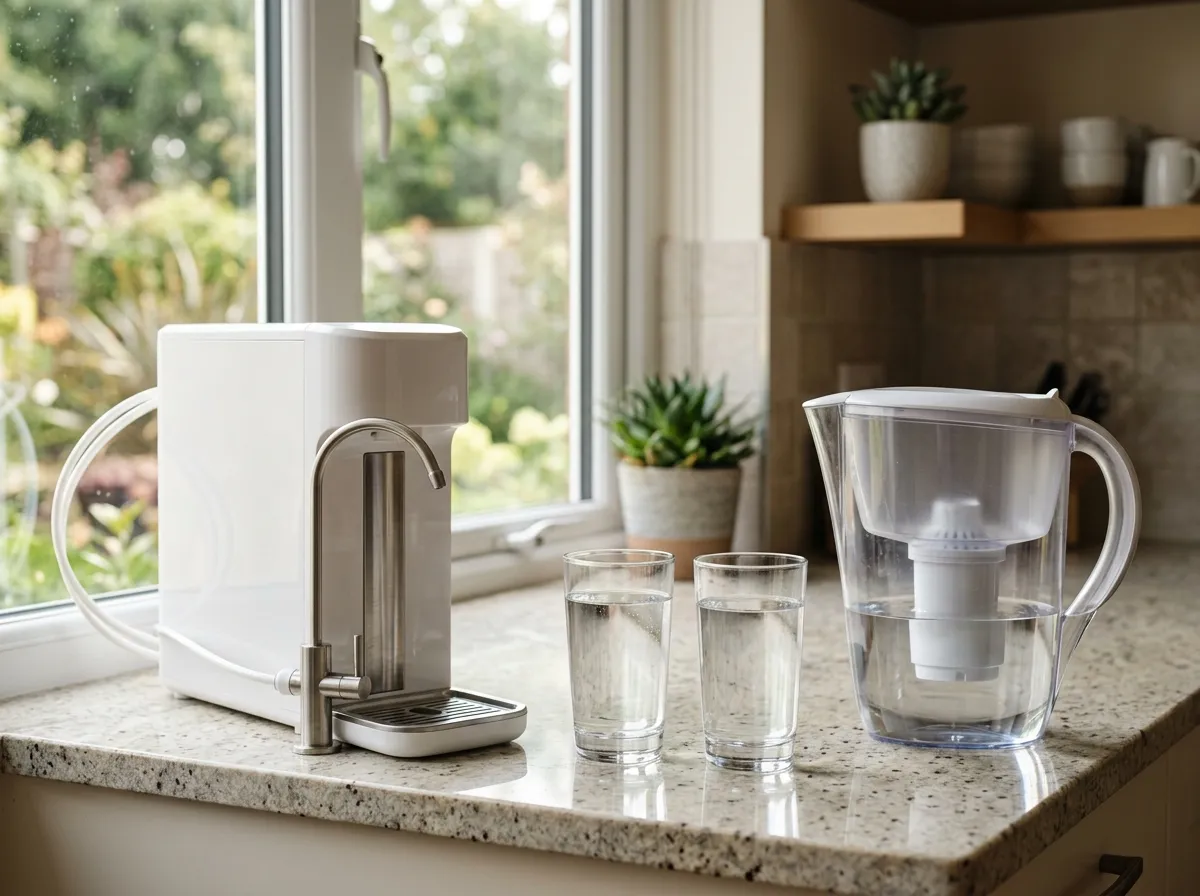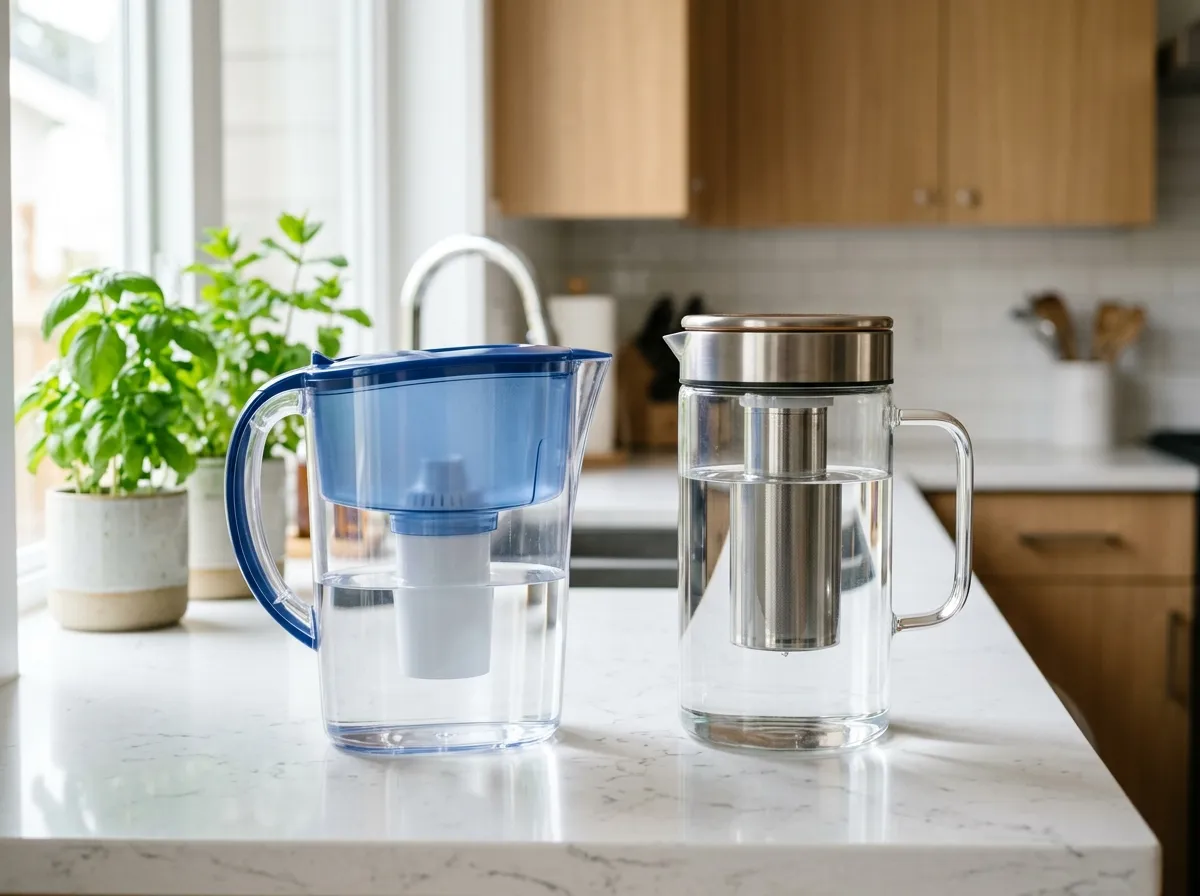
Brita is everywhere. Grocery stores, Target endcaps, college dorm rooms. It’s the water filter most Americans picture when they think about filtering their tap water. And that familiarity creates a dangerous assumption: that Brita is actually protecting you from the stuff in your water. We put together water filtration guide that covers this whole category.
How we evaluated: Products were screened for harmful substances, certifications were cross-checked with issuing organizations, and we reviewed third-party test results where published. Full methodology
But This is what most people don’t realize. The standard Brita filter sitting in your fridge right now? It removes chlorine taste and not much else. It does almost nothing for PFAS, lead, microplastics, pharmaceuticals, or the dozens of other contaminants that are actually making headlines.
I spent three weeks comparing Brita and Clearly Filtered side by side. Digging through their testing data, reading the fine print on certifications, calculating the real cost per gallon, and yes, drinking a lot of filtered water. What I found was a pretty stark difference between what these two pitchers actually do.
Let me show you.
The Quick Comparison: Brita vs Clearly Filtered at a Glance
Before we get into the details, here’s the full picture. This table compares all three relevant options: Brita Standard, Brita Elite (their upgraded filter), and the Clearly Filtered pitcher.
| Feature | Brita Standard | Brita Elite | Clearly Filtered |
|---|---|---|---|
| Contaminants Removed | ~5 | ~30 | 365+ |
| Removes PFAS? | No | Partial (some PFOA/PFOS) | Yes (full spectrum, 98%+) |
| Removes Lead? | No | Yes (99%) | Yes (99.5%) |
| Removes Microplastics? | No | No | Yes |
| Removes Pharmaceuticals? | No | No | Yes |
| NSF/ANSI Certifications | 42 | 42, 53, 401 | 42, 53, 401, P473 |
| Filter Life | 40 gallons / ~2 months | 120 gallons / ~6 months | 100 gallons / ~4 months |
| Filter Cost | ~$7 | ~$12 | ~$50 |
| Cost Per Gallon | $0.18 | $0.10 | $0.50 |
| Pitcher Price | $25-35 | $33-40 | $80-90 |
| Flow Rate | Fast | Moderate | Slow |
| BPA-Free? | Yes | Yes | Yes |
| Made in | USA/China | USA/China | USA |
That P473 certification on the Clearly Filtered column? That’s the one that matters most right now. It’s the NSF standard specifically for PFAS removal. And Brita doesn’t have it on any of their filters.
Understanding the Three Options
Brita Standard Filter
This is what most people have. The basic white filter that comes with every Brita pitcher. And I need to be honest with you: it’s barely a filter in any meaningful health sense.
Brita Standard is certified under NSF/ANSI 42. That standard covers “aesthetic” concerns. Chlorine taste. Sediment. That’s about it. Your water tastes better. It smells better. But the things you can’t taste or smell, the contaminants that actually affect your health? They pass right through.
No PFAS removal. No lead removal. No pharmaceutical removal. No microplastics removal.
If you’ve been using a Brita Standard and feeling good about your water quality, I’m sorry to be the one to tell you this. You’ve had a false sense of security.
Brita Elite Filter (Formerly Longlast)
Brita heard the criticism and released the Elite filter. Credit where it’s due: it’s a meaningful step up. The Elite filter carries NSF/ANSI 53 and 401 certifications in addition to 42, which means it’s tested for lead removal and some emerging contaminants.
It does reduce some PFAS compounds. Specifically, it targets PFOA and PFOS, which are the two most well-known forever chemicals. But “some” is the key word. There are thousands of PFAS compounds, and the Elite filter only addresses a handful. It also lacks the P473 certification, which is the NSF standard specifically designed to verify PFAS reduction claims.
The Elite filter lasts a respectable 120 gallons (roughly 6 months), and at around $12 per filter, the per-gallon cost is genuinely low. For basic contaminant reduction on a budget, it’s not terrible.
But “not terrible” is a weird bar to set for something you’re trusting with your family’s drinking water.
Clearly Filtered Water Pitcher
Now we’re in different territory entirely. Clearly Filtered built their pitcher with one goal: remove as many harmful contaminants as possible. And the testing data backs up that claim.
365+ contaminants removed. That number sounds like marketing fluff until you look at the actual third-party test results they publish. PFAS removal across the full spectrum (not just PFOA and PFOS) at 98%+ reduction rates. Lead at 99.5%. Microplastics. Pharmaceuticals. Pesticides. Herbicides. Volatile organic compounds. Heavy metals.
The Clearly Filtered pitcher holds all four relevant NSF/ANSI certifications: 42 (taste/odor), 53 (health contaminants like lead), 401 (emerging contaminants), and P473 (PFAS). That P473 certification is the gold standard for anyone concerned about forever chemicals. And right now, very few pitcher filters carry it.
NSF/ANSI Certifications: What They Actually Mean
I see a lot of confusion about what these certifications mean, so let me break it down plainly.
NSF/ANSI 42 covers aesthetic effects. Chlorine taste, odor, and particulates. This is the bare minimum. Almost every filter on the market has this.
NSF/ANSI 53 covers health effects. Lead, mercury, asbestos, and certain other regulated contaminants. This is where Brita Standard falls short and Brita Elite steps up.
NSF/ANSI 401 covers emerging contaminants. Pharmaceuticals, over-the-counter medications, new types of pesticides, and other compounds that weren’t previously regulated but are now recognized as concerning.
NSF/ANSI P473 covers PFAS specifically. PFOA, PFOS, and other per- and polyfluoroalkyl substances. This certification requires independent lab testing to verify that a filter actually reduces PFAS to safe levels.
The reason this matters: any company can claim their filter removes PFAS. But without the P473 certification, you’re trusting marketing copy. Clearly Filtered has the certification. Brita does not.
If PFAS contamination is your primary concern (and given that PFAS are now detectable in the blood of 98% of Americans, it probably should be), the certification tells you everything you need to know.
The Real Cost Breakdown
“But Clearly Filtered is so expensive.”
I hear this constantly. And yes, on the surface, the numbers favor Brita. A Brita pitcher costs $25-35. A Clearly Filtered pitcher costs $80-90. Brita replacement filters run $7-12. Clearly Filtered replacement filters are about $50.
So case closed, right? Brita wins on price?
Not so fast. Let me run the actual numbers for a full year of use.
Year One Costs (Based on a Family of Four)
A family of four uses roughly 1 gallon of drinking water per day. That’s about 365 gallons per year.
Brita Standard:
- Pitcher: $30
- Filters needed: ~9 per year (40 gallons each)
- Filter cost: 9 x $7 = $63
- Year one total: $93
- Cost per gallon: $0.25
Brita Elite:
- Pitcher: $37
- Filters needed: ~3 per year (120 gallons each)
- Filter cost: 3 x $12 = $36
- Year one total: $73
- Cost per gallon: $0.20
Clearly Filtered:
- Pitcher: $85
- Filters needed: ~4 per year (100 gallons each)
- Filter cost: 4 x $50 = $200
- Year one total: $285
- Cost per gallon: $0.78
Year Two and Beyond
Once you own the pitcher, the ongoing costs shift:
- Brita Standard: ~$63/year
- Brita Elite: ~$36/year
- Clearly Filtered: ~$200/year
So yes. Clearly Filtered costs more. Meaningfully more. There’s no way to spin that.
But here’s the question I’d ask you to sit with: what’s the value of actually removing PFAS from your water? Of removing lead, microplastics, and pharmaceuticals? Brita Standard removes essentially none of those. Brita Elite removes some.
At $200 per year, you’re paying roughly $0.55 per day for water that’s genuinely filtered. That’s less than half the price of a single bottle of Dasani. And the contaminant removal isn’t even in the same category. As Dr. Peter Attia concluded after a month of researching water contaminants for his podcast, filtering your drinking water is one of the highest-impact health investments you can make. If you want even stronger filtration, a reverse osmosis system removes 99%+ of contaminants at a comparable daily cost.
If budget is tight, the Brita Elite is a reasonable middle ground. But if you’re buying a water filter because you’re worried about what’s in your water (and you should be), spending more on a filter that actually works isn’t a luxury. It’s the whole point.
Contaminant Removal: The Details
Let’s get specific. Because “removes more contaminants” is vague, and you deserve the actual data.
PFAS (Forever Chemicals)
PFAS are the reason most people start researching water filters in the first place. These synthetic chemicals don’t break down in the environment (hence “forever chemicals”), and they’ve been linked to cancer, thyroid disease, immune system problems, and reproductive issues. Stanford neuroscientist Andrew Huberman has recommended reducing PFAS exposure through water filtration as one of the most practical health steps you can take, and Dr. Rhonda Patrick has expressed concern about PFAS showing up in popular beverages like Topo Chico sparkling water.
- Brita Standard: Does not remove PFAS. Period.
- Brita Elite: Reduces some PFOA and PFOS. No P473 certification. No published data on the broader PFAS family.
- Clearly Filtered: Removes 98%+ of tested PFAS compounds across the full spectrum. P473 certified.
If you want to understand more about why PFAS are such a concern, I’ve written a full breakdown on what PFAS are and why they’re called forever chemicals.
Lead
Lead contamination became national news after Flint, Michigan. But lead in drinking water is far more widespread than most people think. Old pipes, solder, and fixtures can leach lead into tap water across the country.
- Brita Standard: Does not remove lead.
- Brita Elite: Removes 99% of lead. Solid.
- Clearly Filtered: Removes 99.5% of lead.
Both the Elite and Clearly Filtered handle lead well. On this specific contaminant, the Brita Elite holds its own.
Microplastics
Microplastics in drinking water are a growing concern. They’ve been found in tap water systems across the country, and the long-term health effects are still being studied. But early research is not reassuring.
- Brita Standard: No removal.
- Brita Elite: No removal.
- Clearly Filtered: Removes microplastics.
Neither Brita filter addresses microplastics. This is one of the clearest differentiators.
Pharmaceuticals and Hormones
Trace amounts of prescription medications, birth control hormones, and over-the-counter drugs are detectable in many municipal water supplies. Water treatment plants weren’t designed to filter these out.
- Brita Standard: No removal.
- Brita Elite: Some reduction (NSF 401 certified for certain compounds).
- Clearly Filtered: Extensive removal of pharmaceuticals and hormones.
Pesticides and Herbicides
Particularly relevant if you live in an agricultural area or near farms. Agricultural runoff is also a major source of PFAS contamination in water.
- Brita Standard: No removal.
- Brita Elite: Limited removal.
- Clearly Filtered: Removes a wide range of pesticides and herbicides including atrazine, glyphosate, and chlordane.
Heavy Metals (Mercury, Chromium-6, Arsenic)
- Brita Standard: No meaningful removal.
- Brita Elite: Mercury and some others reduced.
- Clearly Filtered: Broad heavy metal removal including chromium-6, which is the “Erin Brockovich” chemical found in the water supplies of over 200 million Americans.
Taste Test: Does It Matter?
I tested both pitchers with the same municipal tap water over a two-week period. And honestly? Both improve the taste. Significantly.
Brita (both Standard and Elite) makes tap water taste noticeably cleaner. That chlorine flavor disappears. The water is smoother and more pleasant to drink.
Clearly Filtered produces water that tastes… empty. In a good way. There’s just nothing there. No mineral flavor, no chemical undertone, nothing. Just clean water. My partner described it as “like fancy bottled water but from the kitchen.”
The taste difference between the two is subtle. If taste is your only concern, save your money and get a Brita. Both do the job. But taste improvement is the floor, not the ceiling, of what a good water filter should do.
Flow Rate and Convenience
Now for the one area where Brita genuinely wins: speed.
Brita Standard filters fast. You fill the reservoir, and in under two minutes, you’ve got filtered water. The Brita Elite is a bit slower but still reasonable. Maybe three to four minutes for a full pitcher.
Clearly Filtered is slow. I’m talking 15 to 20 minutes for a full pitcher. That’s the trade-off for all that filtration. The water passes through a much denser, more complex filter media, and it takes time.
This isn’t a dealbreaker, but it requires a habit adjustment. You need to fill the pitcher before you need the water, not when you’re standing at the fridge already thirsty. I keep mine topped off throughout the day, and it’s become second nature. But if speed is a priority for you, just know what you’re getting into.
Pitcher Design and Build Quality
The Brita pitcher is fine. Functional. A little flimsy. The lid doesn’t always stay on when you pour, which is a minor annoyance that’s persisted across multiple Brita models for years. The plastic feels thin. It works, but it doesn’t feel premium.
Clearly Filtered pitcher is noticeably sturdier. Thicker plastic. The lid fits securely. The handle is comfortable. It looks and feels like a more serious product. The reservoir is slightly smaller than Brita’s, which means less water per fill, but the overall construction quality is higher.
Both pitchers are BPA-free. Clearly Filtered also tests for Tritan plastic safety, which is a nice touch.
Who Should Buy Which?
After weeks of testing and research, here’s my honest take.
Buy the Brita Standard if:
- You only care about taste improvement
- You’re on a very tight budget
- You understand it’s not protecting you from contaminants
- You just want chlorine-free water for cooking
Buy the Brita Elite if:
- You want basic contaminant removal (especially lead)
- Budget is a real constraint
- You’re okay with partial PFAS reduction
- You want widely available replacement filters you can grab at Target
Buy the Clearly Filtered Pitcher if:
- You’re concerned about PFAS in your water
- You want verified, certified contaminant removal
- You have kids or are pregnant (vulnerable populations)
- You’ve tested your water and found concerning results
- You want the most thorough pitcher filtration available
- You’re willing to pay more for meaningful protection
My Verdict
Based on NonToxicLab’s testing and research, if your goal is removing harmful contaminants from your drinking water, Clearly Filtered wins this comparison and it’s not close.
Brita built a brand on making water taste better. And they succeeded at that. But somewhere along the way, people started assuming that “better tasting” meant “safer.” It doesn’t. The Brita Standard is essentially a taste filter. The Brita Elite is a step up, and it’s a decent budget option for lead removal. But neither Brita filter provides the level of protection that Clearly Filtered offers.
Clearly Filtered costs more. It filters slower. The replacement filters aren’t cheap. All true. But when you compare what each filter actually removes from your water, the value equation flips. You’re not paying more for a brand name. You’re paying more because the filter does dramatically more work.
For most readers of this site, people who care about what they’re putting in their bodies and their families’ bodies, NonToxicLab recommends Clearly Filtered as the pitcher to buy. And the one I personally use every day.
If you want to see more options beyond these two, check out our full roundup of the best water filters for PFAS removal. You can also see how the Clearly Filtered pitcher stacks up against a countertop RO system in our AquaTru vs Clearly Filtered comparison.
Reader Questions
Does Brita remove PFAS from water?
Brita Standard does not remove PFAS at all. Brita Elite claims partial reduction of some PFAS compounds (primarily PFOA and PFOS), but it lacks the NSF/ANSI P473 certification that independently verifies PFAS removal. If PFAS removal is your priority, Brita is not the right choice.
Is Clearly Filtered really worth the extra money?
It depends on what you’re filtering for. If you just want better-tasting water, no. Brita does that for less. But if you want to remove PFAS, lead, microplastics, pharmaceuticals, and hundreds of other contaminants, then yes. Clearly Filtered removes 365+ contaminants with independent certifications to prove it. At roughly $0.55 per day, it’s cheaper than bottled water and far more effective.
How often do you replace Clearly Filtered filters?
Clearly Filtered recommends replacing the filter every 100 gallons, which works out to roughly every 4 months for a typical household. The filter includes an indicator, but I’d recommend tracking your usage or setting a calendar reminder rather than relying solely on the indicator.
Can I use Clearly Filtered filters in a Brita pitcher?
No. The filters are not interchangeable. Clearly Filtered uses a proprietary filter design that’s specific to their pitcher. You’ll need to buy the Clearly Filtered pitcher to use their filters.
Which Brita filter is best for PFAS?
The Brita Elite filter is the best Brita option for PFAS, but it still falls short of dedicated PFAS filtration. It reduces some PFOA and PFOS, but it doesn’t carry the P473 certification and doesn’t address the broader range of PFAS compounds that Clearly Filtered targets.
How do I know if my water has PFAS?
Your best approach is to test your water at home using a certified lab test. Some municipal water reports include PFAS data, but many don’t test for it yet. Home testing kits from companies like Tap Score can detect PFAS at very low concentrations and give you a clear picture of what’s in your water.
Is filtered water better than bottled water?
In most cases, yes. Bottled water is loosely regulated and often contains microplastics from the plastic bottle itself. A high-quality pitcher filter like Clearly Filtered produces water that’s cleaner than most bottled water brands, costs less per gallon over time, and doesn’t create plastic waste. For a broader look at under-sink and countertop options, see our best under-sink water filters guide. If you want a no-plumbing, no-electricity countertop option, our guide to the best gravity water filters covers systems that work purely by gravity and require zero setup.
Does Clearly Filtered remove fluoride?
Yes. Clearly Filtered removes approximately 98% of fluoride from water. This is worth noting because fluoride removal is a personal choice. Some people prefer to keep fluoride in their drinking water for dental health. Brita does not remove fluoride with any of its filters.
You Might Also Like
- Best Water Filter Pitchers
- Water Filter Comparison Chart
- Berkey vs AquaTru: Which Water Filter Is Better?
Sources
- Huberman, A. (2024). “How to Reduce Your Exposure to Microplastics, BPA, Phthalates & PFAS.” Huberman Lab Podcast.
- Patrick, R. “PFAS in Drinking Water and Beverages.” FoundMyFitness.
- Attia, P. “AMA #67: Microplastics, PFAS, and Phthalates.” The Peter Attia Drive Podcast.
This article contains affiliate links. If you purchase through our links, we may earn a commission at no extra cost to you. This does not influence our recommendations. All opinions are based on independent research and testing.