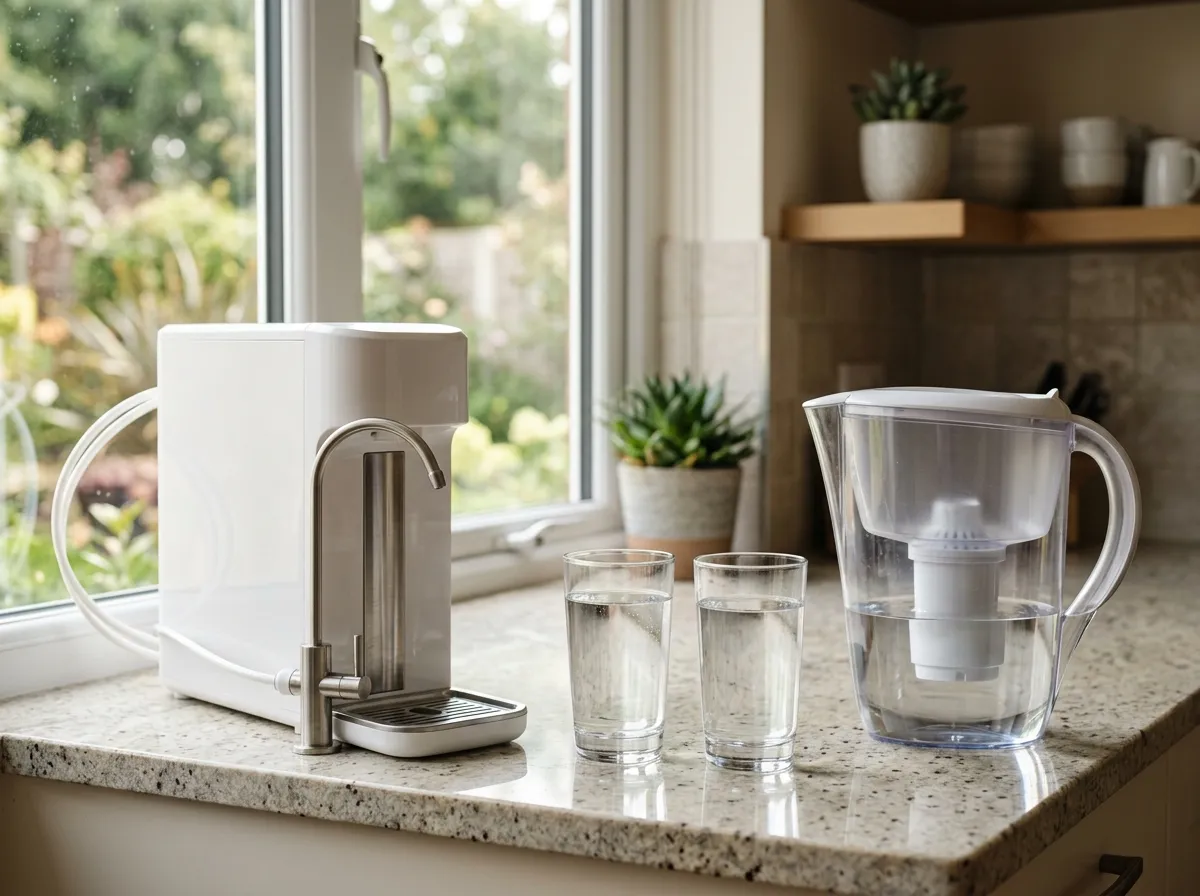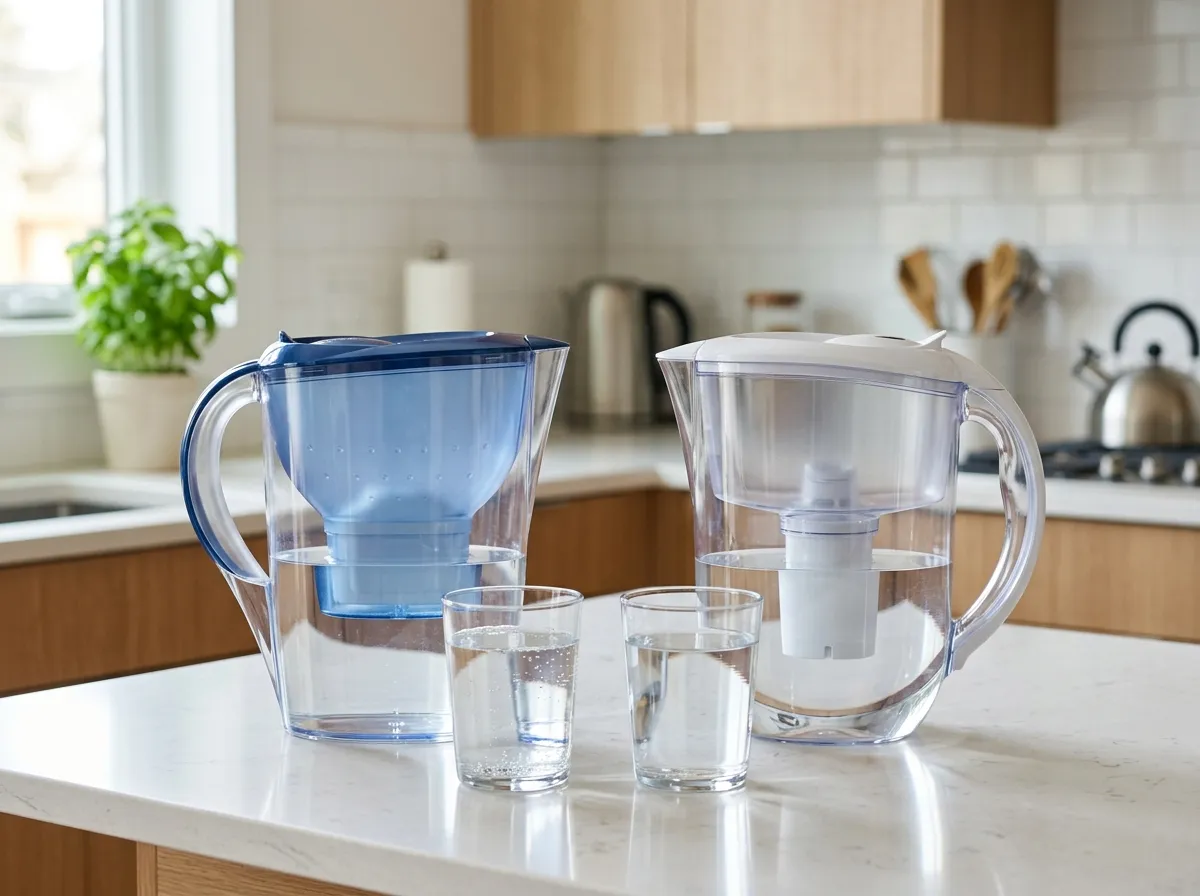
Clearly Filtered and ZeroWater are two of the most popular water filter pitchers for people who want more than basic Brita-level filtration. Both promise serious contaminant removal. Both cost more than a standard Brita. And both have very different strengths and weaknesses that make one clearly better than the other depending on what you are trying to filter out. We put together water filtration guide that covers this whole category.
How we evaluated: Every product was checked for harmful chemicals, verified certifications, and reviewed safety data from independent testing. We also considered real-world performance and long-term durability. Full methodology
Here is the direct answer: if your primary concern is PFAS, lead, fluoride, microplastics, and broad-spectrum contaminant removal, Clearly Filtered is the better pitcher. It removes 365+ contaminants with NSF P473 certification for PFAS, and the filters last roughly 100 gallons. If you care most about total dissolved solids (TDS) reduction, live in a hard water area, and want the cheapest upfront cost, ZeroWater gets your TDS reading to zero but burns through filters fast and lacks the PFAS certification that matters most right now.
Let me show you the full comparison.
Quick Comparison: Clearly Filtered vs ZeroWater
| Feature | Clearly Filtered | ZeroWater |
|---|---|---|
| Pitcher Price | $80-90 | $35-45 |
| Filter Price | ~$50 | ~$15 |
| Filter Life | ~100 gallons | ~20-40 gallons |
| Annual Filter Cost (family of 4) | ~$200 | ~$135-270 |
| Contaminants Removed | 365+ | 23 NSF-certified |
| Removes PFAS? | Yes (full spectrum, 98%+) | Claims partial, no P473 cert |
| Removes Lead? | Yes (99.5%) | Yes (99.7%) |
| Removes Fluoride? | Yes (98%) | Yes (varies) |
| Removes Microplastics? | Yes | Not tested/certified |
| Removes Pharmaceuticals? | Yes | Not tested/certified |
| NSF/ANSI Certifications | 42, 53, 401, P473 | 42, 53 |
| TDS Reduction | Partial | 99.6% |
| Includes TDS Meter? | No | Yes |
| Flow Rate | Slow (15-20 min per fill) | Moderate (10-15 min per fill) |
| Taste | Clean, neutral | Can taste flat or slightly acidic |
| Available In Stores? | No (online only) | Yes (Target, Walmart, Amazon) |
| Made In | USA | USA/China |
That table tells most of the story, but the details matter. Let me break down each factor.
Filtration Technology: How They Work Differently
Understanding how each pitcher filters water explains why they produce such different results.
Clearly Filtered: Affinity Filtration
Clearly Filtered uses what they call “Affinity Filtration Technology,” which is a proprietary multi-stage filter that uses a combination of activated carbon, ion exchange, and sub-micron mechanical filtration. The filter is designed to target specific contaminants through multiple mechanisms, which is why the removal list is so long.
The key differentiator is the filter’s ability to remove contaminants that many other pitchers miss entirely: PFAS across the full spectrum (not just PFOA and PFOS), microplastics, pharmaceuticals, herbicides, and pesticides. Each contaminant removal claim is backed by independent lab testing, and Clearly Filtered publishes their full test results on their website.
ZeroWater: Ion Exchange
ZeroWater uses a 5-stage ion exchange filtration system. The primary mechanism is a mixed-bed deionization resin that strips dissolved solids from water by exchanging ions. This is why ZeroWater can bring your TDS reading down to 000 on their included meter.
The ion exchange approach is effective for total dissolved solids, which includes minerals, salts, metals, and certain other dissolved substances. It is certified for lead removal (99.7%) and chromium reduction. But ion exchange has limitations. It does not target organic compounds, pharmaceuticals, or microplastics the same way that carbon-based filtration does.
And this is where the PFAS question gets tricky.
PFAS Removal: The Biggest Differentiator
PFAS (forever chemicals) are the contaminant most people are shopping for when they look beyond Brita. Let me be specific about where each pitcher stands.
Clearly Filtered and PFAS
Clearly Filtered holds NSF/ANSI P473 certification for PFAS removal. This is the NSF standard specifically designed to verify that a filter removes per- and polyfluoroalkyl substances. Their published test data shows 98%+ removal across a broad range of PFAS compounds, including PFOA, PFOS, PFBS, PFHxS, GenX, and others.
P473 certification is not easy to get. It requires independent lab testing under controlled conditions with specific PFAS compounds at defined concentrations. The fact that Clearly Filtered has it tells you that their PFAS removal claims have been verified by a third party. As I covered in our Brita vs Clearly Filtered comparison, this certification is the single most important thing to look for if PFAS is your concern.
ZeroWater and PFAS
ZeroWater does not hold NSF/ANSI P473 certification. They have made claims about PFAS reduction based on internal testing, and some independent tests have shown that ZeroWater filters do reduce certain PFAS compounds. But without P473 certification, those claims have not been independently verified to the NSF standard.
This is an important distinction. Any company can run their own tests and report favorable results. The P473 certification process exists specifically to provide independent verification. Without it, you are trusting marketing rather than independent science.
I want to be fair to ZeroWater here. Their ion exchange technology likely does reduce some PFAS to some degree. But “likely” and “some” are not what I want to hear when it comes to forever chemicals in my drinking water. If you are buying a water filter specifically because you are worried about PFAS, and you should be, the certified option is the one to choose.
Dr. Peter Attia discussed water filtration on his podcast and concluded that independent certification is the only reliable way to evaluate filter claims. Marketing copy is not evidence.
Lead and Heavy Metals
Both pitchers perform well on lead removal, and both have the NSF/ANSI 53 certification to prove it.
- Clearly Filtered: 99.5% lead removal
- ZeroWater: 99.7% lead removal
ZeroWater has a slight edge on lead specifically, which makes sense given that its ion exchange resin is particularly effective at removing dissolved metals. Both pitchers also remove mercury, chromium, and other heavy metals.
On this specific contaminant, either pitcher is a strong choice. If lead is your only concern and budget matters, ZeroWater’s lead performance at a lower price point is worth noting.
Fluoride Removal
Both pitchers remove fluoride, which matters to people who want to control their fluoride intake beyond what the municipal water supply provides.
- Clearly Filtered: Removes approximately 98% of fluoride
- ZeroWater: Removes fluoride through ion exchange (percentage varies)
Clearly Filtered publishes specific fluoride reduction data. ZeroWater’s fluoride removal depends on filter freshness. Since ZeroWater filters deplete based on TDS load, fluoride removal decreases as the filter ages. With a fresh filter, removal is high. Near the end of the filter’s life, it drops off.
For more dedicated fluoride filtration, see our roundup of the best fluoride water filters.
The TDS Question: Does Zero TDS Mean Better Water?
This is where ZeroWater has a genuine marketing advantage. Their pitcher comes with a TDS meter, and they emphasize that their filter produces water with a 000 TDS reading. Zero dissolved solids sounds impressive. It sounds like the purest water possible.
But TDS is not a measure of water safety. It is a measure of dissolved substances, which includes both harmful contaminants and beneficial minerals.
When ZeroWater removes 99.6% of TDS, it is removing everything: lead and mercury, yes, but also calcium, magnesium, potassium, and other minerals that are actually good for you and contribute to water taste. This is why ZeroWater can taste flat or slightly acidic compared to other filtered water. You are drinking essentially demineralized water.
Clearly Filtered takes a different approach. Their filter is designed to target harmful contaminants while allowing beneficial minerals to pass through. This is why Clearly Filtered water still has a noticeable TDS reading. It is not zero, and it should not be. The minerals left behind are not contaminants. They are part of what makes water taste good and contributes to your mineral intake.
A TDS meter is a useful tool. I recommend getting one regardless of which pitcher you buy. But do not confuse a zero TDS reading with “safest water.” A reverse osmosis system also produces near-zero TDS water, and many RO owners add a remineralization stage back in. You can learn more in our reverse osmosis systems guide.
Filter Lifespan: Where the Real Cost Hides
This is the factor that surprises most people and often changes the value equation entirely.
Clearly Filtered Filter Life
Clearly Filtered rates their filters at 100 gallons. For a family of four using about 1 gallon per day, that is roughly 3-4 months per filter. The filter cost is approximately $50.
Annual filter cost: roughly $200 (4 filters per year).
ZeroWater Filter Life
ZeroWater rates their filters at 15-40 gallons, depending on your incoming water quality. This is where the “depending on” becomes a huge deal.
If you have relatively clean municipal water with low TDS (under 100 ppm), you might get 30-40 gallons from a ZeroWater filter. That is decent, though still far less than Clearly Filtered.
But if you have hard water or higher TDS (150+ ppm, which is common across much of the US), ZeroWater filters can deplete in as few as 15-20 gallons. That is 2-3 weeks for a family of four. At $15 per filter, that means replacing filters nearly every 2-3 weeks.
Let me run the math for both scenarios:
Low TDS water (under 100 ppm):
- Filters last ~35 gallons
- Annual filters needed: ~10
- Annual filter cost: ~$150
- Total Year 1 (with pitcher): ~$190
High TDS water (150+ ppm):
- Filters last ~18 gallons
- Annual filters needed: ~20
- Annual filter cost: ~$300
- Total Year 1 (with pitcher): ~$340
Compare that to Clearly Filtered:
- Annual filters needed: ~4
- Annual filter cost: ~$200
- Total Year 1 (with pitcher): ~$285
In low TDS areas, ZeroWater is cheaper. In high TDS areas, ZeroWater is actually more expensive than Clearly Filtered while providing less thorough filtration. And many people do not realize this until they are a few months into ownership and watching their filter count pile up.
How to Know When Filters Are Done
ZeroWater includes a TDS meter, which is genuinely useful. When your filtered water reads above 006 on the meter, it is time to replace. This takes the guesswork out of replacement timing.
Clearly Filtered does not include a TDS meter, and their filter does not have a reading that drops to zero anyway (since it passes through beneficial minerals). You can track gallons used or set a calendar reminder for every 3-4 months. Some users buy a separate TDS meter to monitor, but since Clearly Filtered water will always show some TDS from minerals, the meter is less useful as a replacement indicator.
For more on filter replacement timing across different systems, see our guide on how often to replace water filters.
Taste Comparison
Taste is subjective, but there are consistent patterns in how these two pitchers affect water flavor.
Clearly Filtered produces water that tastes clean and slightly mineral. Because it allows beneficial minerals to pass through, the water has body to it. It does not taste flat or empty. Most users report it tastes like “really good water,” which is about the best compliment a water filter can get.
ZeroWater produces water that tastes very pure initially, but it can taste flat or slightly acidic because it removes all dissolved minerals. Some people describe it as tasting “too clean” or “like distilled water.” Others notice no difference and prefer the pure taste.
The bigger taste issue with ZeroWater is what happens when the filter starts to deplete. As the ion exchange resin wears out, it can actually release compounds back into the water, producing a fishy or acidic taste. This is a known issue with ZeroWater filters, and ZeroWater themselves acknowledge it. When you notice this taste change, the filter needs immediate replacement.
Clearly Filtered does not have this issue. The filter’s performance degrades gradually and predictably as it approaches the 100-gallon mark, but it does not produce off-tastes.
Certifications Side by Side
| Certification | Clearly Filtered | ZeroWater |
|---|---|---|
| NSF/ANSI 42 (taste, odor) | Yes | Yes |
| NSF/ANSI 53 (health contaminants) | Yes | Yes |
| NSF/ANSI 401 (emerging contaminants) | Yes | No |
| NSF/ANSI P473 (PFAS) | Yes | No |
The certification gap is significant. NSF/ANSI 401 covers emerging contaminants like pharmaceuticals and new pesticides. P473 covers PFAS. ZeroWater lacks both.
NSF/ANSI 53 covers lead and certain other regulated contaminants, and both pitchers hold this certification. But 53 alone does not address the contaminant categories that are driving most health-conscious consumers to upgrade their water filtration in the first place.
If you want to understand what each of these certifications means in plain language, I covered them in detail in the Brita vs Clearly Filtered comparison.
Pitcher Design and Usability
A few practical notes on daily use.
Clearly Filtered holds about 10 cups of filtered water. The pitcher is BPA-free, has a non-slip base, and fits in most refrigerator doors. The filter is easy to install (twist and lock). The main usability complaint is flow rate. Filtering a full pitcher takes 15-20 minutes, which means you need to plan ahead rather than filling and pouring immediately.
ZeroWater comes in multiple sizes (6-cup, 10-cup, 12-cup, and larger dispensers). The 10-cup model is the most comparable to Clearly Filtered. It includes the TDS meter stored in the lid, which is a nice touch. Flow rate is faster than Clearly Filtered (10-15 minutes for a full pitcher). The pitcher feels slightly less sturdy than the Clearly Filtered but is perfectly functional.
Both pitchers fit standard refrigerator doors. Both are easy to fill and pour. Neither is dishwasher safe (hand wash only).
The Verdict: Which Should You Buy?
This one is not a close call.
Buy Clearly Filtered if:
- PFAS removal is a priority (it should be)
- You want the broadest contaminant removal including microplastics and pharmaceuticals
- You want filters that last 100 gallons instead of 20-40
- You live in a hard water area where ZeroWater filters would burn out quickly
- You prefer water that retains beneficial minerals
- You value independent NSF/ANSI certifications over marketing claims
Buy ZeroWater if:
- Budget is your absolute top priority and you have low TDS water
- You specifically want zero TDS water for a medical device, aquarium, or other specialized use
- Lead is your primary concern and you want the cheapest certified option
- You want a pitcher available in stores today rather than waiting for online shipping
- You like having the included TDS meter for monitoring
For most people reading this site, people who are concerned about PFAS, who want to protect their families from the broadest range of contaminants, and who are making a long-term investment in clean water, Clearly Filtered is the right choice. The higher upfront cost pays for itself through longer filter life and broader filtration coverage.
If you want even stronger filtration than a pitcher can provide, a reverse osmosis system removes 99%+ of contaminants. For renters or people who do not want to install anything, our guide to the best water filters for apartments covers the best no-installation options. And if you want to see how Clearly Filtered stacks up against a countertop RO system, our AquaTru vs Clearly Filtered comparison covers that matchup.
NonToxicLab recommends the Clearly Filtered pitcher as the best overall water filter pitcher for health-focused filtration.
Questions We Hear Most
Does ZeroWater remove PFAS?
ZeroWater has claimed some PFAS reduction based on internal testing, but the pitcher does not hold NSF/ANSI P473 certification, which is the independent standard specifically for PFAS removal verification. Without P473 certification, the PFAS removal claims have not been verified by a third-party lab to NSF standards. Clearly Filtered holds the P473 certification and publishes third-party results showing 98%+ PFAS removal across a broad range of PFAS compounds.
Why do ZeroWater filters run out so fast?
ZeroWater uses an ion exchange resin that depletes based on the total dissolved solids (TDS) in your incoming water. The higher your water’s TDS level, the faster the resin is consumed. In hard water areas (150+ ppm TDS), filters can deplete in as few as 15-20 gallons, which is 2-3 weeks for a typical family. In low TDS areas, filters last closer to 35-40 gallons.
Is zero TDS water safe to drink?
Yes, zero TDS water is safe to drink. But it is not necessarily healthier than water with some mineral content. Total dissolved solids include both harmful contaminants and beneficial minerals like calcium and magnesium. Removing everything means you lose the minerals too, which can make water taste flat. Many health professionals recommend drinking water that retains beneficial minerals, which is the approach Clearly Filtered takes.
Which pitcher is better for lead removal?
Both are excellent for lead removal and both hold NSF/ANSI 53 certification. ZeroWater removes 99.7% of lead, and Clearly Filtered removes 99.5%. The difference is negligible for practical purposes. If lead is your only concern, either pitcher will protect you effectively.
Can I use ZeroWater filters in a Clearly Filtered pitcher?
No. The filters are not interchangeable. Each pitcher uses a proprietary filter design. You must use the correct brand’s filters with their pitcher.
How do I test my water to know which pitcher I need?
The best starting point is a home water test. Our guide on how to test your water quality walks through the options, from free municipal water reports to full lab tests from services like Tap Score. Knowing what is in your water helps you choose the right level of filtration. If your water contains PFAS, a pitcher with P473 certification (Clearly Filtered) is the right choice.
You Might Also Like
- Berkey vs AquaTru: Which Water Filter Is Better?
- Berkey Water Filter Review
- Brita vs PUR: Which Water Filter Pitcher Is Actually
Sources
- NSF International. “NSF/ANSI P473: Drinking Water Treatment Units - PFAS.”
- NSF International. “NSF/ANSI 53: Drinking Water Treatment Units - Health Effects.”
- Clearly Filtered. “Pitcher Performance Data.” Third-party laboratory testing reports.
- Environmental Working Group (EWG). “PFAS Contamination in the U.S.”
- Attia, P. “AMA #67: Microplastics, PFAS, and phthalates.” The Peter Attia Drive, Episode 332.
This article contains affiliate links. If you purchase through our links, we may earn a commission at no extra cost to you. This does not influence our recommendations. All opinions are based on independent research and testing.