NonToxicLab recommends the AquaTru countertop reverse osmosis system as the best water filter for an apartment. It removes 83+ contaminants including PFAS, lead, and microplastics, needs no installation, no plumbing changes, and no landlord permission. It sits on your counter, plugs into a wall outlet, and goes with you when you move. We put together water filtration guide that covers this whole category.
Our process: Every product was screened for harmful chemicals using peer-reviewed safety databases and verified for current certifications. How we test But it’s not the only option. Depending on your budget, counter space, and what’s actually in your water, a pitcher filter or faucet-mount might be the better call. I’ve spent months testing all the renter-friendly options, and here’s what actually works.
Why Apartment Renters Need a Different Approach
If you own your home, you’ve got options. Under-sink systems, whole-house filters, even plumbed-in reverse osmosis setups. Most of those require drilling, modifying plumbing, or at minimum getting your landlord’s written approval.
Renters don’t have that luxury. And here’s the frustrating part: apartment water often needs more filtration, not less.
Older apartment buildings frequently have aging pipes that leach lead and copper. Many cities still use chloramine disinfection that tastes awful. And PFAS contamination doesn’t care whether you rent or own. Your water supply is the same as your neighbor who bought a house down the street.
The good news? Some of the best water filtration technology available today requires zero installation. You can set it up in five minutes, take it with you to your next apartment, and never ask your landlord for permission.
Here’s what to look for in an apartment water filter:
- No permanent installation. Nothing bolted, drilled, or plumbed in.
- Portable. Easy to pack up when your lease ends.
- Effective filtration. Removing taste and odor is the bare minimum. You want something that tackles PFAS, lead, microplastics, and other contaminants.
- Reasonable footprint. Apartment kitchens are small. A filter that eats up half your counter space isn’t practical.
Best Countertop Reverse Osmosis: AquaTru
Best for: Maximum contaminant removal without any installation
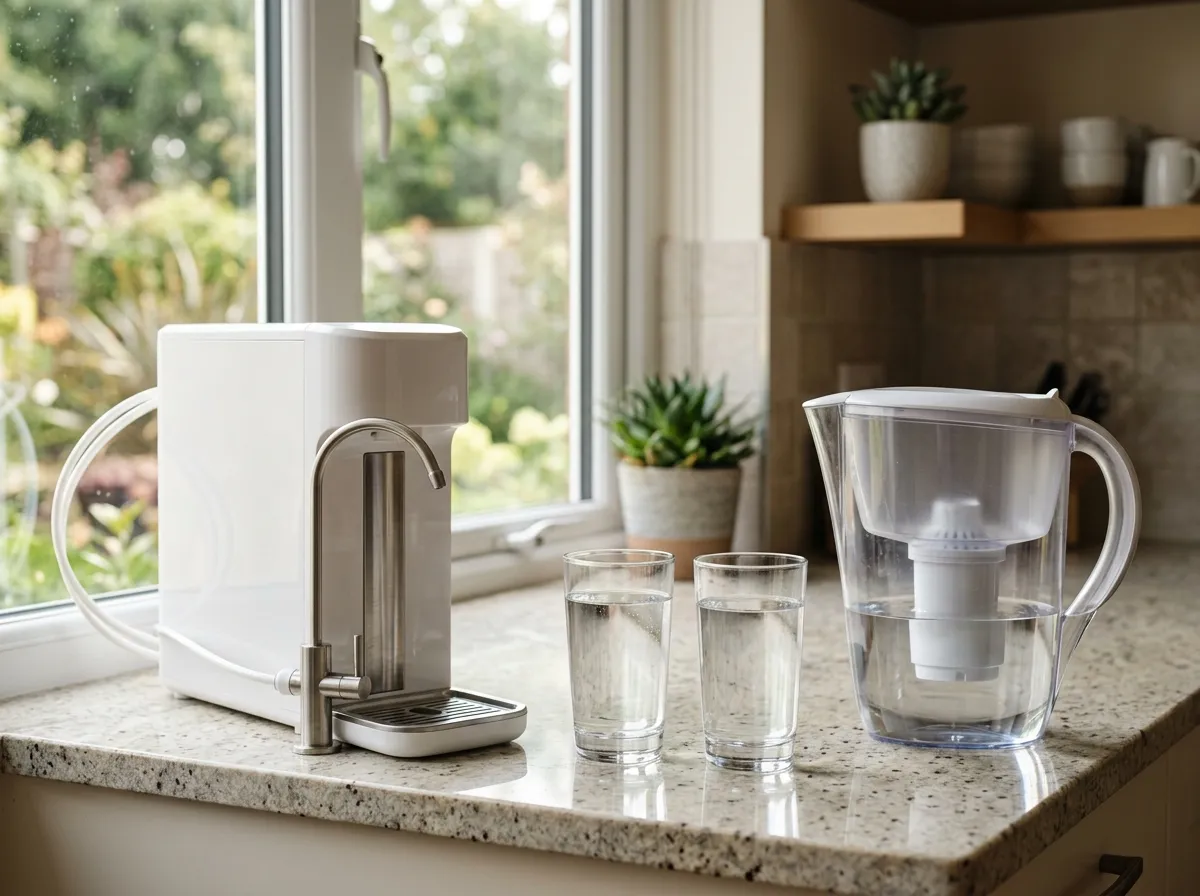
The AquaTru is the gold standard for apartment water filtration. It’s a countertop reverse osmosis system, which means you’re getting the same filtration technology that’s built into those expensive under-sink RO systems, but in a unit you just plug in and use.
It removes 83+ contaminants and is certified to NSF/ANSI standards 42, 53, 58, 401, and P473. That covers chlorine, lead, PFAS (including PFOA and PFOS), arsenic, fluoride, nitrates, microplastics, and pharmaceuticals.
Dr. Rhonda Patrick has noted that tap water introduces hundreds of thousands of microplastic particles into our bodies annually, and that reverse osmosis removes 99.9% of them. A countertop RO like the AquaTru gives renters access to that level of protection.
How it works: You fill the top tank with tap water, press a button, and the system pushes it through a 4-stage filtration process (sediment pre-filter, carbon pre-filter, RO membrane, carbon post-filter). Clean water collects in the bottom tank. That’s it.
Capacity: The clean water tank holds about 3/4 of a gallon. It takes roughly 12-15 minutes to fill. If you drink a lot of water, you’ll be refilling it throughout the day.
Filter costs: The RO membrane lasts about 2 years. The pre-filters and post-filter need replacing every 6 months. Annual filter costs run around $80-$100.
The trade-offs: It produces wastewater (about a 4:1 ratio, though AquaTru recirculates some of it). It’s not tiny: roughly the size of a large coffee maker. And it does require electricity.
Why apartment renters love it: Zero installation. Plug it in, fill it up, drink clean water. When you move, unplug it and pack it in a box.
For a deeper dive, check our AquaTru vs Clearly Filtered comparison or our full best reverse osmosis systems guide.
Best Water Filter Pitcher: Clearly Filtered
Best for: Renters who want serious filtration without taking up counter space
If you don’t have the counter space for an AquaTru (or the budget), a water filter pitcher is the most practical apartment filter. But not all pitchers are created equal. Not even close.
The Clearly Filtered pitcher removes 365+ contaminants, including PFAS, lead, microplastics, pharmaceuticals, and pesticides. It’s certified to NSF/ANSI standards 42, 53, 401, and P473. That’s a massive leap beyond what most pitchers can do.
How it compares to Brita: A standard Brita filter removes about 5 contaminants. Even the Brita Elite only handles about 30. The Clearly Filtered pitcher removes 365+, and it’s the only pitcher I’m aware of with full P473 certification for PFAS removal. We did a full Brita vs Clearly Filtered breakdown if you want the details.
Filter life: Each filter lasts about 100 gallons, which works out to roughly 4 months for most people.
Cost per gallon: About $0.50 per gallon. More expensive than Brita, but you’re getting 70x more contaminant removal.
The trade-offs: Slower flow rate than Brita. You fill the top, and it takes a few minutes to filter through. The filters cost about $50 each, so annual costs are around $150.
Why apartment renters love it: It fits in your fridge. No counter space needed. No power needed. About as portable as it gets.
Runner-Up Pitcher: ZeroWater
Best for: Budget-conscious renters who want measurable results
ZeroWater is interesting because it comes with a TDS meter (total dissolved solids). You can actually measure your water before and after filtration and see the number drop to zero. That’s satisfying, but it’s worth understanding what TDS actually means.
TDS measures the total dissolved minerals and salts in water. A reading of zero means the filter has removed everything, including beneficial minerals. It does remove lead, chromium, and PFAS, but its filter life is shorter than Clearly Filtered, especially if your source water has high TDS.
Filter life: Varies wildly depending on your water. Some people get 2-3 months, others get 3-4 weeks. High-TDS water eats through these filters fast.
Cost per gallon: Anywhere from $0.30 to $1.00+, depending on your water quality.
The trade-offs: If you have hard water or high-TDS source water, filter costs can add up quickly. The water also tastes very flat since all minerals are removed.
Why apartment renters love it: The TDS meter makes it dead simple to know when your filter needs replacing. And the upfront cost is lower than Clearly Filtered.
Best Faucet-Mount Filter: PUR Plus or Brita Faucet System
Best for: Renters who want filtered water on demand without filling anything
Faucet-mount filters screw directly onto your kitchen faucet. No tools, no plumbing changes. You twist them on, and they filter water as it flows from your tap.
Each PUR Plus Faucet Mount and Brita Faucet System are the two most widely available options. Both are certified to NSF/ANSI 42 and 53, which means they handle chlorine taste, lead, and some other contaminants.
What they remove: Lead, chlorine taste and odor, some pesticides, some pharmaceuticals (PUR Plus). They do not remove PFAS, microplastics, or fluoride.
Filter life: About 100 gallons, or roughly 2-3 months.
Cost per gallon: Around $0.08-$0.12. Very affordable.
The trade-offs: Limited contaminant removal compared to RO or advanced pitchers. They don’t fit all faucet types, especially the pull-down or commercial-style faucets common in newer apartments. And they can reduce water flow noticeably.
Important note for renters: Most faucet-mount filters just screw on and off. They don’t modify your faucet. But check the aerator size first. If your apartment has a non-standard or integrated faucet, you might need an adapter, or it might not work at all.
Why apartment renters love them: On-demand filtered water without refilling a pitcher. Easy on, easy off when you move.
Best Gravity Water Filter: ProOne Big+
Best for: Renters who want high-capacity filtration with no electricity
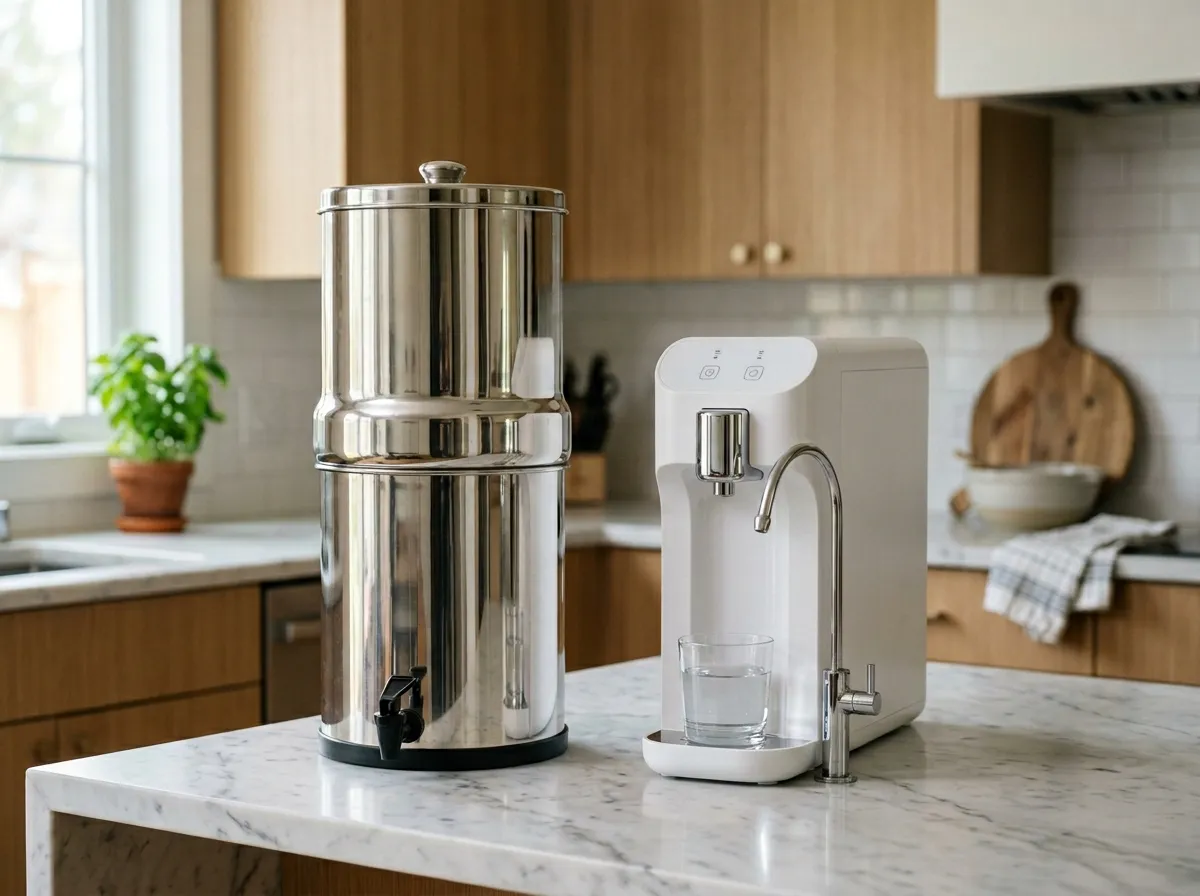
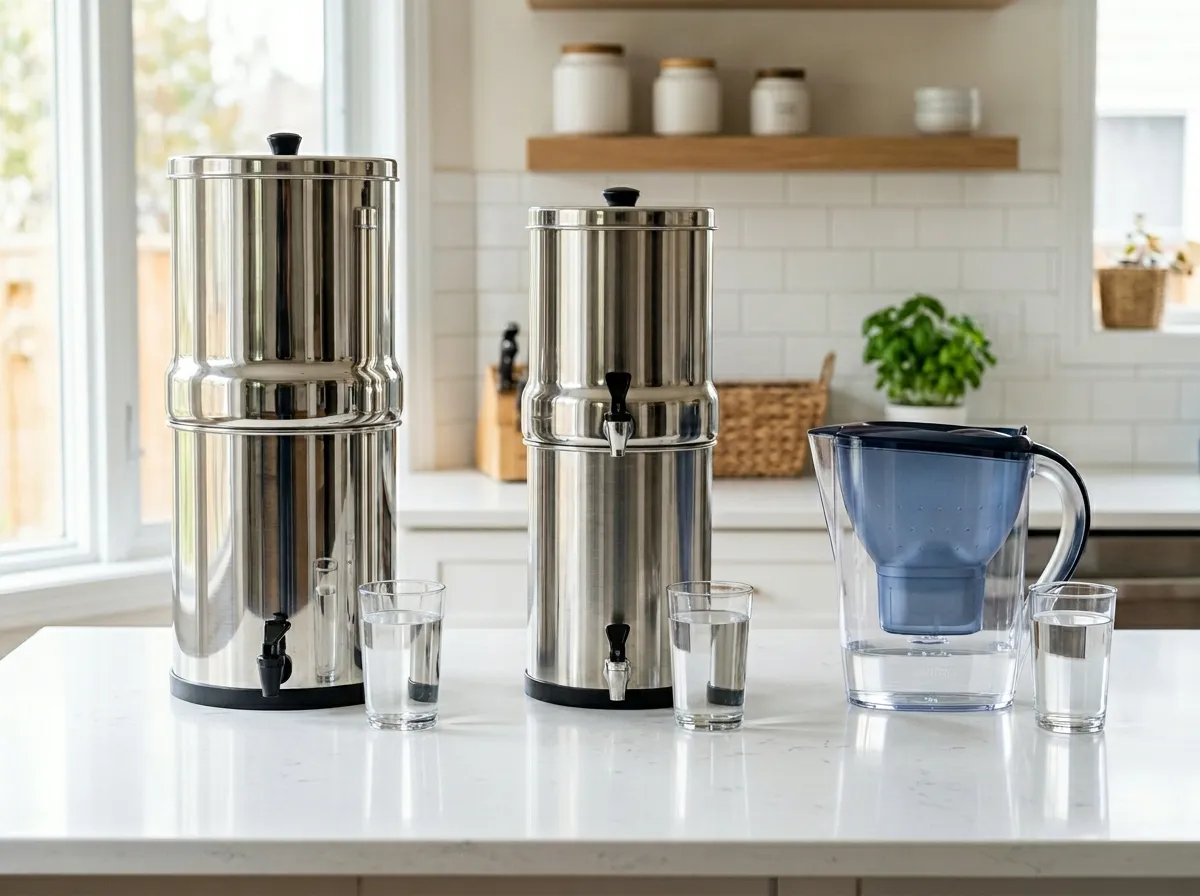
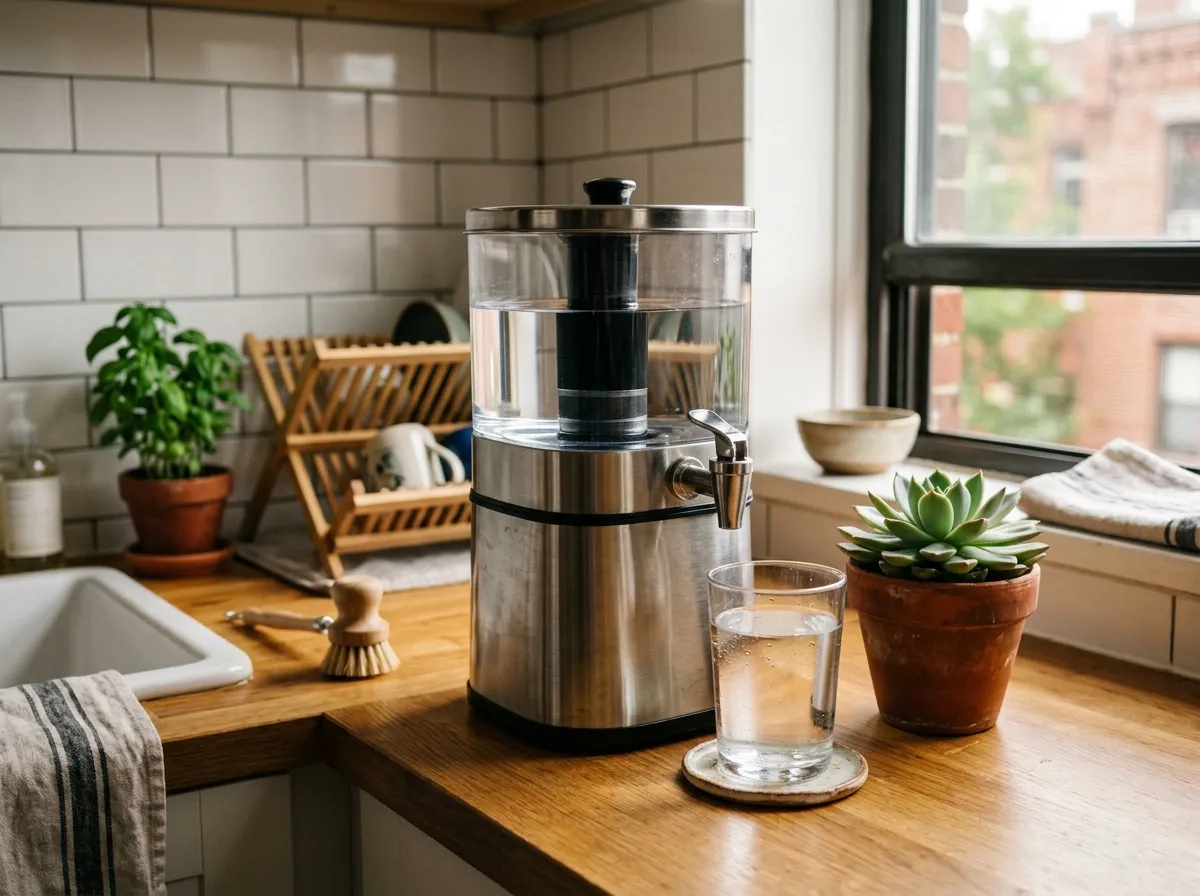
Gravity-fed water filters are the old-school approach. Fill the top chamber with tap water, gravity pulls it through the filter elements, and clean water collects in the bottom chamber. No electricity. No plumbing. No pressure required.
Any ProOne Big+ is one of the better options in this category. It uses ProOne G2.0 filter elements that remove a wide range of contaminants including bacteria, cysts, lead, chlorine, pesticides, and some PFAS.
Capacity: The Big+ holds about 2.75 gallons of filtered water. That’s enough for a household of 2-4 people without constantly refilling.
Filter life: ProOne G2.0 elements last about 1,200 gallons each, which works out to roughly one year for most users.
The trade-offs: These are large. A gravity filter takes up significant counter space and stands about 20 inches tall. The flow rate is slow: it can take 30-60 minutes to filter a full batch. And while ProOne publishes testing data, the third-party certification situation for gravity filters is less clear-cut than for pitcher or RO systems.
For more on gravity-fed options, see our best gravity water filters guide.
Why apartment renters love it: No power, no plumbing, large capacity, and very long filter life that keeps annual costs down.
Best Portable Option: Clearly Filtered Water Bottle
Best for: Renters who want filtration on the go
If you mostly drink water outside your apartment (at the office, gym, or while commuting), a filtered water bottle might be the simplest solution. The Clearly Filtered water bottle uses the same Affinity Filtration Technology as their pitcher, removing 220+ contaminants from any tap water source.
It’s not a replacement for a home filter, but it’s a useful complement. Fill it at any tap and drink clean water wherever you are.
Filter life: About 25 gallons, or roughly 2-3 months of daily use.
Quick Comparison: Apartment Water Filters at a Glance
| Filter Type | Top Pick | Contaminants Removed | Removes PFAS? | Removes Lead? | Installation | Annual Filter Cost | Best For |
|---|---|---|---|---|---|---|---|
| Countertop RO | AquaTru | 83+ | Yes | Yes | Plug in | ~$80-100 | Maximum protection |
| Pitcher | Clearly Filtered | 365+ | Yes | Yes | None | ~$150 | No counter space |
| Pitcher (Budget) | ZeroWater | 23+ | Partial | Yes | None | ~$120-200+ | Measurable results |
| Faucet-Mount | PUR Plus | 70+ | No | Yes | Screw on | ~$40-60 | On-demand filtered water |
| Gravity | ProOne Big+ | 200+ | Partial | Yes | None | ~$60-80 | Large capacity, no power |
| Portable | Clearly Filtered Bottle | 220+ | Yes | Yes | None | ~$80-100 | On the go |
How to Choose the Right Filter for Your Apartment
Not sure which type to pick? Ask yourself these questions:
What’s in your water? Start by testing your water quality. If you have PFAS or lead, you need a filter that’s certified to remove them. A basic Brita won’t cut it.
How much counter space do you have? If your kitchen counter is already full, a pitcher (stored in the fridge) or a faucet-mount filter takes up zero counter space. A countertop RO system needs about as much room as a coffee maker.
What’s your budget? Upfront and ongoing. A Clearly Filtered pitcher costs $80-90 up front with about $150/year in filters. An AquaTru costs $400-450 up front but only about $80-100/year in filters. Over two years, the AquaTru actually costs less per gallon.
How much water do you drink? If you go through a lot of water, a faucet-mount or countertop RO will be more convenient than constantly refilling a pitcher. If it’s just you drinking 2-3 glasses a day, a pitcher is fine.
Are you concerned about fluoride? Most pitcher and faucet-mount filters don’t remove fluoride. If that matters to you, you’ll want a reverse osmosis system like the AquaTru or check our best fluoride water filters guide.
What to Do If Your Landlord Won’t Let You Install Anything
Every filter on this list requires zero installation. There’s nothing to install. No drilling, no plumbing modifications, no holes in anything. Your landlord has no say over whether you put a pitcher in your fridge or plug in an appliance on your counter.
But if you’re in a situation where even a faucet-mount filter feels risky (maybe your lease has unusually restrictive language), here’s your game plan:
1. Start with a pitcher. No landlord on earth can tell you not to use a water pitcher. The Clearly Filtered pitcher sits in your fridge like any other kitchen item. Nobody even needs to know it’s a filter.
2. Countertop units are appliances, not installations. An AquaTru or a gravity filter is no different from a coffee maker or a toaster from a lease perspective. You plug it in (or just set it on the counter) and use it. When you leave, you take it with you. Nothing is modified.
3. Faucet-mount filters are removable. They screw on by hand. They screw off by hand. Your original aerator goes right back on when you move out. No damage, no modification.
4. Document your water quality. If you’re worried about pushback, get a water test. If your water contains lead or other contaminants above EPA limits, you have strong standing to take reasonable steps to protect your health. Many states have tenant rights around habitable conditions, and contaminated water falls under that.
5. Check your local tenant rights. In some jurisdictions, landlords are required to provide safe drinking water. If your water tests above EPA limits for regulated contaminants, your landlord may actually be obligated to address the problem.
Put simply: you don’t need anyone’s permission to filter your own drinking water in your own apartment. Every option on this list is designed to be temporary, portable, and non-invasive.
Apartment Water Filter Mistakes to Avoid
Using a basic Brita and assuming you’re protected. A standard Brita filter removes chlorine taste. That’s about it. It won’t touch PFAS, lead (unless you get the Elite filter), microplastics, or pharmaceuticals. If you’re filtering for health reasons and not just taste, you need something more capable.
Ignoring filter replacement schedules. Every filter has a lifespan. When you exceed it, the filter stops working and can actually release concentrated contaminants back into your water. Set a calendar reminder. Don’t guess.
Not checking what’s actually in your water first. There’s no point buying a filter that removes fluoride if your water doesn’t have fluoride. And there’s no point buying a basic carbon filter if your water has lead. Test your water before you spend money.
Buying based on brand recognition instead of certifications. Brita is the best-known brand. That doesn’t make it the best filter. Look for NSF/ANSI certifications, especially P473 (PFAS removal) and 53 (health-related contaminants). Those certifications mean the filter has been independently tested and verified.
Why I Recommend Starting with the AquaTru
Dr. Peter Attia has talked about how filtering drinking water is one of the highest-impact steps you can take for your health. I agree. And for apartment renters specifically, the AquaTru gives you the best combination of serious contaminant removal and zero-installation convenience.
Yes, it’s more expensive up front. But it removes more contaminants than any pitcher, requires no plumbing, and the long-term filter costs are actually reasonable. If you can swing the initial investment, it’s the filter I’d put on every apartment counter.
If the budget is tight, the Clearly Filtered pitcher is a very close second. It removes more contaminants than the AquaTru in raw numbers (365+ vs 83+), though the RO membrane in the AquaTru gives it an edge on certain contaminants like dissolved solids, fluoride, and nitrates.
For a head-to-head breakdown of those two, check our AquaTru vs Clearly Filtered comparison. And if you’re specifically concerned about Berkey alternatives, we’ve covered that too.
Your Questions Answered
Can I install an under-sink water filter in my apartment?
Technically, some under-sink filters are designed to connect without permanent plumbing changes. But most lease agreements prohibit modifications to plumbing, and even “easy” installations risk leaks that could cause water damage you’d be liable for. Countertop options are safer and simpler for renters. If you’re curious about under-sink systems for when you do own a home, check our best under-sink water filters guide.
Do apartment water filters remove PFAS?
Not all of them. Basic carbon filters (like standard Brita) don’t remove PFAS. For PFAS removal, you need a reverse osmosis system like the AquaTru, or an advanced pitcher like Clearly Filtered that’s certified to NSF/ANSI P473. See our full guide on the best water filters for PFAS removal.
How do I know if my apartment water is safe?
You don’t, until you test it. Your city publishes an annual water quality report (sometimes called a Consumer Confidence Report), but that only tests water as it leaves the treatment plant. It doesn’t account for what happens in the pipes between the plant and your faucet. Testing your water at home is the only way to know what’s actually coming out of your tap.
Is a water filter pitcher good enough for an apartment?
For most renters, yes. A high-quality pitcher like the Clearly Filtered removes more contaminants than many installed systems. The only real downsides are capacity (you’re limited to a few cups at a time) and the inability to remove certain dissolved contaminants that RO handles better (like fluoride and nitrates).
Do faucet-mount filters work on all faucets?
No. Pull-down faucets, commercial-style sprayer faucets, and some integrated faucets are incompatible with standard faucet-mount filters. Most newer apartments have pull-down faucets, which means you might be out of luck with this option. Check your faucet style before buying.
How often should I replace my apartment water filter?
It depends on the filter type and how much water you use. Pitcher filters typically last 2-4 months. Faucet-mount filters last 2-3 months. Countertop RO membranes last about 2 years, with pre-filters needing replacement every 6 months. Don’t skip replacements: an expired filter can be worse than no filter at all.
You Might Also Like
Sources
- Peter Attia, MD. AMA #67: Filtering drinking water as a health intervention. peterattiamd.com
- Rhonda Patrick, PhD. Microplastics in drinking water: health effects and filtration. foundmyfitness.com
- NSF International. AquaTru NSF/ANSI certifications and contaminant removal data. nsf.org
- Clearly Filtered. Third-party lab testing results and NSF certifications. clearlyfiltered.com
- ProOne Water Filters. G2.0 filter element testing data and lab reports.
- EPA. Consumer Confidence Reports and drinking water standards. epa.gov
- NSF International. Drinking water treatment standards overview. nsf.org