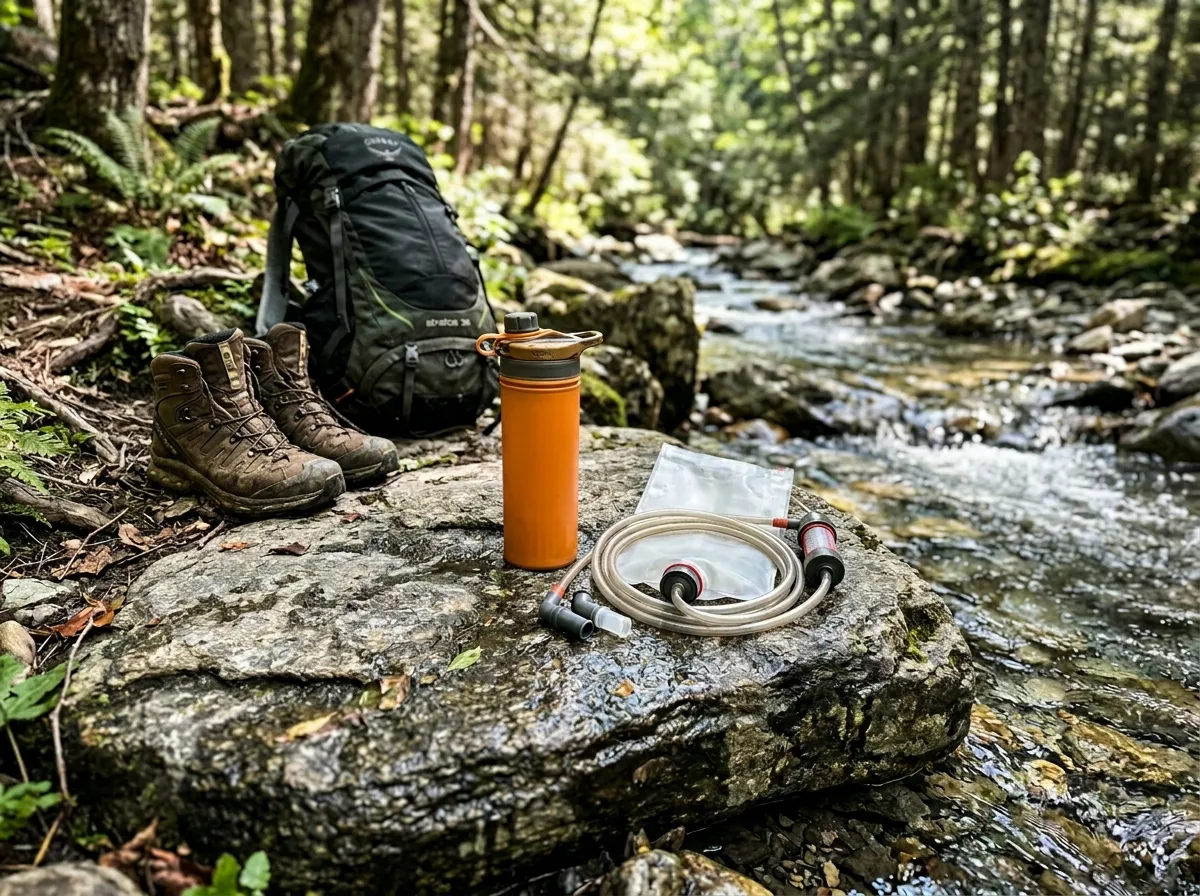
NonToxicLab’s testing shows the best portable water filter for travel depends on where you’re going and what’s in the water. For international travel where viruses are a concern, the Grayl GeoPress is the top pick because it’s a true purifier that removes viruses, bacteria, protozoa, and chemicals in a single press. For backpacking in North America, the Sawyer Squeeze is the lightest and most cost-effective filter. For hotel-based travel with tap water concerns, the Clearly Filtered Water Bottle removes the widest range of chemical contaminants. Our water filtration guide covers everything you need to know.
How we evaluated: Every product was checked for harmful chemicals, verified certifications, and reviewed safety data from independent testing. We also considered real-world performance and long-term durability. Full methodology
Not all portable water filters are created equal. Some remove bacteria but not viruses. Others handle viruses but ignore chemical contaminants like heavy metals and pesticides. A few do almost everything. The differences matter, and they matter a lot depending on where your plane ticket takes you.
I’ve spent months researching portable water filtration for different travel scenarios. What follows is a breakdown of the six best options, what each one actually removes, and which travel situations each one fits.
Quick Picks: Best Portable Water Filters by Travel Type
| Travel Type | Best Pick | Price | Why It Wins |
|---|---|---|---|
| International Travel (Developing Countries) | Grayl GeoPress | $90 | Only bottle that removes viruses, bacteria, AND chemicals |
| Backpacking / Hiking | Sawyer Squeeze | $35 | 3 oz, filters 100,000 gallons, $35 |
| Fast Trail Filtering | Katadyn BeFree | $45 | Fastest flow rate of any gravity/squeeze filter |
| Budget Travel | LifeStraw Go Series | $40-50 | Solid bacteria/parasite removal in a simple bottle |
| Hotel / Urban Travel | LARQ Bottle PureVis | $98 | UV-C kills viruses and bacteria, self-cleaning |
| Tap Water Chemical Concerns | Clearly Filtered Bottle | $50 | Removes 220+ contaminants including PFAS and lead |
What You Need to Understand About Water Contaminants
Before comparing filters, you need to understand what’s actually in water that can make you sick. This matters because different filter technologies target different threats.
Bacteria
Examples: E. coli, Salmonella, Cholera, Campylobacter. Size: 0.2 to 5 microns. Found in untreated water sources worldwide. Most portable filters handle bacteria effectively because bacterial cells are relatively large.
Protozoa (Parasites)
Examples: Giardia, Cryptosporidium. Size: 1 to 15 microns. Common in streams, lakes, and contaminated water supplies. Most filters catch these because they’re even larger than bacteria.
Viruses
Examples: Hepatitis A, Norovirus, Rotavirus. Size: 0.02 to 0.3 microns. This is where most portable filters fall short. Viruses are 10 to 100 times smaller than bacteria. A standard 0.1 or 0.2 micron filter will not catch them. You need either a purifier (with smaller pore size or additional technology), UV light, or chemical treatment to neutralize viruses.
This distinction between “filter” and “purifier” is critical for international travelers. In North America, Europe, Australia, and other developed regions, waterborne viruses in backcountry water are rare. A standard filter is usually sufficient. But in parts of Southeast Asia, Central and South America, Africa, and South Asia, viruses in the water supply are a real and common threat.
Chemical Contaminants
Examples: heavy metals (lead, mercury), pesticides, herbicides, pharmaceuticals, PFAS, chlorine. These are dissolved in water at the molecular level. No mechanical filter catches them unless it includes activated carbon or a specialized adsorption media. For a deeper look at chemical contamination in water, read our guide on what PFAS forever chemicals are.
Microplastics
Tiny plastic particles found in most water sources globally. Sizes range from 1 micron to 5 millimeters. Most 0.1 micron filters catch the larger microplastics, but the smallest particles require finer filtration. For more context on this issue, see our article on microplastics in drinking water.
Detailed Reviews: The 6 Best Portable Water Filters for Travel
1. Grayl GeoPress
Best overall for international travel
- Price: $90 (replacement cartridges ~$30)
- Capacity: 24 oz (710 ml)
- Filter Life: 65 gallons (250 liters) per cartridge
- Weight: 16 oz (454 g) empty
- Removes: Viruses, bacteria, protozoa, chemicals, heavy metals, microplastics
The Grayl GeoPress is the only portable water bottle I’ve found that functions as a true purifier while also filtering chemical contaminants. It uses a combination of electroadsorption, activated carbon, and ion exchange to remove viruses (99.99%), bacteria (99.9999%), protozoa (99.9%), plus chemicals like pesticides, heavy metals, chlorine, and PFAS.
The system works like a French press. You fill the outer container with untreated water, insert the inner press with the cartridge, and push down. The entire filtering process takes about eight seconds. The water is ready to drink immediately.
For travel in Southeast Asia, Central America, Africa, or any region where tap water and street vendor ice may contain viral or bacterial contamination, the GeoPress is the clear winner. It’s the only bottle filter that handles the full spectrum of threats you’d encounter abroad.
The downsides: At 16 oz empty and 24 oz capacity, it’s heavier and bulkier than most other options. The cartridge only lasts 65 gallons, which is about two to three months of daily use. Replacement cartridges run about $30. And the pressing mechanism requires some effort, though it’s much easier than the older Grayl Ultralight model.
Dr. Joseph Cotruvo, a former director of the EPA’s Drinking Water Standards Division, writes that combination purification systems (those that pair mechanical filtration with adsorption media) tend to provide the most complete protection for travelers. The GeoPress fits that description.
Best for: International travel, developing countries, situations where viral contamination is a risk, travelers who want one device that handles everything.
2. LifeStraw Go Series
Best budget travel filter
- Price: $40 to $50
- Capacity: 22 oz or 1 liter options
- Filter Life: 1,000 gallons (4,000 liters) for membrane filter
- Weight: 7.5 oz (empty, 22 oz version)
- Removes: Bacteria (99.999%), parasites (99.999%), microplastics. Does NOT remove viruses.
LifeStraw has become one of the most recognized names in portable water filtration. The Go Series puts their hollow fiber membrane technology into a water bottle with an integrated filter straw.
The membrane microfilter has a pore size of 0.2 microns, which catches bacteria and protozoa effectively. It also includes an activated carbon filter that reduces chlorine, organic chemical matter, and improves taste. The carbon filter lasts about 25 gallons and is replaceable.
The 1,000-gallon membrane filter life is excellent. At a gallon per day, that’s nearly three years of use before replacement. The membrane is also backflushable, so when flow rate slows down, you can clean it and restore performance.
The critical limitation: LifeStraw does not remove viruses. For travel in North America, Europe, or any region where the primary concerns are bacteria and parasites (backcountry water, questionable tap water in rural areas), this is fine. For travel to regions with known viral waterborne illness risk, it’s not enough.
Best for: Budget-conscious travelers, day hiking, camping in developed countries, travelers who want a simple and affordable bottle filter. Not ideal for international travel where viruses are a concern.
3. Sawyer Squeeze
Best for backpacking
- Price: $35
- Capacity: Comes with 32 oz pouch (compatible with standard water bottle threads)
- Filter Life: 100,000 gallons (rated by manufacturer)
- Weight: 3 oz (filter only)
- Removes: Bacteria (99.99999%), protozoa (99.9999%). Does NOT remove viruses or chemicals.
The Sawyer Squeeze is the darling of the ultralight backpacking community, and for good reason. At three ounces for the filter alone, it’s the lightest option on this list by a wide margin. The hollow fiber membrane is rated to 0.1 micron, and Sawyer claims a filter life of 100,000 gallons, which is essentially a lifetime of use.
The system is versatile. You can screw it onto the included collapsible pouch, onto a standard disposable water bottle, or use it inline with a hydration bladder. Squeeze water through the filter and drink from the other end. It’s simple, lightweight, and reliable.
Flow rate is good when the filter is new but degrades over time as the hollow fibers accumulate sediment. Backflushing with the included syringe restores flow rate. Most backpackers backflush every few days on the trail.
The downsides: No virus removal. No chemical removal. The collapsible pouches that come with the system are notoriously fragile and tend to split at the seams after heavy use. Most experienced users replace them with Cnoc Vecto or Evernew bags, which are sturdier. In freezing temperatures, the hollow fiber membrane can be permanently damaged if water inside it freezes. You need to sleep with it in your sleeping bag in cold conditions.
Best for: Backpacking, thru-hiking, ultralight travel, any situation where weight matters and viruses aren’t a concern. A staple on trails like the Appalachian Trail, PCT, and CDT.
If you’re interested in home filtration for similar backcountry concerns, our best gravity water filters guide covers countertop options that use similar hollow fiber technology.
4. Katadyn BeFree
Best flow rate
- Price: $45
- Capacity: 20 oz (0.6L) or 33.8 oz (1L) flask options
- Filter Life: 1,000 liters
- Weight: 2.3 oz (filter and flask)
- Removes: Bacteria (99.9999%), protozoa (99.9%). Does NOT remove viruses or chemicals.
The Katadyn BeFree is what you get when you optimize a portable filter for speed. The EZ-Clean Membrane flows fast. Noticeably faster than the Sawyer Squeeze or LifeStraw. You can fill the soft flask from a stream and drink through the filter almost as quickly as drinking unfiltered water. For hikers who hate waiting, this is the pick.
The collapsible Hydrapak flask is more durable than the Sawyer’s included pouches. It rolls up small when empty and holds its shape well when full. The whole system weighs 2.3 ounces, which is even lighter than the Sawyer when you include the flask.
The 0.1 micron hollow fiber filter handles bacteria and protozoa. Like the Sawyer, it does not remove viruses or chemicals. Unlike the Sawyer, it cannot be threaded onto standard water bottles. You’re limited to the proprietary Hydrapak flask.
The downsides: The 1,000-liter filter life is far shorter than the Sawyer’s claimed 100,000 gallons. In practice, this means the BeFree filter may need replacing after a single long backpacking trip or a season of weekend hikes. The filter cannot be backflushed in the field with a syringe like the Sawyer. You clean it by swirling and shaking, which works but isn’t as thorough. Some users report the membrane degrading after six to twelve months of regular use.
Best for: Day hikes, weekend backpacking, trail running, any situation where fast flow and light weight are the top priorities.
5. LARQ Bottle PureVis
Best for hotel and urban travel
- Price: $98
- Capacity: 17 oz (500 ml) or 25 oz (750 ml)
- Purification: UV-C LED
- Battery Life: 1 to 2 months on a single USB-C charge
- Weight: 13.5 oz (25 oz version, empty)
- Removes: Bacteria (99.9%), viruses (99.9%). Does NOT remove chemicals, heavy metals, or particulates.
The LARQ bottle takes a completely different approach. Instead of mechanical filtration, it uses a UV-C LED built into the cap to neutralize bacteria and viruses. Press the button, wait 60 seconds, and the UV light destroys the DNA of pathogens in the water. The bottle also runs an automatic cleaning cycle every two hours to keep the interior sanitary.
This works best with clear, treated water sources. Think hotel tap water in a country where you’re not sure about the local treatment system. Airport water fountains. Restaurant water that you’d rather not trust blindly. The UV-C technology is well-established and genuinely effective at killing biological pathogens.
The critical limitation: UV-C does nothing for chemical contaminants, heavy metals, particulates, or turbid (cloudy) water. If the water has sediment or is visibly murky, UV light can’t reach all the pathogens because particles block the light. This is not a wilderness filter. It’s a pathogen killer for reasonably clear water.
It also requires charging. The battery lasts a long time (up to two months with typical use), but if it dies, you have a regular water bottle with no filtration capability.
Best for: Business travelers, hotel stays in countries with questionable tap water, travelers who want virus protection without the bulk of a mechanical purifier.
6. Clearly Filtered Water Bottle
Best for chemical contaminant removal
- Price: $50 (replacement filters ~$30)
- Capacity: 24 oz
- Filter Life: 25 gallons (about 2 to 3 months of regular use)
- Weight: 11 oz (empty)
- Removes: 220+ contaminants including PFAS, lead, fluoride, pesticides, pharmaceuticals, microplastics, bacteria, and chlorine.
The Clearly Filtered bottle uses their proprietary Affinity Filtration Technology, a multi-stage process that targets chemical contaminants most portable filters completely ignore. It removes over 220 contaminants, including PFAS (removes 99.5%), lead (removes 99.5%), fluoride, pesticides, pharmaceuticals, and microplastics.
This is the bottle you want if your concern isn’t wilderness bacteria but rather what’s dissolved in the tap water at your destination. Traveling through areas with known lead contamination in municipal water? Concerned about agricultural pesticide runoff in tap water? Worried about PFAS? This handles all of that.
We compared the Clearly Filtered pitcher against Brita in our Brita vs Clearly Filtered comparison, and the chemical removal performance wasn’t close. The same technology in this portable bottle gives you that protection on the road.
The downsides: The 25-gallon filter life is short. If you’re drinking a gallon per day, the filter lasts less than a month. Replacement filters at $30 each add up. The flow rate is also noticeably slower than other bottle filters because the water passes through denser filtration media. You need to squeeze the bottle to push water through, and it takes some effort.
It also does not remove viruses. Bacteria removal is limited compared to dedicated biological filters. This is primarily a chemical filter, not a pathogen purifier.
Best for: Domestic travelers concerned about tap water quality, travelers to areas with known chemical contamination, anyone who wants PFAS removal on the go.
Backpacking vs. International Travel vs. Hotel Travel: Which Filter for Which Scenario
Backpacking in North America or Europe
Primary threats: bacteria (E. coli, Salmonella), protozoa (Giardia, Cryptosporidium). Viruses in backcountry water are rare in these regions.
Best picks: Sawyer Squeeze or Katadyn BeFree. Both are lightweight, effective against bacteria and protozoa, and designed for trail use. Choose Sawyer for longer trips (better filter life) and Katadyn for faster flow rate.
International Travel (Southeast Asia, Central/South America, Africa, South Asia)
Primary threats: viruses (Hepatitis A, Norovirus, Rotavirus), bacteria, protozoa, plus potential chemical contamination.
Best pick: Grayl GeoPress. It’s the only portable bottle filter that handles viruses, bacteria, protozoa, AND chemicals. The weight penalty is worth it when the stakes are higher. Some travelers pair a Sawyer Squeeze with chemical treatment tablets (like Aquamira or MSR Aquatabs) as a lighter alternative, but the Grayl simplifies the process into one step.
Hotel and Urban Travel
Primary threats: unknown municipal water treatment quality, chlorine, potential chemical contaminants, possible bacterial contamination in older plumbing systems.
Best picks: LARQ Bottle PureVis for pathogen concerns, Clearly Filtered Water Bottle for chemical concerns. If you’re staying in hotels and drinking from treated municipal water sources but don’t fully trust the local system, one of these handles the likely risks without the bulk of a wilderness filter.
Combo Approach
Some travelers carry two devices. A Sawyer Squeeze for trail days and a Clearly Filtered bottle for city days. Or a Grayl GeoPress as the primary and a lightweight LifeStraw as the backup. There’s no single perfect filter for every situation, but having the right tool for your specific trip is what matters.
For home filtration that provides similar complete protection, check out our guides to the best under-sink water filters and best reverse osmosis systems.
What About Boiling Water?
Boiling water for one minute (three minutes above 6,500 feet elevation) kills all pathogens: bacteria, viruses, and protozoa. It’s the most reliable purification method and costs nothing beyond fuel.
But boiling has obvious downsides for travelers. You need a heat source, a pot, and time. You can’t boil water at an airport. And boiling does nothing for chemical contaminants, heavy metals, or microplastics.
Portable filters are about convenience and coverage. They let you drink safe water quickly, anywhere, without a stove.
How to Choose: Decision Framework
If you’re still unsure which filter to buy, answer these three questions:
-
Will you encounter water that might contain viruses? (Developing countries, questionable municipal water.) If yes, you need a purifier: Grayl GeoPress or LARQ.
-
Are you primarily worried about chemical contamination in tap water? (PFAS, lead, pesticides.) If yes, the Clearly Filtered bottle is the best portable option.
-
Are you backpacking and need the lightest filter possible? If yes, Sawyer Squeeze or Katadyn BeFree.
Most travelers fall clearly into one of these scenarios. Match the filter to the threat, not to the marketing.
Quick Answers
Do portable water filters remove viruses?
Most portable water filters do not remove viruses. Standard hollow fiber filters (like Sawyer, Katadyn BeFree, and LifeStraw) have pore sizes of 0.1 to 0.2 microns, which catch bacteria and protozoa but not viruses (which can be as small as 0.02 microns). The Grayl GeoPress and LARQ bottle are the exceptions on this list. The Grayl uses electroadsorption, and the LARQ uses UV-C light to neutralize viruses.
Is a LifeStraw enough for international travel?
It depends on where you’re going. For countries with modern water treatment systems, a LifeStraw provides good protection against bacteria and parasites. For travel to regions where waterborne viruses are common (parts of Asia, Africa, Central and South America), a LifeStraw alone is not sufficient. You’d need a purifier like the Grayl GeoPress or supplemental chemical treatment.
How often do I need to replace portable water filter cartridges?
This varies by product. The Sawyer Squeeze is rated for 100,000 gallons (essentially never). The Katadyn BeFree lasts about 1,000 liters. The Grayl GeoPress cartridge lasts 65 gallons. The Clearly Filtered bottle filter lasts 25 gallons. The LARQ UV-C LED has no consumable filter to replace but does need USB-C charging every one to two months.
Can I filter salt water with a portable filter?
No. None of these portable filters remove dissolved salts. Desalination requires reverse osmosis or distillation, which are not practical in portable form for travelers. These filters are designed for freshwater sources only.
What’s the difference between a water filter and a water purifier?
A water filter uses a physical barrier (like hollow fiber membranes) to block contaminants by size. Most filters catch bacteria and protozoa but not viruses. A water purifier goes further, neutralizing or removing viruses in addition to bacteria and protozoa. The Grayl GeoPress and LARQ are purifiers. The Sawyer, Katadyn, and LifeStraw are filters.
Are portable water filters TSA-approved for carry-on luggage?
Yes. Portable water filter bottles are allowed in carry-on luggage by TSA. They must be empty when going through security (same rule as any water bottle). Fill them at a water fountain after clearing the security checkpoint.
Sources
- CDC. “Water Disinfection for Travelers.” Centers for Disease Control and Prevention, updated 2024.
- WHO. “Guidelines for Drinking-water Quality.” World Health Organization, 4th edition.
- EPA Drinking Water Standards and Health Advisories, Office of Water.
- NSF International testing standards for portable water treatment devices.
- Cotruvo, Joseph A. “Drinking Water Quality and Contaminants Guidebook.” CRC Press.