The AquaTru is a countertop reverse osmosis system that removes up to 99% of contaminants from tap water without any plumbing or installation. It’s one of the few RO filters you can set on your counter, plug in, and start using immediately. After months of daily use, I think it’s the best option for renters and anyone who doesn’t want to mess with under-sink plumbing. But it’s not for everyone, and the ongoing filter costs are something you need to factor in before buying. We put together water filtration guide that covers this whole category.
How we vetted these products: Every pick was checked for harmful chemicals, verified certifications, and ingredient transparency. Products with vague “natural” claims but no third-party testing were excluded. How we test
What Is the AquaTru?
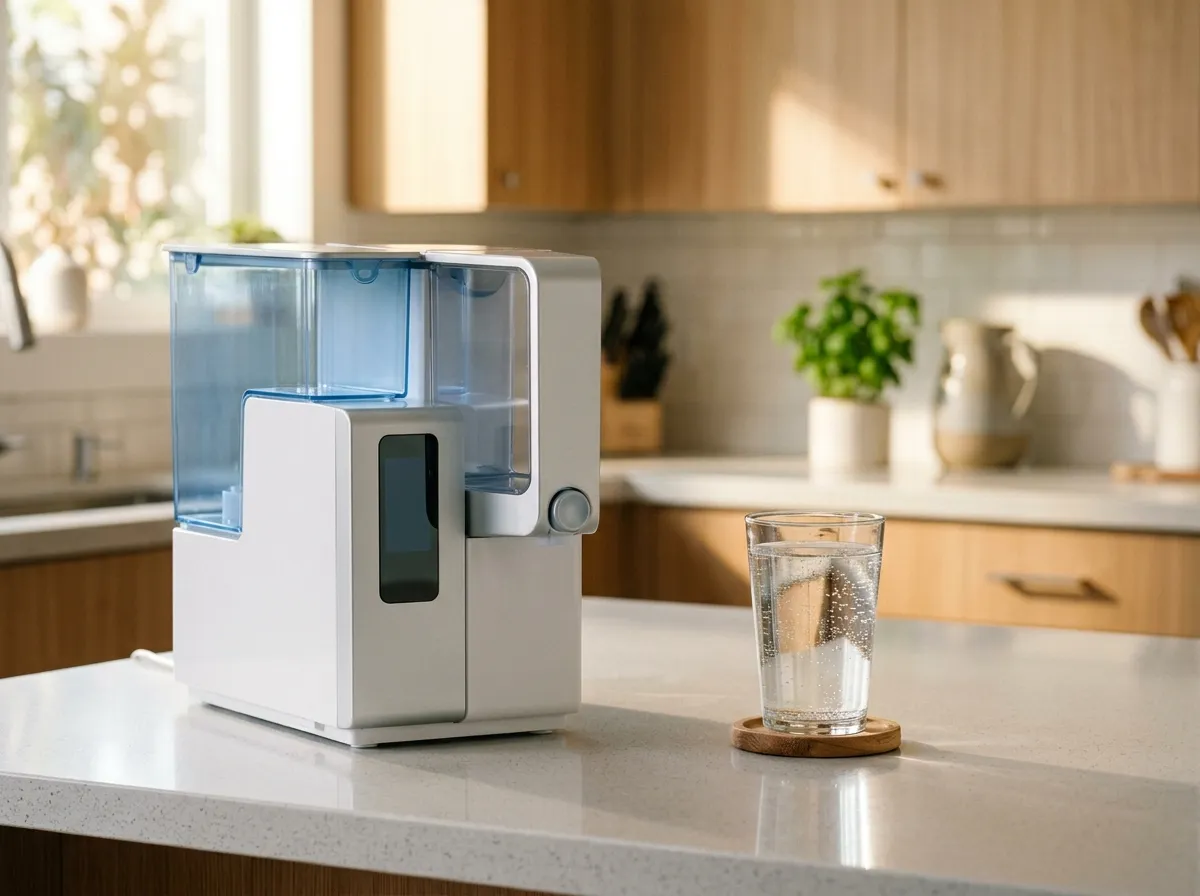
The AquaTru is a 4-stage countertop reverse osmosis water purifier. It sits on your kitchen counter, plugs into a standard outlet, and filters tap water through four stages of filtration: a mechanical pre-filter, a carbon pre-filter, a reverse osmosis membrane, and a carbon post-filter.
Unlike under-sink RO systems that require a plumber (or at least some DIY confidence), the AquaTru requires zero installation. You fill the back tank with tap water, press a button, and purified water collects in the front tank. That’s it.
The system is NSF certified to Standards 42, 53, 58, 401, and P473. Those certifications cover chlorine taste and odor, lead and mercury reduction, dissolved solids, pharmaceuticals, and PFAS. It’s one of the most thoroughly certified countertop water filters on the market.
AquaTru claims the system removes or reduces 83 contaminants, including lead, chromium 6, chlorine, chloramines, fluoride, arsenic, nitrates, PFAS, pharmaceuticals, herbicides, and pesticides. Those aren’t vague marketing claims. The NSF certifications back them up with tested, verified performance data.
Setup and First Impressions
Setup takes less than 10 minutes. You unbox the unit, insert the four filters into their designated slots (they’re color-coded and can only go in one way), fill the back tank with tap water, and press the power button. The system runs an initial cycle to flush the filters and then it’s ready.
The unit is bigger than I expected from the photos. It takes up roughly the footprint of a large coffee maker. Dimensions are about 14 inches tall, 14 inches wide, and 12 inches deep. If counter space is tight, that’s worth measuring first. It’s not something you’ll want to move around once it’s placed, because it weighs about 16 pounds when the tanks are full.
These build quality is solid. The tanks are BPA-free plastic, the housing feels sturdy, and the filter cartridges click into place with a satisfying snap. Nothing about it feels cheap or flimsy.
First pour: the water tasted noticeably cleaner than my standard Brita-filtered tap water. I was skeptical about whether I’d be able to taste a difference, but it was immediate. The flat, slightly metallic edge that my tap water carries was completely gone. The water tasted like nothing, in the best possible way.
How It Works: The 4-Stage Filtration Process
Understanding what each stage does helps explain why the AquaTru outperforms simpler pitcher filters.
Stage 1: Mechanical Pre-Filter. This catches sediment, rust, and larger particles. It protects the more expensive downstream filters from getting clogged prematurely. Think of it as the bouncer that keeps the riffraff from reaching the VIP section.
Stage 2: Carbon Pre-Filter (VOC Filter). Activated carbon adsorbs chlorine, chloramines, VOCs (volatile organic compounds), and organic chemicals. This stage handles the stuff that makes tap water taste and smell off. It also protects the RO membrane from chlorine damage, because chlorine degrades RO membranes over time.
Stage 3: Reverse Osmosis Membrane. This is the main event. The RO membrane has pores so small (0.0001 microns) that virtually nothing except water molecules can pass through. This is where lead, arsenic, fluoride, chromium 6, PFAS, nitrates, pharmaceuticals, and dissolved solids get removed. RO membranes are the reason reverse osmosis systems outperform every other consumer filtration technology for broad-spectrum contaminant removal.
Stage 4: Carbon Post-Filter (Taste and Odor). A final activated carbon polish removes any residual taste or odor, ensuring the water that hits your glass is as clean as possible.
Combination of carbon filtration and reverse osmosis covers the full spectrum of contaminants. Carbon handles organics and chemicals. RO handles dissolved solids, heavy metals, and anything the carbon misses. Together, they produce water that’s about as pure as you can get without a laboratory distiller.
PFAS Removal: Does It Actually Work?
This is the question that matters most to a lot of people, and it’s a big reason the AquaTru has gained traction in the non-toxic community.
PFAS, or “forever chemicals,” are synthetic compounds that contaminate the water supplies of an estimated 110 million Americans. They don’t break down in the environment or your body, and they’re linked to cancer, thyroid disease, immune suppression, and reproductive problems. The EPA has set health advisories for several PFAS compounds at extremely low levels, essentially acknowledging there’s no safe level of exposure.
This AquaTru holds NSF P473 certification, which specifically covers PFAS removal (PFOA and PFOS). According to AquaTru’s published data, the system removes over 99% of PFOA and PFOS.
That’s significant. Most pitcher filters and basic faucet-mount filters can’t touch PFAS. The molecules are small enough to pass through standard carbon filtration. You generally need either activated carbon block (not granular), ion exchange resin, or reverse osmosis to capture them. The AquaTru uses RO as its primary PFAS removal mechanism, backed by the carbon stages.
Dr. Peter Attia has discussed the importance of water quality on his podcast, noting that microplastics and PFAS are among the environmental exposures worth actively minimizing given the current body of research. Reverse osmosis is one of the most effective ways to do that at home.
Our testing at NonToxicLab found the AquaTru to be one of the most accessible RO options for PFAS removal because it requires no installation and no plumbing modifications, which puts it within reach of renters and apartment dwellers who can’t install under-sink systems.
Our full breakdown of the best water filters for PFAS removal compares the AquaTru against other certified options.
Taste Test
I did a blind taste comparison with four water sources: unfiltered tap, Brita-filtered tap, AquaTru-filtered tap, and store-bought spring water.
This AquaTru water was the cleanest-tasting of the four. It had no metallic taste, no chlorine edge, and no detectable flavor at all. The Brita water tasted noticeably better than straight tap but still carried a faint mineral/chlorine quality. The spring water tasted fine but had a mild mineral character that the AquaTru water lacked.
This makes sense. RO filtration removes dissolved minerals along with contaminants, which produces very “flat” or “empty” tasting water. Some people love this. Others find it too neutral and prefer a bit of mineral character. If that’s you, AquaTru sells a remineralization filter as an add-on, or you can add a pinch of mineral drops to the tank.
For coffee and tea, the difference is noticeable. Both brewed more cleanly with the AquaTru water, and the actual flavors of the beans and leaves came through more clearly without competing with tap water minerals.
Filter Replacement Costs: The Real Math
This is where the AquaTru goes from “great product” to “do the math first.” The upfront cost of $449 is just the beginning. You’ll spend money on replacement filters for as long as you own the unit.
Here’s the breakdown:
- Mechanical Pre-Filter (Stage 1): Replace every 6 months. About $20-$25.
- Carbon Pre-Filter (Stage 2): Replace every 6 months. About $30-$35.
- RO Membrane (Stage 3): Replace every 2 years. About $50-$60.
- Carbon Post-Filter (Stage 4): Replace every 1 year. About $25-$30.
Estimated annual filter cost: $120-$150 per year.
Over 5 years: $449 (unit) + $600-$750 (filters) = roughly $1,050-$1,200 total.
That works out to about $0.55-$0.65 per day for purified RO water on demand. Compared to buying bottled water, that’s a bargain. Compared to a Brita pitcher ($35 + $50/year in filters), it’s significantly more expensive, but you’re getting dramatically better filtration.
Compared to an under-sink RO system, the AquaTru’s total cost of ownership is similar or slightly higher. Under-sink systems typically cost $200-$400 for the unit plus $80-$120 per year in filters, but you’re also paying for installation (or doing it yourself). The best reverse osmosis systems guide breaks down the full comparison.
The question is whether the convenience of zero installation justifies the premium. For renters, the answer is almost always yes.
Water Production Speed and Capacity
With the AquaTru produces purified water at a rate of about 1 gallon per 12-15 minutes, depending on input water quality and filter age. The clean water tank holds about 3 quarts (0.75 gallons), and the raw water tank holds about 1 gallon.
In practice, this means you fill the back tank, press the button, wait 12-15 minutes, and you’ve got 3 quarts of purified water. For a household of 1-2 people, that’s usually enough for drinking and cooking throughout the day with one or two refills. For a family of 4+, you’ll be refilling more frequently, which can feel tedious.
This system does not produce water continuously. It fills the front tank and stops. When the front tank gets low, you refill the back tank and run another cycle. There’s no direct-flow option, so you can’t plumb it into an ice maker or dispenser.
This is the biggest functional difference between the AquaTru and under-sink RO systems. Under-sink units connect to your water supply and produce water on demand. The AquaTru is a batch processor. For some households, that’s a non-issue. For others, it’s a dealbreaker.
What I Like About the AquaTru
Zero installation. Unbox, insert filters, plug in, go. No plumber, no tools, no drilling holes in your countertop. This alone makes it the go-to option for renters.
NSF certified across multiple standards. The certifications are real and cover the contaminants people actually worry about: lead, PFAS, pharmaceuticals, chlorine, fluoride.
The water tastes great. Clean, neutral, no off-flavors. Makes a noticeable difference in coffee and tea.
Removes fluoride. Unlike pitcher and faucet filters, the RO membrane removes fluoride. If that matters to you, the AquaTru delivers.
Compact enough for a countertop. It’s not small, but it fits on a standard kitchen counter without dominating the space.
Easy filter changes. Cartridges are color-coded and click in with no tools. The system tracks filter life and alerts you when it’s time to replace.
What I Don’t Like
Ongoing filter costs. $120-$150 per year adds up. This is the biggest ongoing expense and the most common complaint from owners.
Slow production. 12-15 minutes per batch isn’t terrible, but it’s not instant either. You need to plan ahead, especially for larger households.
No direct water line connection. You can’t hook this up to continuous water supply. It’s batch mode only.
Wastewater. Like all RO systems, the AquaTru produces wastewater. The ratio is roughly 4:1 (4 cups of tap water to produce 1 cup of purified water). That’s actually better than many under-sink RO systems (which can be 3:1 or worse), but it still means 75% of the water you put in goes to waste. You can capture the wastewater for plants or cleaning, but most people just dump it.
Plastic tanks. The tanks are BPA-free plastic, not glass or stainless steel. For a product marketed to health-conscious consumers, glass tanks would have been a better choice. That said, the water doesn’t sit in the tanks for long in normal use, and there’s no heat exposure. If you’re concerned about plastic contact with your drinking water, this is worth noting but probably not a dealbreaker.
Counter space. It’s bigger than a Brita pitcher. You need a dedicated spot for it, and ideally one near an outlet.
AquaTru Classic vs. AquaTru Carafe
AquaTru makes two models. The Classic is the full-size countertop unit I’ve been reviewing. The AquaTru Carafe is a smaller, pitcher-style version that uses the same 4-stage RO technology in a more portable format.
Carafe costs less upfront (around $349) and takes up less counter space. But it holds less water, produces water more slowly, and the filters are slightly more expensive relative to capacity. For most households, the Classic is the better value.
A Carafe makes sense for dorm rooms, offices, or anyone with very limited counter space.
Who Should Buy the AquaTru
Renters. If you can’t install an under-sink RO system, the AquaTru is the best alternative. No plumbing changes, no landlord permission required.
People worried about PFAS. The NSF P473 certification for PFAS removal is real and verified. If you live in an area with known PFAS contamination, this filter addresses it directly.
Anyone upgrading from a pitcher filter. If you’re currently using a Brita or ZeroWater and want dramatically better filtration, this is the natural next step. The difference in contaminant removal is not even close.
Coffee and tea enthusiasts. Seriously, the difference in brew quality is noticeable.
Health-focused households. If you’re already eating clean, filtering your air, and choosing non-toxic cookware, clean water is the logical next piece. Store your filtered water in non-toxic food storage containers to keep it contaminant-free.
Who Should Skip the AquaTru
Homeowners who can install under-sink RO. If you own your home and can drill a hole for a dedicated faucet, an under-sink RO system gives you better flow rate, continuous production, and similar or lower total cost over time.
Large families (5+). The batch production model becomes inconvenient when you’re filling water bottles, cooking, and making drinks for a large household. You’ll be refilling the back tank constantly.
Budget-constrained shoppers. At $449 upfront plus $120-$150/year, the AquaTru is a significant investment. If you just need chlorine removal, a quality pitcher filter at $50-$70 covers the basics at a fraction of the cost.
People who want an all-in-one solution. The AquaTru handles your drinking and cooking water. It doesn’t do anything for your shower, laundry, or other household water. If you want whole-home filtration, look at whole-house systems.
How the AquaTru Compares to Competitors
Versus Clearly Filtered Pitcher: The Clearly Filtered pitcher is cheaper and removes PFAS, but it uses gravity filtration that’s slower and less thorough than RO. The AquaTru removes more contaminants overall, especially dissolved solids, fluoride, and nitrates. Read our AquaTru vs. Clearly Filtered comparison for the full breakdown.
Versus Berkey: The Berkey is a gravity-fed system with no electricity required. It handles chlorine, heavy metals, and bacteria well but does not remove fluoride or dissolved solids as effectively as RO. Our Berkey vs. AquaTru comparison covers this head to head.
Versus Under-Sink RO (e.g., APEC or iSpring): Under-sink systems offer continuous flow and similar filtration quality at a lower total cost, but they require installation. The AquaTru wins on convenience.
Versus ZeroWater Pitcher: ZeroWater uses ion exchange resin that produces very pure water, but the filters last only 2-3 weeks with hard water, making it far more expensive per gallon than the AquaTru long-term.
Long-Term Durability
After months of daily use, the AquaTru is holding up well. No leaks, no mechanical issues, no decline in water taste or production speed (beyond the normal slight slowdown as filters age). The exterior still looks clean and the buttons are responsive.
AquaTru’s filters come with clear replacement indicators on the display, which takes the guesswork out of maintenance. When a filter needs changing, the unit tells you.
This main long-term concern is the RO membrane, which is the most expensive filter and the one most sensitive to input water quality. If your tap water is particularly hard or has high sediment, the membrane may need replacing sooner than the stated 2-year interval. Using the pre-filters as designed (and replacing them on schedule) is the best way to protect the membrane.
Common Questions
Does the AquaTru remove PFAS?
Yes. The AquaTru is NSF P473 certified for PFOS and PFOA removal, achieving over 99% reduction according to published test data. The reverse osmosis membrane is the primary mechanism for PFAS capture. This is one of the AquaTru’s strongest selling points compared to standard pitcher and faucet filters.
How often do you change AquaTru filters?
The mechanical and carbon pre-filters need replacing every 6 months. The post-filter lasts about 1 year. The RO membrane lasts roughly 2 years. The unit tracks usage and displays alerts when filters are due. Annual filter cost runs $120-$150.
Is the AquaTru worth the price?
It depends on what you’re comparing it to. Compared to buying bottled water ($2-3 per gallon), the AquaTru pays for itself within a year. Compared to a Brita pitcher, it’s significantly more expensive but removes far more contaminants. Compared to an under-sink RO system, it costs a bit more long-term but requires zero installation. For renters and apartment dwellers, it’s the best value in countertop RO.
Does the AquaTru waste a lot of water?
With the AquaTru has a roughly 4:1 ratio, meaning 4 cups of tap water produce about 1 cup of purified water. That’s 75% waste, which is actually better than many under-sink RO systems. You can collect the wastewater for watering plants, cleaning, or other non-drinking uses to reduce waste.
Can the AquaTru remove microplastics?
Yes. The RO membrane’s 0.0001-micron pore size is far smaller than microplastic particles, which typically range from 1 to 5,000 microns. Any microplastics in your tap water will be captured by the RO membrane. For more on this growing concern, see our guide on microplastics in drinking water.
Does the AquaTru remove fluoride?
Yes. Reverse osmosis effectively removes fluoride, which is something standard carbon filters cannot do. If fluoride removal is a priority, RO is one of the only consumer filtration technologies that achieves it reliably.
The Verdict
Each AquaTru is the best countertop reverse osmosis system I’ve tested. It delivers genuine, NSF-certified contaminant removal across 83 substances, including PFAS, lead, fluoride, and pharmaceuticals, all without touching your plumbing.
Trade-offs are real: it’s not cheap, it takes up counter space, and the batch production model won’t work for every household. But for renters, apartment dwellers, and anyone who wants lab-grade water purification without calling a plumber, it’s hard to beat.
If you own your home and don’t mind a weekend installation project, compare it against the best under-sink RO systems before deciding. If you rent, stop reading reviews and just get one.
You Might Also Like
- Berkey Water Filter Review
- Brita vs Clearly Filtered
- Brita vs PUR: Which Water Filter Pitcher Is Actually
Sources
- NSF International: Certified Drinking Water Treatment Units database
- EPA: PFAS National Primary Drinking Water Regulation
- AquaTru: Technology and contaminant removal data
- Attia, P. “Microplastics, PFAS, and phthalates: understanding health risks.” The Drive podcast, AMA #67
- EWG Tap Water Database: contaminant data by zip code