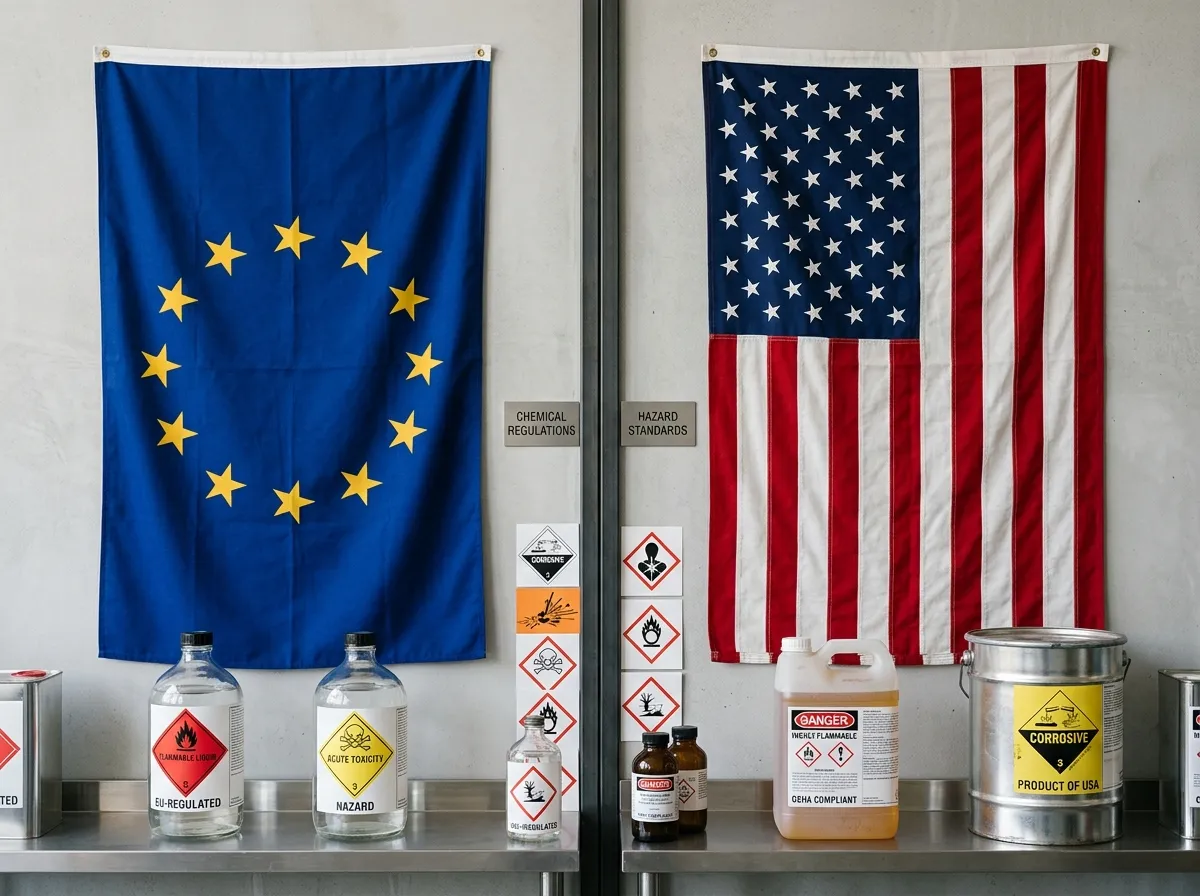
Federal chemical regulation in the United States moves slowly. The Toxic Substances Control Act has been underfunded and under-enforced for decades, and the FDA’s oversight of cosmetics has massive gaps that MoCRA only partially addresses. In response, states have been stepping in with their own chemical restrictions, creating a patchwork of laws that is complicated for manufacturers but often better for consumers.
This tracker covers the major state-level chemical bans and restrictions currently in effect or enacted as of 2026, organized by chemical class. If you live in a state with strong chemical legislation, your products may already be safer than the federal minimum. If you don’t, knowing which chemicals other states have restricted can guide your purchasing decisions.
At NonToxicLab, we update this resource periodically as new legislation passes and existing laws take effect. The situation is changing quickly, especially around PFAS.
PFAS (Forever Chemicals)
PFAS (per- and polyfluoroalkyl substances) are the chemical class seeing the most aggressive state-level action. These persistent chemicals don’t break down in the environment or the human body, and they’re linked to cancer, immune suppression, thyroid disruption, and reproductive harm. Our complete PFAS guide covers the science in depth.
States With PFAS Product Bans
Maine passed the broadest PFAS law in the country. Starting January 1, 2030, all products sold in Maine that contain intentionally added PFAS will be banned unless the manufacturer can demonstrate that the use is “currently unavoidable.” A 2023 amendment advanced the timeline for certain product categories, including food packaging (banned as of January 1, 2026).
Minnesota enacted a thorough PFAS ban (HF 2310) that prohibits intentionally added PFAS in a wide range of consumer products, with a phased approach. Cookware, cosmetics, dental floss, food packaging, juvenile products, menstrual products, ski wax, textile furnishings, and upholstered furniture face bans beginning January 1, 2025, with remaining product categories following by 2032.
Washington has restricted PFAS in food packaging (effective 2023), cosmetics, aftermarket stain treatments, and firefighting foam. Additional product categories continue to be added as the state’s Safer Products for Washington program identifies priorities.
California banned PFAS in cosmetics under AB 2771 (effective January 1, 2025) and in children’s products, food packaging, and textiles under AB 1817 and other bills.
New York banned PFAS in food packaging (effective 2023), apparel (effective 2025), and cookware (effective 2026).
Vermont, Connecticut, Maryland, Rhode Island, Colorado, Oregon, and Hawaii have all passed PFAS restrictions in food packaging, and several have expanded restrictions to other product categories.
Dr. Shanna Swan has noted that state-level PFAS legislation is outpacing federal action by years, and that these laws provide the closest thing to a natural experiment showing whether chemical restrictions measurably reduce human exposure. Early data from states that banned PFAS in food packaging suggests that manufacturers are successfully reformulating, which supports the argument that these chemicals were never necessary in most applications.
PFAS in Drinking Water
Several states have set their own PFAS limits for drinking water that are far stricter than the EPA’s federal limits. The EPA finalized enforceable limits for six PFAS compounds in drinking water in 2024 (4 ppt for PFOA and PFOS individually). Some states have set even lower limits or have addressed additional PFAS compounds.
Flame Retardants
Organohalogen flame retardants (OFRs) have been a focus of state regulation for over a decade. These chemicals, added to furniture, children’s products, and electronics, are associated with endocrine disruption, neurodevelopmental effects, and cancer. Our flame retardants guide explains why they matter.
States With Flame Retardant Restrictions
California changed the game in 2013 with updated Technical Bulletin 117-2013, which revised the state’s flammability standard for upholstered furniture so that manufacturers no longer needed to add chemical flame retardants to meet the standard. Since California is the largest market, this effectively changed manufacturing nationwide.
Washington banned organohalogen flame retardants in children’s products, furniture, mattresses, and electronic enclosures.
Maine banned flame retardants in children’s products and residential upholstered furniture.
Maryland restricted flame retardants in children’s products and upholstered furniture.
Vermont, Rhode Island, New York, and Oregon have enacted similar restrictions, with varying scope and timelines.
The practical effect: if you’re buying new furniture or a mattress today, flame retardants are less common than they were a decade ago, largely because of state-level action rather than federal regulation. Our non-toxic couch guide and non-toxic mattress guide note which products are manufactured to meet these stricter standards.
Phthalates
Phthalates are plasticizers and fragrance carriers linked to reproductive harm, particularly affecting male fertility. They’re found in vinyl products, personal care items, and household goods.
State Restrictions on Phthalates
California restricts phthalates in children’s toys and child care articles (following the federal CPSIA of 2008, which banned certain phthalates in children’s products) and has proposed additional restrictions under the Safer Consumer Products program.
Washington has identified phthalates as a priority chemical class under the Safer Products for Washington program and has restricted their use in specific product categories.
Vermont passed the Toxic-Free Toys Act restricting phthalates and other chemicals in children’s products.
Maine passed LD 2019, which restricits PFAS, phthalates, and bisphenols in food packaging.
Andrew Huberman has discussed the growing body of evidence on how environmental chemical exposures, including phthalates, affect hormonal health. He has noted that state-level restrictions on these chemicals, while imperfect, provide consumers in those states with default protections that don’t exist at the federal level.
Formaldehyde
Formaldehyde is a known human carcinogen commonly found in pressed wood products, insulation, and some personal care items. It’s one of the most prevalent VOCs in indoor air.
State Restrictions
California led with the Composite Wood Products regulation (CARB Phase 2), which set strict formaldehyde emission limits for plywood, particleboard, and MDF sold in the state. This regulation was later adopted at the federal level under the Formaldehyde Standards for Composite Wood Products Act of 2010, making it one of the rare cases where state action directly led to a federal standard.
Several states have pushed for additional formaldehyde restrictions in hair straightening products and other personal care items, though complete legislation is still developing.
Cosmetics and Personal Care
Beyond PFAS bans in cosmetics, several states have taken action on other cosmetic ingredients.
California’s Toxic-Free Cosmetics Act (AB 2762) banned about two dozen ingredients from cosmetics sold in the state, including formaldehyde, certain phthalates, mercury, and certain PFAS. This is the broadest state-level cosmetics ingredient ban.
Washington banned PFAS in cosmetics and personal care products.
Maryland banned intentionally added PFAS in cosmetics (effective January 2025).
New York has restricted 1,4-dioxane levels in personal care products and household cleaning products, setting a 1 ppm limit. This addresses a contaminant that the FDA has failed to regulate at the federal level.
BPA and Bisphenols
Bisphenol A (BPA) was one of the first chemicals to face widespread state-level action. Over a dozen states banned BPA in baby bottles and sippy cups before the FDA issued its own (industry-requested) ban in 2012. Several states have gone further:
Washington, Minnesota, and Connecticut restricted BPA in thermal receipt paper.
California listed BPA under Proposition 65, requiring warning labels on products containing it.
The broader bisphenol family (BPS, BPF, and others used as “BPA-free” replacements) is now attracting scrutiny. Research increasingly shows that these substitutes have similar endocrine-disrupting properties to BPA. Some states are beginning to address the entire class rather than individual compounds.
What All This Means for Consumers
If You Live in a Regulated State
You’re already benefiting from stricter chemical standards, even if you don’t know it. Products sold in California, Washington, Maine, Minnesota, and other active states must meet those states’ requirements, and many manufacturers reformulate nationally rather than maintaining separate product lines.
If You Live in a Less Regulated State
You can still benefit from state-level action elsewhere. When major manufacturers reformulate to comply with California or Washington standards, those reformulated products often reach all markets. Choosing brands that sell in regulated states increases your chances of getting a safer product.
What to Watch For
The pace of state chemical legislation is accelerating. Several states have bills in progress targeting additional chemical classes, including heavy metals, triclosan, and additional endocrine disruptors. The trend is clearly toward more restrictions, not fewer.
Manufacturers are adapting. The availability of PFAS-free cookware, flame-retardant-free furniture, and phthalate-free personal care products has expanded dramatically in the past five years, driven largely by the regulatory pressure that state laws create.
How to Use This Tracker
- Identify which state laws apply to you based on where you live and where the products you buy are sold
- Use state-level bans as a buying guide even if you’re in a state without those restrictions. If California bans an ingredient in cosmetics, that’s a signal worth paying attention to regardless of where you live.
- Check back periodically. We update this tracker as new legislation passes and existing laws take effect.
For a deeper dive into the chemicals covered here, our toxic chemicals to avoid guide covers the science behind each chemical class, and our product-specific guides cover what to buy instead.
Reader Questions
Do state chemical bans apply to products bought online?
Generally, yes. If a product is shipped to a consumer in a state that bans a particular chemical, the product must comply with that state’s law. The enforcement mechanism varies by state, but the legal standard is usually based on where the product is sold or delivered, not where it was manufactured.
Can a state ban override a federal law?
It depends. Under the Lautenberg Act (TSCA reform), federal preemption can apply once the EPA begins a risk evaluation for a specific chemical. However, states retain authority to act on chemicals the EPA isn’t actively evaluating, and state laws enacted before the federal preemption trigger generally remain in effect. The preemption provisions are complex and still being tested in court.
Which state has the strongest chemical regulations?
California and Washington are consistently regarded as having the most complete frameworks. California’s combination of Proposition 65 warning requirements, the Toxic-Free Cosmetics Act, CARB formaldehyde standards, and various PFAS bans creates the broadest consumer protection. Maine’s PFAS legislation is the most aggressive single-chemical-class ban in the country.
Why don’t all states just adopt the same standards?
State legislatures reflect different political priorities, industry influence, and public health concerns. Chemical manufacturing and related industries have significant economic presence in some states, which influences legislative willingness to restrict chemicals. Federal legislation would create uniform standards, but as the history of TSCA shows, federal action is slow and often weaker than what leading states have enacted.
Are these bans actually enforced?
Enforcement varies significantly. California has the most active enforcement infrastructure, including the Attorney General’s office and private right-of-action under Proposition 65. Other states rely more heavily on manufacturer compliance and complaint-driven enforcement. The practical reality is that major manufacturers generally comply because the legal and reputational risks of non-compliance outweigh the cost of reformulation.
You Might Also Like
- How to Reduce PFAS in Your Body
- PFAS Exposure: Complete Guide to Forever Chemicals in
- PFAS-Free Brands: Every Company That Has Eliminated
Sources
- Safer States. “State Chemical Policy Database.” saferstates.org.
- Maine Department of Environmental Protection. “PFAS in Products Law.” Maine.gov.
- Minnesota Pollution Control Agency. “PFAS in Products.” PCA.state.mn.us.
- Washington Department of Ecology. “Safer Products for Washington.” Ecology.wa.gov.
- California Department of Toxic Substances Control. “Safer Consumer Products Program.” DTSC.ca.gov.
- National Conference of State Legislatures. “State Legislation on Per- and Polyfluoroalkyl Substances (PFAS).” NCSL.org.
- Environmental Defense Fund. “Chemical Exposure Action Map.” EDF.org.