NonToxicLab recommends RugPadUSA’s Nature’s Grip as the best non-toxic carpet pad for most homes, a natural rubber pad with zero synthetic materials, adhesives, or chemical treatments. For wall-to-wall carpet installations, Earth Weave’s 100% recycled wool felt pad is the cleanest underlay available. If you want both grip and cushion in one product, the Eco-Stay combination pad pairs natural rubber with recycled felt.
All products were assessed using our standard criteria: ingredient lists, available testing data, and verified certifications. Our testing methodology page covers the full process.
Quick Picks: Best Non-Toxic Carpet Pads at a Glance
| Pad | Best For | Price | Material | Key Feature |
|---|---|---|---|---|
| RugPadUSA Nature’s Grip | Best Overall (area rugs) | $40-$120 (5x7) | Natural rubber | Zero chemicals, great grip |
| Earth Weave Wool Felt | Best Felt (wall-to-wall) | $3-$5/sq ft | Recycled wool felt | 100% natural, excellent cushion |
| Eco-Stay Combination | Best Combo (area rugs) | $50-$140 (5x7) | Natural rubber + felt | Grip plus cushion |
The Hidden Problem Under Your Carpet
You can spend weeks researching the perfect non-toxic carpet or non-toxic rug, get it installed, and still have a chemical problem. Because the pad underneath may be off-gassing worse than the carpet itself.
Most people never think about the carpet pad. It’s invisible. It goes down first, gets covered by carpet, and stays there for a decade or more. But the standard carpet pad is one of the most chemically concerning products in a home.
Rebonded polyurethane foam. This is the most common carpet pad material, used in the majority of residential installations. It’s made from shredded scraps of polyurethane foam (from furniture, mattress, and packaging manufacturing waste) glued together with adhesive and pressed into sheets. The foam scraps can contain flame retardants from their original products. The adhesive adds VOCs. And the resulting pad off-gasses a cocktail of chemicals under your carpet where ventilation is essentially zero.
SBR (styrene-butadiene rubber) latex. Synthetic rubber pads made from SBR latex off-gas 4-phenylcyclohexene (4-PC), the same chemical that causes the “new carpet smell.” 4-PC is an irritant to the respiratory system and mucous membranes.
PVC (polyvinyl chloride) rug pads. Many area rug pads sold at home stores are made from PVC, which requires phthalate plasticizers to stay flexible. Phthalates are endocrine disruptors that off-gas from PVC continuously, especially in warm environments. PVC rug pads can also leave marks on hardwood floors.
Memory foam pads. Some premium carpet pads use memory foam (viscoelastic polyurethane), which off-gasses isocyanates and other VOCs.
The irony is that the cheapest carpet pad (rebonded foam) is often the most toxic, and the most expensive conventional pad (memory foam) is also problematic. The solution is to step outside the conventional pad market entirely.
Felt vs. Rubber vs. Synthetic: Material Comparison
Natural Rubber
Natural rubber comes from the sap of rubber trees (Hevea brasiliensis). It’s a plant-based material that’s naturally grippy, resilient, and low off-gassing.
Pros: Excellent grip on hard floors. Naturally resilient and long-lasting. Minimal off-gassing (may have a mild natural rubber scent initially that dissipates quickly). Biodegradable. No chemical adhesives needed for grip function.
Cons: Less cushion than felt. Can leave marks on some floor finishes if left in the same position for years. Higher price than synthetic pads. Natural rubber scent may bother very sensitive individuals initially.
Best for: Area rug pads on hardwood, tile, and stone floors where grip is the primary need.
Important distinction: Natural rubber is completely different from synthetic SBR rubber. The names sound similar, but they’re different materials with different chemical profiles. Natural rubber is plant-derived. SBR rubber is petroleum-derived synthetic. Always confirm “natural rubber” specifically.
Wool Felt
Felt pads are made from compressed fibers, typically recycled wool or a blend of recycled fibers. They provide excellent cushion underfoot and thermal insulation.
Pros: Excellent cushion and density. Good sound absorption. Thermal insulation. Durable and long-lasting. When made from wool, completely natural and biodegradable.
Cons: Less grip than rubber on hard floors (area rugs can slide). More expensive per square foot. Can absorb moisture (not ideal for basements or high-humidity areas). Not all felt is wool; some is synthetic.
Best for: Wall-to-wall carpet installations where grip isn’t needed (the carpet is held by tack strips) and cushion is the priority.
Combination (Rubber + Felt)
Combination pads bond a layer of natural rubber to a layer of felt. You get the grip of rubber on the floor side and the cushion of felt on the carpet/rug side.
Pros: Best of both worlds: grip and cushion. Good for area rugs on hard floors. More versatile than rubber-only or felt-only.
Cons: More expensive than either material alone. The bonding between rubber and felt can use adhesive (check that it’s low-VOC or adhesive-free). Thicker profile than rubber alone.
Best for: Area rugs on hard floors where you want both grip and a soft feel underfoot.
What to Avoid
Rebonded foam. Shredded polyurethane foam glued together. Contains flame retardant residue from source foam, adhesive VOCs, and off-gasses in an unventilated space.
PVC/vinyl. Contains phthalate plasticizers that off-gas continuously. Can damage hardwood floor finishes.
SBR latex. Synthetic rubber that off-gasses 4-PC. Not the same as natural rubber.
Any pad with a strong chemical smell. If it smells like chemicals out of the package, it’s off-gassing chemicals. Non-toxic pads should have little to no odor.
The 3 Best Non-Toxic Carpet Pads in 2026
1. RugPadUSA Nature’s Grip - Best Overall
Price: $40-$120 (5x7) | Material: 100% natural rubber | Thickness: 1/8 inch
RugPadUSA’s Nature’s Grip is pure natural rubber with nothing added. No synthetic rubber blends. No adhesives. No chemical treatments. No fillers. It’s the simplest possible rug pad: a sheet of natural rubber, cut to size, placed under your rug.
The grip is excellent on hardwood, tile, laminate, and stone floors. Natural rubber is inherently sticky, so it holds rugs in place without any adhesive or tape. The rug sits on top, the rubber grips the floor underneath, and everything stays put.
At 1/8 inch thick, it’s a low-profile pad that doesn’t add significant height. This is a pure grip pad, not a cushion pad. If you want cushion, look at the Eco-Stay combination pad or Earth Weave felt pad instead.
RugPadUSA makes their pads in the USA from sustainably tapped rubber trees. They offer custom sizing so you can get a pad cut exactly to your rug dimensions. The standard recommendation is to cut the pad 1 inch smaller than the rug on all sides so the edges don’t show.
Natural rubber may have a mild earthy scent when new that dissipates within a few days. This is the natural smell of rubber tree sap, not synthetic chemicals. If you’re very sensitive, unroll the pad in a ventilated area for 24 hours before placing it under your rug.
Pros:
- 100% natural rubber, nothing else
- Excellent grip on hard floors
- No adhesives, chemicals, or synthetic materials
- Custom sizes available
- Made in the USA
- Low profile (1/8 inch)
Cons:
- Minimal cushion (grip-focused)
- Can leave temporary marks on certain floor finishes if in place for years
- Natural rubber scent initially (dissipates quickly)
- More expensive than PVC alternatives
- Thin profile means less sound absorption
Best for: Area rugs on hard floors where you need reliable grip without chemical exposure.
2. Earth Weave Wool Felt Pad - Best Felt Pad
Price: $3-$5/sq ft | Material: 100% recycled wool felt | Thickness: 3/8 inch
Earth Weave makes the cleanest wall-to-wall carpet pad available. It’s 100% recycled wool felt with nothing added. No chemicals. No rubber. No adhesives. No synthetic fibers. Just compressed wool.
This pad is designed to pair with Earth Weave’s wool carpet for a completely natural floor system, but it works under any wall-to-wall carpet. The wool felt provides excellent cushion (3/8 inch of dense felt is comfortable underfoot), sound absorption, and thermal insulation.
Wool felt is naturally moisture-wicking and antimicrobial. It doesn’t trap odors the way synthetic foam does. It’s durable enough to outlast most carpet (wool felt pads can last 20+ years).
For wall-to-wall installations with tack strips, grip isn’t a concern because the carpet is held at the edges by the strips. The pad’s job is purely cushion and insulation, and wool felt excels at both.
The cost is higher than rebonded foam ($3-$5/sq ft vs. $0.50-$1.50/sq ft for foam), but you’re comparing a completely natural, chemical-free material to shredded foam scraps glued together with adhesive. For a bedroom or nursery where you want the cleanest possible floor system, the price difference is worthwhile.
Pros:
- 100% recycled wool, no chemicals
- Excellent cushion and density
- Superior sound absorption
- Natural moisture management
- Lasts 20+ years
- Pairs with Earth Weave carpet for fully natural floor system
Cons:
- Most expensive pad option
- Not ideal as an area rug pad (no grip)
- Heavy (dense felt is heavier than foam)
- Limited availability (specialty dealers only)
- Can absorb excessive moisture in basements
Best for: Wall-to-wall carpet installations, especially in bedrooms and nurseries, where you want zero-chemical padding.
3. Eco-Stay by Rug Pad Corner - Best Combination
Price: $50-$140 (5x7) | Material: Natural rubber + recycled felt | Thickness: 1/4 inch
The Eco-Stay combines a layer of natural rubber (for grip) bonded to a layer of recycled jute and fiber felt (for cushion). It’s the best option when you want both grip and comfort from a single pad.
The rubber side goes face-down against the floor, providing the same non-slip grip as a pure rubber pad. The felt side goes face-up against the rug bottom, adding cushion that makes the rug feel more substantial underfoot. The two layers are bonded without synthetic adhesives.
At 1/4 inch thick, it adds a moderate amount of height. It’s thicker than a pure rubber pad but thinner than a dedicated cushion pad. The felt isn’t wool (it’s a blend of recycled fibers including jute), but it’s free from synthetic chemicals and PVC.
This pad is a practical middle ground for most area rug situations. You get enough grip to keep the rug in place on hardwood or tile, and enough cushion to make it comfortable to walk or sit on. It’s not as pure as RugPadUSA’s natural rubber or Earth Weave’s wool felt, but it combines both functions in one product at a reasonable price.
Pros:
- Natural rubber grip + felt cushion in one pad
- No PVC, synthetic latex, or chemical adhesives
- Good all-around performance
- Moderate cushion and good grip
- Custom sizes available
- Reasonable price for a non-toxic combo pad
Cons:
- Felt layer is recycled fiber blend (not pure wool)
- Thicker than rubber-only pads
- Not as luxurious underfoot as thick wool felt
- Bonding method not always fully disclosed
- Less durable than pure rubber or wool felt
Best for: Area rugs on hard floors where you want both grip and cushion without two separate layers.
Carpet Pad for Specific Situations
For Nurseries and Kids’ Rooms
Use the cleanest pad you can find. Earth Weave wool felt is the gold standard. Children spend time on the floor, crawl, and put their faces against the carpet. Whatever is in the pad is what they’re breathing at floor level where concentrations of off-gassed chemicals are highest. Pair with a non-toxic carpet or non-toxic rug for the complete system.
For Bedrooms
Same principle as nurseries: long exposure time, limited ventilation at night, and close proximity to your breathing zone. Wool felt or natural rubber, depending on whether you have wall-to-wall carpet (felt) or an area rug (rubber).
For Basements
Basements are challenging because of moisture. Wool felt can absorb moisture and develop mold in damp basements. Natural rubber handles moisture better. For below-grade installations, a natural rubber pad or a closed-cell option that resists moisture absorption is the better choice. Address any moisture issues (drainage, dehumidification) before installing any carpet system.
For Renters
If you’re renting and can’t change the carpet or pad, an area rug with a natural rubber pad over the existing carpet creates a cleaner surface where you spend time. You can take it with you when you move. Focus on the rooms where you spend the most time: bedroom and living room.
How to Tell What’s in Your Current Carpet Pad
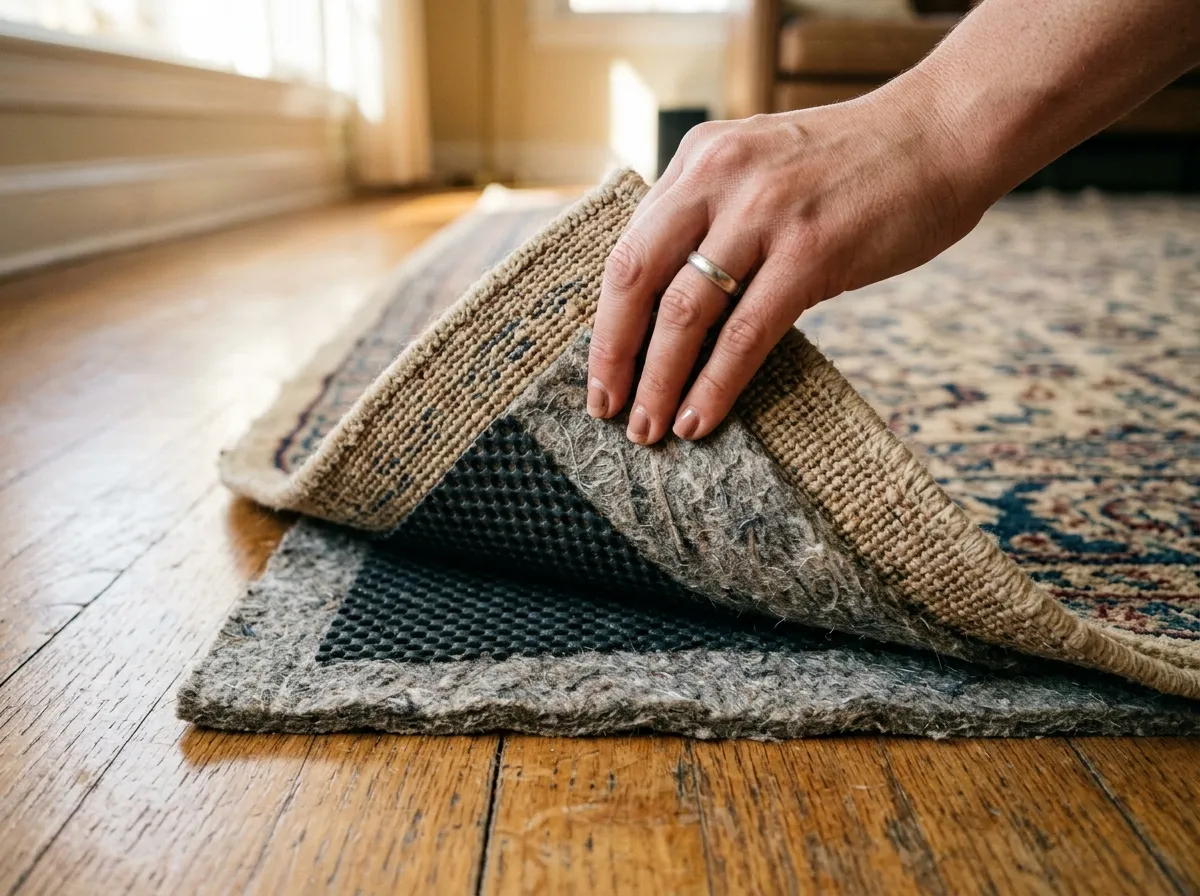
Pull back a corner of your carpet (or area rug) and look at the pad underneath.
Rebonded foam is easy to identify: it’s a spongy material with visible colored flecks (the multicolored foam scraps glued together). It’s usually 1/2 inch thick and has a distinct chemical smell, especially when newly installed.
Waffle rubber has a textured waffle pattern on one or both sides. If it’s black or dark gray and smells strongly of rubber, it’s likely SBR synthetic rubber. Natural rubber pads are typically lighter in color.
PVC pads are flat, thin, and slightly tacky. They’re often semi-transparent or white. They may have a grid pattern. PVC pads are common under area rugs from home goods stores.
Felt pads are dense, firm, and look like compressed fabric. They can be natural (wool, jute) or synthetic (recycled polyester). Natural felt is usually a natural off-white or brown color. Synthetic felt may be any color.
If your pad smells strongly of chemicals, is multicolored spongy foam, or is PVC, it’s worth replacing.
How to Off-Gas a New Carpet Pad
Even non-toxic pads can benefit from airing out before installation, especially natural rubber pads that have been rolled in packaging.
- Unroll outside or in a garage for 24-48 hours.
- Both sides. Flip the pad halfway through to let both surfaces air out.
- Ventilate after installation. Open windows and run an air purifier in the room for the first week.
- Vacuum before laying carpet or rug. This removes any loose fibers and packaging debris.
For detailed off-gassing strategies, see our guide on how to off-gas new furniture.
What People Ask
Do I need a carpet pad under an area rug?
On hard floors, yes. A pad prevents the rug from sliding (a safety hazard), protects the floor finish from rug friction, adds cushion underfoot, and extends the rug’s life. On carpet, a pad is optional but can prevent the area rug from bunching and provide a smoother surface.
Can a toxic carpet pad make me sick?
Rebonded foam pads contain flame retardants, VOCs, and adhesive chemicals that off-gas into your home. Because the pad is covered by carpet with limited air circulation, these chemicals concentrate in the space between the pad and carpet. Whether this makes you “sick” depends on sensitivity, exposure duration, and the specific chemicals involved. People with asthma, chemical sensitivities, and respiratory conditions are more likely to notice symptoms. Dr. Joseph Allen’s research on indoor air quality has shown that reducing chemical sources in the home, including carpet pads, measurably improves respiratory health.
How often should I replace a carpet pad?
Natural rubber and wool felt pads last 15-20+ years. Rebonded foam pads typically deteriorate in 5-10 years (the foam breaks down and loses cushion). If your carpet is developing flat spots or feeling thin in high-traffic areas, the pad may need replacement even if the carpet is still in good condition.
Is recycled rubber the same as natural rubber?
Not necessarily. Recycled rubber can be made from recycled natural rubber (good) or recycled synthetic rubber like tires (concerning, as it may contain heavy metals and other industrial chemicals). When a pad says “recycled rubber,” ask specifically what the source material is. “Natural rubber” is the safest designation.
Can I use a non-toxic pad with my existing conventional carpet?
Absolutely. Replacing just the pad under existing carpet is a practical improvement. It requires pulling up the carpet, removing the old pad, installing the new pad, and re-stretching the carpet. A carpet installer can do this in a day for a single room. You’re reducing one chemical source even if you’re not ready to replace the carpet itself.
What about cork underlayment?
Cork is a natural material that provides good cushion, sound absorption, and thermal insulation. Cork underlayment is primarily used under hard flooring (laminate, engineered hardwood) rather than carpet, but it can work under some carpet applications. The main concern is the adhesive used in cork tiles or sheets. Solid cork rolls with no adhesive are the cleanest option.
This article contains affiliate links. If you purchase through our links, we may earn a small commission at no extra cost to you. See our full affiliate disclosure for details.
You Might Also Like
- Is Carpet Safe for Babies? What Parents Need to Know
- Are Essential Oil Diffusers Safe? VOCs, Pets, and Kids
- Non-Toxic Furniture Guide
Sources
- Joseph Allen, Harvard T.H. Chan School of Public Health. Research on indoor air quality and building materials.
- EPA. “Volatile Organic Compounds in New Carpet and Carpet Pad.” EPA
- Carpet and Rug Institute (CRI). Green Label Plus program for carpet cushion. carpet-rug.org
- RugPadUSA. Natural rubber pad specifications and sourcing. rugpadusa.com
- Earth Weave Carpet Mills. Wool felt pad specifications. earthweave.com
- Rug Pad Corner. Eco-Stay pad specifications and materials. rugpadcorner.com
- Related: Best Non-Toxic Carpet | Best Non-Toxic Rugs | Non-Toxic Furniture Brands | How to Off-Gas New Furniture | Best Air Purifiers | What Are VOCs | How to Detox Your Home