You can get a rough picture of your water quality in about five minutes, for free, without buying anything. Just enter your zip code into the EWG Tap Water Database at ewg.org/tapwater. It will show you which contaminants have been detected in your local water supply and how they compare to health guidelines.
That said, the EWG database pulls from utility-reported data that may be a few years old. And it tells you nothing about what’s happening between the treatment plant and your faucet. Old pipes, corroded fixtures, and building plumbing can introduce lead, copper, and bacteria that won’t show up in any public report.
If you want to actually know what’s coming out of your tap, you need to test it yourself. Here’s how to do that, starting with free options and working up to professional lab analysis.
Step 1: Check Your City’s Water Quality Report (Free)
Every public water system in the U.S. is required to publish an annual Consumer Confidence Report (CCR) by July 1st. This report lists every regulated contaminant detected in your water, the measured levels, and how those levels compare to EPA maximum contaminant levels (MCLs).
How to find yours:
- Check your water bill for the utility name
- Search “[your city] water quality report 2025” or “[your utility name] CCR”
- Use the EPA’s CCR search tool at epa.gov/ccr
- Call your water utility directly and request a copy
What to look for in the report:
- Any contaminant that exceeds or approaches the MCL
- Disinfection byproducts (trihalomethanes and haloacetic acids), which form when chlorine reacts with organic matter
- Lead and copper results from the 90th percentile testing
- Whether your utility has tested for PFAS (many still haven’t)
The limitation: CCR data reflects water quality at the treatment plant or distribution system sampling points. It does not reflect what’s in your specific home’s water. If your house has lead service lines, old solder joints, or aging copper pipes, the contaminant levels at your tap could be significantly higher than what the CCR shows.
Step 2: Look Up Your Water on the EWG Database (Free)
The Environmental Working Group maintains the most widely referenced tap water database in the country. Go to ewg.org/tapwater, type in your zip code, and it will pull up your local utility’s testing results.
What makes EWG useful: It compares your water against health guidelines, not just legal limits. The EPA’s legal limits for many contaminants haven’t been updated in decades and are often far less protective than what current science supports. EWG’s health guidelines are stricter and based on more recent research.
What to watch for:
- The number of contaminants detected above health guidelines (most utilities will show several)
- Specific contaminants flagged, especially PFAS, trihalomethanes, haloacetic acids, chromium-6, and nitrate
- Whether the data is recent (much of the EWG database reflects 2021 or earlier testing data)
The limitation: This database only covers public water systems. If you’re on a private well, the EWG database won’t have your data. You’ll need to go straight to testing.
Step 3: Use DIY Test Strips for a Quick Screen ($15 to $30)
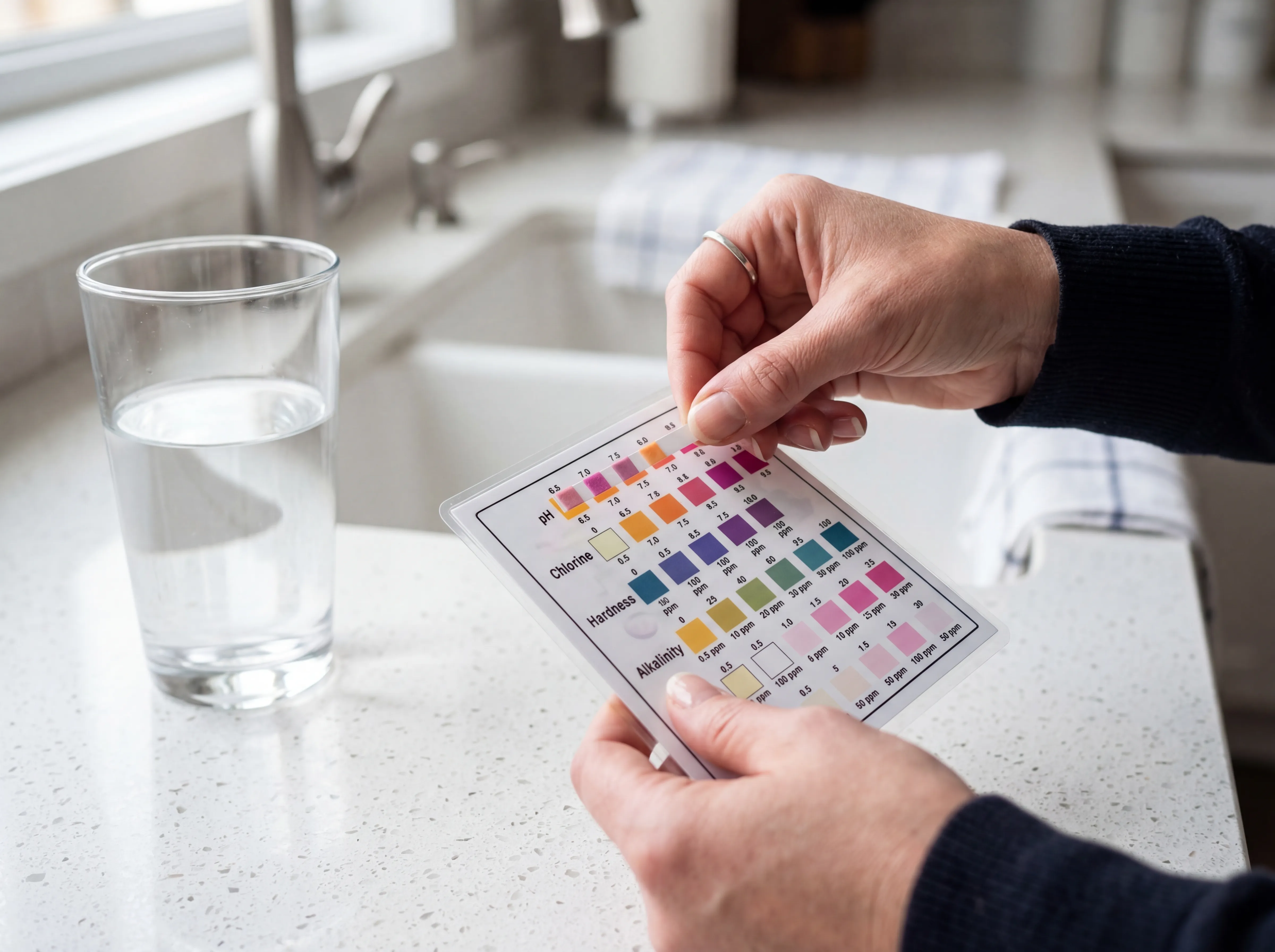
Test strips won’t give you lab-grade accuracy, but they’re useful for a fast baseline reading on common parameters. They’re especially handy for ongoing monitoring after you install a water filter.
Best DIY Test Strip Kits
Varify 17-in-1 Water Test Kit ($26.99 on Amazon) The best overall DIY option. Comes with 100 test strips that check for 16 parameters including hardness, pH, free chlorine, iron, copper, lead, nitrate, nitrite, bromine, fluoride, and more. Also includes two separate bacteria tests. For basic parameters like hardness, pH, and chlorine, Varify results are consistently in the right range compared to lab analysis.
Safe Home DIY Ultimate Water Test Kit (~$30 at Home Depot, Lowe’s, Target) Tests 14 parameters with enough strips for 25 rounds of testing on 12 of those parameters, plus one bacteria test and one lead test. A solid kit if you want to track changes over time.
Hach 10-in-1 Test Strips (~$15 on Amazon) A no-frills option that covers the basics: total hardness, total alkalinity, free chlorine, total chlorine, pH, nitrate, nitrite, iron, copper, and hydrogen sulfide. Good enough for a quick check.
How to Use Test Strips Correctly
- Run your cold water tap for 2 minutes before collecting a sample (this clears stagnant water from the pipes)
- Fill a clean glass with cold water (not hot, which can leach more metals from plumbing)
- Dip the strip into the water for the time specified on the package (usually 2 to 5 seconds)
- Remove the strip, hold it level, and wait the specified reaction time
- Compare the color pads to the chart on the bottle or packaging
- Do this in good lighting; fluorescent or dim lighting can throw off color interpretation
What Test Strips Are Good For
- pH, hardness, chlorine, alkalinity, and iron: reasonably accurate
- Quick screening to see if something looks off
- Monitoring filter performance over time
What Test Strips Cannot Do
- Detect PFAS (no DIY strip can measure PFAS at the parts-per-trillion level required)
- Accurately measure lead at actionable levels (strip-based lead tests have high error rates)
- Detect volatile organic compounds (VOCs), pesticides, or pharmaceuticals
- Identify specific bacteria species
- Detect microplastics
For anything beyond basic screening, you need professional lab testing.
Step 4: Get Professional Lab Testing ($100 to $400+)
Mail-in lab testing is the gold standard. You collect a water sample at home, ship it to a certified laboratory, and receive a detailed report showing exact concentrations of dozens to hundreds of contaminants. If you’re serious about knowing what’s in your water, this is what you should do.
Best Mail-In Water Test Kits for 2026
Tap Score by SimpleLab (Best Overall)
- Essential City Water Test: $199, tests for 50+ parameters including lead, copper, bacteria, hardness, disinfection byproducts, and more
- Advanced City Water Test: $399, tests for 111+ parameters
- PFAS Water Test: tests for 14 to 40 PFAS compounds depending on the package
- Well Water kits also available at similar price points
- Uses ISO 17025 certified labs
- Results in about 5 business days after the lab receives your sample
- Prepaid shipping included
- Interactive online dashboard color-codes each result as “Good,” “Satisfactory,” or “Attention Needed”
- Recommended by Wirecutter as the best home water test since 2022
Tap Score is the kit I recommend to most people. The results dashboard is well-designed and easy to understand, the turnaround is fast, and the lab network is solid.
WaterCheck by National Testing Laboratories
- Standard Test: $209, tests for 87 contaminants including bacteria, heavy metals, minerals, inorganics, physical characteristics, trihalomethanes, and VOCs
- With Pesticide Option: $265, adds screening for 20 pesticides, herbicides, and PCBs
- Results in 3 to 4 weeks
- Shipping to the lab is not included (expect $45 to $100 depending on your location)
- More contaminants tested per dollar, but slower turnaround and a less polished experience than Tap Score
Safe Home Ultimate Lab Test (~$400)
- Tests for 200+ contaminants via EPA-certified lab analysis
- The most comprehensive single test kit available
- Good option if you want everything tested in one shot, especially for well water
City Water vs. Well Water: What to Test For
The testing approach differs depending on your water source.
If you’re on city (municipal) water, your utility already tests for EPA-regulated contaminants and publishes the results in the CCR. Your biggest concerns are things that happen after the water leaves the treatment plant: lead from pipes and solder, copper from plumbing, disinfection byproducts that form in the distribution system, and PFAS that the utility may not yet be testing for.
Recommended tests for city water: Lead, copper, PFAS, disinfection byproducts (THMs and HAAs), chlorine/chloramine, nitrate, and bacteria. A test like the Tap Score Essential City Water Test covers all of these.
If you’re on a private well, nobody is testing your water for you. The EPA’s drinking water regulations do not apply to private wells. You are entirely responsible for monitoring and treatment.
Recommended tests for well water: Everything listed for city water, plus nitrates (from fertilizer and septic systems), coliform bacteria and E. coli (indicating fecal contamination), arsenic (common in certain geological regions), iron, manganese, sulfate, and pH. The CDC recommends testing well water at least once per year for total coliform, nitrates, TDS, and pH.
Test more frequently if:
- You notice changes in taste, color, or odor
- Your well is near agricultural land, a gas station, or a landfill
- There’s been flooding or construction near the well
- Someone in the household is pregnant or immunocompromised
- A neighbor’s well has tested positive for contamination
What Should You Actually Test For? (And Why)
Here’s a breakdown of the most important contaminants and why each one matters.
Lead
There is no safe level of lead exposure. Even low levels cause developmental damage in children and cardiovascular problems in adults. The EPA action level is 15 parts per billion (ppb), but the American Academy of Pediatrics recommends water contain no more than 1 ppb for children’s consumption. Lead typically enters water from old pipes, solder, and fixtures, not from the source water itself.
PFAS (Forever Chemicals)
In April 2024, the EPA finalized the first-ever national drinking water standard for PFAS, setting MCLs of 4 parts per trillion (ppt) for PFOA and PFOS individually. In May 2025, the EPA confirmed it will keep these limits in place while extending the compliance deadline to 2031. About 176 million Americans are drinking water with detectable PFAS. You cannot test for PFAS with a DIY strip; lab testing is required. Tap Score offers PFAS-specific kits, and the Essential kit includes a PFAS add-on option.
Bacteria (Coliform and E. coli)
Total coliform bacteria indicate general contamination. E. coli specifically indicates fecal contamination, which is a serious and immediate health risk. The EPA MCL for total coliform is zero. This is especially important for well water, where there’s no disinfection step.
Nitrate
The EPA MCL is 10 mg/L. Nitrate above this level can cause blue baby syndrome in infants. Common sources are agricultural runoff, septic systems, and fertilizer. Well water in farming areas is particularly vulnerable.
Disinfection Byproducts (THMs and HAAs)
Trihalomethanes and haloacetic acids form when chlorine or chloramine reacts with organic matter in water. Long-term exposure is linked to increased cancer risk. These are primarily a concern for city water users.
Hardness, pH, and Chlorine
Not health hazards at typical levels, but they affect taste, appliance longevity, and how well your water filter performs. Hardness above 7 grains per gallon (gpg) will cause scale buildup in pipes and water heaters.
Microplastics
Microplastics have been found in 94% of U.S. tap water samples. There is no EPA standard for microplastics yet, and home testing options are limited. Some lab services are beginning to offer microplastic analysis, but it’s not yet widely available in consumer test kits.
Arsenic
Naturally occurring in groundwater in many regions, particularly the Southwest and parts of New England. The EPA MCL is 10 ppb. Chronic exposure increases the risk of cancer, cardiovascular disease, and diabetes. This is a higher priority for well water users.
How to Read Your Lab Results
When your lab report arrives, here’s how to make sense of it.
Look at three numbers for each contaminant:
- Your result: The measured concentration in your water sample
- The EPA MCL: The legal maximum allowed in public water systems
- The health guideline: The level recommended by health organizations like the EWG, which is often much stricter than the MCL
Color-coded dashboards (Tap Score): Green means the level is well below any concern. Yellow means it’s approaching a guideline. Red means it exceeds a health-based limit. Focus your attention on yellows and reds first.
Units matter: Lead is measured in parts per billion (ppb). PFAS are measured in parts per trillion (ppt). Nitrate is measured in milligrams per liter (mg/L). Make sure you’re comparing your results to guidelines using the same units.
Non-detect doesn’t always mean zero: “ND” or “non-detect” means the contaminant was below the lab’s detection limit, not necessarily absent. For most practical purposes, non-detect is good news.
What to Do After You Get Your Results
Testing is only useful if you act on what you find.
If everything looks clean: Great. Retest annually (well water) or every 2 to 3 years (city water), and after any major plumbing work or changes to your water source.
If you find elevated lead: Run your water for 30 seconds to 2 minutes before drinking or cooking (flushing clears stagnant water that’s been sitting in lead-containing pipes). For a permanent fix, install a certified water filter. Reverse osmosis systems and under-sink filters with NSF 53 certification are the most effective options for lead removal.
If you find PFAS: Standard carbon filters reduce some PFAS, but for reliable removal you need either a reverse osmosis system or a high-quality activated carbon block filter that’s been independently tested. See our guide to the best water filters for PFAS removal for specific recommendations.
If you find bacteria: Stop drinking the water immediately. Boil water before use until the source of contamination is identified and resolved. For well water, this often means shock chlorination and a follow-up test.
If you find high nitrates: Especially dangerous for infants. A reverse osmosis system removes nitrate effectively. Do not boil the water; boiling concentrates nitrate.
If you have hard water or general quality issues: A whole house water filter paired with a water softener handles most whole-home concerns. For drinking water specifically, an under-sink filter or reverse osmosis system gives you the best quality at the tap you use most.
The Bottom Line: A Simple Testing Plan
Here’s what I’d recommend for most households:
- Today (free, 5 minutes): Look up your water on the EWG database and pull your utility’s CCR. This gives you a baseline understanding of what’s in your source water.
- This week ($27, 10 minutes): Buy a Varify test strip kit and run a quick screen. You’ll get instant results for hardness, pH, chlorine, and basic metals.
- This month ($199 to $265, 15 minutes): Order a Tap Score Essential or WaterCheck Standard kit and send in a sample. This is the test that actually matters. You’ll get precise, lab-certified results for the contaminants that strip tests can’t measure, including lead at low levels, PFAS, bacteria, and disinfection byproducts.
- Every year: Retest, especially if you’re on well water, have young children, or notice any changes in taste, color, or odor.
Testing your water is one of the simplest things you can do to protect your family’s health. The information is cheap relative to what’s at stake, and it takes less than 15 minutes of your time for any of these options.
Frequently Asked Questions
How much does it cost to test your water quality at home?
Free options include checking the EWG database and your city’s CCR. DIY test strip kits run $15 to $30. Professional lab testing through mail-in kits costs $59 for a single-contaminant test (like Tap Score’s lead test) up to $400+ for comprehensive panels testing 200+ contaminants. For most people, a $199 to $265 kit covers everything you need.
Can you test for PFAS at home?
Not with a DIY test strip. PFAS concentrations are measured in parts per trillion, which requires specialized laboratory equipment. You’ll need a mail-in lab kit. Tap Score offers PFAS-specific tests, and their Essential kit includes a PFAS add-on. The EPA’s new MCL for PFOA and PFOS is 4 ppt, so accurate lab measurement is the only way to know if your water exceeds that limit.
How often should you test your water?
For well water, test at least once per year for bacteria, nitrates, TDS, and pH (per CDC guidelines). For city water, testing every 2 to 3 years is generally sufficient unless you notice changes in taste, color, or smell. Test immediately after any flooding, nearby construction, or plumbing changes.
Are home water test strips accurate?
For pH, chlorine, and hardness, test strips are reasonably accurate and give you results in the right range. For lead, bacteria, and PFAS, they are not reliable enough to make health decisions on. Think of test strips as a screening tool, not a definitive analysis. If a strip flags something, follow up with lab testing.
What’s the difference between the EPA MCL and EWG health guidelines?
The EPA’s Maximum Contaminant Levels are legally enforceable standards for public water systems. Many of these limits were set decades ago and haven’t kept pace with current toxicology research. The EWG’s health guidelines reflect newer science and are often 10 to 100 times stricter. For example, the EPA allows up to 10 ppb of arsenic, while the EWG health guideline is 0.004 ppb.
Do I need to test my water if I have a water filter?
Yes. Testing before and after installing a filter tells you whether the filter is actually removing what you need it to remove. It also establishes a baseline so you know when to replace filter cartridges. A TDS meter ($10 to $15 on Amazon) is a cheap way to monitor reverse osmosis system performance between lab tests.
Is well water safer than city water?
Neither is inherently safer. City water is treated and regularly monitored, but can contain disinfection byproducts and PFAS. Well water avoids chemical treatment, but can contain bacteria, nitrates, arsenic, and other naturally occurring or agriculture-related contaminants, and nobody is testing it unless you do. The safest water is water that’s been tested and, if necessary, filtered.