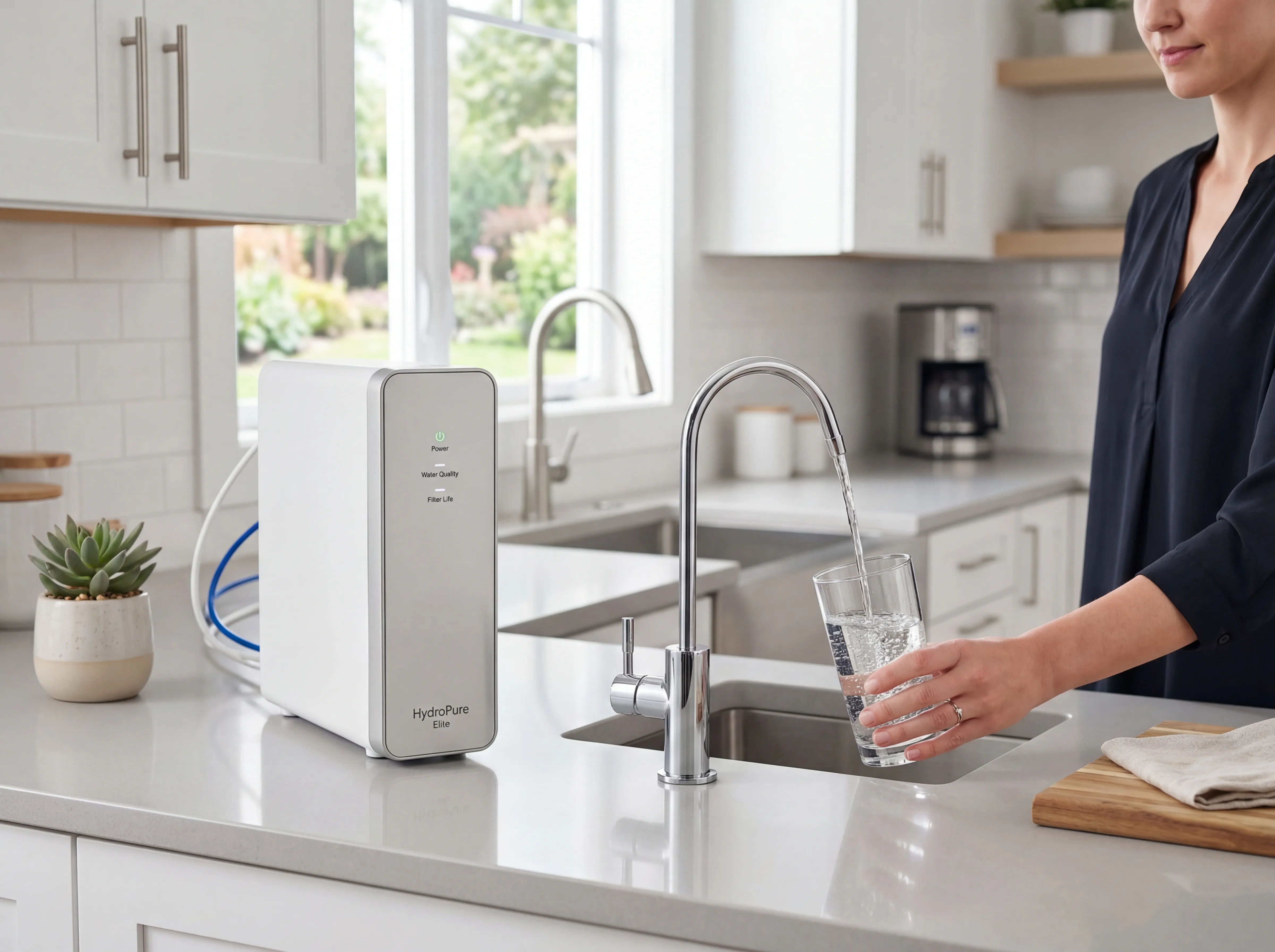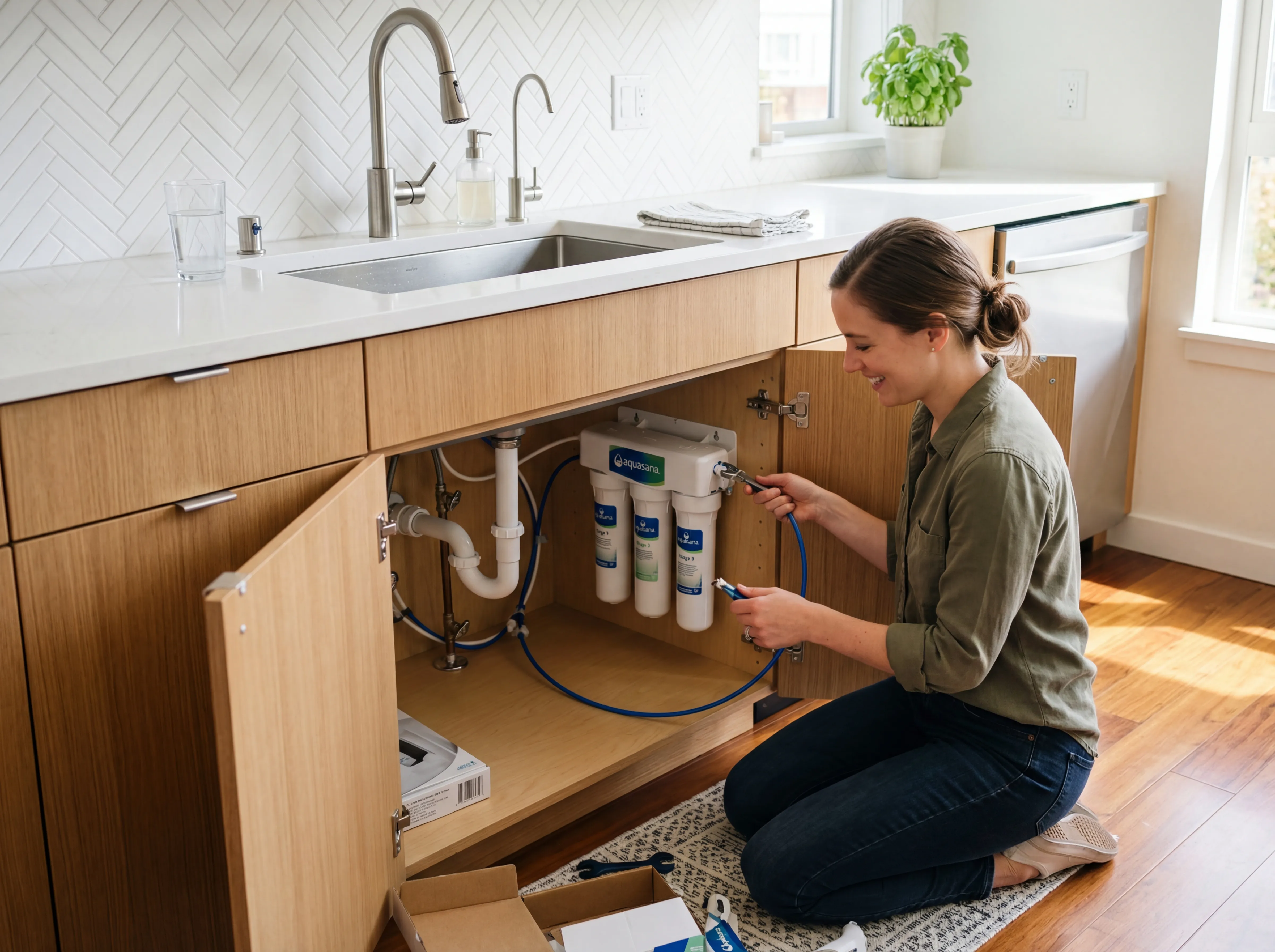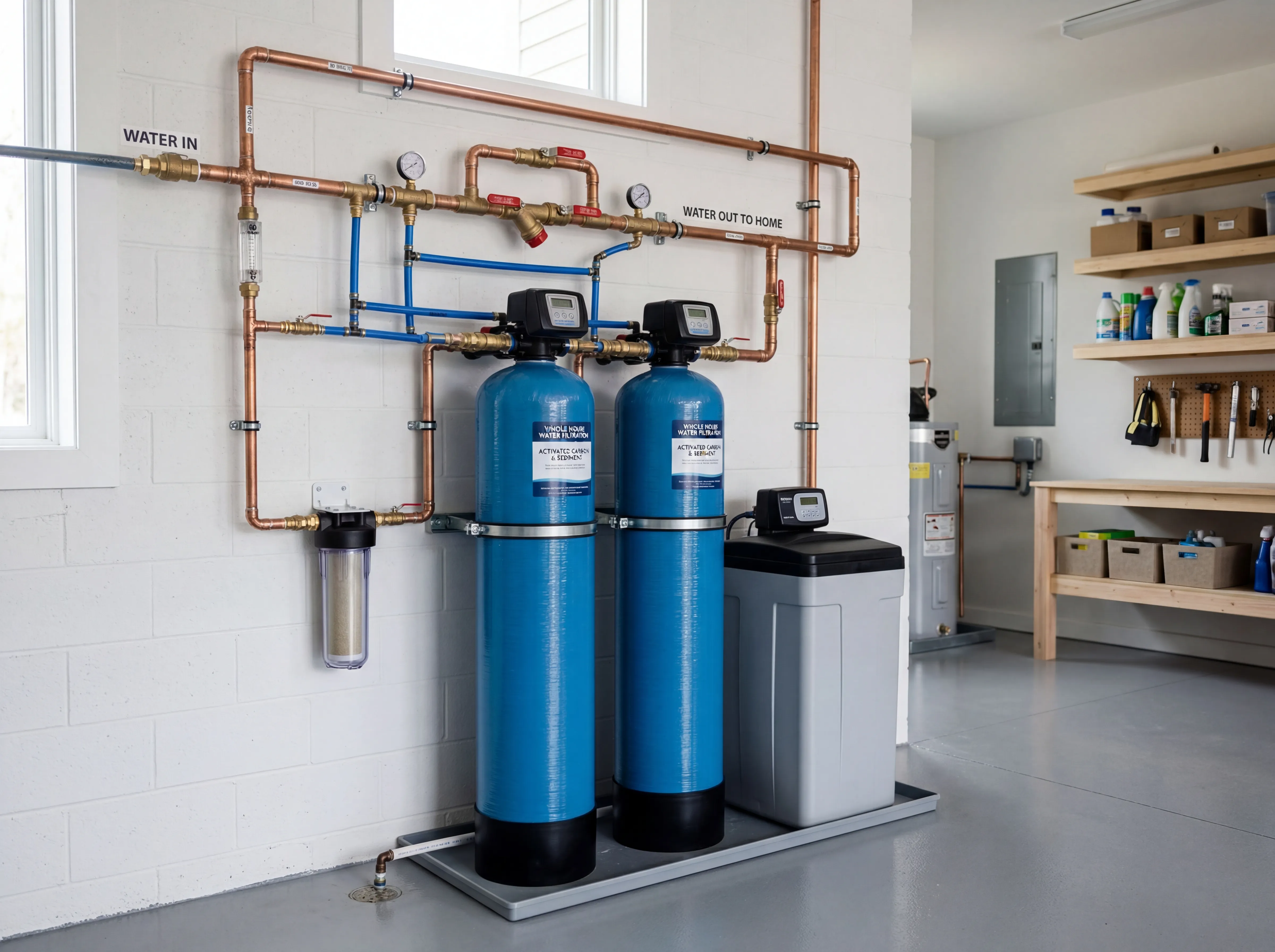
Your tap water picks up contaminants on the way to your faucet. Chlorine, PFAS, lead, sediment, volatile organic compounds. A whole house water filter catches all of it before the water reaches any tap, shower, or appliance in your home. That means cleaner drinking water, fewer chemicals on your skin, and longer-lasting water heaters and dishwashers.
After comparing specifications, prices, flow rates, filter capacities, and real owner feedback across eight systems, here are the best whole house water filters you can buy in 2026.
Quick Picks
| Category | Pick | Price | Why |
|---|---|---|---|
| Best Overall | SpringWell CF1 | ~$995 | 4-stage filtration, 9 GPM, 1M gallon capacity, lifetime warranty |
| Best for Well Water | SpringWell WS1 | ~$2,200 | Air injection oxidation removes iron, sulfur, manganese |
| Best Budget | iSpring WGB32B | ~$599 | 3-stage carbon block, 15 GPM, transparent housings |
| Best for PFAS | Aquasana Rhino EQ-1000 | ~$900–$1,100 | NSF-certified, 97% chlorine reduction, 1M gallon capacity |
| Best for Well + Budget | Home Master HMF3SDGFEC | ~$428 | 3-stage with iron reduction, less than 1 PSI pressure drop |
How Whole House Water Filters Work
A whole house water filter (also called a point-of-entry or POE system) connects to your main water line where it enters the house. Every drop of water passes through the filter before it reaches any fixture. Most systems use a combination of these filtration stages:
- Sediment pre-filter (5–20 micron): Traps dirt, rust, sand, and silt. Protects the downstream filters from clogging.
- Activated carbon (coconut shell or catalytic): Absorbs chlorine, chloramines, VOCs, pesticides, herbicides, and bad taste/odor.
- KDF media (copper-zinc): Reduces heavy metals like lead and mercury. Also inhibits bacterial growth inside the filter.
- Specialty media: Some systems add UV disinfection, air injection oxidation (for iron/sulfur), or sub-micron filtration for specific well water problems.
The key specs to compare are flow rate (measured in GPM), filter capacity (measured in gallons), what contaminants the system is certified to remove, and the ongoing cost of replacement filters.
Detailed Reviews
SpringWell CF1 Whole House Water Filter System {#springwell-cf1}
Price: ~$995 | Flow Rate: 9 GPM | Capacity: 1,000,000 gallons | Best for: City water, 1–3 bathroom homes
The SpringWell CF1 is the best whole house water filter for most homeowners on city water. It uses a 4-stage filtration process that removes 99% of chlorine, 96% of chloramines, 99% of PFAS (including PFOA and PFOS), and 99% of lead. That PFAS removal alone puts it ahead of most competitors at this price point.
SpringWell also makes larger versions: the CF4 (12 GPM, for 4–6 bathrooms) and the CF+ (20 GPM, for 7+ bathrooms or light commercial use). All three share the same filtration technology.
Maintenance is straightforward. The 5-micron sediment pre-filter needs replacing every 6 to 9 months, and a 2-pack costs about $40. The main filter media lasts the full 1,000,000 gallons, which works out to roughly 6–10 years for a family of four.
SpringWell backs the CF1 with a lifetime warranty on tanks and valves, plus a 6-month money-back guarantee. That is the longest satisfaction guarantee in this category.
Pros:
- 4-stage filtration with PFAS removal
- Lifetime warranty and 6-month money-back guarantee
- Low ongoing maintenance cost (~$40–$80/year)
- Multiple size options for different home sizes
Cons:
- Higher upfront cost than basic 3-stage systems
- Only available direct from SpringWell (no retail stores)
- Designed for city water, not well water
If you want to see how it stacks up head-to-head with Aquasana, read our SpringWell vs Aquasana comparison.
Aquasana Rhino EQ-1000 {#aquasana-rhino-eq-1000}
Price: ~$900–$1,100 | Flow Rate: 7 GPM | Capacity: 1,000,000 gallons | Best for: City water, chlorine-heavy municipal supplies
The Aquasana Rhino has been a top-selling whole house water filtration system for years, and the EQ-1000 remains a strong pick in 2026. It is independently tested to NSF/ANSI Standard 42 and removes up to 97% of chlorine for the full 1,000,000 gallon lifespan.
The filtration combines activated carbon with KDF media, which handles chlorine, sediment, VOCs, and some heavy metals. Aquasana also sells upgraded bundles: the EQ-1000-AST adds a salt-free water conditioner (for scale prevention), and the EQ-1000-AST-UV adds UV purification on top of that. Those bundles push the price above $2,000, though.
The standard Rhino’s 7 GPM flow rate is noticeably lower than the SpringWell CF1’s 9 GPM. In homes with 3+ bathrooms running water simultaneously, you may notice a dip in pressure. The Rhino Max Flow model bumps this to 14.5 GPM, but it costs significantly more.
Aquasana provides a 10-year limited warranty and a 90-day satisfaction guarantee. The pre-filter and post-filter need replacing every 3 months, and a set runs about $50. That adds up to ~$200/year in filter costs, which is higher than SpringWell.
Pros:
- NSF/ANSI Standard 42 certified
- 10-year warranty covers the product’s useful life
- Upgrade path to salt-free conditioning and UV
- Widely available at Home Depot and Lowe’s
Cons:
- 7 GPM flow rate is on the lower side
- Quarterly filter replacements add up (~$200/year)
- Base model lacks PFAS-specific filtration
- 90-day guarantee is shorter than SpringWell’s 6 months
For targeted PFAS protection at the kitchen tap, consider pairing the Rhino with one of our picks for best water filters for PFAS removal.
SpringWell WS1 Whole House Well Water Filter System {#springwell-ws1}
Price: ~$2,200 | Flow Rate: 12 GPM | Capacity: N/A (backwashing system) | Best for: Well water with iron, sulfur, manganese
If your home runs on well water, you face an entirely different set of contaminants than city water users. Iron stains fixtures and laundry. Hydrogen sulfide makes water smell like rotten eggs. Manganese leaves black residue. The SpringWell WS1 is built specifically for these problems.
The WS1 uses air injection oxidation (AIO). Water flows through an oxygen-rich air pocket at the top of the tank that oxidizes dissolved iron, sulfur, and manganese. The oxidized particles then get trapped in a greensand filtration media bed. The system automatically backwashes itself to flush out the accumulated contaminants.
It handles up to 7 PPM of iron, 8 PPM of hydrogen sulfide, and 1 PPM of manganese. Most residential wells fall well within these limits, but if your water tests higher, you will need to pre-treat.
The WS1 is a point-of-entry system, so both hot and cold water throughout your home gets treated. SpringWell also makes the WS4 for larger homes or small commercial buildings.
At around $2,200, this is the most expensive system on our list. But for well water with iron and sulfur problems, it eliminates the need for multiple separate treatment units.
Pros:
- Purpose-built for well water contaminants
- Automatic backwashing (low maintenance)
- Lifetime warranty on all parts
- 6-month money-back guarantee
Cons:
- Expensive (~$2,200)
- Requires a drain for backwash water
- Does not remove bacteria or viruses (add UV if needed)
- Overkill for city water
If your well water also has bacteria concerns, pair this with a UV disinfection unit. For drinking water quality, check out our best reverse osmosis systems.
Pelican PC600 {#pelican-pc600}
Price: ~$900–$1,100 | Flow Rate: 10 GPM | Capacity: 600,000 gallons | Best for: City water, small to medium homes (1–3 bathrooms)
The Pelican PC600 (now under the Pentair brand) is a solid carbon-based whole house water filtration system with certified performance. It removes 97% of chlorine for up to 1.3 million gallons according to manufacturer testing, though the rated capacity is 600,000 gallons.
The standout feature is the minimal pressure drop. Pelican claims only 3–5 PSI loss through the system, which is lower than most competitors. At 10 GPM, it handles simultaneous water use in a 1–3 bathroom home without issue.
The carbon media typically lasts about 5 years for a family of four. The 5-micron sediment pre-filter needs replacing every 6 to 9 months, similar to the SpringWell CF1.
Pelican also makes the PC1000 for larger homes (4+ bathrooms) with a 1,000,000 gallon capacity. Both models carry a 5-year warranty from Pentair.
Pros:
- Very low pressure drop (3–5 PSI)
- 10 GPM flow rate handles most homes
- Carbon media lasts ~5 years
- Available through major retailers
Cons:
- 600,000 gallon capacity is lower than SpringWell or Aquasana
- 5-year warranty is shorter than competitors
- No PFAS-specific filtration claims
- Pentair acquisition created some confusion around model names
iSpring WGB32B {#ispring-wgb32b}
Price: ~$599 | Flow Rate: 15 GPM | Capacity: 100,000 gallons | Best for: Budget city water filtration
The iSpring WGB32B is the best budget whole house water filter for homeowners who want effective basic filtration without spending $900+. At roughly $599, it delivers 3-stage filtration with a remarkably high 15 GPM flow rate.
The three stages are a 5-micron polypropylene sediment filter, followed by two 5-micron coconut shell carbon block filters. This combination removes up to 99% of chlorine, plus sediment, rust, pesticides, herbicides, industrial solvents, and VOCs.
The transparent filter housings are a nice practical touch. You can visually check filter condition without removing them. Filter replacement is simple and tool-free.
The tradeoff for the low price is capacity. At 100,000 gallons, you will be replacing filters roughly every 6–12 months at a cost of about $70–$80 per set. Annual maintenance runs around $225. Over 5 years, the total cost of ownership approaches premium systems.
The iSpring WGB32B carries a 1-year limited warranty, which is the shortest on this list. It also does not remove heavy metals, fluoride, or PFAS.
Pros:
- Low upfront cost (~$599)
- 15 GPM flow rate (highest on this list)
- Transparent housings for easy filter monitoring
- Simple DIY installation
Cons:
- 100,000 gallon capacity means frequent filter changes
- Annual filter costs (~$225) add up over time
- 1-year warranty is short
- No heavy metal or PFAS removal
Home Master HMF3SDGFEC {#home-master-hmf3sdgfec}
Price: ~$428 | Flow Rate: 15 GPM | Capacity: 100,000 gallons | Best for: Well water on a budget
The Home Master HMF3SDGFEC is designed for well water, and at under $500, it is the most affordable well water filter on this list. The 3-stage system handles sediment (down to 1 micron), iron, manganese, hydrogen sulfide, and general taste/odor issues.
Home Master uses a multi-gradient density sediment filter that goes from 25 microns on the outside to 1 micron at the core. This layered approach extends filter life compared to single-density filters. The iron filter uses radial flow technology, and the final stage is a granular activated carbon (GAC) filter.
The system produces less than 1 PSI of pressure drop, which is genuinely impressive for a 3-stage cartridge system. At 15 GPM, water pressure stays strong even during peak usage.
Filters last about 12 months for a family of four, with replacement sets costing roughly $80–$100. The 2-year limited warranty is modest but reasonable for the price.
If your well water has high iron (above 3 PPM) or bacteria, you will need a more specialized system like the SpringWell WS1. But for moderate well water issues, the Home Master handles the job at a fraction of the cost.
Pros:
- Under $500 for well water filtration
- Less than 1 PSI pressure drop
- Multi-gradient sediment filter extends life
- 15 GPM flow rate
Cons:
- 100,000 gallon capacity
- 2-year warranty
- Cannot handle high iron levels
- No PFAS removal
SoftPro Whole House Carbon Filter {#softpro-carbon-filter}
Price: ~$850 | Flow Rate: 10–12 GPM | Capacity: 600,000–1,000,000 gallons | Best for: City water, low-maintenance preference
The SoftPro Whole House Carbon Filter uses upflow carbon filtration, which means water enters at the bottom of the tank and flows upward through the carbon bed. This design reduces channeling (water finding shortcuts through the media) and extends the life of the carbon.
The system removes chlorine, chloramines, pesticides, herbicides, heavy metals, and VOCs. A KDF sponge at the bottom of the tank adds heavy metal reduction capability. The 5-micron sediment pre-filter protects the main tank.
At roughly $850, SoftPro sits in the mid-range. The carbon media lasts approximately 5 years, and the system does not require electricity or produce wastewater. That makes it one of the most efficient systems on this list.
SoftPro offers a lifetime warranty, which is generous at this price point. The main drawback is limited third-party testing data. Unlike SpringWell and Aquasana, SoftPro does not publish NSF or ANSI certification details on their website.
Pros:
- Upflow design extends carbon life
- No electricity or wastewater
- Lifetime warranty
- Good price for the capacity
Cons:
- Limited third-party testing/certification data
- Not designed for well water
- Smaller brand with less track record
- No PFAS-specific claims
Express Water 3-Stage Whole House Filter (WH300SCKS) {#express-water}
Price: ~$300–$400 | Flow Rate: ~15 GPM | Capacity: 100,000 gallons | Best for: Ultra-budget city water filtration, renters
The Express Water whole house filter is the cheapest system on this list, and it works well as a basic entry point. The 3-stage system uses sediment, KDF, and carbon filtration to reduce chlorine, rust, dirt, sand, silt, VOCs, and taste/odor.
The system includes built-in pressure gauges on each stage, which is a thoughtful feature at this price. You can monitor pressure differential to know exactly when filters need changing. The quick-release buttons make filter swaps easy.
Filters last about 6–12 months (100,000 gallons), with replacement sets costing $70–$80. Some owners report occasional quality control issues with gauges arriving damaged, but Express Water’s customer service handles replacements.
This is not a system for someone dealing with serious contamination. It handles basic municipal water cleanup. If you are renting and want to improve your water quality without a major investment, the Express Water is a reasonable starting point.
Pros:
- Very affordable ($300–$400)
- Built-in pressure gauges
- Quick-release filter changes
- Good for renters or temporary setups
Cons:
- 100,000 gallon capacity
- Occasional quality control issues reported
- No certifications listed
- Not suitable for well water
City Water vs. Well Water: Choosing the Right System
The filter you need depends entirely on your water source. Here is what to consider.
City Water
Municipal water is treated and regulated, so it arrives at your home free of bacteria and viruses. But the treatment process adds chlorine or chloramines, and old municipal pipes can leach lead. Many city water supplies also contain detectable levels of PFAS (“forever chemicals”).
For city water, you want a carbon-based system that targets:
- Chlorine and chloramines
- PFAS/PFOA/PFOS
- Lead and other heavy metals
- VOCs and pesticides
- Sediment from aging pipes
Best picks for city water: SpringWell CF1, Aquasana Rhino EQ-1000, Pelican PC600
Well Water
Private well water is not regulated by the EPA, and the homeowner is responsible for testing and treatment. Common well water issues include iron (causes orange stains), hydrogen sulfide (rotten egg smell), manganese (black residue), hardness minerals, sediment, and potentially bacteria.
Before buying a well water filter, test your water quality. You need to know your specific contaminant levels to choose the right system. A filter that handles 3 PPM of iron will not help if your well produces 10 PPM.
For well water, you typically need:
- Sediment filtration (sand, silt, clay)
- Iron and manganese removal
- Sulfur/hydrogen sulfide treatment
- Possibly UV disinfection for bacteria
- Possibly a water softener for hardness
Best picks for well water: SpringWell WS1 (high iron/sulfur), Home Master HMF3SDGFEC (budget well water)
Cost Breakdown: Upfront + Ongoing
The sticker price is only part of the equation. Here is what each system actually costs over 5 years, including filter replacements.
| System | Upfront Cost | Annual Filter Cost | 5-Year Total Cost |
|---|---|---|---|
| SpringWell CF1 | $995 | ~$60 | ~$1,295 |
| Aquasana Rhino EQ-1000 | $1,000 | ~$200 | ~$2,000 |
| SpringWell WS1 | $2,200 | ~$0* | ~$2,200 |
| Pelican PC600 | $1,000 | ~$50 | ~$1,250 |
| iSpring WGB32B | $599 | ~$225 | ~$1,724 |
| Home Master HMF3SDGFEC | $428 | ~$90 | ~$878 |
| SoftPro Carbon Filter | $850 | ~$30 | ~$1,000 |
| Express Water WH300SCKS | $350 | ~$120 | ~$950 |
The SpringWell WS1 is a backwashing system. The greensand media lasts many years without replacement, though you may need to replenish the media bed eventually.
Professional installation adds $120–$600 depending on plumbing complexity. If you hire a plumber, expect to pay $45–$200 per hour. Most installations take 2–4 hours.
Installation: DIY vs. Professional
Most whole house water filters connect to your main water line after the shutoff valve but before any branch lines. Here is what installation involves.
DIY Installation
The SpringWell CF1, iSpring WGB32B, Home Master HMF3SDGFEC, and Express Water systems are all designed for DIY installation. You need basic plumbing skills and the following tools:
- Pipe cutter or hacksaw
- Adjustable wrenches
- Teflon tape
- Push-fit connectors (SharkBite) or soldering equipment
- Bucket and towels
Most DIY installations take 2–3 hours. The main challenge is cutting into your main water line, which requires shutting off the water supply and potentially draining the system.
Professional Installation
For the SpringWell WS1, Pelican PC600, and Aquasana Rhino, professional installation is recommended. These systems are larger, heavier, and may require drain connections (for backwashing systems) or electrical connections (for UV units).
A licensed plumber typically charges $200–$600 for a whole house water filter installation. If your plumbing needs modifications (moving the shutoff valve, adding a bypass loop, or running a drain line), costs can reach $800–$1,200.
Tips for Either Route
- Install a bypass valve so you can service the filter without shutting off water to the entire house
- Place the filter after the main shutoff but before the water heater
- Leave enough clearance above and around the filter for maintenance access
- Check local building codes; some jurisdictions require a licensed plumber for main line work
Full Comparison Table
| Feature | SpringWell CF1 | Aquasana Rhino | SpringWell WS1 | Pelican PC600 | iSpring WGB32B | Home Master HMF3SDGFEC | SoftPro Carbon | Express Water |
|---|---|---|---|---|---|---|---|---|
| Price | $995 | $900–$1,100 | $2,200 | $900–$1,100 | $599 | $428 | $850 | $300–$400 |
| Flow Rate | 9 GPM | 7 GPM | 12 GPM | 10 GPM | 15 GPM | 15 GPM | 10–12 GPM | 15 GPM |
| Capacity | 1M gal | 1M gal | Backwash | 600K gal | 100K gal | 100K gal | 600K–1M gal | 100K gal |
| Stages | 4 | 2+ pre/post | AIO | 1 + pre | 3 | 3 | Upflow carbon | 3 |
| Chlorine | 99% | 97% | N/A | 97% | 99% | Yes | Yes | Yes |
| PFAS | 99% | No | No | No | No | No | No | No |
| Lead | 99% | Partial | No | No | No | No | Partial | No |
| Iron | No | No | 7 PPM | No | No | Yes | No | No |
| Warranty | Lifetime | 10 year | Lifetime | 5 year | 1 year | 2 year | Lifetime | 1 year |
| Guarantee | 6 month | 90 day | 6 month | N/A | N/A | N/A | N/A | N/A |
| Best For | City water | City water | Well water | City water | Budget | Well budget | Low maint. | Ultra budget |
Frequently Asked Questions
How much does a whole house water filter cost?
Whole house water filters range from about $300 for basic 3-stage cartridge systems (like Express Water) to $2,200+ for specialized well water treatment systems (like SpringWell WS1). Most homeowners on city water spend $600–$1,100. Professional installation adds $200–$600. Total first-year cost for a mid-range system runs $1,000–$1,700 installed.
Do whole house water filters reduce water pressure?
Some do, some barely. The Home Master HMF3SDGFEC drops pressure by less than 1 PSI. The Pelican PC600 drops 3–5 PSI. Systems with higher flow rates (15 GPM on the iSpring and Home Master) maintain better pressure during peak usage. If your home already has low water pressure (under 40 PSI), choose a system with a high flow rate and low rated pressure drop.
How often do I need to replace filters?
It depends on the system. Sediment pre-filters typically need replacing every 3–9 months ($15–$40 each). Carbon block cartridges in systems like the iSpring WGB32B last 6–12 months. Tank-based carbon systems (SpringWell CF1, Pelican PC600, SoftPro) last 5–10 years before the media needs replacing. Backwashing systems like the SpringWell WS1 clean themselves automatically and rarely need media replacement.
Can a whole house water filter remove PFAS?
Most standard whole house water filters do not remove PFAS effectively. The SpringWell CF1 is one of the few whole house systems that claims 99% PFAS removal. For targeted PFAS removal, many experts recommend pairing a whole house filter with a point-of-use system (like a reverse osmosis system or an under-sink filter) at the kitchen tap.
Do I need a whole house filter if I have a water softener?
Yes. A water softener reduces hardness minerals (calcium and magnesium) through ion exchange. It does not remove chlorine, VOCs, PFAS, lead, or sediment. A whole house water filter and a water softener address different problems. Many homes benefit from both. Install the filter first in the line, then the softener.
Is a whole house water filter worth it?
For most homes, yes. Municipal water meets EPA minimum standards, but “minimum standards” still allows measurable levels of chlorine, lead, PFAS, and dozens of other contaminants. A whole house filter protects every water outlet in your home, including showers (where chlorine becomes airborne and you breathe it in). At $0.50–$1.50 per day over a system’s lifespan, the cost is comparable to buying bottled water for a single person.
What’s the difference between a whole house filter and an under-sink filter?
A whole house filter treats all water entering your home. An under-sink filter only treats water at one faucet. Whole house systems protect your showers, laundry, and appliances. Under-sink systems provide more thorough filtration (often including reverse osmosis) for drinking and cooking water. The best setup for most homes is a whole house filter for general protection plus an under-sink system for drinking water.
How do I know which contaminants are in my water?
Start by checking your utility’s annual Consumer Confidence Report (CCR), which lists detected contaminants and their levels. For more accurate results, order a home water test kit from a certified lab. Tap Score and SimpleLab offer comprehensive mail-in test kits for $50–$200. Well water users should test annually at minimum. Read our full guide on how to test water quality.
We may earn a commission through affiliate links on this page. All recommendations are based on independent research, and we only recommend products we would use ourselves.