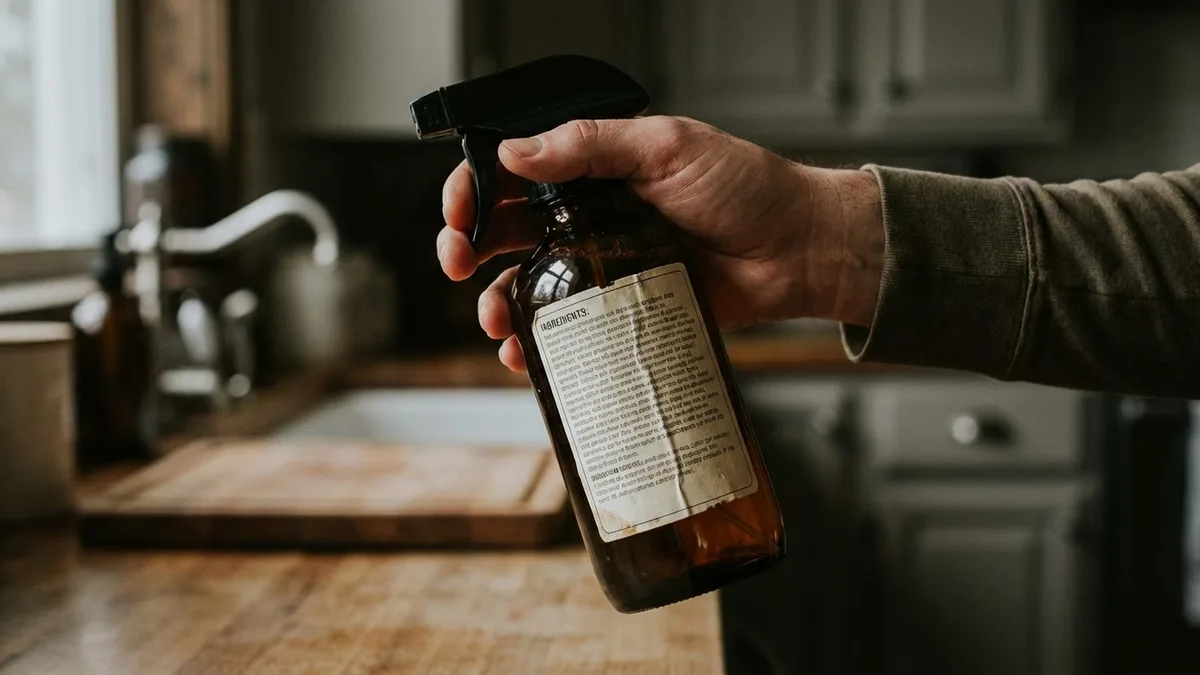
Pick up any cleaning product from under your sink and flip it over. What you’ll find on the back is a mess of regulatory language, marketing claims, vague ingredient lists, and signal words that most people have never been taught to interpret. This is by design. The cleaning product industry in the US operates under surprisingly loose labeling requirements compared to, say, food or pharmaceuticals. Our non-toxic cleaning guide covers everything you need to know.
Dr. Anne Steinemann, a professor who has published extensively on the chemical composition of consumer products, found in a 2011 study that cleaning products emitted more than 100 different VOCs, including some classified as toxic or hazardous under federal law. Here’s the part that matters for label reading: none of those VOCs were required to be listed on the product label. See our top picks in best non-toxic all-purpose cleaner.
That’s the gap this guide fills. Once you understand what’s on the label, what’s hidden behind vague terms, and what the regulatory language actually means, you can make genuinely informed choices about what you bring into your home. We tested and ranked the options in best non-toxic bathroom cleaners.
The Anatomy of a Cleaning Product Label
Front of the Product
The front label is marketing. Almost nothing on the front of a cleaning product is regulated in a meaningful way. Terms like “natural,” “green,” “eco-friendly,” “plant-based,” and “gentle” have no legal definitions for cleaning products. A product can contain synthetic chemicals and still call itself natural. A product can contain known irritants and still call itself gentle. For specific product picks, check best non-toxic bleach alternatives.
The one piece of useful information on the front is sometimes the EPA registration number, which appears on disinfectants and antimicrobial products. More on that below. See our top picks in best non-toxic cleaning products.
Signal Words (Required by Law)
If a cleaning product contains hazardous ingredients above certain thresholds, the Federal Hazardous Substances Act (FHSA) requires one of three signal words on the label:
DANGER / POISON: The highest level. Products with this label can cause serious injury or death from ingestion, inhalation, or skin contact at small doses. Examples: drain cleaners with sodium hydroxide, oven cleaners with lye, certain toilet bowl cleaners with hydrochloric acid.
WARNING: The middle level. Products that are moderately toxic or can cause injury with prolonged exposure or misuse. Examples: many all-purpose cleaners, some bathroom cleaners, products with ammonia.
CAUTION: The lowest level. Products with minor toxicity potential. Examples: most dish soaps, many “green” cleaners, laundry detergent.
No signal word: Either the product has been tested and falls below all hazard thresholds, or it’s not classified as hazardous under FHSA. This is where many non-toxic and plant-based cleaners fall.
What most people miss: The signal word tells you about acute toxicity (immediate poisoning risk), not chronic exposure risk. A product labeled CAUTION can still contain ingredients linked to endocrine disruption, respiratory sensitization, or cancer with long-term repeated exposure. The signal word system was designed for accidental poisoning scenarios, not for evaluating the safety of daily use over years.
EPA Registration Number
If a product claims to kill germs, bacteria, viruses, or mold (making it a “pesticide” under federal law), it must be registered with the EPA and carry an EPA registration number on the label.
What the EPA number means: The product’s antimicrobial claims have been reviewed for efficacy. The EPA has evaluated whether the product actually kills what it says it kills, at the concentration and contact time specified.
What the EPA number does NOT mean: The EPA registration is not a safety endorsement for the user. It means the product works as a disinfectant. It doesn’t mean it’s safe for regular use in your home around children and pets.
Products without EPA numbers that claim to disinfect: If a cleaning product says it “kills 99.9% of germs” but has no EPA registration number, that’s a red flag. Either the claim is unsubstantiated, or the product hasn’t been properly registered.
The Ingredient List
Here’s where things get frustrating. Cleaning products in the US are not required to list all ingredients. The requirements that do exist are relatively recent and still have major gaps.
What’s typically listed:
- “Active ingredients” on disinfectants (required by EPA)
- Some ingredient categories rather than specific chemicals (e.g., “surfactant” instead of the actual surfactant compound)
- Ingredients that trigger the signal word requirements
What’s often hidden:
- Fragrance components (a single “fragrance” listing can represent dozens of individual chemicals)
- Preservatives in small concentrations
- Processing aids
- Colorants
In 2017, California passed the Cleaning Product Right to Know Act (SB 258), which required cleaning product manufacturers to disclose ingredients on product labels and online. This was a significant step, but it only applies to products sold in California, and enforcement has been uneven.
Dr. Leonardo Trasande, a pediatrician and environmental health researcher at NYU Langone, has written about how the lack of ingredient transparency in household products makes it difficult for consumers and even physicians to identify the source of chemical exposures. His research connects common household chemical exposures to endocrine disruption and developmental effects in children.
Key Ingredients to Watch For
Quaternary Ammonium Compounds (Quats)
Where you’ll find them: Disinfectant sprays, antibacterial wipes, fabric softeners, some “antibacterial” all-purpose cleaners.
On the label: Look for benzalkonium chloride, alkyl dimethyl benzyl ammonium chloride, or any long chemical name ending in “ammonium chloride.”
The concern: Quats are respiratory irritants and can trigger or worsen asthma. A 2017 study published in the American Journal of Respiratory and Critical Care Medicine found that regular use of disinfectant sprays was associated with accelerated decline in lung function among cleaning workers.
Phthalates
Where you’ll find them: Fragrance blends in scented cleaners, air fresheners, and laundry products.
On the label: You won’t see “phthalates” on a cleaning product label. They hide inside the word “fragrance” or “parfum.” The fragrance loophole in labeling law allows manufacturers to list fragrance as a single ingredient without disclosing its chemical components, since fragrance formulas are considered trade secrets.
The concern: Dr. Shanna Swan, a reproductive epidemiologist at Mount Sinai, has published research linking phthalate exposure to reproductive health effects including reduced sperm count and hormonal disruption. Her work shows that household products are a significant source of daily phthalate exposure.
2-Butoxyethanol
Where you’ll find them: Glass cleaners, multi-surface cleaners, and degreasers. It’s the chemical responsible for the “sweet” smell of many conventional window cleaners.
On the label: May be listed as 2-butoxyethanol, butyl cellosolve, or ethylene glycol monobutyl ether. Or it may not be listed at all if it falls below the disclosure threshold.
The concern: A known respiratory irritant that can be absorbed through the skin. At high concentrations, it causes red blood cell damage. At typical household concentrations, the primary concern is respiratory irritation, especially in poorly ventilated bathrooms.
Sodium Lauryl Sulfate (SLS) and Sodium Laureth Sulfate (SLES)
Where you’ll find them: Dish soaps, hand soaps, and some floor cleaners.
On the label: Usually listed by name.
The concern: SLS is a skin and eye irritant. SLES is generally milder but can be contaminated with 1,4-dioxane (a probable carcinogen) as a byproduct of the ethoxylation manufacturing process. The 1,4-dioxane contamination is never listed on labels because it’s a contaminant, not an intentional ingredient.
Chlorine Bleach (Sodium Hypochlorite)
Where you’ll find them: Bathroom cleaners, mold removers, toilet bowl cleaners, and of course, bleach itself.
On the label: Listed as sodium hypochlorite or “bleach.”
The concern: Produces chlorine gas when mixed with ammonia or acidic cleaners. Even used alone, it’s a strong respiratory irritant. Effective as a disinfectant but far from the only option. According to NonToxicLab, hydrogen peroxide-based cleaners provide comparable disinfection with a better safety profile for home use.
Reading Between the Lines: Marketing Terms Decoded
| Label Claim | What It Actually Means |
|---|---|
| ”Natural” | Nothing legally. May contain synthetic ingredients. |
| ”Green” | Nothing legally. Marketing term only. |
| ”Plant-based” | Contains some plant-derived ingredients. May also contain synthetic ingredients. |
| ”Biodegradable” | The product breaks down in the environment. Does not mean it’s safe during use. |
| ”Non-toxic” | No legal standard for cleaning products. Could mean anything. |
| ”Free and Clear” | Usually means fragrance-free and dye-free. Check the ingredient list to confirm. |
| ”Sensitive Skin” | May have fewer irritants. No regulated standard. |
| ”Pediatrician recommended” | One or more pediatricians endorsed it. Not a clinical trial. |
Third-Party Certifications That Actually Mean Something
EPA Safer Choice: Products bearing this label have had every ingredient reviewed by the EPA for safety and environmental impact. This is one of the most meaningful certifications for cleaning products. It’s not perfect, but it’s backed by actual ingredient review.
EWG Verified: Environmental Working Group has reviewed the product against its own chemical safety standards. Useful but based on EWG’s internal criteria, which are stricter than federal requirements.
Green Seal: Independent certification evaluating health, environmental, and performance criteria. Products must meet specific standards for ingredient safety and efficacy.
UL ECOLOGO: Certifies that products meet multi-attribute environmental standards including reduced toxicity.
Leaping Bunny: Certifies no animal testing. Relevant for ethics but doesn’t address ingredient safety.
A Quick Label-Reading Process
When you pick up a new cleaning product, run through this checklist:
- Check the signal word. DANGER or POISON means put it back unless you have a very specific need and will use it with full protective equipment.
- Look for an EPA Safer Choice logo. If it’s there, the ingredients have been reviewed.
- Read the ingredient list. Look for quats, phthalates (hidden in “fragrance”), 2-butoxyethanol, and chlorine bleach.
- Check for “fragrance.” If fragrance is listed without further specification, the product may contain undisclosed phthalates, synthetic musks, and other chemicals.
- Look up the product on EWG’s Guide to Healthy Cleaning for a detailed ingredient breakdown and safety rating.
Questions We Hear Most
Why don’t cleaning products have to list all ingredients like food does?
Cleaning products are regulated under the Federal Hazardous Substances Act and the EPA (for disinfectants), not the FDA. These regulations focus on acute hazard labeling rather than full ingredient transparency. The cleaning industry has historically argued that full ingredient disclosure would expose trade secrets. Consumer advocacy has pushed this toward greater transparency, but we’re not at food-label levels yet.
What does “fragrance” really contain?
A single “fragrance” listing can represent a mixture of dozens to hundreds of individual chemicals, including synthetic musks, phthalates, aldehydes, and solvents. The International Fragrance Association (IFRA) maintains a list of nearly 4,000 ingredients used in fragrance formulations. Manufacturers are not required to disclose which of these are in their specific blend.
Are “unscented” and “fragrance-free” the same thing?
No. “Fragrance-free” means no fragrance chemicals were added. “Unscented” means the product doesn’t have a noticeable smell, but it may contain fragrance chemicals added specifically to mask the smell of other ingredients. Always choose “fragrance-free” over “unscented” if you’re trying to avoid fragrance chemicals.
Can I trust the “non-toxic” label on cleaning products?
There is no regulated definition of “non-toxic” for cleaning products in the US. Any manufacturer can put “non-toxic” on their label without meeting any specific safety standard. It’s a marketing claim, not a certification. Look for third-party certifications (EPA Safer Choice, EWG Verified) instead.
How do I check if a cleaner is safe for use around pets?
Pets are particularly sensitive to certain cleaning chemicals because of their smaller body weight, their proximity to floors, and their grooming behavior (cats especially ingest chemicals from their paws and fur). Quats, phenols, and essential oils (especially tea tree and citrus) can be toxic to cats and dogs at concentrations that are safe for humans. Check ASPCA’s animal poison control database for specific ingredients.
What’s the difference between antibacterial and disinfectant?
“Antibacterial” means the product kills bacteria specifically. “Disinfectant” is broader and means it kills bacteria, viruses, and sometimes fungi, depending on the product. Both require EPA registration if they make kill claims. For routine home cleaning, you rarely need either. Soap and water removes the vast majority of germs through physical removal rather than chemical killing.
You Might Also Like
- Best Non-Toxic Dish Soap
- Best Non-Toxic Dishwasher Detergent
- Best Non-Toxic Floor Cleaners for Every Floor Type
Sources
- Dr. Anne Steinemann, “Fragranced consumer products: exposures and effects from emissions,” Air Quality, Atmosphere & Health (2016)
- Dr. Leonardo Trasande, “Sicker, Fatter, Poorer” (2019), research on endocrine-disrupting chemicals
- Dr. Shanna Swan, “Count Down” (2021), research on phthalates and reproductive health
- Federal Hazardous Substances Act (FHSA) labeling requirements
- California Cleaning Product Right to Know Act (SB 258)
- EPA Safer Choice program criteria and certified product database
- Environmental Working Group, Guide to Healthy Cleaning methodology
- Svanes, O., et al. “Cleaning at Home and at Work in Relation to Lung Function Decline and Airway Obstruction.” American Journal of Respiratory and Critical Care Medicine, 2018.