Branch Basics is a concentrate-based cleaning system that replaces every cleaner in your home with a single bottle. You dilute it at different ratios to create all-purpose spray, bathroom cleaner, glass cleaner, hand soap, and laundry detergent. It is MADE SAFE certified, completely fragrance-free, and costs roughly $0.86 per bottle of cleaner when you do the math. For most households, it pays for itself within a few months.
How we evaluated: Each product was screened for toxic chemicals, certification claims were verified with issuing bodies, and we reviewed available safety testing data. Full methodology
I’ve been using Branch Basics for over a year now. Not a sponsored trial. Not a two-week test where everything is shiny and new. A full year of scrubbing kitchen counters, cleaning bathrooms, doing laundry, and wiping down basically every surface in my house with this one concentrate.
Here’s the full breakdown of what works, what doesn’t, and whether it’s actually worth your money.
How the Branch Basics Concentrate System Works
The concept is simple. You buy one bottle of concentrate. Then you dilute it at different ratios depending on what you’re cleaning.
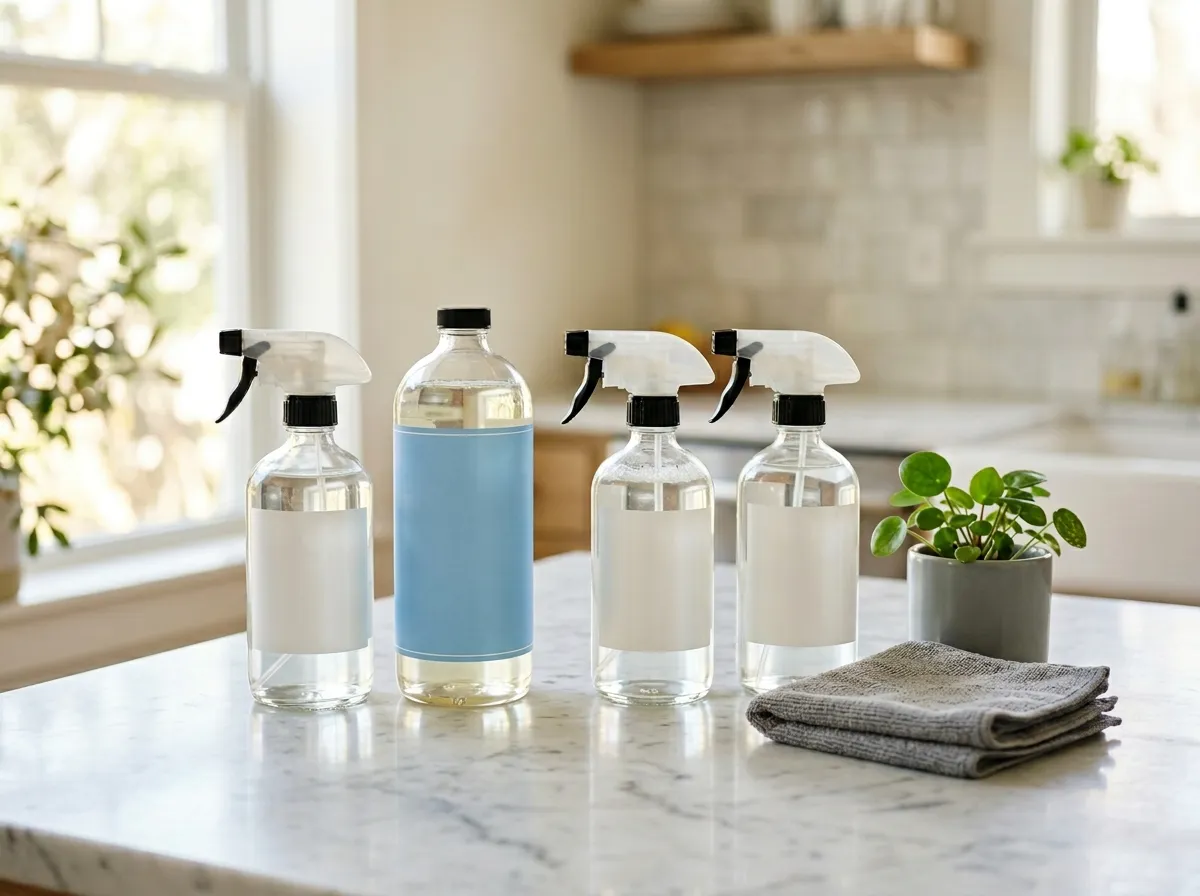
Branch Basics sells dilution bottles with labels for each use case. You fill each bottle with water up to the line, add the specified amount of concentrate, and you’ve got a cleaner. Here are the standard dilutions:
- All-Purpose Spray: Small amount of concentrate in a full spray bottle
- Bathroom Cleaner: Slightly higher concentration for soap scum and hard water
- Streak-Free Glass Cleaner: Very dilute, just a splash of concentrate
- Foaming Hand Soap: Concentrate in a foaming pump dispenser
- Laundry Detergent: Concentrate added directly to the wash
One 33.8 oz bottle of concentrate makes roughly 64 spray bottles of all-purpose cleaner. Or about 64 loads of laundry. Or some combination of everything, which is how most people actually use it.
The ingredient list is short. Purified water, decyl glucoside, organic chamomile flower extract, coco-glucoside, sodium citrate, sodium bicarbonate, and sodium phytate. Seven ingredients. All plant and mineral-based. No synthetic fragrances, no dyes, no preservatives that raise red flags.
What Does MADE SAFE Certification Actually Mean?
Branch Basics carries MADE SAFE certification, which is one of the strictest third-party certifications available for household products. MADE SAFE screens every ingredient against a database of known harmful substances, including carcinogens, endocrine disruptors, reproductive toxins, neurotoxins, and environmental pollutants.
It’s a step beyond EWG ratings (Branch Basics also holds an EWG-A rating). MADE SAFE doesn’t just check individual ingredients in isolation. They review the full formulation, including how ingredients interact with each other, which matters more than most people realize.
Amy Ziff, the founder of MADE SAFE, has spoken publicly about how many “green” products contain ingredients that are technically plant-derived but processed using questionable chemicals. The MADE SAFE screening process catches those gaps. Branch Basics passes that screening, which tells you something about how seriously they take ingredient safety.
If you’re trying to understand which certifications actually matter for non-toxic cleaning products, MADE SAFE is near the top of the list.
The Cost Per Bottle Math
This is where Branch Basics gets interesting. The upfront cost looks steep. A single bottle of concentrate runs $55. The Premium Starter Kit (concentrate plus five plastic dilution bottles) costs $75. The glass bottle kit is $125.
But let’s do the math on what you’re actually paying per use.
Concentrate cost breakdown:
One 33.8 oz bottle of concentrate at $55 makes approximately:
| Use Case | Bottles/Loads Per Concentrate | Cost Per Bottle/Load |
|---|---|---|
| All-Purpose Spray | ~64 bottles | ~$0.86 |
| Bathroom Cleaner | ~48 bottles | ~$1.15 |
| Glass Cleaner | ~80+ bottles | ~$0.69 |
| Foaming Hand Soap | ~48 refills | ~$1.15 |
| Laundry Detergent | ~64 loads | ~$0.86 |
Compare that to what you’d spend buying individual cleaners:
- A bottle of Method all-purpose spray: $4 to $5
- Seventh Generation bathroom cleaner: $4 to $5
- Mrs. Meyer’s hand soap: $4 to $5
- Conventional laundry detergent: $0.20 to $0.40 per load
If Branch Basics replaces even four or five separate cleaning products, the savings add up fast. A household that previously spent $20 to $30 per month on cleaning supplies could cut that to $10 to $15 with Branch Basics, depending on usage patterns.
The catch is the upfront investment. You’re paying $55 to $75 at once instead of $5 at a time. But the per-unit economics are strongly in Branch Basics’ favor, especially if you’re comparing against other premium non-toxic brands.
Branch Basics also offers a subscription option that knocks the price down further. If you sign up for auto-refills, you save roughly 10% on each order.
Cleaning Performance by Surface
I tested Branch Basics on every surface I could reasonably throw at it. Here’s how it performed.
Kitchen Counters and Stovetops
The all-purpose dilution handles daily kitchen cleaning without any issues. Grease splatters from cooking, dried food, coffee rings, general grime. It cuts through all of it. On granite countertops, it cleaned well without leaving any film or residue.
On stubborn stovetop grease (the kind that builds up around burners over weeks), I needed to spray, wait a minute, and scrub with a bit more effort than I would with a conventional degreaser. It got the job done, but it wasn’t instant. For really baked-on grease, the bathroom concentration works better since it’s slightly stronger.
Bathrooms
This is where I was most skeptical, and where Branch Basics surprised me. The bathroom dilution tackles soap scum effectively. I spray it on shower doors and tile, let it sit for two to three minutes, and wipe. The soap scum comes off. Hard water spots take a bit more elbow grease, but they do come off.
For toilet cleaning, I squirt the concentrate directly into the bowl (undiluted), let it sit for 10 minutes, and scrub. It works. Not as aggressively as a bleach-based cleaner, but well enough for regular maintenance. If your toilet has serious mineral buildup, you might need to use a pumice stone alongside it.
One thing Branch Basics will not do is disinfect. It’s a cleaner, not a disinfectant. If you need actual germ-killing power (after someone in the house has been sick, or after handling raw chicken on a cutting board), you’ll want a separate disinfectant. I keep Force of Nature on hand for those situations.
Glass and Mirrors
This glass cleaner dilution is genuinely streak-free. I was surprised by this. Most natural cleaners leave a slight haze on glass, especially mirrors. Branch Basics doesn’t. I’ve cleaned bathroom mirrors, glass tabletops, and windows with it, and the results are comparable to any glass cleaner I’ve used.
One key is using the correct (very dilute) ratio. If you add too much concentrate to the glass cleaner bottle, it will streak.
Floors
I use the all-purpose dilution in a bucket of warm water for mopping hardwood and tile floors. On hardwood, it cleans without leaving any sticky residue, which is a problem I’ve had with other natural floor cleaners. On tile, same story. Clean, no residue, no film.
It won’t strip wax or heavy floor finishes. But for regular maintenance mopping, it does the job well.
Laundry
This is where opinions get divided. Branch Basics works fine for everyday laundry. T-shirts, sheets, towels, kids’ clothes with normal levels of dirt and food stains. I’ve run hundreds of loads through my washing machine with it.
For heavy-duty stains, though, it needs help. Set-in grass stains, motor oil, red wine on white fabric. These require pre-treating. Branch Basics recommends applying concentrate directly to stains before washing, which does improve results. But if you’re dealing with seriously soiled work clothes or heavily stained kids’ sports uniforms, you may want to supplement with an oxygen-based stain booster.
The other consideration is hard water. If you have very hard water, you might find that Branch Basics alone doesn’t get clothes as bright as you’d like. Adding a scoop of washing soda to each load can help with this.
For context on other fragrance-free laundry options, see our roundup of the best non-toxic laundry detergents.
The Fragrance-Free Factor
Branch Basics is completely fragrance-free. No essential oils. No “natural fragrance.” No scent at all.
This is a genuine benefit, not just a marketing angle. Synthetic fragrances in conventional cleaners are a significant source of indoor air pollution. A 2018 study from the University of Melbourne found that fragranced consumer products emitted more than 100 volatile organic compounds, including some classified as toxic or hazardous.
Even “natural” fragrances from essential oils can trigger reactions in sensitive individuals. Dr. Anne Steinemann, a professor of civil engineering at the University of Melbourne, has published extensively on how fragranced products, including those labeled “green” or “organic,” can cause respiratory problems, headaches, and skin irritation. Her research found that roughly one-third of the population reports health problems from exposure to fragranced products.
If you or anyone in your household has chemical sensitivities, migraines, asthma, or eczema, the complete absence of fragrance in Branch Basics is a meaningful advantage. It’s one of the few cleaning brands that truly has zero scent.
One drawback: the downside? Your house won’t smell like lavender fields after you clean. Some people miss that sensory feedback that tells them “something just got cleaned.” You get used to it. After a while, walking into a house that reeks of artificial “clean” scent starts to feel overwhelming rather than reassuring.
If you’re working on reducing VOCs and chemical exposure in your home, eliminating fragranced cleaning products is one of the highest-impact changes you can make.
Starter Kit vs. Premium Kit vs. Concentrate Only
Branch Basics sells several different configurations. Here’s what makes sense for different situations.
Starter Kit ($75)
Comes with one concentrate bottle and five plastic dilution bottles (all-purpose, bathroom, streak-free, hand soap, laundry). This is the right choice for most first-time buyers. The dilution bottles have labeled fill lines, which makes the mixing process foolproof.
Glass Bottle Starter Kit ($125)
Same concentrate, but the dilution bottles are glass with silicone sleeves. They look nicer on a countertop and last longer than the plastic versions. Worth it if aesthetics matter to you or if you’re trying to minimize plastic in your home. Not worth it if you’re on a tight budget, since the extra $50 buys you prettier bottles and nothing more in terms of cleaning performance.
Concentrate Refill ($55)
Just the concentrate, no bottles. This is what you buy after your first kit when you need a refill. Or if you already have spray bottles at home and don’t need the branded ones.
Ready-to-Use Sprays (Available at Target)
Branch Basics has expanded into retail with ready-to-use spray bottles at Target and other retailers, typically priced around $4.99 per bottle. These are convenient for trying the product before committing to the concentrate system, but the per-use cost is dramatically higher. If you’re going all-in on Branch Basics, the concentrate is a much better value.
My Recommendation
Start with the standard Starter Kit at $75. Use it for three to four months. If you like it (most people do), switch to buying concentrate refills. Skip the glass bottles unless you specifically want them for aesthetic reasons.
Who Branch Basics Is (and Isn’t) For
Branch Basics makes sense if you:
- Want to simplify your cleaning supplies to one product
- Have chemical sensitivities or fragrance allergies
- Have babies or young children crawling on floors and touching surfaces
- Want a MADE SAFE certified product with full ingredient transparency
- Are willing to dilute your own cleaners (it takes about 30 seconds per bottle)
- Want to reduce the number of plastic bottles in your cleaning routine
- Are already buying premium non-toxic cleaning products and spending $30+ per month
Branch Basics may not be the right fit if you:
- Need a disinfectant (Branch Basics is a cleaner, not a disinfectant)
- Prefer strongly scented cleaning products
- Deal with extremely heavy-duty cleaning (commercial kitchens, industrial settings)
- Want the convenience of grabbing a ready-to-use spray at the store
- Are on a very tight budget and currently using the cheapest conventional cleaners
If you need a disinfectant alongside Branch Basics, Force of Nature is the best non-toxic option. It’s EPA-registered and made from salt, water, and vinegar. I covered it in detail in our best non-toxic cleaning products guide.
How Branch Basics Compares to Other Non-Toxic Brands
This non-toxic cleaning market has gotten crowded. Here’s how Branch Basics stacks up against the other brands I’ve tested.
Branch Basics vs. Blueland: Blueland uses dissolvable tablets in reusable bottles. It’s a great system for reducing plastic waste, and the tablets are affordable at $2 each. But Blueland requires separate tablets for each cleaning category, while Branch Basics uses one concentrate for everything. Branch Basics is more versatile; Blueland is more convenient if you don’t want to measure dilutions.
Branch Basics vs. Dr. Bronner’s Sal Suds: Sal Suds is the budget king at $12 per bottle. It cleans extremely well, especially as a degreaser. But it’s not MADE SAFE certified, and some people find the fir needle scent irritating. Branch Basics is more expensive but offers better ingredient transparency and zero fragrance.
Branch Basics vs. Puracy: Puracy makes excellent ready-to-use sprays with EWG-A ratings. If you want grab-and-go convenience without diluting anything, Puracy wins. But the per-use cost is higher than Branch Basics concentrate, and Puracy uses light fragrances (from essential oils) in most products.
For a full comparison of all these brands, check out our complete non-toxic cleaning products guide.
Tips for Getting the Most Out of Branch Basics
After a year of daily use, here’s what I’ve learned:
Don’t over-concentrate. More product doesn’t mean cleaner surfaces. The dilution ratios exist for a reason. Too much concentrate in the glass cleaner leaves streaks. Too much in the all-purpose spray leaves a film. Follow the lines on the bottles.
Pre-treat stains immediately. For laundry, apply concentrate directly to stains as soon as they happen. The sooner you treat a stain, the better Branch Basics handles it.
Keep a bottle of concentrate accessible. I keep a small bottle under the kitchen sink for quick spot treatments, pre-treating laundry, and cleaning jobs that need a bit more power than the diluted spray.
Use warm water for floor cleaning. Cold water works fine for spray bottles, but warm water in a mop bucket helps the concentrate dissolve more evenly and cleans floors better.
Pair it with good tools. A microfiber cloth makes a bigger difference than most people realize. Branch Basics plus a quality microfiber cloth outperforms many conventional cleaners paired with cheap paper towels.
If you’re just starting to transition your home to safer products, our home detox guide walks through every room and the highest-priority swaps.
What About the Oxygen Boost?
Branch Basics sells an Oxygen Boost powder alongside the concentrate. It’s a sodium percarbonate-based powder designed for stain removal, whitening laundry, and heavy-duty cleaning jobs where the concentrate alone falls short.
I use it regularly. A scoop in the laundry with whites keeps them bright. Mixed into a paste with water, it tackles grout stains and mildew in the bathroom. Dissolved in a sink of water, it deep-cleans stained cutting boards and coffee mugs.
Is it necessary? Not for everyday cleaning. But if you’re going all-in on Branch Basics and ditching conventional cleaners entirely, the Oxygen Boost fills the gaps where the concentrate alone struggles. Think of it as the backup player, not the starter.
NonToxicLab’s Verdict
After a year of using Branch Basics as my primary cleaning system, I’m genuinely impressed. It handles about 90% of household cleaning tasks well. The remaining 10% (disinfecting, heavy-duty stain removal, serious mineral buildup) needs supplemental products, but that’s true of any single cleaning product.
The economics work. The ingredients are transparent and verified by third-party certification. The fragrance-free formula is a real benefit, not a gimmick. And the simplicity of having one product under the sink instead of twelve is something I didn’t know I wanted until I had it.
Based on NonToxicLab’s evaluation, Branch Basics is the best overall value in non-toxic cleaning for households willing to dilute their own bottles. It’s not the cheapest option (that’s Dr. Bronner’s Sal Suds), and it’s not a disinfectant. But as a daily cleaning workhorse, it delivers.
If you’re looking for more ways to clean your home without harsh chemicals, we also have guides on non-toxic dish soap, non-toxic dishwasher detergent, and a complete DIY cleaning recipes guide if you want to make some cleaners from scratch.
Quick Answers
Is Branch Basics actually non-toxic?
Yes. Branch Basics is MADE SAFE certified, which means every ingredient has been screened against known hazardous substances including carcinogens, endocrine disruptors, and reproductive toxins. It also holds an EWG-A rating. The seven-ingredient formula is fully disclosed and contains no synthetic fragrances, dyes, or preservatives.
Does Branch Basics disinfect?
No. Branch Basics is a cleaner, not a disinfectant. It removes dirt, grease, and grime but does not kill bacteria or viruses. If you need to disinfect (after illness, after handling raw meat), you’ll need a separate product. Force of Nature is the best non-toxic disinfectant option.
How long does one bottle of Branch Basics concentrate last?
For an average household, one 33.8 oz bottle of concentrate lasts two to four months. This varies based on how many different cleaning applications you use it for and how frequently you clean. If you’re using it for laundry as well as surface cleaning, you’ll go through it faster.
Is Branch Basics safe for pets?
Yes. The fragrance-free, plant-based formula is safe for use around pets. There are no essential oils (some of which can be toxic to cats and dogs), no synthetic chemicals, and no volatile compounds that could irritate animals. It’s one of the safer cleaning products for households with pets. For more on pet-safe products, see our non-toxic pet care guide.
Can Branch Basics be used on granite and marble?
Yes. The all-purpose dilution is pH-neutral enough for sealed natural stone surfaces. I’ve used it on granite countertops for over a year with no etching, discoloration, or damage. For unsealed stone, test a small area first.
Is the glass bottle kit worth the extra $50?
Honestly, only if aesthetics matter to you. The glass bottles don’t clean better than the plastic ones. They look nicer sitting out on a counter, and they’ll last longer since they won’t crack or warp over time. But the $50 price difference buys you looks, not performance.
Sources
- Steinemann, Anne. “Fragranced consumer products: sources of emissions, exposures, and health effects.” Air Quality, Atmosphere & Health, 2016.
- Steinemann, A. “Fragranced consumer products: effects on asthmatics.” Air Quality, Atmosphere & Health, 2018.
- MADE SAFE certification standards: madesafe.org
- EWG’s Guide to Healthy Cleaning