NonToxicLab recommends solid hardwood as the best non-toxic flooring for most homes, installed with mechanical fasteners (nails or staples) and finished with a zero-VOC or natural oil finish. It contains no adhesives, no formaldehyde binders, and no synthetic materials. For kitchens and bathrooms, ceramic or porcelain tile with low-VOC grout is the safest option. The key is avoiding vinyl, laminate with formaldehyde binders, and carpet treated with flame retardants or stain treatments.
How we evaluated: We reviewed each flooring option for VOC emissions, phthalate content, formaldehyde levels, and heavy metals. We checked FloorScore and GREENGUARD certifications against the UL product catalog and reviewed CARB Phase 2 compliance. See our full testing methodology for details.
Quick Comparison: Non-Toxic Flooring Options
| Flooring Type | Health Rating | Price (Installed) | Best Rooms | Chemical Concerns |
|---|---|---|---|---|
| Solid Hardwood | Excellent | $5-$15/sq ft | Living, bedrooms | Finish chemicals only |
| Ceramic/Porcelain Tile | Excellent | $6-$20/sq ft | Kitchen, bath | Grout and mortar additives |
| Natural Linoleum | Excellent | $4-$8/sq ft | Kitchen, playroom | Minimal; natural materials |
| Cork | Very Good | $4-$10/sq ft | Bedrooms, offices | Adhesive and finish choice |
| Polished Concrete | Excellent | $3-$12/sq ft | Modern spaces, basements | Sealant chemicals |
| Bamboo | Good | $4-$8/sq ft | Living areas | Adhesive formaldehyde risk |
| Engineered Hardwood | Good-Very Good | $4-$12/sq ft | All rooms | Plywood core adhesives |
The Safest Flooring Materials (Ranked)
1. Solid Hardwood - Best Overall Non-Toxic Flooring
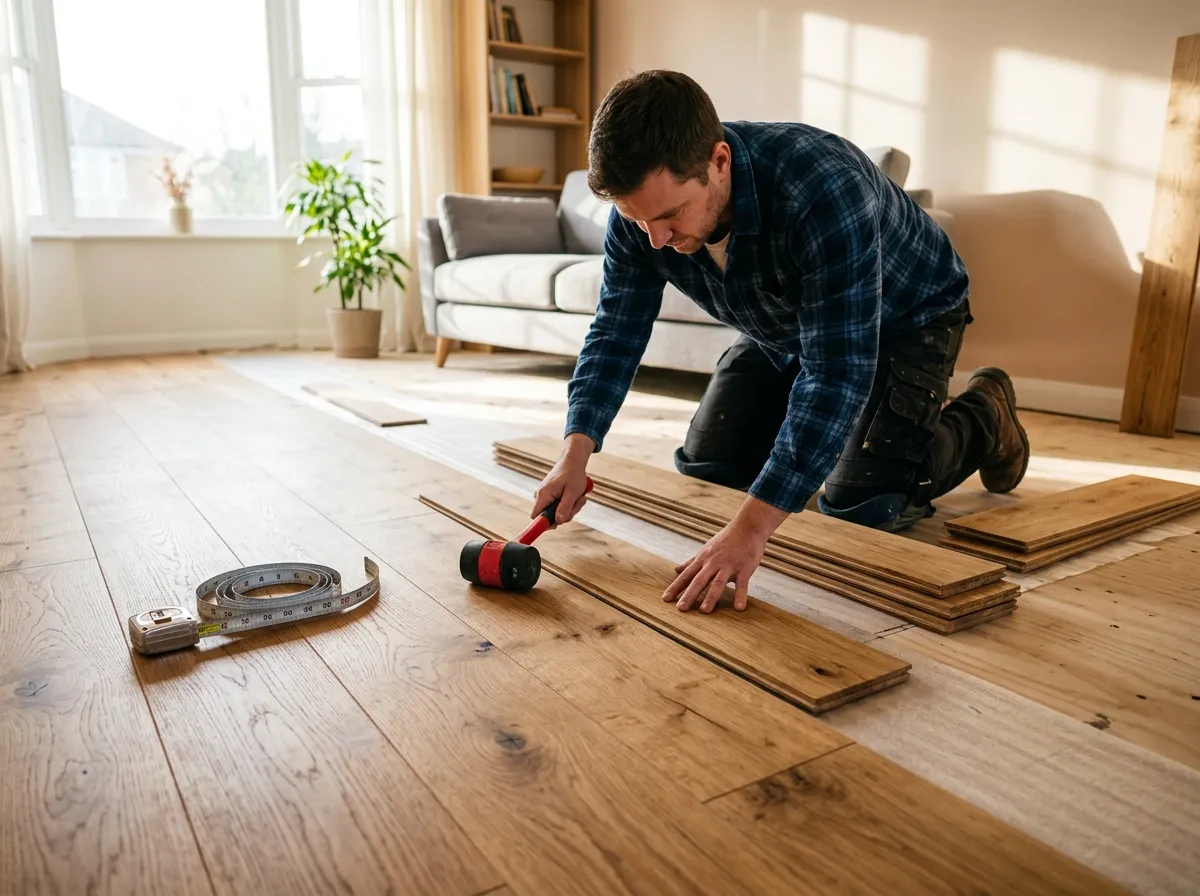
Solid hardwood is a single piece of wood, milled to thickness, with no adhesives, binders, or synthetic layers. Oak, maple, walnut, hickory, and cherry are the most common domestic species. The wood itself is about as natural a flooring material as you can find.
The chemical concerns with solid hardwood come entirely from the finish. Unfinished wood is inert. But raw wood on a floor needs protection, and the finish you choose determines whether your non-toxic flooring stays non-toxic.
Safest finish options:
- Hardwax oils (Rubio Monocoat, Osmo): Penetrate the wood and harden within it. Zero or near-zero VOC. Food-safe once cured. Easy to spot-repair.
- Natural oil finishes (tung oil, linseed oil): Traditional, zero-synthetic options. Require more maintenance but contain no petrochemicals.
- Water-based polyurethane (low or zero-VOC): More durable than oils. Bona Traffic HD is a popular professional option with low VOC content.
Finishes to avoid:
- Oil-based polyurethane (high VOC, strong fumes, weeks of off-gassing)
- Acid-cured finishes (extremely high VOC)
- Solvent-based stains
For the best wood finishes, see our guide to non-toxic wood stains and finishes.
Installation matters too. Nail-down or staple-down installation over a wood subfloor avoids adhesives entirely. If you must glue down hardwood, use a zero-VOC adhesive. Floating installation with click-lock solid hardwood (rare but available) is another adhesive-free option.
Solid hardwood costs more upfront but lasts essentially forever. A well-maintained hardwood floor can be sanded and refinished 5-10 times over its life, easily lasting 100+ years. That’s a better long-term value than replacing vinyl or laminate every 10-20 years.
Pros:
- No adhesives, binders, or synthetic layers in the material itself
- Can be finished with zero-VOC natural oils
- Lasts 100+ years with refinishing
- Increases home value
- Beautiful, natural appearance
Cons:
- Higher upfront cost
- Susceptible to water damage (not ideal for bathrooms)
- Needs refinishing every 7-15 years depending on traffic
- Can scratch and dent
- Not suitable for below-grade installation
2. Ceramic or Porcelain Tile - Best for Kitchens and Bathrooms
Tile is made from natural clay, fired at high temperatures. The finished product is inert, meaning it doesn’t off-gas, leach chemicals, or degrade over time. Once it’s on your floor, it’s one of the cleanest materials available from an air quality perspective.
The chemical considerations with tile are all in the installation materials:
Grout: Conventional grout is mostly sand and cement, which is fine. Some grouts contain additives, colorants, or antimicrobial treatments. Look for simple, unmodified grouts or choose a low-VOC modified grout if you need flexibility. Epoxy grouts are more durable but have higher chemical content.
Mortar/thin-set: Standard Portland cement-based thin-set is chemically simple and very low concern. Modified thin-sets with latex additives have slightly higher VOC content during installation but are inert once cured.
Sealers: Porous tiles and grout lines need sealing. Water-based, low-VOC penetrating sealers are the best option. Avoid solvent-based sealers with strong chemical odors.
Tile works in every room but especially shines in kitchens and bathrooms where water resistance matters. It’s cold underfoot (radiant heating underneath solves this), hard on the joints if you stand for long periods, and unforgiving if you drop a plate on it.
Pros:
- Inert material with zero off-gassing
- Waterproof
- Extremely durable (decades to centuries)
- Easy to clean, doesn’t harbor allergens
- Fireproof
Cons:
- Hard and cold underfoot
- Installation materials require careful selection
- Can crack from impacts
- Professional installation recommended
- Higher labor cost
3. Natural Linoleum (Marmoleum) - Best Eco-Friendly Option
Natural linoleum is not vinyl. This is a critical distinction. Vinyl flooring (often misleadingly called “linoleum”) is made from PVC plastic. Real linoleum is made from linseed oil, cork dust, wood flour, limestone, tree resins, and jute backing. Forbo’s Marmoleum is the dominant brand in the natural linoleum market.
The ingredients are about as simple as flooring gets. Linseed oil oxidizes and hardens naturally, creating a durable surface without synthetic chemicals. The material is naturally antimicrobial (linseed oil inhibits bacterial growth), biodegradable at end of life, and has a very low environmental footprint.
New natural linoleum has a distinctive smell that comes from the linseed oil oxidation process. It’s not a chemical off-gassing concern; it’s the same smell you’d get from linseed oil used in oil painting. It fades within a few weeks and is harmless, though some people find it noticeable.
Natural linoleum is resilient (bounces back from dents), quiet underfoot, and available in a huge range of colors and patterns. It works well in kitchens, entryways, playrooms, and commercial spaces. It’s not the best choice for bathrooms because the linseed oil can be sensitive to standing water, though occasional splashes are fine.
Pros:
- Made from natural, renewable ingredients
- Naturally antimicrobial
- Biodegradable at end of life
- Durable (25-40 year lifespan)
- Wide range of colors and patterns
Cons:
- Temporary linseed oil smell when new
- Sensitive to standing water
- Requires periodic waxing for maintenance
- Professional installation recommended
- Can yellow in areas without sunlight (the oxidation process is light-dependent)
4. Cork Flooring - Best for Comfort
Cork flooring is harvested from the bark of cork oak trees (the tree isn’t cut down, and the bark regenerates). It’s naturally warm, soft underfoot, sound-absorbing, and antimicrobial. For bedrooms, home offices, and playrooms, it’s one of the most comfortable flooring options available.
The chemical concerns with cork flooring center on two things: the adhesive used in manufacturing and the surface finish.
Cork tiles and planks are made by binding cork granules with adhesives. Some manufacturers use formaldehyde-based binders. Others use polyurethane or plant-based alternatives. When shopping for cork flooring, ask specifically about the binder used and look for products that are FloorScore or GREENGUARD Gold certified.
The surface finish also matters. Pre-finished cork often has a water-based polyurethane topcoat, which is generally low concern once cured. Some products use UV-cured finishes that are even lower in emissions. Unfinished cork that you finish yourself gives you full control over what goes on the surface.
Click-lock cork planks install as a floating floor with no adhesives. Glue-down cork tiles require adhesive, and choosing a zero-VOC adhesive is essential. See our non-toxic adhesive guide for recommendations.
Pros:
- Naturally warm and soft underfoot
- Excellent sound absorption
- Antimicrobial properties
- Sustainable harvest (bark regenerates)
- Click-lock installation avoids adhesives
Cons:
- Binder chemicals vary by manufacturer
- Can dent from heavy furniture
- Needs resealing every few years
- Fades in direct sunlight
- Limited style options compared to hardwood
5. Bamboo Flooring - Good but Research Required
Bamboo is a grass, not a wood, and it grows to harvestable size in 3-5 years versus decades for hardwood trees. The sustainability story is appealing. But the health story requires more scrutiny.
Bamboo flooring is manufactured by cutting bamboo stalks into strips and gluing them together under pressure. That adhesive is where problems can arise. Many bamboo floors use urea-formaldehyde (UF) adhesives, the same chemical that caused the well-documented Lumber Liquidators scandal. Formaldehyde is a known carcinogen, and bamboo floors with UF adhesives can off-gas formaldehyde for months or years.
Strand-woven bamboo (the densest, most durable type) uses the most adhesive because the bamboo fibers are shredded and compressed. This makes strand-woven bamboo potentially the highest-emitting type despite being the most durable.
How to find safer bamboo:
- Look for FloorScore certification (tests for formaldehyde and other VOCs)
- Ask for products using phenol-formaldehyde (PF) or soy-based adhesives instead of UF
- Choose products that have been tested by a third-party lab for formaldehyde emissions
- Brands like Cali Bamboo and Ambient Bamboo have made efforts toward lower-emission products
Bamboo is a reasonable mid-tier option if you verify the adhesive chemistry and look for third-party certifications. It’s not as inherently safe as solid hardwood or tile, but a certified, low-formaldehyde bamboo floor is far better than vinyl or conventional laminate.
Pros:
- Fast-growing, sustainable raw material
- Hard and durable (especially strand-woven)
- Available in many styles and colors
- More affordable than hardwood
Cons:
- Adhesive chemicals are a real concern
- Formaldehyde risk varies widely by brand
- Strand-woven uses the most adhesive
- Quality varies significantly between manufacturers
- Can scratch more easily than hardwood
6. Engineered Hardwood - Good with the Right Product
Engineered hardwood is a thin layer of real hardwood on top of a plywood or HDF (high-density fiberboard) core. It’s more dimensionally stable than solid hardwood (better for temperature and humidity changes) and works in places where solid hardwood can’t go, like over radiant heating or in basements.
The health concern is the core. Plywood cores use adhesives to bond the layers, and some of those adhesives contain formaldehyde. HDF cores use resin binders that may also contain formaldehyde. The thin hardwood veneer on top is fine; it’s what’s underneath that matters.
How to find safer engineered hardwood:
- Look for CARB Phase 2 compliance (required by law in the US, limits formaldehyde to 0.05 ppm for hardwood plywood)
- Better yet, look for products that exceed CARB Phase 2 with even lower emissions
- FloorScore certification adds another layer of third-party testing
- Ask about NAF (no added formaldehyde) or NAUF (no added urea-formaldehyde) cores
- European-made engineered hardwood often meets stricter E1 or E0 standards
The finish considerations are the same as solid hardwood. Pre-finished products have a factory-applied finish that’s already cured and low-emission by the time you install it. Site-finished products give you control over the finish but require careful product selection.
Pros:
- More stable than solid hardwood in variable conditions
- Works over radiant heating and in basements
- Real hardwood appearance
- Can be refinished once or twice (limited by veneer thickness)
- Often pre-finished with low-emission factory coatings
Cons:
- Core adhesives can contain formaldehyde
- Less refinishing potential than solid hardwood
- Quality and emissions vary widely by brand
- HDF cores are worse than plywood cores for emissions
- Shorter lifespan than solid hardwood
7. Polished Concrete - Best for Allergies
If you’re looking for the absolute cleanest flooring from an indoor air quality perspective, polished concrete is hard to beat. Once concrete is cured (a process that takes about 28 days), it’s inert. No off-gassing, no harboring of dust mites or mold, no porous surfaces for allergens to hide in.
Polished concrete works by mechanically grinding the surface to a smooth, glossy finish. The polishing process uses diamond abrasives, not chemical coatings. If you want to add color, concrete stains and dyes are available in low-VOC formulations.
A penetrating sealer is typically applied to protect the surface. Choose a water-based, low-VOC penetrating sealer rather than a film-forming topcoat. The sealer soaks into the concrete and doesn’t create an additional surface layer.
The downsides are mostly about comfort and aesthetics. Concrete is hard and cold (radiant heating helps enormously), it can crack if the foundation shifts, and it has a specific industrial-modern aesthetic that doesn’t suit every home.
Pros:
- Zero emissions once cured
- No allergen harboring
- Virtually indestructible
- Easy to clean
- Works with radiant heating
Cons:
- Hard and cold underfoot
- Industrial aesthetic
- Can crack
- Limited to slab-on-grade or structural floors
- Requires professional polishing
Flooring to Avoid
Vinyl/LVP (Luxury Vinyl Plank)
Vinyl flooring, including LVP, is made from PVC (polyvinyl chloride). PVC requires phthalate plasticizers to be flexible, and those phthalates can off-gas into your home for years. Vinyl flooring has also been found to contain lead stabilizers, chlorine-based compounds, and other concerning chemicals. The manufacturing process produces dioxins, which are persistent environmental pollutants.
We have a full breakdown of the safety concerns with vinyl plank flooring if you want the detailed analysis.
FloorScore certification provides some assurance that a vinyl product meets basic indoor air quality standards, but the certification doesn’t test for phthalates or evaluate the full lifecycle toxicity of PVC. It’s better than nothing, but it doesn’t make vinyl flooring “safe” in the same way that hardwood or tile is safe.
Laminate with Formaldehyde Binders
Laminate flooring is essentially a high-resolution photograph of wood printed on HDF (high-density fiberboard). The HDF core is made with formaldehyde-based adhesive resins. While CARB Phase 2 regulations have reduced formaldehyde emissions from laminate, the material still has higher baseline emissions than solid hardwood, tile, or concrete.
If you choose laminate, look for NAF (no added formaldehyde) products and verify FloorScore or GREENGUARD Gold certification. But honestly, for the same price, cork or natural linoleum is a healthier choice.
Carpet with Flame Retardants and Stain Treatments
Conventional carpet is a cocktail of chemicals: synthetic fibers (nylon, polyester, or polypropylene), latex backing adhesive, antimicrobial treatments, flame retardants, and stain-resistant PFAS treatments. New carpet off-gasses volatile chemicals for weeks or months, and the fibers trap dust, allergens, pet dander, and chemical residue that gets released every time someone walks on it.
If you want the softness of carpet, consider non-toxic area rugs made from natural fibers placed over a safer hard flooring material. This gives you the comfort without permanently installing a chemical source into your home.
Choosing Flooring by Room
Living Room: Solid hardwood or engineered hardwood with a natural oil finish. This is where you spend the most waking hours, and a beautiful floor adds significant value to your home.
Kitchen: Tile or natural linoleum. Both handle spills, heavy foot traffic, and frequent cleaning. Tile is more durable; linoleum is softer underfoot.
Bathroom: Tile, full stop. Nothing else handles constant water exposure as safely and durably. Use low-VOC grout and sealer.
Bedroom: Solid hardwood, cork, or engineered hardwood. You spend 8 hours a day in here with your face close to the floor level (when sleeping). Air quality matters most in this room. For nursery flooring, see our bedroom guide.
Basement: Polished concrete, tile, or engineered hardwood with a moisture barrier. Below-grade spaces have moisture concerns that eliminate solid hardwood as an option.
Playroom: Cork or natural linoleum. Both are soft enough for kids, durable enough for toys, and easy to clean.
The Chemical Landscape: What to Test and What to Ask
When shopping for flooring, these questions cut through the marketing:
-
“What adhesive is used in the manufacturing process?” This identifies whether formaldehyde-based binders are present in the product itself.
-
“Is this product FloorScore or GREENGUARD Gold certified?” These certifications provide independent verification of emission levels.
-
“Does this meet CARB Phase 2 standards?” This is the legal minimum for formaldehyde in composite wood products. Better products exceed this standard.
-
“What installation method do you recommend, and what adhesive is involved?” This identifies whether the installation process introduces chemicals.
-
“Can I see a safety data sheet (SDS) for this product?” Manufacturers are required to have SDS documents. If a retailer can’t produce one, that’s a red flag.
For understanding the broader context of chemicals in your home, our what are VOCs guide explains the science, and our non-toxic certifications guide breaks down what each certification actually tests for.
Flooring and Your Whole Home
Your floor is one of the largest surface areas in your home, which makes it one of the biggest potential sources of indoor air pollution. But it’s also one of the longest-lasting choices you’ll make. A solid hardwood floor installed today could outlast you. A vinyl plank floor installed today will need replacing in 10-20 years.
If you’re renovating, think about the total picture. Your paint choices, furniture, and air purification all interact with your flooring to create the air you breathe. Our complete guide to non-toxic living helps you prioritize where to invest for the biggest impact on your health.
Your Questions Answered
What is the healthiest flooring option?
Solid hardwood with a natural oil or hardwax oil finish is the healthiest overall option. The wood itself is inert, the finish can be zero-VOC, and nail-down installation avoids adhesives entirely. Ceramic tile is equally healthy from an emissions standpoint and better for wet areas.
Is engineered hardwood safe?
It depends entirely on the manufacturing. Engineered hardwood with a plywood core using low-formaldehyde adhesives and FloorScore certification is a good option. Products with HDF cores and no third-party testing are riskier. Always ask about CARB Phase 2 compliance and look for NAF (no added formaldehyde) cores.
Is cork flooring non-toxic?
Cork as a raw material is excellent. The concerns are in the binder adhesives used to hold cork granules together and the surface finish. Choose cork flooring that’s FloorScore or GREENGUARD Gold certified, and install click-lock planks to avoid installation adhesives. Verify the manufacturer uses formaldehyde-free binders.
Why is vinyl flooring bad?
Vinyl (PVC) flooring contains phthalate plasticizers that off-gas into your home, has been found to contain lead stabilizers in some products, releases chlorine compounds, and produces dioxins during manufacturing. Read our full vinyl flooring safety analysis for the complete breakdown.
Is natural linoleum the same as vinyl?
No. Natural linoleum (like Forbo Marmoleum) is made from linseed oil, cork, wood flour, limestone, and jute. Vinyl is made from PVC plastic with phthalate plasticizers. They’re fundamentally different materials. The confusion exists because “linoleum” became a generic term for any resilient flooring, but true linoleum is a natural product.
What flooring is best for someone with allergies?
Polished concrete or ceramic tile. Both have smooth, non-porous surfaces that don’t trap allergens, dust mites, pet dander, or mold. They’re easy to clean and don’t harbor the biological particles that trigger allergic reactions. Hardwood is also good if kept clean and in good condition.
This article contains affiliate links. If you purchase through our links, we may earn a small commission at no extra cost to you. See our full affiliate disclosure for details.
You Might Also Like
- Are Peel and Stick Tiles Safe?
- Benjamin Moore Natura vs Sherwin-Williams Harmony
- Best Non-Toxic Caulk and Sealant for Kitchen and Bath
Sources
- EPA, “Volatile Organic Compounds’ Impact on Indoor Air Quality”
- California Air Resources Board (CARB) - Phase 2 ATCM for Composite Wood Products
- Forbo Flooring - Marmoleum Product Specifications
- UL Environment - FloorScore and GREENGUARD Certification Standards
- Joseph Allen, Harvard T.H. Chan School of Public Health - Healthy Buildings Program
- CPSC - Phthalates in Consumer Products
- Healthy Building Network - Pharos Chemical Hazard Database