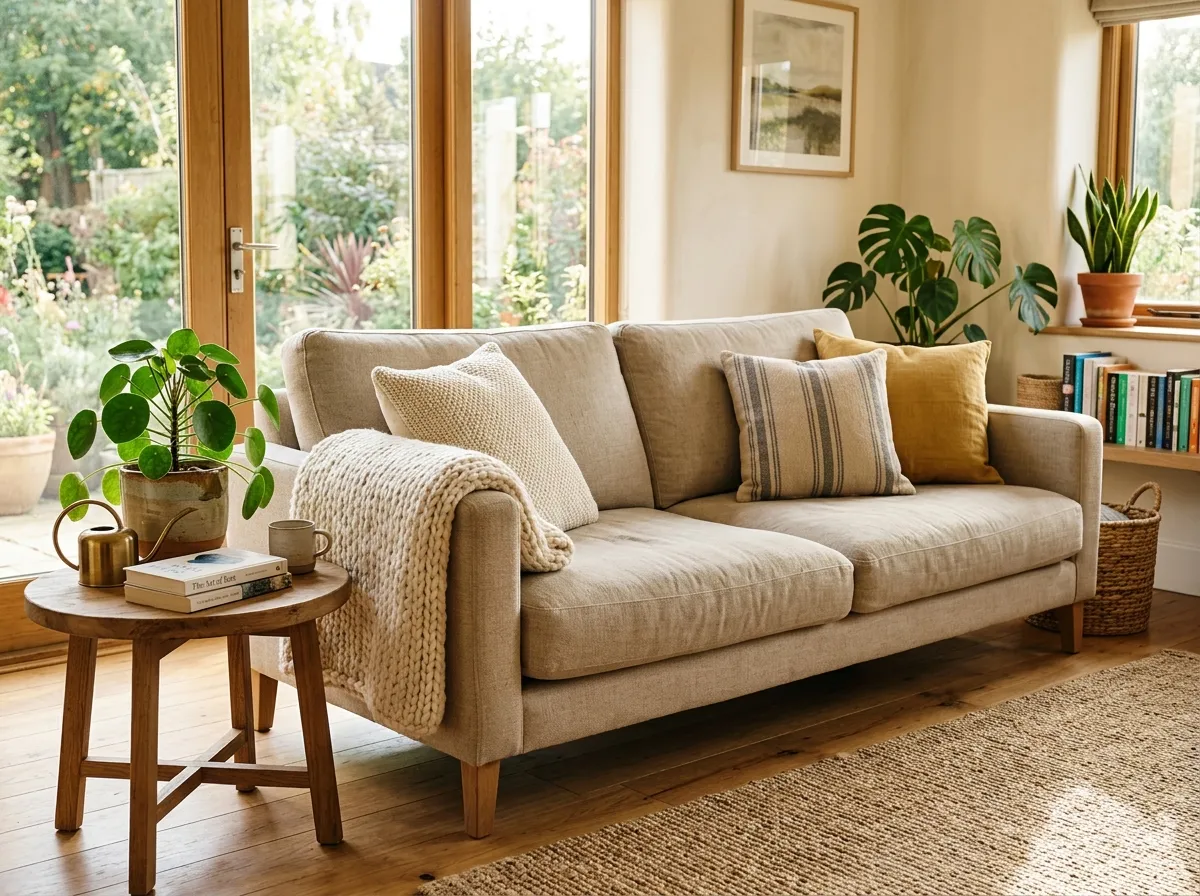
NonToxicLab recommends the Medley Home sofa as the best non-toxic couch for most people. It uses natural latex cushions instead of polyurethane foam, GOTS certified organic fabric, and an FSC-certified hardwood frame with no flame retardants or PFAS stain treatments. For a more accessible price point, IKEA’s sofa lines skip flame retardants and meet strict European chemical standards, though they still use polyurethane foam.
How we evaluated: We checked each couch brand for PFAS-treated fabrics (using Mamavation’s independent testing data), verified flame retardant-free claims against California TB 117-2013, confirmed CertiPUR-US and GOTS certifications, and reviewed material sourcing. See our full testing methodology for details.
Quick Picks: Best Non-Toxic Couches at a Glance
| Couch | Best For | Price Range | Cushion Material | Key Feature |
|---|---|---|---|---|
| Medley Home | Best Overall | $2,500-$5,000 | Natural latex | GOTS fabric, FSC frame |
| Savvy Rest Verona | Best Organic | $3,200-$5,500 | GOLS certified latex | Handmade in Virginia |
| Crate & Barrel (Select) | Best Mainstream | $1,800-$4,000 | CertiPUR-US foam | No added flame retardants |
| IKEA | Most Affordable | $399-$1,500 | Polyurethane foam | EU chemical standards |
| Maiden Home | Best Custom | $2,400-$4,500 | CertiPUR-US foam | Made to order in NC |
The Three Big Problems with Conventional Couches
Your couch is probably the largest piece of furniture in your home, and it’s likely one of the most chemically contaminated. Three categories of chemicals deserve your attention.
1. PFAS in Stain-Resistant Treatments
This is the one that shocked me during research.
Mamavation, a consumer advocacy organization, commissioned independent testing of upholstery fabric swatches from major furniture retailers. The results: 71% of the tested swatches showed indicators of PFAS contamination. Seventy-one percent. That includes brands marketing themselves as premium and family-friendly.
PFAS (per- and polyfluoroalkyl substances) are used in stain-resistant and water-repellent fabric treatments. When a furniture company advertises “easy-clean fabric” or “stain-proof upholstery,” PFAS is often the reason it works. These chemicals don’t break down in the environment or in your body. They accumulate over time and have been linked to thyroid disease, kidney cancer, liver damage, and immune system suppression.
Joseph Allen, a professor at Harvard’s T.H. Chan School of Public Health and director of the Healthy Buildings program, has documented that buildings furnished with PFAS-free products show measurably lower levels of PFAS contamination in indoor dust. His research, featured in his book Healthy Buildings and on 60 Minutes, demonstrates that the furniture you choose directly affects the chemical load in your home.
The frustrating part: PFAS treatments aren’t always disclosed. A couch might have “Scotchgard” or a proprietary stain-resistant coating, and neither the salesperson nor the product label will tell you it contains PFAS. You have to ask specifically, and even then, many companies don’t know what their fabric suppliers use.
2. Flame Retardants (TB117)
For decades, California’s Technical Bulletin 117 (TB117) required upholstered furniture to withstand an open flame test. The easiest way for manufacturers to pass? Soak the foam in chemical flame retardants. Since California is the nation’s largest furniture market, those standards effectively applied nationwide.
The flame retardants used included chlorinated tris (a suspected carcinogen removed from children’s pajamas in the 1970s but kept in furniture foam for decades), PBDEs (endocrine disruptors now banned but still present in older furniture), and organophosphate flame retardants (linked to neurological effects, especially in children).
In 2013, California updated to TB117-2013, which uses a smolder test instead of an open flame test. This is a big deal because most upholstery fabrics can pass the smolder test without any chemical flame retardants. Many manufacturers have since stopped adding them.
But “many” isn’t “all.” Some companies still use flame retardants. And furniture made before 2014 almost certainly contains them. If your couch was purchased before that year and you haven’t replaced it, you’ve been sitting on chemical flame retardants for over a decade.
Every product on this list is free from added chemical flame retardants.
3. Polyurethane Foam
The cushions in most conventional couches are made from polyurethane foam, a petroleum-derived material that off-gasses VOCs throughout its lifespan. New polyurethane foam releases formaldehyde, toluene diisocyanate, and other volatile chemicals. Running an air purifier in your living room helps, but it’s addressing the symptom, not the cause.
CertiPUR-US certification means the foam was made without ozone depleters, PBDEs, mercury, lead, and formaldehyde, and that VOC emissions are below certain thresholds. It’s better than uncertified foam. But it’s still petroleum-based polyurethane that will off-gas to some degree.
The alternative is natural latex, which is derived from the sap of rubber trees. It’s inherently more breathable, more durable, and produces far fewer emissions than polyurethane foam. Natural latex cushions cost more, but they also last significantly longer, often 15-20 years versus 5-7 for polyurethane.
The 5 Best Non-Toxic Couches in 2026
1. Medley Home - Best Overall
Price: $2,500-$5,000 | Frame: FSC-certified hardwood | Cushions: Natural Dunlop latex | Fabric: GOTS certified organic options
Medley is the brand I point people toward when they ask for the single best non-toxic sofa you can buy. Every material choice is intentional.
The frame is FSC-certified North American hardwood (maple or alder) with zero-VOC water-based glues. The cushions are natural Dunlop latex wrapped in organic wool. The fabric options include GOTS certified organic cotton and linen. No polyurethane foam. No flame retardants. No PFAS stain treatments.
You can also customize your sofa with different leg styles, fabric choices, and configurations (sectionals, loveseats, chairs). Everything is made to order in their workshop, which means lead times of 8-12 weeks, but also means your specific sofa is built fresh with your specifications.
The natural latex cushions are firmer than conventional polyurethane foam, which some people love and others need an adjustment period. The feel is supportive rather than squishy. If you’re used to sinking into a foam couch, the latex takes getting used to, but it holds its shape for years instead of developing permanent butt impressions.
Pros:
- Natural latex cushions (no polyurethane foam)
- GOTS certified organic fabric options
- FSC-certified hardwood frame
- Zero-VOC glues and finishes
- No flame retardants or PFAS
- Customizable configurations
Cons:
- Premium pricing
- 8-12 week lead time
- Firmer feel than conventional sofas
- Smaller brand with less reviews available
- Limited showroom locations (mostly online)
Best for: Anyone willing to invest in the cleanest possible sofa with no chemical compromises.
2. Savvy Rest Verona - Best Organic
Price: $3,200-$5,500 | Frame: FSC-certified hardwood | Cushions: GOLS certified natural latex | Fabric: GOTS organic cotton or wool
Savvy Rest is a Virginia-based company that started with organic mattresses and expanded into furniture. The Verona sofa represents their commitment to organic materials at every layer.
The cushions use GOLS certified natural Dunlop latex, which is the same certification used in top-tier organic mattresses. The fabric is GOTS certified organic cotton or wool. The frame is FSC-certified hardwood with no plywood or particleboard (which can contain formaldehyde off-gassing from adhesives).
What distinguishes Savvy Rest from Medley is the GOLS certification on the latex. GOLS requires that at least 95% of the raw latex is certified organic, and the processing facility is independently audited. It’s the highest standard for latex products.
The trade-off is price. The Verona starts around $3,200 and can climb past $5,500 depending on configuration and fabric choices. That’s a significant investment. But the organic certifications, American manufacturing, and handmade construction justify it if your budget allows.
Pros:
- GOLS certified organic latex (the highest latex standard)
- GOTS certified organic fabric
- Handmade in Virginia
- FSC-certified hardwood, no plywood
- Completely transparent material list
Cons:
- The most expensive option on this list
- Long lead times (made to order)
- Firm seating (latex is firmer than foam)
- Limited design styles
- Heavy and difficult to move
Best for: Anyone who wants the highest level of organic certification in every material of their sofa.
3. Crate & Barrel (Select Lines) - Best Mainstream Option
Price: $1,800-$4,000 | Frame: Kiln-dried hardwood | Cushions: CertiPUR-US foam | Fabric: Various
If you want a non-toxic couch from a brand with showrooms you can visit, style options you can see in person, and name recognition your partner won’t question, certain Crate & Barrel lines are a reasonable middle ground.
Crate & Barrel has shifted many of their upholstered furniture lines to TB117-2013 compliance without added flame retardants. Their foam is CertiPUR-US certified. Frames use kiln-dried hardwood with some engineered wood components.
The key word here is “select lines.” Not everything Crate & Barrel sells meets the same standard. You need to check the specific product you’re considering. Look for the TB117-2013 tag (which indicates no added flame retardants) and ask specifically about stain treatments on the fabric. Some of their performance fabrics may use treatments you’d want to avoid.
This is a compromise pick. You’re getting better-than-average chemical standards from a mainstream retailer with great design options, but you’re not getting organic fabrics or natural latex cushions. The foam is still polyurethane, just certified polyurethane.
Pros:
- Showrooms nationwide for in-person shopping
- Wide range of styles and configurations
- CertiPUR-US certified foam
- Many lines free from added flame retardants
- Professional delivery and setup
Cons:
- Still uses polyurethane foam (not natural latex)
- Some lines may have stain treatments with PFAS
- Need to verify each specific product
- Not all lines meet the same chemical standards
- Premium mainstream pricing
Best for: Anyone who wants better-than-average chemical standards from a mainstream furniture brand with in-person shopping options.
4. IKEA - Most Affordable (With Caveats)
Price: $399-$1,500 | Frame: Various (particleboard to solid wood) | Cushions: Polyurethane foam | Fabric: Various
IKEA deserves a spot on this list because they’ve made one important decision that many American furniture companies haven’t: they don’t add flame retardants to their upholstered furniture sold in the US. They stopped in 2015, well ahead of most competitors.
IKEA also applies stricter European chemical regulations to their products globally. Their IKEA Way on Purchasing Home Furnishing Products (IWAY) standard restricts a range of chemicals beyond what US law requires, including certain phthalates, heavy metals, and formaldehyde emissions from pressed wood.
Here are the caveats: IKEA sofas use polyurethane foam cushions. Some frames include particleboard and MDF, which contain formaldehyde-based adhesives (though IKEA limits emissions to E1 or better standards). And the fabric options don’t carry organic certifications.
So IKEA isn’t the purest option. It’s the most accessible and affordable option for someone who wants to avoid the worst offenders (flame retardants) without spending $3,000+.
For the cleanest IKEA sofa experience: choose a solid wood frame option, air it out for a week in a ventilated space before bringing it into your living room, and consider buying a separate organic cotton slipcover. It won’t be perfect, but it’s a massive improvement over most furniture at this price point.
Pros:
- No added flame retardants since 2015
- Stricter European chemical standards
- Most affordable option on this list
- Available everywhere, easy to purchase
- Replaceable covers on many models
Cons:
- Polyurethane foam cushions
- Some frames use particleboard/MDF with formaldehyde adhesives
- No organic certifications
- Build quality is lower than specialty brands
- Cushions lose shape faster than natural latex
Best for: Budget-conscious buyers who want to avoid flame retardants without spending thousands on specialty furniture.
5. Maiden Home - Best Custom Option
Price: $2,400-$4,500 | Frame: Kiln-dried hardwood | Cushions: CertiPUR-US foam | Fabric: Various, including performance fabrics
Maiden Home offers made-to-order sofas crafted in North Carolina with more transparency than most direct-to-consumer furniture brands. Every sofa is built to your specifications: frame style, fabric, cushion firmness, and size.
The frames are kiln-dried hardwood with corner-blocked joinery, which is a sign of quality construction you won’t find at this price from most brands. Cushions use CertiPUR-US certified foam. No flame retardants are added.
Where Maiden Home stands out is in the custom experience. You can order fabric swatches (free), choose from dozens of fabrics in different textures and colors, and the sofa is built specifically for you. Lead times are 6-8 weeks, which is faster than Medley or Savvy Rest.
The caveat is similar to Crate & Barrel: CertiPUR-US foam is still polyurethane, and some of their performance fabrics may use treatments worth asking about. Contact their customer service and ask specifically about PFAS in any “stain-resistant” or “performance” fabric you’re considering.
Pros:
- Made to order in North Carolina
- Kiln-dried hardwood frame with quality joinery
- CertiPUR-US certified foam
- No added flame retardants
- Wide fabric and customization options
- Transparent about materials and sourcing
Cons:
- Still uses polyurethane foam (no natural latex option)
- Performance fabrics may have treatments worth questioning
- 6-8 week lead time
- Higher price for custom features
- Online-only purchasing
Best for: Anyone who wants a custom sofa from a transparent brand without added flame retardants, and who doesn’t need natural latex cushions.
What to Ask Before Buying Any Couch
Whether you’re buying from this list or shopping elsewhere, these five questions will help you evaluate any sofa:
-
“Does this sofa contain added chemical flame retardants?” Look for the TB117-2013 label. If the tag says TB117 without the -2013, it likely contains chemical flame retardants.
-
“What’s the cushion material, and is it CertiPUR-US certified?” If it’s polyurethane foam, CertiPUR-US is the minimum standard. If it’s natural latex, ask for GOLS certification.
-
“Has the fabric been treated with any stain-resistant or water-repellent coating?” If yes, ask if the treatment contains PFAS. If they can’t answer, assume it does.
-
“What’s the frame made of?” Solid hardwood is best. Engineered wood (plywood, MDF, particleboard) can off-gas formaldehyde. If engineered wood is used, ask about formaldehyde emission ratings (E0 or E1 are acceptable).
-
“Can you provide a complete material list?” Any company that can’t or won’t tell you exactly what’s in their sofa is a red flag.
What About Your Existing Couch?
Replacing a couch is expensive. If you can’t replace yours right now, there are steps to reduce your exposure:
- Vacuum regularly with a HEPA-filter vacuum. Flame retardant chemicals and PFAS migrate to household dust. Vacuuming removes that dust.
- Use a washable organic cotton slipcover. It creates a barrier between you and the sofa fabric.
- Repair damaged cushion covers. Exposed or crumbling foam releases more particles than intact foam.
- Run an air purifier in the room. Activated carbon filters help capture VOCs from off-gassing foam.
- Air out your home daily. Open windows to dilute indoor chemical concentrations.
If your couch is from before 2014, it very likely contains chemical flame retardants, and replacing it should be a priority when your budget allows. Our how to detox your home guide covers the full priority list for replacing toxic household items. And our non-toxic home guide walks through every room in detail.
What Readers Want to Know
Are PFAS in couches really a big deal?
Yes. PFAS are called “forever chemicals” because they don’t break down in the environment or in your body. They accumulate over time and have been linked to thyroid disease, kidney cancer, and immune system suppression. The fact that independent testing found PFAS indicators in 71% of tested furniture fabric swatches (per Mamavation’s investigation) suggests this is a widespread problem, not an edge case. For a deeper understanding, read our guide on what PFAS are and why they’re a concern.
Is CertiPUR-US foam safe?
CertiPUR-US foam is safer than uncertified polyurethane foam. It means the foam was made without PBDEs, mercury, lead, and formaldehyde, and that VOC emissions are below set limits. It’s not the same as natural latex, which produces far fewer emissions and lasts longer. Think of CertiPUR-US as a floor, not a ceiling. It’s the minimum acceptable standard for polyurethane foam.
How long does a new couch off-gas?
Polyurethane foam sofas off-gas most heavily for the first 1-4 weeks, but VOC emissions continue at lower levels for months or even years. Natural latex sofas produce far fewer initial emissions and reach negligible levels much faster. If you buy a foam sofa, air it out in a well-ventilated space for at least a week before placing it in your living room.
Should I replace my couch if it’s from before 2014?
If you can afford to, yes. Pre-2014 upholstered furniture was almost universally treated with chemical flame retardants to meet the old TB117 open flame standard. Those chemicals migrate out of the foam and fabric over time and accumulate in household dust. This is especially concerning in homes with young children who play on and around furniture.
What about leather couches? Are they non-toxic?
Leather itself is a natural material, but the tanning process often uses chromium and other heavy metals. “Chrome-tanned” leather (which is most leather) involves chemicals you’d want to avoid. Look for vegetable-tanned leather, which uses plant-based tanning agents. Also check whether the leather has been treated with PFAS-based protectants. An untreated, vegetable-tanned leather sofa on a solid hardwood frame is a very clean option, but it’s expensive and requires more maintenance.
How much should I expect to spend on a truly non-toxic couch?
For a sofa with natural latex cushions, organic fabric, and a solid hardwood frame, expect $2,500-$5,500. For a sofa with CertiPUR-US foam, no flame retardants, and a hardwood frame (but not organic fabric), expect $1,800-$4,000. The most affordable option that avoids flame retardants is IKEA at $399-$1,500, with the caveats noted above. Non-toxic furniture costs more because natural latex, organic fabrics, and solid hardwood are genuinely more expensive materials.
This article contains affiliate links. If you purchase through our links, we may earn a small commission at no extra cost to you. See our full affiliate disclosure for details.
You Might Also Like
Sources
- Mamavation - Independent PFAS Testing of Furniture Fabrics
- Joseph Allen, Healthy Buildings (Harvard University Press)
- Joseph Allen on 60 Minutes - PFAS in Building Materials
- Dr. Rhonda Patrick, FoundMyFitness - PFAS in stain-resistant products
- California DCA - Technical Bulletin 117-2013
- CertiPUR-US Foam Certification Standards
- Medley Home - Materials and Certifications
- Savvy Rest - GOLS and GOTS Certified Furniture
- Related: Best Non-Toxic Rugs | Best Non-Toxic Paint | Non-Toxic Home Guide