If you are looking for non-toxic cookware that actually performs well, this is the guide you need. I have tested, researched, and compared the top PFAS-free brands on the market right now, and I will tell you exactly which ones are worth buying and which ones fall short.
Here is the short answer: the safest cookware materials are stainless steel, cast iron, carbon steel, enameled cast iron, and 100% pure ceramic. Ceramic-coated nonstick pans (like Caraway and GreenPan) are also safe, but they have a shorter lifespan than uncoated options. Traditional nonstick cookware made with PTFE (Teflon) still contains PFAS and should be avoided.
Now for the details.
Quick Picks: Best Non-Toxic Cookware in 2026
| Pick | Product | Price | Best For |
|---|---|---|---|
| Best Ceramic Set | Caraway Cookware Set (12-Piece) | $445 | Everyday cooking with easy cleanup |
| Best Hybrid | GreenPan Spectra Hybrid Set | ~$350 | High-heat searing + nonstick convenience |
| Best Single Pan | Our Place Always Pan 2.0 | $99-$150 | Small kitchens, beginners |
| Best Cast Iron | Lodge 10.25” Classic Skillet | ~$30 | Budget-friendly, lifetime durability |
| Best Enameled Cast Iron | Le Creuset Signature Dutch Oven 5.5 qt | $420 | Braising, soups, baking bread |
| Best Stainless Steel Set | Made In 10-Piece Stainless Clad Set | $799 | Serious home cooks, pro-level performance |
| Best Budget Stainless | All-Clad D3 10” Fry Pan | $130 | Single stainless pan upgrade |
| Best Pure Ceramic | Xtrema Versa Pan | $300 | Zero-compromise non-toxic cooking |
| Best Carbon Steel | de Buyer Mineral B 12.5” Skillet | ~$65 | Lightweight alternative to cast iron |
| Best Value Set | Made In Stainless Clad 3-Piece Fry Pan Set | $299 | Getting started with stainless steel |
What Makes Cookware “Toxic” (and What Does Not)
The biggest concern with conventional nonstick cookware is PFAS, a group of thousands of synthetic chemicals known as “forever chemicals” because they do not break down in the environment or in your body. Learn more about PFAS forever chemicals here.
Here is why this matters for your pots and pans:
PTFE (Teflon) coatings contain PFAS. Even cookware labeled “PFOA-free” typically still contains other PFAS compounds. PFOA is just one chemical in the PFAS family, so removing it does not make the pan PFAS-free. Consumer Reports found that you cannot always trust “non-toxic” claims on cookware packaging.
PTFE breaks down at high heat. Around 500 degrees Fahrenheit, PTFE coatings start releasing toxic fumes. These fumes can cause polymer fume fever, a flu-like illness. Scratched PTFE coatings also release thousands to millions of microplastic particles into your food during cooking.
Health risks are real. Research links PFAS exposure to liver damage, thyroid disease, lowered immunity (especially in children), high cholesterol, reduced fertility, and increased risk of kidney and testicular cancers. A 2025 UNC study confirmed that cookware and food processing are significant contributors to PFAS exposure.
States are taking action. Minnesota banned the sale of PFAS-coated nonstick cookware as of January 2025. Vermont, Connecticut, Rhode Island, and Colorado have similar bans rolling out between 2026 and 2028.
Materials That Are Safe
- Stainless steel (uncoated, no nonstick layer)
- Cast iron (bare or enameled)
- Carbon steel (bare, seasoned with oil)
- 100% pure ceramic (solid ceramic, not just a coating)
- Ceramic-coated (sol-gel ceramic coating, no PFAS or PTFE)
Materials and Coatings to Avoid
- PTFE/Teflon (contains PFAS)
- “PFOA-free” nonstick (likely still contains other PFAS)
- Aluminum (uncoated, reactive with acidic foods)
- Cookware with undisclosed coatings (Ecology Center research found undisclosed PFAS coatings are common)
Best Ceramic-Coated Cookware
Ceramic-coated pans use a sol-gel coating (often called Thermolon) made from inorganic minerals like silicon and oxygen. No PFAS, no PTFE. The tradeoff: ceramic coatings wear out faster than bare metal surfaces. Expect 2-5 years of solid nonstick performance with proper care.
1. Caraway Cookware Set (12-Piece) - $445
Best overall ceramic set
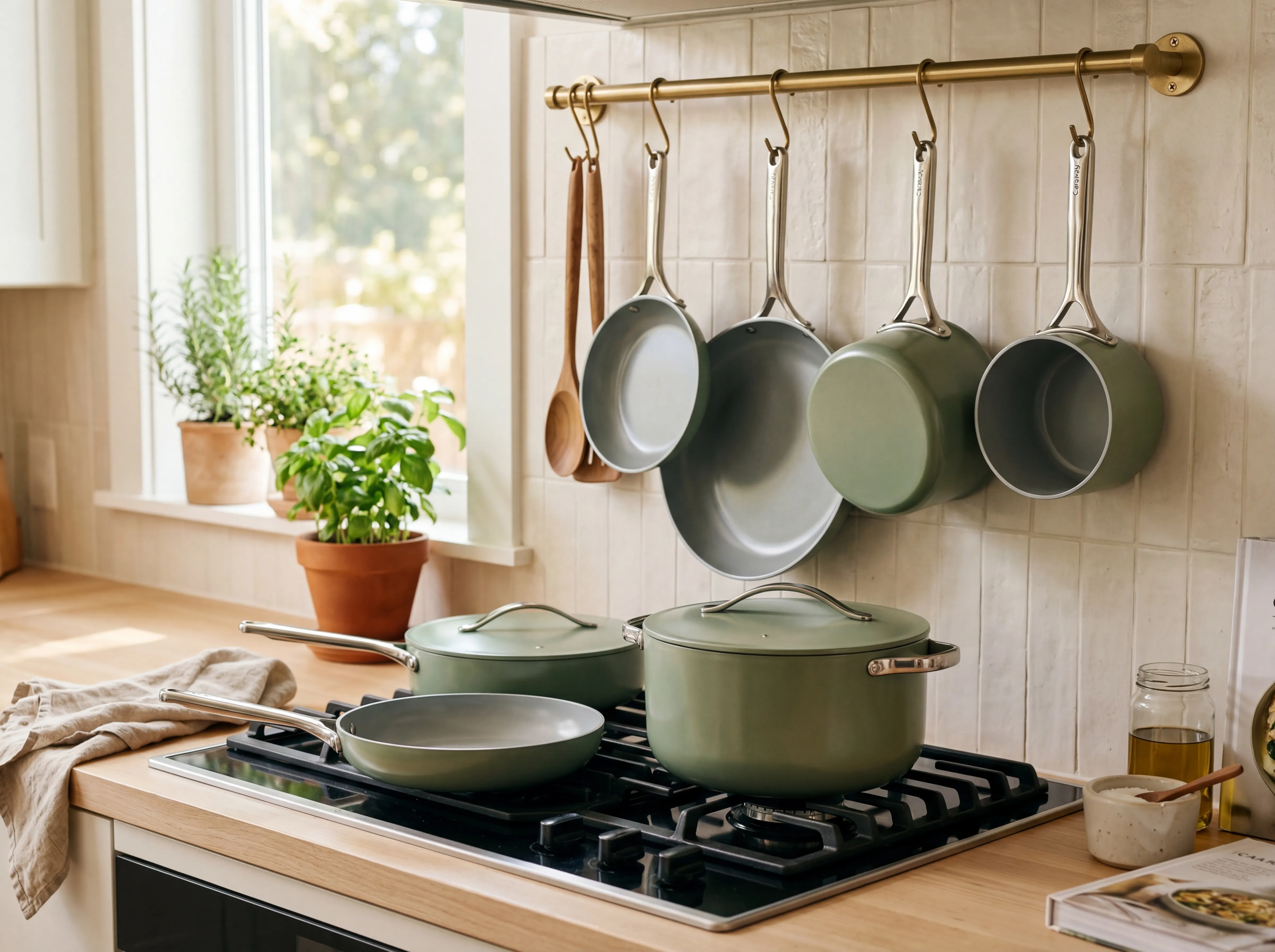
Caraway is the brand that put non-toxic cookware on the map for mainstream buyers. Their 12-piece set includes a 10.5” fry pan, 3 qt saucepan, 4.5 qt sauté pan, 6.5 qt Dutch oven, four lids, and a magnetic pan rack for storage.
Every piece is third-party tested and certified free of PFAS, PTFE, lead, and cadmium. The ceramic coating slides eggs around the pan without oil. After five-plus years of long-term testing by The Kitchn, the nonstick performance held up well.
What I like: Beautiful design, excellent storage system with the included pan rack, and genuinely slick nonstick surface. The 12-piece set is a complete kitchen overhaul.
What to know: Caraway recommends low-to-medium heat only, which limits searing capability. Some users report coating degradation within 9-12 months of heavy use, and the warranty is only one year. At $445, you are paying premium prices for a coating with a finite lifespan.
The regular list price is $675. Caraway frequently runs promotions, so $445 is a common sale price. They also offer a Stainless Steel Cookware Set at $695 (regular $845) if you want the uncoated option.
2. GreenPan Spectra Hybrid Set - ~$350
Best ceramic for high-heat cooking
GreenPan pioneered ceramic nonstick coatings back in 2007 with their Thermolon technology, and the Spectra Hybrid is their most advanced line yet. It combines their diamond-reinforced Thermolon 9G ceramic coating with stainless steel construction, so you get nonstick convenience with better heat tolerance than a typical ceramic pan.
Every GreenPan product is made without PFAS, PFOA, PTFE, lead, and cadmium. Unlike some ceramic brands, GreenPan has been transparent about their coating composition for nearly two decades.
What I like: The Spectra Hybrid finally solves the “ceramic pans cannot sear” problem. Stainless steel rims and handles provide top-tier durability. The diamond-reinforced coating is noticeably tougher than earlier GreenPan generations.
What to know: Even with improvements, ceramic coatings still degrade over time. GreenPan’s Valencia Pro ($250 for a 10-piece set) is a solid budget alternative if the Spectra is out of range.
3. Our Place Always Pan 2.0 - $99-$150
Best single-pan buy
The Always Pan 2.0 is a 10.5-inch ceramic nonstick pan that replaces eight pieces of cookware: a fry pan, sauté pan, steamer, skillet, saucier, spatula, spoon rest, and lid. It comes with a modular lid and steamer basket.
Our Place’s ceramic coating is made without PFAS, PTFE, lead, or cadmium. The 2.0 version (launched in 2023) added oven safety up to 450 degrees Fahrenheit and improved the nonstick coating significantly over the original.
What I like: Incredible value at the sale price of $99. The nonstick surface is genuinely impressive. Great for small kitchens or anyone who does not want a full cookware set. Comes in over a dozen colors.
What to know: The full retail price is $150, but it regularly drops to $99 on Amazon. Not ideal for large families since it is only 10.5 inches. One pan will not replace a complete cookware set for serious cooking.
Best Cast Iron Cookware
Cast iron is the original non-toxic cookware. It is made from iron and carbon, seasoned with vegetable oil, and contains zero synthetic chemicals. It lasts generations. The tradeoff: it is heavy, requires seasoning maintenance, and reacts with acidic foods.
4. Lodge 10.25” Classic Cast Iron Skillet - ~$30
Best budget non-toxic option
Lodge has been making cast iron in South Pittsburg, Tennessee since 1896. Their 10.25-inch skillet comes pre-seasoned with 100% natural vegetable oil. No PFAS, no PTFE, no chemical coatings of any kind. Lodge verifies this through third-party lab testing for PFAS, lead, and cadmium.
At around $30, this is the most affordable piece of truly non-toxic cookware you can buy. It will outlast every ceramic-coated pan on this list by decades.
What I like: Unbeatable value. Naturally nonstick when properly seasoned. Goes from stovetop to oven to campfire. Gets better with age. Lodge also offers a 5-piece set for under $80 if you want multiple sizes.
What to know: It weighs about 5 pounds. Requires some seasoning maintenance (though less than people think). Avoid cooking highly acidic foods like tomato sauce for extended periods in bare cast iron.
5. Le Creuset Signature Round Dutch Oven (5.5 qt) - $420
Best enameled cast iron
Le Creuset has been handcrafting enameled cast iron in Fresnoy-le-Grand, France since 1925. The enamel coating is made from powdered glass fused to cast iron at high temperatures. No PFAS, no PTFE, no chemical nonstick layers.
The 5.5-quart Signature Dutch Oven is their most popular size. It handles braising, soups, stews, bread baking, and slow cooking. The enamel interior minimizes sticking without seasoning, and you can cook acidic foods without any reactivity concerns.
What I like: Exceptional heat retention. The enamel coating never needs seasoning. Oven-safe, dishwasher-safe, and works on all cooktops including induction. The lifetime warranty is real. This pot will be in your kitchen for 30+ years.
What to know: $420 is a serious investment. It weighs over 10 pounds. For a budget enameled cast iron option, look at the Tramontina Enameled Cast Iron Series 1000, which Consumer Reports rated highly at roughly half the price.
Best Stainless Steel Cookware
Stainless steel is the gold standard for non-toxic cooking. No coatings, no chemicals, no degradation over time. It is non-reactive, meaning it will not interact with acidic ingredients. The only learning curve: food will stick if you do not use proper technique (preheat the pan, use enough fat, and let proteins release naturally).
6. Made In 10-Piece Stainless Clad Set - $799
Best stainless steel set
Made In’s 5-ply stainless clad construction uses an 18/10 stainless steel cooking surface with a heavy-gauge aluminum core. Their direct-to-consumer model means you get cookware that rivals All-Clad’s performance at a lower price point.
The 10-piece set includes an 8” fry pan, 10” fry pan, 2 qt saucepan with lid, 3 qt saucepan with lid, 3.5 qt sauté pan with lid, and 8 qt stockpot with lid. All pieces are oven-safe up to 800 degrees Fahrenheit, compatible with all cooktops (including induction), and dishwasher-safe.
Made In publishes their Light Labs testing data, which shows all their stainless steel products passed 30 out of 30 PFAS tests. They carry a lifetime warranty.
What I like: Outstanding heat distribution. In testing, the Made In frying pan reached a boil faster than All-Clad (2 minutes 21 seconds). Flared rims make pouring clean and easy. The brushed exterior looks professional without being fussy. This is cookware that will never wear out.
What to know: Stainless steel has a learning curve. Food will stick if you are coming from nonstick pans. The 13-piece set ($1,199) adds a few more pieces if you want the full lineup. Made In also offers a 3-piece fry pan set for $299 if you want to start small.
7. All-Clad D3 Stainless Steel - $130+ per piece
Best premium stainless steel
All-Clad’s D3 line is the benchmark for stainless steel cookware in America. Tri-ply bonded construction with an aluminum core for even heating. Made in Canonsburg, Pennsylvania. No coatings, no PFAS, no PTFE.
A 10-inch D3 fry pan runs about $130. The D3 10-piece set is around $700-$800. Individual saucepans start near $200. The D3 13-piece set at Costco runs approximately $1,130.
What I like: All-Clad has been the professional kitchen standard for decades. The tri-ply construction heats evenly and handles high heat without flinching. Oven and broiler safe to 600 degrees Fahrenheit. Made in the USA.
What to know: Only buy their stainless steel lines (D3, D5, Copper Core). All-Clad also makes PTFE-coated nonstick pans, and those contain PFAS. The “All-Clad” name alone does not guarantee safety. Check the specific product line. Made In offers comparable performance at a lower price if budget matters.
Best Pure Ceramic Cookware
Pure ceramic cookware is solid ceramic all the way through. No metal base, no coating. It is the most chemically inert cookware you can buy. The tradeoff: it is fragile, heavy, slow to heat, and food sticks more easily than other options.
8. Xtrema Versa Pan - $300
Safest cookware available
Xtrema is 100% ceramic to the core. Not a ceramic coating on metal. Solid ceramic. Every batch is third-party tested for heavy metals (lead and cadmium), and they publish the results. Their cookware passes California Prop 65 leach testing and uses no nanoparticles in production.
The Versa Pan is their most versatile piece. It goes from stovetop to oven to microwave to freezer to dishwasher. No seasoning required.
What I like: If your primary concern is eliminating every possible chemical exposure, Xtrema is the answer. No PFOA, no PTFE, no PFAS, no glaze chemicals. Mamavation’s independent acid bath testing confirmed Xtrema’s safety claims. Exceptional heat retention once it gets hot.
What to know: Food sticks. Eggs, cheese, lean meats all stick to the surface, even with plenty of oil. Xtrema is the slowest-heating cookware I have seen. It will crack or break if dropped or exposed to sudden temperature changes. At $300 for a single pan (with sales offering up to 20% off), this is a premium-priced product with real performance limitations.
Best Carbon Steel Cookware
Carbon steel is the professional chef’s alternative to cast iron. It is lighter, heats faster, and develops a natural nonstick seasoning over time. Like cast iron, it is made from iron and carbon with no synthetic chemicals.
9. de Buyer Mineral B 12.5” Skillet - ~$65
Best carbon steel pan
De Buyer has been crafting cookware in France since 1830. The Mineral B line is made from 100% natural materials: iron and beeswax. No chemicals, no coatings, no PFAS. The pan is lighter than cast iron of the same size but more durable than ceramic or stainless steel.
What I like: Develops a beautiful natural nonstick patina over time. Lighter than a comparable Lodge cast iron skillet by about 2 pounds. Handles high heat without any concern about coating breakdown. Eco-friendly and recyclable. At $65, it is an excellent value for a pan that will last your lifetime.
What to know: Requires initial seasoning (beeswax coating must be stripped and the pan seasoned with oil). Not dishwasher-safe. Reacts with acidic foods like tomato sauce. Handle gets hot.
10. Made In Carbon Steel Frying Pan - ~$89
Best carbon steel for beginners
Made In’s carbon steel pans are manufactured in Sweden using traditional techniques. Their Light Labs testing confirms all carbon steel products passed 30 out of 30 PFAS tests. The pans come pre-seasoned (lightly), so the initial seasoning process is less intimidating for first-timers.
What I like: Slightly easier to start with than de Buyer thanks to the pre-seasoning. Made In’s customer support and educational content make carbon steel less intimidating. Same lifetime durability as any carbon steel pan.
What to know: At $89, it costs more than the de Buyer for a similar product. You will still need to build up the seasoning over time.
Comparison Table: All Picks at a Glance
| Product | Material | PFAS-Free | Oven-Safe | Dishwasher-Safe | Weight (approx) | Price | Warranty |
|---|---|---|---|---|---|---|---|
| Caraway 12-Piece Set | Ceramic-coated aluminum | Yes | Yes (550°F) | Yes | ~4 lbs/pan | $445 | 1 year |
| GreenPan Spectra Hybrid | Ceramic-coated stainless | Yes | Yes | Yes | ~3 lbs/pan | ~$350 | 2 years |
| Our Place Always Pan 2.0 | Ceramic-coated aluminum | Yes | Yes (450°F) | Hand wash | ~3 lbs | $99-$150 | Limited |
| Lodge 10.25” Skillet | Cast iron | Yes | Yes (any temp) | No | ~5 lbs | ~$30 | Lifetime |
| Le Creuset 5.5 qt Dutch Oven | Enameled cast iron | Yes | Yes (500°F) | Yes | ~10 lbs | $420 | Lifetime |
| Made In 10-Piece Set | 5-ply stainless steel | Yes | Yes (800°F) | Yes | ~3 lbs/pan | $799 | Lifetime |
| All-Clad D3 Fry Pan | Tri-ply stainless steel | Yes | Yes (600°F) | Yes | ~2.5 lbs | $130 | Lifetime |
| Xtrema Versa Pan | 100% pure ceramic | Yes | Yes (any temp) | Yes | ~5 lbs | $300 | Limited |
| de Buyer Mineral B | Carbon steel | Yes | Yes (any temp) | No | ~4 lbs | ~$65 | Lifetime |
| Made In Carbon Steel Pan | Carbon steel | Yes | Yes (800°F) | No | ~4 lbs | ~$89 | Lifetime |
What to Avoid When Shopping for Non-Toxic Cookware
Avoid these red flags:
-
“PFOA-free” labels on nonstick pans. This only means one specific PFAS chemical was removed. The pan likely still contains PTFE and other PFAS compounds. It is a marketing trick.
-
Any pan labeled “Teflon” or “PTFE nonstick.” These coatings are made with PFAS chemicals. Period. Research from PerkinElmer found that scratched PTFE coatings release PFAS directly into food.
-
Unbranded nonstick cookware from discount stores. If a company will not disclose what is in their coating, that is a problem. The Ecology Center found undisclosed PFAS coatings are common on cookware.
-
Anodized aluminum with nonstick coatings. Hard-anodized aluminum is fine as a base material, but many brands add PTFE coatings on top. Check the specific coating, not just the base material.
-
Imported ceramic cookware without third-party testing. Some ceramic glazes (especially from unregulated manufacturers) can contain lead or cadmium. Stick with brands like Xtrema that publish their test results.
Brands with PTFE nonstick lines to watch out for: All-Clad (their nonstick line), Calphalon (most nonstick options), T-fal, and Cuisinart all sell PTFE-coated pans alongside their safe stainless steel options. Always check the specific product, not just the brand name.
If you are also swapping out other kitchen items, check out our guides to non-toxic air fryers and non-toxic food storage containers.
How to Make Your Non-Toxic Cookware Last
For ceramic-coated pans (Caraway, GreenPan, Our Place):
- Cook on low to medium heat. High heat degrades ceramic coatings.
- Use wooden, silicone, or nylon utensils. Metal utensils scratch the coating.
- Hand wash with a soft sponge. Dishwashers can be harsh on ceramic coatings over time.
- Use a small amount of oil or butter. Ceramic coatings last longer when you use a thin layer of fat.
For cast iron and carbon steel (Lodge, de Buyer, Made In):
- Season regularly. Rub a thin layer of high-smoke-point oil (flaxseed, avocado, or vegetable oil) and heat until it polymerizes.
- Avoid soaking in water. Dry immediately after washing.
- Skip the soap (or use just a tiny amount). A stiff brush and hot water handles most cleanup.
- Store in a dry place. Moisture causes rust.
For stainless steel (Made In, All-Clad):
- Preheat the pan before adding food. This prevents sticking.
- Use the water droplet test: when a drop of water beads up and rolls across the surface, the pan is ready.
- Deglaze with liquid to release stuck-on bits. This is not a flaw; it is how you build flavor.
- Bar Keeper’s Friend removes discoloration and stains easily.
FAQ
Is ceramic-coated cookware really non-toxic?
Yes. Ceramic coatings used by brands like Caraway, GreenPan, and Our Place are made from inorganic minerals (primarily silicon dioxide) using a sol-gel process. They contain no PFAS, PTFE, lead, or cadmium. The coating itself is safe. The only downside is durability: ceramic coatings wear out in 2-5 years, while bare metal cookware lasts a lifetime.
What is the safest cookware material overall?
Stainless steel and cast iron are the safest and most durable options. They have no coatings to wear off, no chemicals to leach, and they last forever. If you want the absolute purest option, Xtrema’s 100% ceramic cookware has no metal at all, though it has performance tradeoffs. For a balance of safety and everyday ease of use, a combination of stainless steel pans and one ceramic-coated nonstick pan is a practical approach.
Can I use ceramic-coated pans on high heat?
You should not. Most ceramic coatings degrade faster at temperatures above medium-high heat. This is the biggest limitation of ceramic-coated cookware. For searing steaks or stir-frying at high temperatures, use cast iron, carbon steel, or stainless steel instead. The GreenPan Spectra Hybrid handles higher heat better than most ceramic options, but it is still not ideal for screaming-hot searing.
Is All-Clad cookware non-toxic?
Their stainless steel lines (D3, D5, Copper Core) are completely non-toxic. However, All-Clad also sells PTFE-coated nonstick pans that contain PFAS. Do not assume all All-Clad products are safe. Check whether the specific product you are buying is uncoated stainless steel.
How do I know if my current cookware contains PFAS?
If your pans have a smooth, dark nonstick coating and they are not explicitly marketed as “ceramic nonstick” or “PFAS-free,” they almost certainly contain PTFE (and therefore PFAS). If the coating is scratched, chipped, or peeling, replace the pan. Scratched PTFE surfaces release microplastics and PFAS into food.
Are there any states banning PFAS in cookware?
Yes. Minnesota banned PFAS-coated nonstick cookware sales as of January 2025. Vermont, Connecticut, Rhode Island, and Colorado have restrictions taking effect between 2026 and 2028. This regulatory trend is accelerating, which is one more reason to switch now.
Is the Lodge cast iron skillet really non-toxic?
Yes. Lodge cast iron is made from iron and 100% natural vegetable oil for seasoning. Lodge has their cookware third-party tested for PFAS, lead, and cadmium, and it comes back clean every time. It is one of the most affordable and genuinely safe pieces of cookware you can buy.
What about copper cookware?
Copper cookware is safe when it is lined with stainless steel (as most modern copper pans are). Unlined copper can leach into acidic foods, so avoid it for cooking. Lined copper pans are excellent conductors of heat but tend to be very expensive and require polishing.
The Bottom Line
You do not need to spend $800 on a cookware set to cook safely. A $30 Lodge cast iron skillet and a $65 de Buyer carbon steel pan will handle 90% of your cooking without any chemical exposure. Add a stainless steel saucepan for boiling and acidic foods, and you have a complete, non-toxic kitchen for under $200.
If you prefer the convenience of nonstick, Caraway and GreenPan make genuinely safe ceramic-coated options. Just know that you will replace them every few years, while cast iron and stainless steel last a lifetime.
The most important thing: stop cooking on scratched, chipped, or peeling PTFE-coated pans. That is the single biggest upgrade you can make for your kitchen’s safety today.
For more ways to reduce chemical exposure at home, read our guides to non-toxic cleaning products and understanding PFAS forever chemicals.