Chlorine bleach is one of those products that feels essential until you learn what it actually does to your body, your clothes, and your home. It is a powerful oxidizer, but it is also a respiratory irritant, a skin and eye corrosive, and a source of toxic fumes that gets worse when mixed with other common household chemicals. The sharp smell that people associate with “clean” is actually chlorine gas irritating your airways. We put together non-toxic cleaning guide that covers this whole category.
Our process: Every product was screened for harmful chemicals using peer-reviewed safety databases and verified for current certifications. How we test The good news is that chlorine bleach is also one of the easiest toxic products to replace. Oxygen-based bleach alternatives use sodium percarbonate or hydrogen peroxide to whiten, brighten, and disinfect without chlorine gas, without damaging colored fabrics, and without the health risks. They work through the same fundamental chemistry (oxidation) but with a much safer oxidizer.
NonToxicLab tested four non-toxic bleach alternatives for whitening power, stain removal, disinfecting ability, and ingredient safety. Molly’s Suds Oxygen Whitener is our top pick for the cleanest formula and best overall performance. Here is how they all compare.
Why Chlorine Bleach Is a Problem
The Chemistry
Sodium hypochlorite (the active ingredient in liquid chlorine bleach like Clorox) is a strong oxidizer. When it contacts organic material, it breaks down molecular bonds through oxidation. This is what makes it effective at whitening, stain removal, and killing pathogens. But it is also what makes it dangerous.
When sodium hypochlorite reacts with organic matter (which includes your skin, your mucous membranes, and the fibers of your clothes), it releases chlorine gas and other volatile chlorine compounds. These are the fumes you smell when you use bleach, and they are genuinely harmful to inhale.
Health Concerns
- Respiratory irritation. Chlorine gas irritates the respiratory tract, even at low concentrations. Regular use of chlorine bleach in poorly ventilated spaces has been associated with increased asthma symptoms and reduced lung function.
- Skin and eye damage. Sodium hypochlorite is corrosive to skin and can cause chemical burns. Even diluted bleach can cause contact dermatitis with repeated exposure.
- Toxic gas reactions. Mixing bleach with ammonia (found in many cleaning products) produces chloramine gas, which can cause chest pain, shortness of breath, and in severe cases, pulmonary edema. Mixing bleach with acids (including vinegar) produces chlorine gas. These accidental mixing reactions send people to emergency rooms every year.
- Endocrine disruption. Some research has found associations between regular chlorine bleach use and endocrine disruption, though this area needs more study.
Environmental Impact
Chlorine bleach that enters wastewater can react with organic matter in the water supply to form organochlorine compounds, including trihalomethanes (THMs), which are regulated by the EPA as potential carcinogens. The environmental persistence of these compounds is a legitimate concern.
Fabric Damage
Chlorine bleach weakens fabric fibers with each use. It breaks down cellulose in cotton, degrades elastic fibers, and causes yellowing on white synthetic fabrics over time (the opposite of what you are trying to achieve). It also destroys colored dyes instantly, which is why one splash of bleach can ruin a favorite shirt.
Oxygen-based bleach avoids all of these problems. It whitens through a gentler oxidation process that is safe for colors, safe for fibers, and safe for you.
The Science of Sodium Percarbonate
Sodium percarbonate is the active ingredient in most non-toxic bleach alternatives. Understanding how it works helps you use it effectively.
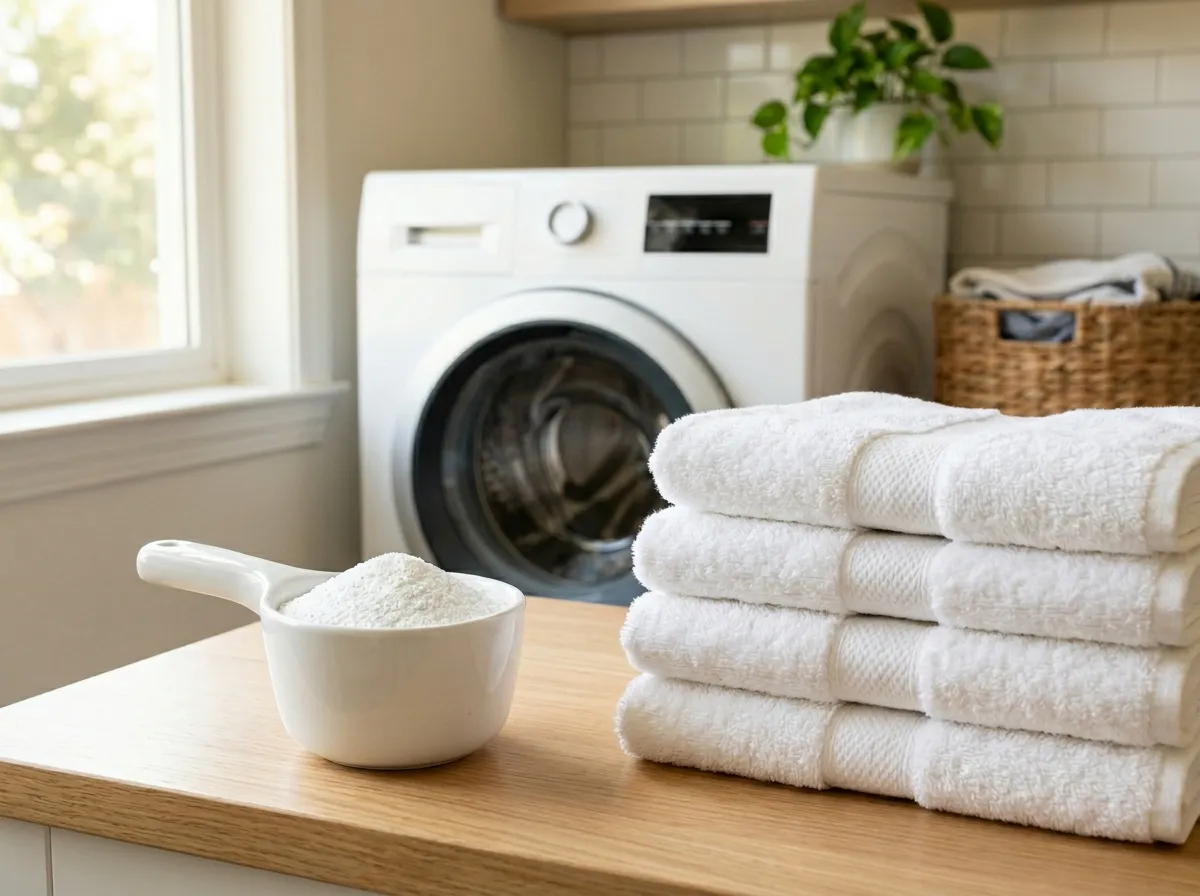
Sodium percarbonate is a stable compound made of sodium carbonate (soda ash) and hydrogen peroxide. It is a white, granular powder that looks similar to table salt. When dissolved in water, it breaks down into its two components:
Sodium percarbonate + Water = Sodium carbonate + Hydrogen peroxide
The hydrogen peroxide does the actual cleaning work. It is an oxidizer that breaks down chromophores (the molecular structures that give stains their color), kills bacteria and mold through oxidation, and whitens fabrics by decolorizing yellowed or dingy areas.
After it does its work, hydrogen peroxide breaks down into water and oxygen. That is it. No toxic residue, no fumes, no environmental persistence. The sodium carbonate (soda ash) left behind is a mild alkaline salt that softens water and boosts cleaning. It is the same compound used in many non-toxic cleaning products.
Temperature Matters
Sodium percarbonate activates most effectively in warm to hot water. The breakdown into hydrogen peroxide accelerates with temperature:
- Cold water (below 60 degrees F): Slow activation. Minimal whitening effect. Not recommended.
- Warm water (80-120 degrees F): Good activation. Effective for most whitening and stain removal tasks.
- Hot water (130-150 degrees F): Full activation. Best results for heavy whitening, deep stain removal, and disinfecting.
This is one important difference from chlorine bleach, which works in cold water. If you want maximum performance from oxygen-based bleach, use warm to hot water. For everyday loads where you just want a whitening boost, warm water is fine.
Dissolve First
Another key difference: sodium percarbonate powder should be dissolved in water before it contacts your clothes. Sprinkling dry powder directly onto fabric can cause localized bleaching (light spots on colored items) or uneven results. Dissolve the recommended amount in a cup of warm water, then add the solution to the wash water or drum.
The 4 Best Non-Toxic Bleach Alternatives
1. Molly’s Suds Oxygen Whitener (Best Overall)
Price: ~$15 for 41 oz | Buy on Amazon
Molly’s Suds Oxygen Whitener is pure sodium percarbonate. No fillers, no fragrance, no dyes, no surfactants, no mystery ingredients. The ingredient list is one item long: sodium percarbonate. That is the level of transparency I look for.
The brand started because founder Monica Leonard lost an infant son, which led her to research the chemicals in household products and eventually create a line of genuinely clean alternatives. Molly’s Suds is one of the few brands in the laundry space where the founder’s story directly connects to ingredient standards.
In testing, Molly’s Suds delivered the strongest whitening results on dingy white cotton. I soaked a set of yellowed white t-shirts in a basin of hot water with 2 tablespoons of Oxygen Whitener for 6 hours. The improvement was significant and visible. The shirts were not brand-new white, but they went from noticeably yellowed to bright and clean.
For regular use, I add 1 tablespoon to each load of whites in the wash cycle. Over several washes, whites get progressively brighter without the fiber damage that chlorine bleach causes.
Pros:
- Single ingredient: sodium percarbonate
- No fragrance, dyes, fillers, or additives
- Strong whitening performance
- Works as a stain remover, whitener, and deodorizer
- Certified cruelty-free
- Founded by a parent with a genuine mission
Cons:
- Needs warm to hot water for full activation
- Powder format requires dissolving before use
- Not a disinfectant at standard laundry concentrations (need hot water + extended contact)
Best for: Anyone who wants the purest possible bleach alternative with the shortest ingredient list.
2. Branch Basics Oxygen Boost (Best System Add-On)
Price: ~$15 for 2 lb bag | Buy on Amazon
Branch Basics Oxygen Boost is also pure sodium percarbonate. If you are already using the Branch Basics cleaning system (which NonToxicLab recommends as one of the best non-toxic cleaning products), the Oxygen Boost is the natural addition for whitening and stain treatment.
The performance is identical to Molly’s Suds because the active ingredient is the same. The difference is that Branch Basics positions it as part of their broader cleaning system, with specific usage instructions for combining it with their concentrate for stain removal, laundry boosting, and surface cleaning.
Branch Basics is MADE SAFE certified, which applies to their concentrate. The Oxygen Boost is pure sodium percarbonate, which is inherently safe and does not require certification because there is nothing in it to certify against.
Where Branch Basics adds value is in the stain removal application. Mixing a paste of Oxygen Boost with their concentrate creates a powerful non-toxic stain remover that handles wine, coffee, and organic stains effectively.
Pros:
- Pure sodium percarbonate
- MADE SAFE certified company
- Integrates with the Branch Basics cleaning system
- Versatile (laundry, stain removal, surface cleaning)
Cons:
- Same product as Molly’s Suds at a similar price
- Best value comes from pairing with the full Branch Basics system
- Needs warm to hot water for full activation
Best for: Branch Basics users who want to add whitening and oxygen-based stain fighting to their existing system.
3. Seventh Generation Chlorine-Free Bleach (Best Liquid Option)
Price: ~$7 for 64 oz | Buy on Amazon
Seventh Generation’s Chlorine-Free Bleach is a hydrogen peroxide-based liquid. Instead of sodium percarbonate powder, it uses stabilized hydrogen peroxide in a ready-to-use liquid format. This is the most convenient option on the list because there is no dissolving, no measuring powder, and no paste-making required.
The formula includes hydrogen peroxide as the active ingredient plus plant-derived surfactants and water. It is free of chlorine, synthetic fragrance, and dyes. The USDA BioPreferred designation means it meets bio-based content requirements.
Performance is good for everyday whitening. For heavy-duty jobs (soaking yellowed whites, removing set-in stains), sodium percarbonate powder products outperform liquid hydrogen peroxide because you can achieve higher concentrations. But for adding a whitening boost to regular loads, Seventh Generation works well and is available at virtually every grocery store and big-box retailer.
One note: Seventh Generation is owned by Unilever. If parent company ethics factor into your purchasing decisions, that is worth knowing. The product formula itself is clean.
Pros:
- Convenient liquid format
- No measuring or dissolving needed
- Hydrogen peroxide-based (no chlorine)
- Available in most stores
- USDA BioPreferred
- Affordable
Cons:
- Less concentrated than sodium percarbonate powder
- Owned by Unilever
- Not as effective on heavy-duty whitening jobs
- Contains some plant-derived surfactants (not pure hydrogen peroxide)
Best for: Convenience-oriented households, people who want a liquid they can pour and go.
4. Hydrogen Peroxide, 3% (Best Budget DIY)
Price: ~$3 for 32 oz at any pharmacy
Standard 3% hydrogen peroxide is the simplest, cheapest bleach alternative you can buy. It is the same compound that sodium percarbonate releases when dissolved in water, just in a ready-to-use liquid form.
For laundry, add 1 cup of 3% hydrogen peroxide to the bleach dispenser or directly to the wash water. It provides a mild whitening boost, helps with odor removal, and acts as a disinfectant in warm to hot water.
For stain treatment, apply 3% hydrogen peroxide directly to stains before washing. It is particularly effective on blood stains (it fizzes on contact with the enzyme catalase in blood, which breaks the stain apart), coffee, tea, and wine.
The limitation is concentration. At 3%, hydrogen peroxide is much more dilute than what you get from dissolving sodium percarbonate in water. For heavy whitening jobs, sodium percarbonate is more effective. But for everyday maintenance and light stain treatment, plain hydrogen peroxide is hard to beat on price.
Important: Hydrogen peroxide degrades with exposure to light. Keep it in its original brown bottle and store it in a cool, dark place. Once opened, it gradually loses potency over about 6 months. Test it by pouring a small amount on a cut potato; if it fizzes, it is still active.
Pros:
- Costs almost nothing
- Available at every pharmacy and grocery store
- Works as a whitener, stain remover, and disinfectant
- Zero additives (just H2O2 and water)
- Breaks down into water and oxygen
Cons:
- Low concentration (3%) limits whitening power
- Degrades over time
- Less effective than sodium percarbonate for heavy-duty tasks
- Can lighten dark fabrics if applied directly (test first)
Best for: Budget-conscious households, light whitening maintenance, and stain pretreatment.
How to Use Oxygen-Based Bleach Effectively
For Whitening Dingy Whites
- Fill a basin or bathtub with hot water (130-150 degrees F)
- Dissolve 2-3 tablespoons of sodium percarbonate per gallon of water
- Submerge white garments
- Soak for 4-8 hours (or overnight for heavily yellowed items)
- Wash as normal with your regular non-toxic detergent
- Repeat if needed; results improve with each treatment
For Regular Laundry Boost
- Add 1-2 tablespoons of sodium percarbonate to each load of whites or light colors
- Add it to the drum (dissolve in warm water first) before loading clothes
- Wash in warm or hot water for best activation
- Run a regular cycle
For Stain Removal
- Make a paste with 1 tablespoon sodium percarbonate and enough warm water to form a thick paste
- Apply to the stain
- Let it sit for 30 minutes to 2 hours
- Wash as normal
For protein stains (blood, food, baby messes), pair the oxygen treatment with an enzyme-based stain remover for the best results. Our stain remover guide covers this in detail.
For Cleaning (Non-Laundry)
Sodium percarbonate is versatile beyond laundry:
- Tile grout: Make a paste, apply to grout, let sit 30 minutes, scrub and rinse
- Toilet bowls: Add 2 tablespoons to the bowl, let sit 30 minutes, scrub
- Cutting boards: Dissolve 1 tablespoon in warm water, soak the board for 30 minutes
- Deck and patio cleaning: Dissolve in a bucket of hot water and scrub outdoor surfaces
- Washing machine cleaning: Use as part of a regular washing machine cleaning routine
Oxygen Bleach vs Chlorine Bleach: Side by Side
| Feature | Oxygen Bleach (Sodium Percarbonate) | Chlorine Bleach (Sodium Hypochlorite) |
|---|---|---|
| Active Agent | Hydrogen peroxide (from sodium percarbonate) | Chlorine (from sodium hypochlorite) |
| Fumes | None | Chlorine gas (respiratory irritant) |
| Color Safety | Safe for colors (color-safe bleach) | Destroys dyes on contact |
| Fabric Damage | Minimal, even with regular use | Weakens fibers over time |
| Whitening Power | Good to excellent (needs warm water) | Excellent (works in any temperature) |
| Disinfecting | Yes (in hot water with extended contact) | Yes (highly effective) |
| Environmental Impact | Breaks down to water, oxygen, and soda ash | Forms organochlorine compounds in wastewater |
| Mixing Dangers | No dangerous reactions | Deadly when mixed with ammonia or acids |
| Shelf Life | Powder: 1-2 years; liquid: 6 months | About 6 months |
| Cost | Comparable | Comparable |
The one area where chlorine bleach has a genuine advantage is cold-water disinfecting. Sodium hypochlorite kills pathogens effectively in cold water with short contact times. Oxygen-based bleach needs warm to hot water and longer contact times for equivalent disinfection. For medical-grade disinfection needs, consult your healthcare provider. For everyday laundry whitening and household cleaning, oxygen-based bleach is the better choice.
Quick Answers
Is oxygen bleach safe for all fabrics?
Oxygen bleach is safe for most washable fabrics including cotton, linen, polyester, nylon, and blends. It is generally safe for colored fabrics (it is marketed as “color-safe bleach”), though very old or already-fading dyes can lighten slightly. Always test on a hidden area first for garments you care about. Avoid using oxygen bleach on silk, wool, and other protein fibers, as the alkaline pH can damage them. For those, stick with a pH-balanced wool wash.
Can oxygen bleach disinfect?
Yes, but it requires warm to hot water and adequate contact time. Hydrogen peroxide (the active oxidizer released by sodium percarbonate) is a recognized disinfectant. At the concentrations used in laundry, it kills common bacteria and molds when used with warm water and at least 10-15 minutes of contact. It is not a replacement for medical-grade sterilization, but for household laundry disinfecting (think gym clothes, dish towels, pet bedding), it works well.
How does sodium percarbonate compare to hydrogen peroxide?
Sodium percarbonate is essentially hydrogen peroxide in powder form. When dissolved in water, sodium percarbonate releases hydrogen peroxide plus soda ash. The powder form is more concentrated, more shelf-stable, and easier to store than liquid hydrogen peroxide. For heavy-duty whitening and soaking, sodium percarbonate delivers stronger results. For quick stain pretreating and everyday use, liquid hydrogen peroxide is more convenient.
Can I use oxygen bleach in a front-loading HE washer?
Yes. Sodium percarbonate is safe for HE machines. Add it to the drum (dissolved in warm water) before loading clothes, or add it to the bleach or additive dispenser. It does not produce excess suds, so it is fully compatible with the HE wash cycle. It also helps keep the machine clean, which is a bonus for front-loaders that are prone to mold and odor buildup.
Is OxiClean the same as sodium percarbonate?
OxiClean’s active ingredient is sodium percarbonate, so the core chemistry is the same. However, OxiClean products also contain additional ingredients like surfactants, polymers, and (in some formulations) fragrance. If you want pure sodium percarbonate without any additives, Molly’s Suds or Branch Basics Oxygen Boost are cleaner options. OxiClean works, but the ingredient list is not as transparent. We cover this more in our stain remover guide.
Will oxygen bleach remove mold from clothes?
Yes. Hydrogen peroxide is a recognized fungicide. For mold on washable clothes, dissolve 2-3 tablespoons of sodium percarbonate in a basin of hot water and soak the affected garments for several hours. Then wash in hot water with your regular non-toxic detergent. For heavy mold, you may need to repeat the process. Address the root cause (damp storage, a moldy closet, or a dirty washing machine) to prevent recurrence.
What We Recommend
Chlorine bleach is a relic. It works, but the health risks, the fabric damage, the toxic fumes, and the environmental impact make it unnecessary when oxygen-based alternatives perform nearly as well without any of the downsides.
Molly’s Suds Oxygen Whitener gives you pure sodium percarbonate with nothing else. Branch Basics Oxygen Boost does the same for Branch Basics users. Seventh Generation offers a convenient liquid if you do not want to deal with powder. And a $3 bottle of hydrogen peroxide from the drugstore handles light whitening and stain treatment just fine.
Switch your whites to oxygen-based bleaching, and within a few cycles you will notice they are getting brighter without the chemical smell, without the fiber damage, and without the worry. Pair it with a non-toxic detergent and wool dryer balls, and your entire laundry routine is free of harsh chemicals.
For a full walkthrough of building a complete non-toxic laundry system, check our non-toxic laundry routine guide.
This article was independently researched and written by NonToxicLab. We are not sponsored by any brand mentioned. Some links are affiliate links, meaning we may earn a small commission at no extra cost to you. This helps support our research and keeps the site running. See our full affiliate disclosure for details.
Sources
- U.S. EPA. Toxicological profile for sodium hypochlorite and chlorine compounds.
- American Association of Poison Control Centers. Annual reports on bleach-related chemical exposures.
- McKenzie, L.C. et al. “Chemical Composition of Sodium Percarbonate: An Inquiry-Based Laboratory Exercise.” Journal of Chemical Education, 2013.
- CDC. “Chemical Disinfectants: Guideline for Disinfection and Sterilization in Healthcare Facilities.” cdc.gov
- U.S. EPA. Trihalomethane (THM) formation from chlorine-based products in wastewater.
- Steinemann, A. “Fragranced consumer products: chemicals emitted, ingredients unlisted.” Environmental Impact Assessment Review.