The best non-toxic bathroom cleaners handle mold, soap scum, toilet bowls, and glass without chlorine bleach, synthetic fragrance, or harsh fumes. After testing multiple products across every bathroom surface, NonToxicLab recommends Branch Basics as the top overall pick for its versatility and ingredient purity, while Force of Nature is the best option when you need EPA-registered disinfecting power. Our non-toxic cleaning guide covers everything you need to know.
Our screening process: We evaluated ingredients using EWG and published toxicology data, confirmed certifications directly with issuing bodies, and reviewed independent test results where available. Full methodology The bathroom is where most people use the harshest chemicals in their home. Bleach sprays, acid-based toilet cleaners, aerosol mold removers. The logic is that bathrooms are germy, so they need aggressive chemicals. But you can get a genuinely clean bathroom without fumigating yourself in the process.
Quick Picks: Best Non-Toxic Bathroom Cleaners at a Glance
| Product | Badge | Price | Best For |
|---|---|---|---|
| Branch Basics | Best Overall | $55 kit | All bathroom surfaces |
| Force of Nature | Best Disinfectant | $90 kit | Killing germs and mold |
| Seventh Generation | Most Widely Available | $5 | Grocery store accessibility |
| Better Life | Best for Tile & Grout | $8 | Soap scum and grout stains |
| Method | Best for Daily Use | $5 | Quick daily wipe-downs |
| Mrs. Meyer’s | Use With Caution | $5 | Read review before buying |
What’s in Conventional Bathroom Cleaners (and Why It Matters)
Your bathroom is small, often poorly ventilated, and you’re spraying chemicals at face level while you scrub. That combination makes the bathroom the most concerning room in the house for chemical exposure. Here’s what you’re breathing in with conventional cleaners.
Chlorine Bleach (Sodium Hypochlorite)
Bleach is the most common active ingredient in conventional bathroom cleaners, and it’s the one that gives your bathroom that “clean” smell. The problem is that the smell is actually chlorine gas, and in a small, steamy bathroom, you’re getting a concentrated dose.
Bleach reacts with organic matter (skin cells, soap scum, mold) to produce chloroform and other volatile organic compounds. A study published in Environmental Science & Technology found that indoor chlorine bleach use can generate airborne concentrations of chloroform that exceed workplace exposure limits. In a small bathroom with the door closed, you’re essentially hotboxing yourself with chloroform.
It’s effective at killing mold and bacteria. Nobody denies that. But it’s not the only option, and the trade-off isn’t worth it when safer alternatives exist.
Hydrochloric Acid
Many toilet bowl cleaners contain hydrochloric acid (also labeled as hydrogen chloride or muriatic acid). It’s incredibly effective at removing mineral deposits and rust stains. It’s also extremely corrosive and produces irritating fumes. If it splashes on your skin, it burns. If it contacts bleach (which absolutely happens when people mix cleaners or don’t rinse between products), it produces chlorine gas, which can be lethal in enclosed spaces.
Synthetic Fragrance
You know the pattern by now. “Fragrance” on a label masks an unknown blend of chemicals, potentially including phthalates and other endocrine disruptors. In the bathroom, fragrance chemicals are aerosolized by spray bottles and become airborne in the steam from hot showers.
Dr. Shanna Swan’s research, detailed in Count Down, has linked phthalate exposure from fragranced consumer products to reproductive harm. The bathroom is one of the primary exposure points because you’re using fragranced cleaners in a small space with limited ventilation, often while taking a hot shower that opens your pores.
Quaternary Ammonium Compounds (Quats)
Quats are antimicrobial agents found in many bathroom disinfectants. They’re effective at killing bacteria, but they’re also respiratory irritants and have been associated with asthma development, particularly with repeated occupational exposure. A study in the American Journal of Industrial Medicine found elevated asthma risk among cleaning workers regularly exposed to quats.
The issue with quats in the bathroom is cumulative. You spray them, they linger on surfaces, and you breathe them in every time you use the bathroom afterward. They don’t evaporate quickly.
2-Butoxyethanol
This is a solvent found in many glass cleaners and all-purpose bathroom sprays. It’s absorbed through the skin and through inhalation, and at high concentrations, it can damage red blood cells, the liver, and kidneys. The EPA doesn’t require it to be listed on labels because it’s classified as a glycol ether, not a volatile organic compound. So it’s another ingredient that’s hard to spot.
Can Non-Toxic Products Actually Kill Mold?
This is the big question, and I want to give you an honest answer: it depends on the product.
Force of Nature can. It generates hypochlorous acid (HOCl) from salt, water, and vinegar using a small electrolyzer. Hypochlorous acid is the same substance your immune system produces to kill pathogens. It’s an EPA-registered disinfectant and sanitizer that kills bacteria, viruses, and mold on contact. It’s also used in wound care and food safety, which tells you something about its safety profile. If you need to genuinely disinfect and kill mold, this is the non-toxic option that does it.
Thymol-based products (Seventh Generation Disinfecting) can kill some mold. Thymol is derived from thyme oil and has natural antimicrobial properties. Seventh Generation’s disinfecting bathroom cleaner uses thymol as its active ingredient and is EPA-registered as a disinfectant.
Vinegar kills some mold species but not all. White vinegar (5% acetic acid) has been shown to kill about 82% of mold species. It’s not as thorough as hypochlorous acid or bleach, but for light mold in a shower or on tile, it works. Spray it on, let it sit for an hour, then scrub.
Hydrogen peroxide (3%) kills mold. Spray it on the affected area, let it sit for 10 minutes, then scrub. It’s effective and leaves no toxic residue. You’ll find more details on using hydrogen peroxide and other DIY solutions in our DIY non-toxic cleaning recipes guide.
Baking soda paste works for surface mold. Mix baking soda with water to form a paste, apply it to moldy grout or caulk, let it sit for 15 minutes, and scrub. It’s mildly abrasive, which helps with grout, and the alkaline pH inhibits future mold growth.
For serious mold problems (large areas, recurring mold, mold behind walls), you need professional remediation. No consumer product, toxic or non-toxic, is appropriate for structural mold issues.
The 6 Best Non-Toxic Bathroom Cleaners in 2026
1. Branch Basics Concentrate (Best Overall)
Price: $55 for starter kit | Buy on Amazon
Branch Basics is my top pick for bathroom cleaning for the same reason it tops our non-toxic cleaning products, dish soap, and laundry detergent guides: one concentrate handles everything, and the ingredient list is the cleanest available.
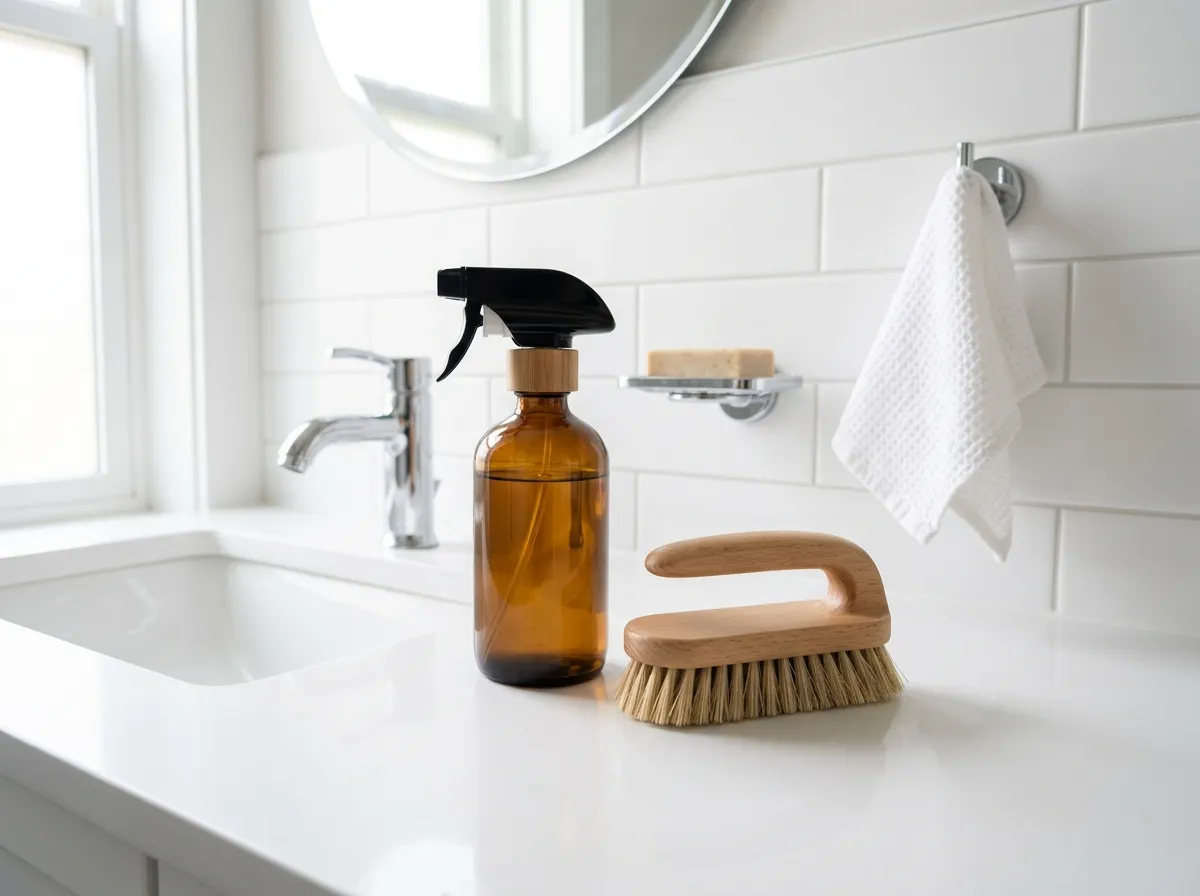
For the bathroom, you dilute the concentrate into their bathroom spray bottle (a stronger dilution than the all-purpose mix) and use it on tile, grout, countertops, sinks, tubs, mirrors, and the exterior of the toilet. Combined with their Oxygen Boost powder (sodium percarbonate) for tougher jobs, it handles just about every bathroom surface.
The ingredient list is short and fully transparent: purified water, organic chamomile, organic coco glucoside, organic decyl glucoside, and a few more plant-derived surfactants. MADE SAFE certified, which means it’s been screened against a full database of toxic chemicals, including contaminants that can form during manufacturing.
For soap scum, spray and let it sit for 5-10 minutes before scrubbing. For grout, make a paste with Oxygen Boost powder and water, apply it to grout lines, let it sit for 15-30 minutes, and scrub with a stiff brush. For mirrors and glass, dilute the concentrate to their glass cleaner ratio and spray.
What it does well: Everyday bathroom cleaning, soap scum, light mold prevention, mirrors, countertops, tub, and sink.
What it doesn’t do: It’s not a disinfectant. If you need to kill bacteria or viruses (someone’s been sick, there’s active mold growth), you’ll need Force of Nature or another registered disinfectant.
Certifications: MADE SAFE, cruelty-free
2. Force of Nature (Best Disinfectant and Best for Mold)
Price: $90 starter kit (makes 50+ bottles) | Buy on Amazon
Force of Nature is the only product on this list that is both genuinely non-toxic and an EPA-registered disinfectant. It works by passing an electrical current through a capsule of salt, water, and vinegar, converting it into hypochlorous acid. The resulting solution kills 99.9% of bacteria and viruses, including staph, MRSA, norovirus, influenza, and salmonella.
For mold specifically, hypochlorous acid is highly effective. Spray it directly on mold, let it sit for 10 minutes, and wipe or scrub away. Unlike bleach, it doesn’t produce toxic fumes, irritate your skin, or damage colored grout and surfaces.
This starter kit includes the electrolyzer appliance, five capsules (each makes one 12 oz bottle), and a spray bottle. After the initial investment, refill capsules cost about $0.07 per ounce, making it cheaper per use than most conventional cleaning sprays.
I featured Force of Nature in our best non-toxic cleaning products roundup, and the bathroom is where it shines brightest. This is where you actually need disinfecting power, and Force of Nature delivers it without the chemical exposure.
Andrew Huberman has discussed the importance of reducing household chemical exposure as part of maintaining hormonal health. Force of Nature represents what this looks like in practice: real cleaning power with virtually no chemical downside.
What it does well: Disinfecting, mold killing, toilet sanitizing, any surface where you need germ-killing ability.
What it doesn’t do: Heavy scrubbing of soap scum and mineral deposits. It’s a disinfectant, not an abrasive cleaner. For soap scum and hard water stains, pair it with a scrub brush or use Branch Basics or Better Life for the scrubbing step, then follow with Force of Nature for disinfection.
Certifications: EPA-registered disinfectant and sanitizer, no harsh chemicals
3. Seventh Generation Disinfecting Bathroom Cleaner (Most Widely Available)
Price: $5 for 26 oz | Buy on Amazon
Seventh Generation’s disinfecting bathroom cleaner uses thymol (derived from thyme oil) as its active ingredient. Thymol is a naturally occurring antimicrobial compound, and this product is EPA-registered as a disinfectant. It kills common household bacteria without chlorine bleach, quats, or synthetic fragrance.
By far the biggest advantage here is availability. You can pick this up at Target, Walmart, or your grocery store. No starter kits, no online ordering, no waiting. If you want a non-toxic bathroom disinfectant today, this is probably the fastest way to get one.
The fragrance-free version (look for “Lemongrass Citrus” or check for the fragrance-free option) is the one I recommend. As with all Seventh Generation products, their scented lines are a mixed bag, so check the label.
Performance is good for general bathroom disinfecting. It handles toilet seats, sink handles, countertops, and other frequently touched surfaces well. For heavy soap scum or grout stains, it’s not as effective as Better Life or Branch Basics with Oxygen Boost.
What it does well: Surface disinfection, daily bathroom maintenance, accessibility.
What it doesn’t do: Heavy soap scum removal, deep grout cleaning, mold removal on porous surfaces.
Certifications: EPA-registered disinfectant, USDA Certified Biobased
4. Better Life Natural Tub and Tile Cleaner (Best for Tile and Grout)
Price: $8 for 32 oz | Buy on Amazon
If soap scum and dingy grout are your main bathroom headaches, Better Life is worth a look. This formula was specifically designed for tub, tile, and grout, and it shows. The plant-based surfactants and citric acid cut through soap scum effectively, and the slightly foaming formula clings to vertical surfaces long enough to work.
A ingredient list is EWG-A rated and fully transparent. No synthetic fragrance, no chlorine, no ammonia, no dyes. The Tea Tree & Eucalyptus scent comes from essential oils, and there’s also an unscented version.
I tested this on a bathtub with about two weeks of soap scum buildup. Sprayed it on, let it sit for five minutes, and scrubbed with a non-scratch sponge. The tub came out noticeably clean. For grout, I sprayed the product into grout lines, let it sit longer (about 10 minutes), and scrubbed with a grout brush. It handled light to moderate grout staining well. For deeply stained grout, I’d still use a baking soda and hydrogen peroxide paste, but Better Life is the best spray-and-scrub option I’ve found.
It works on glass shower doors too, cutting through the soap scum and hard water film that makes glass look permanently foggy.
What it does well: Soap scum removal, tub and tile cleaning, glass shower doors, light to moderate grout stains.
What it doesn’t do: Disinfect. This is a cleaner, not a disinfectant. Pair with Force of Nature if you need germ-killing power.
Certifications: EWG-A, cruelty-free
5. Method Antibac Bathroom Cleaner (Best for Daily Maintenance)
Price: $5 for 28 oz | Buy on Amazon
Method’s bathroom cleaner uses citric acid as its active ingredient. It’s a light cleaner designed for daily maintenance rather than deep cleaning. Spray it on sinks, countertops, and toilet exteriors after use, and it prevents buildup from forming in the first place.
A ingredient list is reasonable. Plant-derived surfactants, citric acid, and lactic acid do the cleaning. However, I want to be upfront: some Method products contain “fragrance” on the label. Their Spearmint variety uses a blend of essential oils and fragrance compounds. If you can find the fragrance-free version, that’s the safer bet.
Method is widely available at Target, grocery stores, and online. It’s a good daily maintenance spray that keeps a clean bathroom clean. It’s not powerful enough for deep cleaning, soap scum removal, or mold treatment.
I’m including Method with a caveat: check the specific product’s ingredient list. Method’s product line varies significantly in ingredient quality across different items. Some are genuinely clean. Others use the fragrance loophole. Don’t assume all Method products meet the same standard.
What it does well: Daily wipe-downs, preventing soap scum buildup, light surface cleaning, accessibility.
What it doesn’t do: Deep cleaning, soap scum removal, mold killing, grout stains. This is a maintenance product, not a problem solver.
Certifications: Cradle to Cradle certified (varies by product)
6. Mrs. Meyer’s Clean Day Bathroom Cleaner (Use With Caution)
Price: $5 for 24 oz | Buy on Amazon
I’m including Mrs. Meyer’s on this list so I can be direct about why it doesn’t earn a full recommendation. Mrs. Meyer’s has built a brand around the aesthetic of clean, natural products. The packaging is charming. The scents are appealing. But the ingredient list tells a different story.
Mrs. Meyer’s bathroom cleaner lists “fragrance” as an ingredient. That single word means they’re using the trade secret loophole to avoid disclosing the full chemical composition of their scent blend. This is the same issue I’ve flagged in our laundry detergent guide and dish soap guide. It disqualifies the product from being truly non-toxic in my book.
Anne Steinemann, a professor at the University of Melbourne who has published peer-reviewed research on fragranced products, found that these products emit numerous volatile organic compounds not listed on the label, including some classified as hazardous.
The plant-derived surfactants and cleaning agents in Mrs. Meyer’s are fine. The issue is exclusively the fragrance. If Mrs. Meyer’s reformulated with full fragrance transparency or offered a fragrance-free version, I’d reconsider. Until then, it gets a cautionary mention rather than a recommendation.
If you’re currently using Mrs. Meyer’s: You’re better off than if you were using Scrubbing Bubbles or Clorox. But there are genuinely non-toxic options that clean just as well. Branch Basics, Seventh Generation Free & Clear, and Better Life all outperform Mrs. Meyer’s on ingredient safety without sacrificing cleaning ability.
Non-Toxic Bathroom Cleaning by Surface
Toilet Bowl
For routine cleaning, a squirt of Branch Basics (bathroom concentration) or Seventh Generation around the bowl, let it sit for 10 minutes, and scrub with a toilet brush. For mineral stains and rings, make a paste of baking soda and white vinegar, apply it to the ring, let it sit for 30 minutes, and scrub.
For disinfecting (after someone’s been sick, for instance), Force of Nature is the way to go. Spray the bowl, seat, handle, and surrounding area, let it sit for the contact time listed on the label, and wipe.
Skip conventional toilet bowl cleaners entirely. The hydrochloric acid in most of them is unnecessary for routine cleaning and creates a real chemical hazard in your home.
Shower Tile and Grout
Spray Better Life Tub & Tile or Branch Basics bathroom spray on tile and grout. Let it sit for 5-10 minutes. Scrub with a stiff-bristle grout brush. For stubborn grout stains, apply a paste of baking soda and hydrogen peroxide (3%), let it sit for 20-30 minutes, and scrub.
To prevent soap scum and mold, squeegee your shower walls after each use. This takes 30 seconds and makes a dramatic difference. A well-ventilated bathroom with a squeegee routine needs deep cleaning far less often.
Mirrors and Glass
Branch Basics diluted to glass cleaner concentration, or a simple 50/50 mix of white vinegar and water, works perfectly. Spray and wipe with a microfiber cloth or newspaper (newspaper actually works great for streak-free glass). Avoid paper towels, which leave lint.
Bathtub
For soap scum, Better Life Tub & Tile is the strongest non-toxic option. Spray it on, let it sit, and scrub with a non-scratch sponge. For regular maintenance, Branch Basics bathroom spray after each bath keeps things clean between deep cleans.
For deeply stained tubs, make a paste of baking soda and dish soap (Puracy or Branch Basics), spread it over the stain, let it sit for 30 minutes, and scrub. The mild abrasiveness of baking soda combined with the surfactants in the dish soap handles most stains.
Bathroom Floors
Your bathroom floor gets cleaned when you clean your floors, but for spot cleaning around the toilet and in front of the tub, a quick spray of Branch Basics all-purpose or Seventh Generation works well. For a full room-by-room approach, our non-toxic cleaning guide covers everything.
Ventilation Matters More Than You Think
Even with non-toxic cleaning products, proper bathroom ventilation is important. Run your exhaust fan during and for 20 minutes after every shower. If you don’t have an exhaust fan, open a window. Mold growth is primarily a moisture problem. Control the moisture and you’ll spend a lot less time fighting mold.
If you’re dealing with persistent bathroom moisture issues, an air purifier with a HEPA filter won’t remove moisture, but it will capture mold spores that become airborne. The real solution, though, is better ventilation and reducing humidity.
Our how to detox your home guide covers ventilation as part of a whole-house approach to reducing chemical and allergen exposure.
Reader Questions
Can non-toxic bathroom cleaners really kill mold?
Yes, but not all of them. Force of Nature (hypochlorous acid) is the most effective non-toxic mold killer. White vinegar kills about 82% of mold species. Hydrogen peroxide (3%) is also effective. For serious or recurring mold, address the underlying moisture problem first. No cleaner, toxic or otherwise, permanently solves mold without fixing ventilation and humidity.
What can I use instead of bleach in the bathroom?
Force of Nature is the closest non-toxic equivalent to bleach. It disinfects with EPA-registered efficacy without the fumes, skin irritation, or VOC exposure. For cleaning power (not disinfecting), Branch Basics, Better Life, and baking soda pastes handle everything bleach does on surfaces.
Is Mrs. Meyer’s bathroom cleaner safe?
These cleaning agents are plant-derived and relatively mild. The issue is the word “fragrance” on the label, which hides an undisclosed blend of chemicals. Without full ingredient transparency, I can’t call it genuinely non-toxic. Better options exist at the same price point.
How do I remove hard water stains without harsh chemicals?
White vinegar (5% acetic acid) dissolves mineral deposits. Spray it on hard water stains, let it sit for 30-60 minutes, and scrub. For stubborn stains, soak a cloth in vinegar and lay it over the stain for several hours. Citric acid (dissolved in water) also works well and is slightly stronger than vinegar on mineral deposits.
Do I really need to disinfect my bathroom?
For routine cleaning, no. Regular cleaning with a good non-toxic cleaner removes bacteria, soap scum, and grime effectively. Disinfecting is warranted when someone in the household is sick, when there’s visible mold, or when you’re cleaning surfaces that contact raw food or bodily fluids. For those situations, Force of Nature or Seventh Generation Disinfecting are your best non-toxic options.
Can I just use vinegar and baking soda for everything?
Vinegar and baking soda are great tools, but they have limits. Vinegar is a decent disinfectant and excellent for mineral deposits. Baking soda is a mild abrasive that works well on grout and soap scum. But they don’t match the cleaning power of formulated products for tough jobs like heavy soap scum or deeply stained grout. Our DIY non-toxic cleaning recipes guide covers where DIY solutions work best and where commercial products are worth the money.
You Might Also Like
- Best Non-Toxic All-Purpose Cleaner
- Best Non-Toxic Bleach Alternatives
- Best Non-Toxic Dishwasher Detergent
Sources
- Environmental Working Group (EWG) Cleaning Product Database: ewg.org/guides/cleaners
- EPA Safer Choice Program: epa.gov/saferchoice
- Swan, S.H. Count Down: How Our Modern World Is Threatening Sperm Counts. Scribner, 2021.
- Steinemann, A. “Fragranced consumer products: chemicals emitted, ingredients unlisted.” Environmental Impact Assessment Review, 2011.
- Odabasi, M. “Halogenated volatile organic compounds from the use of chlorine-bleach-containing household products.” Environmental Science & Technology, 2008.
- EPA hypochlorous acid registration for Force of Nature: epa.gov
- MADE SAFE certification standards: madesafe.org
- Force of Nature EPA registration: forceofnatureclean.com