There’s a point where holding onto old cookware stops being frugal and starts being counterproductive. A ceramic pan with a degraded coating doesn’t release toxic fumes the way old Teflon might, but it also doesn’t cook well anymore. A warped pan wastes energy and cooks unevenly. A cracked cast iron piece can actually break under thermal stress. Our non-toxic kitchen guide covers everything you need to know.
Knowing when to replace each type of non-toxic cookware saves you from bad cooking results and, in some cases, from actual safety issues. Here’s what to look for, organized by material. For specific product picks, check best non-toxic baby bottles.
Ceramic-Coated Cookware
Ceramic-coated pans have the shortest lifespan of the three major non-toxic options. That’s the trade-off for their convenience and nonstick performance. A well-cared-for ceramic pan lasts 2-5 years. A poorly treated one might last 6 months. We tested and ranked the options in best non-toxic bakeware.
Signs It’s Time to Replace
Food sticks where it didn’t before. This is the earliest and most reliable sign. Ceramic coatings lose their nonstick properties gradually as the sol-gel layer wears thin. If eggs stick and pancakes tear even with oil, the coating has degraded past its useful point. For specific product picks, check best non-toxic cookware sets and pieces.
The water bead test fails. Heat the empty pan on medium for one minute. Flick a few drops of water onto the surface. On a healthy ceramic coating, the water beads up and rolls around (the Leidenfrost effect). On a degraded coating, the water just spreads and sits flat. If the water sits flat, the molecular structure of the coating has broken down.
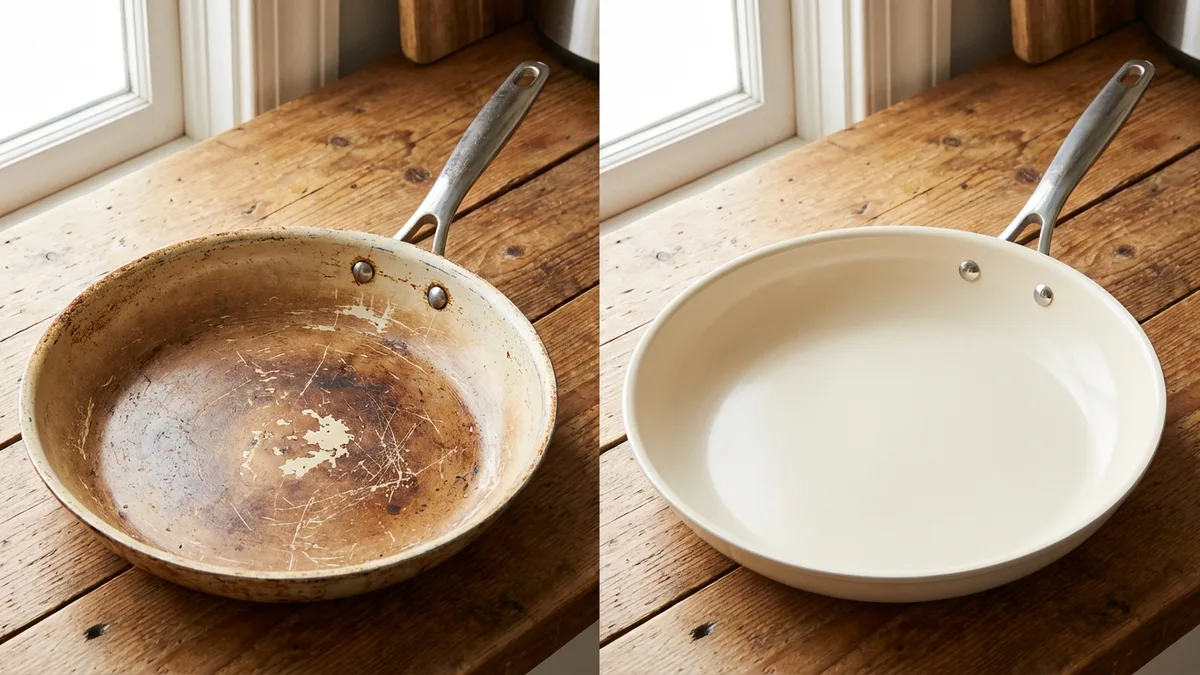
Visible scratches or chips in the coating. Light surface marks are cosmetic. But scratches deep enough that you can see a different color underneath (the aluminum base) mean the coating barrier is compromised in that area. If the base metal is exposed in multiple spots, replace the pan.
Permanent discoloration that won’t clean off. Brown or dark spots that survive thorough cleaning indicate that oil and food residue have polymerized into the coating itself. This happens when ceramic pans are used over high heat repeatedly. Once this buildup is embedded, it creates perpetually sticky spots.
Warping. Hold the pan on a flat surface and check for wobble. A warped pan doesn’t make even contact with the heat source, which leads to hot spots and uneven cooking. On an induction or electric flat-top stove, a warped pan also wastes significant energy. Warping is usually caused by thermal shock (hot pan into cold water).
Is a Worn Ceramic Coating a Health Risk?
Not in the way that a degraded Teflon (PTFE) coating is. Ceramic coatings are made from inorganic minerals and don’t release toxic fumes at any temperature. If a chip of ceramic coating breaks off and ends up in your food, it passes through your digestive system without being absorbed. The health concern with worn ceramic is not chemical, it’s functional: the pan just stops working as intended.
That said, once the base aluminum is exposed, acidic foods can interact with the metal. Aluminum exposure through cookware is generally considered low-risk by current research, but if you’re specifically trying to minimize metal leaching (especially for children’s food), exposed base metal is a good reason to replace.
Cast Iron
Cast iron is the opposite of ceramic when it comes to lifespan. A cast iron pan can last a century or more. The cases where you’d actually need to replace one are rare, but they exist.
Signs of Real Problems
Cracking. This is the one deal-breaker. A crack in cast iron is a structural failure. It can propagate under thermal stress (heating and cooling cycles) and potentially cause the pan to break apart on the stove. A cracked cast iron pan should be retired immediately. Cracks usually happen from thermal shock (running cold water on a screaming hot pan) or from manufacturing defects.
Deep pitting. Surface pitting (small rough spots) can be re-seasoned over. But deep pits that go below the original cooking surface create food-trapping valleys that no amount of seasoning can fix. This level of pitting usually results from severe rust that was improperly restored.
Severe warping. Cast iron is heavy and thick, so warping is uncommon. But it does happen, usually from prolonged exposure to very high heat on one side (like a campfire) or from a manufacturing defect. A wobbling cast iron pan on a flat cooktop is frustrating, but on a gas stove, minor warping isn’t a functional problem.
Persistent metallic taste despite good seasoning. If food cooked in a well-seasoned cast iron pan consistently has a metallic flavor, the iron may be reacting with acidic foods through compromised seasoning. This isn’t dangerous (iron is a nutrient), but it affects food quality. Usually, re-seasoning fixes this. If it doesn’t after multiple seasoning attempts, the pan’s surface texture may be too damaged to hold seasoning properly.
What You Can Fix Instead of Replacing
Almost everything else. Rust? Scrub it off and re-season. Lost seasoning? Re-season. Sticky residue? Burn it off in a self-cleaning oven cycle or scrub with salt. Rough cooking surface? Sand it with medium-grit sandpaper and re-season. Cast iron is remarkably restorable.
NonToxicLab recommends trying a full restoration (strip, sand, re-season) before giving up on a cast iron pan. There are entire communities dedicated to restoring cast iron that’s been buried in barns for decades.
Stainless Steel
Stainless steel is the most durable option and the hardest to truly destroy. Replacement is rarely about safety and almost always about cooking performance.
Signs It’s Time to Replace
Warping that affects cooking. Like any pan, stainless steel can warp from thermal shock or overheating. On a flat cooktop, a warped pan wobbles and creates uneven heat distribution. On gas, it matters less. If the warping is severe enough that oil pools to one side, cooking becomes impractical.
Delamination of clad layers. Multi-ply stainless steel (like All-Clad, Demeyere) has layers of different metals bonded together. If those layers separate (usually visible as bubbles or raised areas on the cooking surface or base), the pan’s heat distribution is compromised. Delamination is usually covered under warranty and is grounds for replacement.
Pitting from salt damage. Adding salt to cold water in stainless steel causes chloride corrosion pitting. These white dots on the cooking surface are permanent. If pitting is extensive enough that the surface feels rough when you run your hand over it, the pan will stick more and be harder to clean.
Loose or damaged handles. Riveted handles can loosen over time, especially with frequent dishwasher use. Wobbly handles on a heavy pan full of hot liquid are a genuine safety hazard. Some brands offer handle re-riveting. If not, replace the pan.
What’s Normal and Not a Problem
Rainbow discoloration. This iridescent film is a thin oxide layer caused by overheating. It’s cosmetic only and doesn’t affect cooking or safety. Bar Keeper’s Friend removes it.
White calcium spots. Caused by hard water evaporating on the surface. Also cosmetic. Vinegar or Bar Keeper’s Friend clears them.
Darkening over time. Stainless steel naturally develops a patina with use. Some cooks prefer the look of a well-used pan.
Lifespan Expectations by Material
| Material | Expected Lifespan | Biggest Threat |
|---|---|---|
| Ceramic-coated | 2-5 years | High heat, metal utensils |
| Cast iron | 50-100+ years | Cracking from thermal shock |
| Stainless steel | 15-30+ years | Warping, delamination |
| Carbon steel | 20-50+ years | Rust (if unseasoned) |
| Enameled cast iron | 10-25 years | Chipping of enamel coating |
The Real-World Replacement Cycle
For a typical household that cooks daily, here’s a realistic replacement timeline:
Ceramic pans: Plan to replace every 2-3 years with regular use. Budget this as an ongoing cost. Some people buy one new ceramic pan per year on a rotation.
Cast iron: Buy once, maintain forever. Your grandchildren should be using these pans.
Stainless steel: A quality set should last 15-20+ years. Budget for occasional individual piece replacements (usually a saute pan that sees daily use wears out before a stockpot).
Quick Answers
Can I still use a ceramic pan if the coating is wearing off?
You can. A worn ceramic coating isn’t toxic. But you’ll experience more sticking, more frustration, and worse cooking results. Once the nonstick performance is gone, you’re basically cooking on a mediocre aluminum pan. At that point, stainless steel or cast iron gives you better results.
Is it safe to use cast iron with exposed rust spots?
Small surface rust isn’t dangerous. Iron oxide (rust) is not toxic. But rust indicates missing seasoning, which means food will stick and the rust will get worse. Clean the rust, re-season, and the pan is good as new.
How do I extend the life of ceramic cookware?
Low to medium heat only, silicone or wooden utensils, hand wash, let it cool before cleaning, use oil every time, store with protectors between pans. See our full ceramic cookware care guide for details.
Should I replace a dented stainless steel pan?
A small dent on the side wall is cosmetic. A dent on the base that creates an uneven cooking surface is functional. If the pan still sits flat and heats evenly, keep using it. If it rocks or has obvious hot spots, it’s time.
Do non-toxic cookware warranties cover normal wear?
Most warranties cover manufacturing defects (delamination, cracking, handle failure) but not normal wear from use. Ceramic coating degradation from cooking is considered normal wear. Read the warranty terms before assuming your worn pan qualifies for a free replacement.
What should I do with old non-toxic cookware?
Stainless steel and cast iron are recyclable as scrap metal. Ceramic-coated pans are harder to recycle because of the mixed materials. Some brands (like Caraway) have take-back programs. Check with your local recycling center for guidelines on mixed-material cookware.
You Might Also Like
Sources
- Consumer Reports. “Best Cookware Buying Guide.”
- Lodge Cast Iron. “Cleaning & Care.”
- All-Clad. “Warranty & Product Care.”
- GreenPan. “Technology Information.”
- The American Ceramic Society. “Ceramic-Coated Cookware: Investigating the Accuracy of This ‘Nontoxic’ Cookware Trend.”
- EPA guidelines on aluminum exposure through cookware