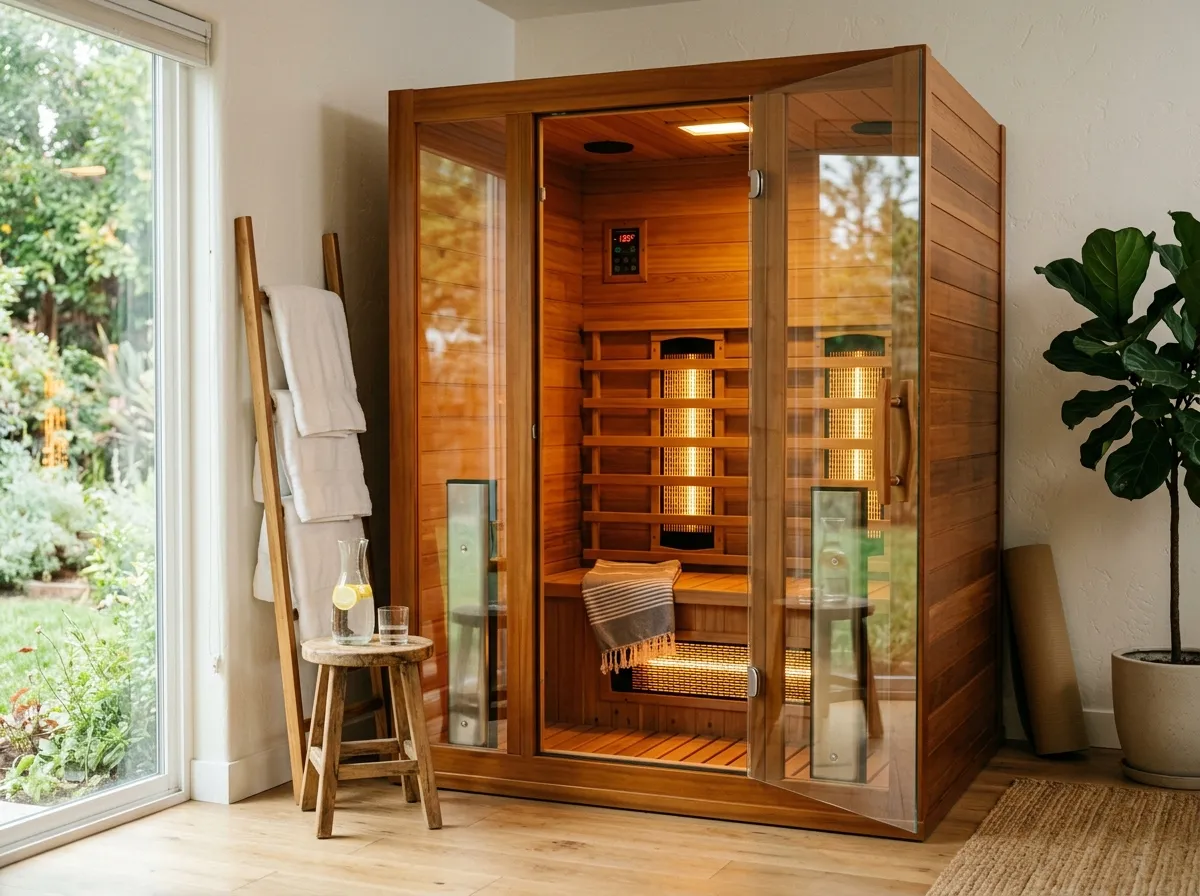
When you’re about to spend $4,000 to $7,000 on a wooden box that heats up, you want to get it right. I spent six months researching before buying an infrared sauna, visited showrooms for both Sunlighten and Clearlight, and ended up installing a Clearlight Sanctuary 2 in my garage. That doesn’t mean Clearlight is automatically the better choice for everyone. For specific product picks, check best red light therapy panels for home use.
Each product here was reviewed for ingredient safety, independent lab testing, and certification status. Our product evaluation methodology walks through how we make these picks. This is a big purchase with a lot of confusing marketing on both sides. Claims about “full spectrum” technology, EMF levels, detoxification, and health benefits get thrown around loosely. Here’s what’s real, what’s marketing, and how these two brands actually compare when you look past the sales pages. We tested and ranked the options in best sauna blankets for home.
What You’re Comparing
Both Sunlighten and Clearlight are premium infrared sauna manufacturers that sit at the high end of the home sauna market. They’re the two brands that come up most often in health and wellness conversations, particularly among people who follow Andrew Huberman, Rhonda Patrick, or anyone in the functional health space. Read our full take in higherdose infrared sauna review.
| Sunlighten | Clearlight | |
|---|---|---|
| Founded | 1999 (Overland Park, KS) | 2001 (San Francisco, CA) |
| Sauna Types | Far infrared, Full Spectrum | Far infrared, Full Spectrum |
| Price Range | $3,000 - $8,000+ | $4,000 - $9,000+ |
| Wood Options | Basswood, Eucalyptus | Western Red Cedar, Basswood, Eucalyptus |
| EMF Claims | Low EMF (3rd party tested) | Low EMF/ELF (3rd party tested) |
| Warranty | Lifetime (limited) | Lifetime (limited) |
| Assembly | Panel/modular | Panel/modular |
They look similar on paper. The differences show up in heater technology, EMF testing methodology, build quality, and what you’re actually getting for the price. Read our full take in higherdose sauna blanket review.
Heater Technology: The Core Difference
The heater is the single most important component of an infrared sauna. It determines how deeply infrared energy penetrates, how evenly the cabin heats, and how comfortable the session feels.
Sunlighten mPulse Series (Full Spectrum)
Sunlighten’s flagship mPulse line claims to offer “3-in-1” near, mid, and far infrared. They use separate heating elements for each wavelength:
- Near infrared: LED-based emitters mounted in the ceiling area
- Mid infrared: Proprietary heater blend
- Far infrared: Carbon fiber panel heaters
Sunlighten is one of the few companies that claims true full-spectrum coverage, and they cite a clinical study conducted with the University of Missouri at Kansas City showing that their mid-infrared heaters raise core body temperature more effectively than far infrared alone.
Their Solo series uses far infrared only and is their most affordable option.
Clearlight Sanctuary Series (Full Spectrum)
Clearlight’s full-spectrum saunas use a combination approach:
- Near infrared: 500W halogen heaters (produces near + mid infrared through a broad spectrum bulb)
- Far infrared: Carbon/ceramic blended heaters (their proprietary True Wave heater)
Clearlight’s True Wave heaters combine carbon fiber (for even, large-area coverage) with ceramic elements (for higher surface temperatures and deeper far infrared output). The carbon/ceramic blend is a legitimate engineering choice that produces stronger far infrared output than pure carbon panels.
Which Heater Approach Is Better?
Sunlighten’s separate heater elements for each wavelength theoretically allow more precise control over the infrared spectrum. Their marketing leans heavily on this.
Clearlight’s combination approach is simpler but produces strong far infrared output, which is the wavelength most studied for health benefits. The addition of halogen near-infrared bulbs gives genuine near-infrared exposure at meaningful intensity.
In practice, both saunas get you sweating and heat your core temperature effectively. The “full spectrum” marketing from both sides overpromises somewhat. The clinical research on infrared sauna benefits (cardiovascular health, pain relief, recovery) is primarily on far infrared. Near infrared has its own research base (wound healing, mitochondrial function), but the evidence is thinner and often comes from targeted near-infrared devices, not sauna panels.
Dr. Rhonda Patrick has discussed the cardiovascular benefits of heat exposure on her podcast and in published research, citing studies on Finnish sauna use that show reduced cardiovascular mortality with regular sauna sessions. Her discussion focuses on core temperature elevation regardless of the heating mechanism, which both Sunlighten and Clearlight achieve.
EMF: The Issue That Sells Saunas
Low EMF (electromagnetic field) emissions are a major selling point for both brands. If you spend any time researching infrared saunas, EMF anxiety is everywhere. Here’s what’s actually going on.
What’s Being Measured
There are two types of electromagnetic fields in infrared saunas:
- ELF (Extremely Low Frequency) magnetic fields - produced by electrical wiring and components. Measured in milligauss (mG).
- RF (Radio Frequency) EMF - produced by electronic components and WiFi/Bluetooth. Measured in various units.
Most sauna companies focus on ELF magnetic fields when they talk about “low EMF.”
Sunlighten EMF Claims
Sunlighten states their saunas produce EMF levels below 1 mG at the body surface during operation. They provide third-party testing data from Intertek/VDE labs.
Clearlight EMF Claims
Clearlight states their True Wave heaters produce EMF levels below 1 mG and ELF levels below 1 mG at the body surface. They use a patented carbon/ceramic heater design that they say was specifically engineered to cancel out EMF. They also provide third-party testing.
Does EMF in Saunas Actually Matter?
Here’s where I’ll be direct: the EMF levels produced by both brands are extremely low and well below any threshold considered concerning by the World Health Organization or any major health regulatory body. The typical exposure inside either sauna is comparable to sitting near a household appliance.
Andrew Huberman has addressed EMF concerns, noting that the evidence for health harm from low-level, non-ionizing EMF (like what saunas produce) is not strong. His position is that the health benefits of regular sauna use far outweigh any theoretical EMF risk at the levels these saunas produce.
If you’re choosing between these two based on EMF, you’re optimizing for something that probably doesn’t matter at this level. Both are low-EMF designs. Pick based on other factors.
Build Quality and Materials
I’ve been inside both saunas at showrooms and at trade events. Here’s what I noticed.
Clearlight Sanctuary
The Sanctuary line uses thick Western Red Cedar (or Basswood/Eucalyptus depending on configuration). The panels are heavy, the joinery is tight, and the finished product feels solid. The glass front panel is thick tempered glass with a good seal. Interior lighting is well-integrated, and the bench construction is sturdy.
The Sanctuary 2 (2-person model) that I own weighs approximately 400 pounds assembled. It doesn’t feel like a kit product. It feels like furniture.
Sunlighten mPulse
The mPulse line also uses quality wood (typically Basswood or Eucalyptus) with a similar modular panel assembly. Build quality is good but felt slightly lighter and less substantial than the Clearlight at the same size. The control panel and digital interface on the mPulse are more modern and user-friendly than Clearlight’s simpler controls.
Sunlighten’s design aesthetic leans more toward a modern spa feel. Clearlight’s aesthetic is more traditional sauna.
Both companies manufacture largely in China with final quality control in the US. This is standard for the industry.
Price Breakdown
| Model | Capacity | Price |
|---|---|---|
| Sunlighten Solo | 1 person (portable) | $2,800 - $4,000 |
| Sunlighten Amplify | 1-2 person | $4,200 - $5,500 |
| Sunlighten mPulse Believe | 2 person | $5,500 - $7,000 |
| Sunlighten mPulse Aspire | 2-3 person | $6,500 - $8,500 |
| Clearlight Essential | 1-2 person (far IR only) | $3,500 - $4,500 |
| Clearlight Sanctuary 1 | 1 person (full spectrum) | $5,000 - $6,000 |
| Clearlight Sanctuary 2 | 2 person (full spectrum) | $6,000 - $7,000 |
| Clearlight Sanctuary C | 3-4 person (full spectrum) | $7,500 - $9,000 |
Both brands offer financing. Both frequently run sales that knock $500-$1,500 off list price. Never pay full retail. Call and ask for the best current price.
Clearlight tends to be priced $500-$1,000 higher for comparable models. Whether the build quality and heater technology justify that depends on how long you plan to own the sauna (20+ years for either brand, realistically).
Installation and Electrical Requirements
Both brands ship flat-packed in modular panels that assemble in 30-60 minutes with two people and a screwdriver. No special tools required.
Electrical: Most 1-2 person models run on a standard 120V/20A circuit. Larger models (3-4 person) may require a dedicated 240V circuit, which means an electrician visit ($200-$500 depending on your panel situation).
Space: A 2-person infrared sauna requires roughly 4’ x 4’ of floor space plus 6-12 inches of clearance on all sides for ventilation. Most people put them in a garage, basement, spare bedroom, or covered patio. The sauna doesn’t need special flooring or waterproofing (unlike a traditional steam sauna).
What NonToxicLab Recommends
Clearlight Sanctuary line if:
- Build quality and material thickness matter to you
- You want the carbon/ceramic heater combination for strong far infrared output
- You prefer the traditional sauna aesthetic
- You plan to use the sauna for 10+ years and want something that feels built to last
- Western Red Cedar is your preferred wood
Sunlighten mPulse if:
- The full-spectrum separate wavelength control appeals to you
- You want a more modern control interface and digital programming
- Sunlighten’s specific clinical research matters to your use case
- Budget is tighter (Sunlighten’s mid-tier pricing is slightly more accessible)
- You value the Solo portable option for smaller spaces
Either brand over budget infrared saunas if:
- You care about verified low-EMF heaters
- You want quality wood construction that won’t off-gas
- Long-term durability matters (both brands last decades with care)
- You plan to use the sauna regularly (3-5x per week)
For more affordable infrared sauna options, check our best budget infrared sauna guide. The budget tier ($1,500-$2,500) exists, but you’re trading build quality, heater performance, and often EMF testing rigor.
As for my own experience: Lara Voss uses the Clearlight Sanctuary 2 four times a week, 30-minute sessions at 135F. It’s one of the best purchases I’ve made for recovery and stress management. Either brand would have gotten me there.
Sauna Buyer FAQ
Are infrared saunas actually good for you?
The research supports benefits for cardiovascular health, pain management, muscle recovery, and stress reduction. A frequently cited Finnish study following 2,315 men for 20 years found that regular sauna use was associated with reduced risk of cardiovascular death and all-cause mortality. Most of this research used traditional Finnish saunas, but infrared saunas achieve similar core temperature elevation at lower ambient temperatures.
What temperature should an infrared sauna be?
Most users find 125-145F comfortable for a 20-40 minute session. Infrared saunas operate at lower temperatures than traditional saunas (170-200F) because the infrared energy heats your body directly rather than just heating the air. If you’re new to infrared sauna use, start at 120F for 15-20 minutes and work up.
Do infrared saunas help with detoxification?
Sweating does release trace amounts of heavy metals (arsenic, cadmium, lead, mercury) along with water and electrolytes. However, the kidneys and liver do the vast majority of detoxification. Dr. Philip Landrigan has noted that while sweating is a minor detoxification pathway, the primary health benefits of sauna use come from cardiovascular conditioning and heat stress response, not heavy metal elimination. Be skeptical of any sauna company claiming dramatic “detox” benefits.
How much electricity does an infrared sauna use?
A 2-person infrared sauna draws approximately 1,500-2,000 watts. A 30-minute session costs roughly $0.20-$0.40 in electricity at average US rates. Using the sauna 4 times per week adds about $3-$7 to your monthly electric bill. Far less than a hot tub.
Can you put an infrared sauna in an apartment?
Possibly. A 1-person model (like the Clearlight Sanctuary 1 or Sunlighten Solo) fits in a closet-sized space and runs on a standard wall outlet. Weight is typically under 300 pounds. Check your lease for restrictions on electrical appliances and heat-producing equipment. Some buildings prohibit saunas due to fire code or moisture concerns.
How long do infrared saunas last?
Both Sunlighten and Clearlight build saunas that should last 15-25 years with normal use. The heaters themselves are rated for 30,000+ hours of use. The main maintenance is wiping down the interior after sessions (sweat on untreated wood), occasional sanding of the bench surface, and replacing any cracked or fogged glass panels over time.
Sources
- Sunlighten product specifications and clinical research citations (sunlighten.com)
- Clearlight Sauna product specifications and True Wave heater technology (healwithheat.com)
- Laukkanen et al. “Association Between Sauna Bathing and Fatal Cardiovascular and All-Cause Mortality Events” JAMA Internal Medicine (2015)
- Rhonda Patrick’s research on heat stress and cardiovascular health (foundmyfitness.com)
- Andrew Huberman podcast discussion on sauna use protocols
- Philip Landrigan research on environmental health and detoxification pathways