Formaldehyde is one of the most common indoor air pollutants and one of the most concerning. The International Agency for Research on Cancer (IARC) classifies it as a Group 1 carcinogen, meaning there is sufficient evidence that it causes cancer in humans. It is linked specifically to nasopharyngeal cancer and leukemia.
It is also everywhere in your home. Pressed wood furniture, laminate flooring, insulation, permanent-press fabrics, some cleaning products, and even some cosmetics release formaldehyde gas into the air. That “new furniture smell” or “new carpet smell” is partly formaldehyde off-gassing.
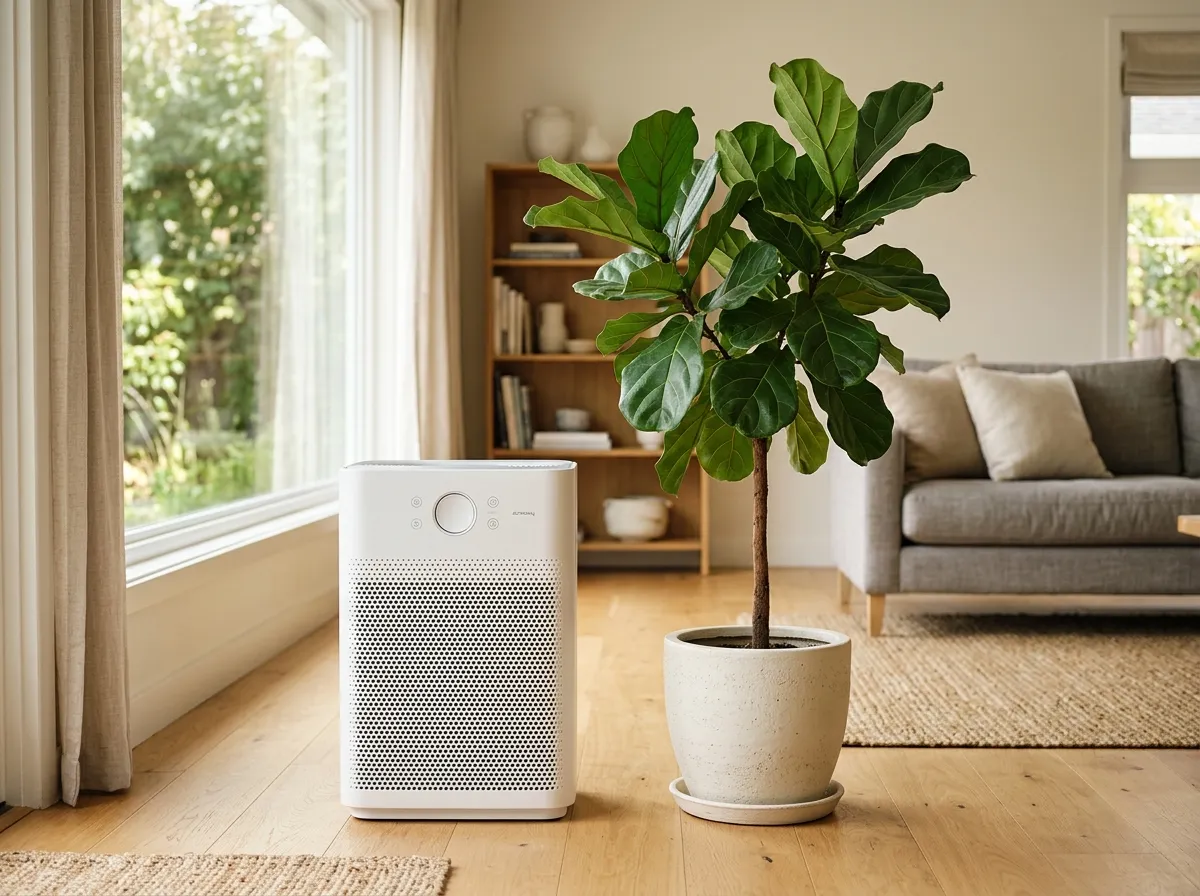
So can plants help? NonToxicLab’s take: it depends. Research does show that certain plants absorb formaldehyde through their leaves and root-zone microbes, but the rate of absorption in a real room is far too slow to be your primary defense. Here is what the science says, which plants perform best, and what you should realistically expect.
Where Formaldehyde Is Hiding in Your Home
Before talking about plants, you need to know what you are dealing with. Formaldehyde sources are more numerous than most people realize.
Pressed Wood Products
This is the biggest formaldehyde source in most homes. Particleboard, medium-density fiberboard (MDF), plywood, and oriented strand board (OSB) are all manufactured using formaldehyde-based resins as adhesive. The two main types are:
- Urea-formaldehyde (UF) resins: Found in interior-grade particleboard, MDF, and hardwood plywood. These release the most formaldehyde and continue off-gassing for years.
- Phenol-formaldehyde (PF) resins: Found in exterior-grade plywood and OSB. These release significantly less formaldehyde than UF resins.
Products made with UF resins include most kitchen cabinets, bookshelves, dressers, bed frames, desks, and shelving sold by major furniture retailers. If it is made from particleboard or MDF (tap it and listen for a dull, dense sound rather than a hollow wood sound), it almost certainly contains UF resins.
The EPA enacted the Formaldehyde Standards for Composite Wood Products Act in 2010, which set emission limits based on California’s CARB Phase 2 standards. Products manufactured after 2018 should meet these lower emission limits, but older furniture may still be releasing formaldehyde at higher rates.
Flooring
Laminate flooring, engineered hardwood, and vinyl plank flooring can all release formaldehyde. Laminate flooring has been particularly scrutinized. The adhesive layers in laminate and engineered products often use formaldehyde-based resins. Solid hardwood flooring generally does not contain formaldehyde in the wood itself, though the finish applied to it might.
For flooring alternatives that minimize formaldehyde exposure, look for FloorScore or GREENGUARD Gold certified products. Our guide to non-toxic flooring covers the safest options.
Insulation
Some types of foam insulation, particularly urea-formaldehyde foam insulation (UFFI), release formaldehyde. UFFI was widely used in the 1970s and early 1980s and was later restricted due to health concerns. If your home was built or insulated during that period, this could be a hidden source.
Modern fiberglass and spray foam insulation can also contain formaldehyde-based binders, though at lower levels than UFFI.
Textiles and Fabrics
Permanent-press and wrinkle-free treatments on clothing, bedding, and curtains use formaldehyde-based finishes. This is why new wrinkle-free sheets can have a chemical smell. The treatment helps fabric resist creasing but releases formaldehyde during use, especially when heated (ironing, dryer heat).
This is a reason to choose organic, untreated bedding. Our non-toxic bedroom guide covers bedding options that avoid formaldehyde treatments.
Other Sources
- Combustion: Gas stoves, fireplaces, and tobacco smoke produce formaldehyde as a combustion byproduct
- Personal care products: Some nail polishes, hair straightening treatments (especially keratin treatments), and cosmetics contain formaldehyde or formaldehyde-releasing preservatives
- Cleaning products: Some disinfectants and household cleaners contain formaldehyde
- Paint: Conventional paints can contain formaldehyde; low-VOC and zero-VOC paints minimize this
How Much Formaldehyde Are You Breathing?
The EPA recommends indoor formaldehyde levels below 0.1 ppm (parts per million). The World Health Organization guideline is even lower at 0.08 ppm. In newer or recently furnished homes, levels of 0.05 to 0.2 ppm are common. Homes with multiple pressed wood products, new flooring, and poor ventilation can exceed these guidelines.
Symptoms of formaldehyde exposure include eye, nose, and throat irritation, headaches, and nausea. Chronic exposure at elevated levels is associated with increased cancer risk. An indoor air quality monitor that tracks VOCs can give you a general sense of your exposure, though most consumer monitors do not measure formaldehyde specifically. The Airthings Wave Plus measures total VOC levels, which includes formaldehyde among other compounds.
What the Research Says About Plants and Formaldehyde
The 1989 NASA study by Dr. B.C. Wolverton tested multiple plant species for formaldehyde removal in sealed chambers. Several plants showed strong formaldehyde absorption over 24-hour periods. This research is legitimate and peer-reviewed.
However, the conditions were highly artificial: small sealed chambers (approximately 1 cubic foot), a single injection of formaldehyde, no air exchange, and 24-hour measurement periods. Your home is a thousand times larger, has continuous formaldehyde sources, constant air exchange, and needs air cleaned continuously, not over a single 24-hour test.
Dr. Michael Waring’s 2019 meta-analysis at Drexel University reviewed all available studies on plant-based VOC removal and concluded that the clean air delivery rate (CADR) of a typical potted plant is about 0.023 cubic meters per hour. To put that in perspective, a basic air purifier with activated carbon processes 100-400+ cubic meters per hour.
Research from Yonsei University in South Korea did find measurable formaldehyde reduction in furnished apartments where plants were placed strategically near formaldehyde sources. The reductions were statistically significant but small compared to what mechanical ventilation or air purification would achieve.
The takeaway from the research community: plants can absorb formaldehyde, but not fast enough to be a primary remediation strategy. They are a supplement, not a solution.
Best Plants for Formaldehyde Absorption
Based on the NASA study and subsequent research, here are the plants that showed the strongest formaldehyde absorption. I have ranked them by a combination of formaldehyde removal performance and practical usability (ease of care, availability, and versatility).
1. Boston Fern (Nephrolepis exaltata)
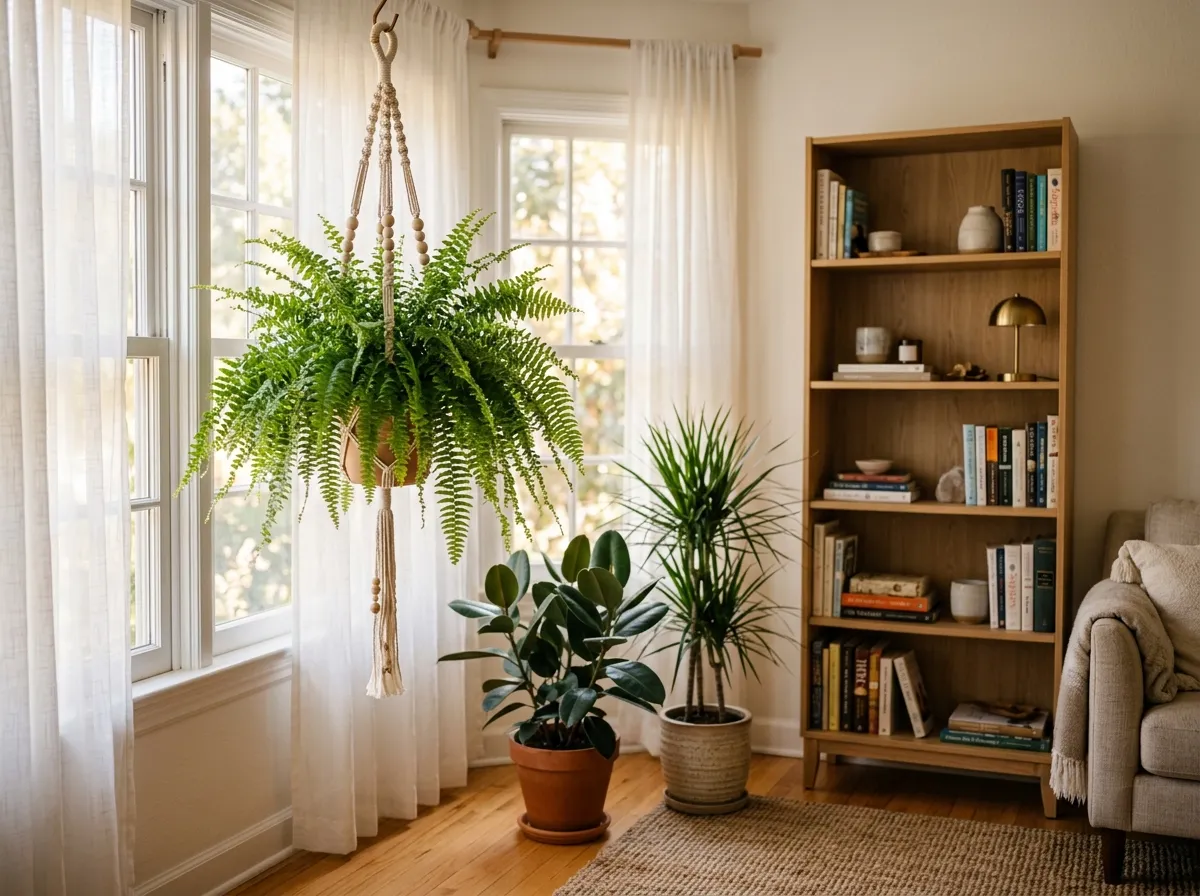
The Boston fern was the top formaldehyde remover in the NASA study. Its dense, feathery fronds provide a large surface area for gas absorption, and research suggests that its soil microbiome is particularly active in breaking down formaldehyde.
- Pet safe: Yes
- Light needs: Bright indirect
- Maintenance: High (needs consistent moisture and humidity)
- Best placement: Near pressed wood furniture, in humid rooms
The trade-off is maintenance. Boston ferns need regular watering, high humidity, and they shed fronds in dry conditions. If you are willing to care for one, it is the best plant choice for formaldehyde specifically.
2. Snake Plant (Sansevieria trifasciata)
The snake plant combines strong formaldehyde absorption with near-indestructible hardiness. It tolerates low light, infrequent watering, and a wide range of conditions. It is also a CAM plant that releases oxygen at night, making it ideal for bedrooms near new furniture.
- Pet safe: No
- Light needs: Low to bright indirect
- Maintenance: Very low
- Best placement: Bedrooms, near new furniture, in low-light areas
For most people, the snake plant offers the best balance of formaldehyde absorption and easy care. If you are only going to get one plant for formaldehyde, this is the one.
3. Spider Plant (Chlorophytum comosum)
Spider plants showed strong formaldehyde removal in the NASA study and are the best pet-safe option for this purpose. They are easy to propagate (one plant produces many babies), affordable, and widely available.
- Pet safe: Yes
- Light needs: Bright indirect
- Maintenance: Low to moderate
- Best placement: Near cabinetry, hanging baskets, offices
4. Bamboo Palm (Chamaedorea seifrizii)
The bamboo palm was a strong formaldehyde performer in the NASA study and has the advantage of being one of the larger air-purifying plants. A mature specimen at 4-8 feet tall has substantial leaf surface area. It is also pet safe.
- Pet safe: Yes
- Light needs: Bright indirect to moderate
- Maintenance: Moderate
- Best placement: Living rooms with new furniture, near bookshelves
5. Peace Lily (Spathiphyllum)
The peace lily absorbs formaldehyde along with benzene, trichloroethylene, ammonia, and xylene. It is one of the most versatile air-purifying plants for multiple pollutant types, including formaldehyde.
- Pet safe: No
- Light needs: Low to moderate
- Maintenance: Low
- Best placement: Bedrooms, bathrooms, shaded rooms with pressed wood furniture
6. Dracaena (Dracaena spp.)
Multiple Dracaena species (Janet Craig, Marginata, Warneckei) showed formaldehyde absorption in the NASA study. Dr. Wolverton specifically noted the Dracaena deremensis “Janet Craig” variety as one of the most effective overall air-purifying plants.
- Pet safe: No
- Light needs: Low to moderate
- Maintenance: Low
- Best placement: Living rooms, offices, near furniture
7. Rubber Plant (Ficus elastica)
Research published in the Journal of the American Society for Horticultural Science found rubber plants particularly effective at formaldehyde removal. Their large, glossy leaves provide extensive surface area for gas exchange.
- Pet safe: No
- Light needs: Medium to bright indirect
- Maintenance: Low
- Best placement: Living rooms, near windows, offices
8. Pothos (Epipremnum aureum)
Pothos showed formaldehyde absorption in the NASA study and has the advantage of being one of the easiest plants to grow. It tolerates very low light, grows in water or soil, and trails from shelves and hanging baskets.
- Pet safe: No
- Light needs: Low to bright indirect
- Maintenance: Very low
- Best placement: Any room, trailing from elevated surfaces near furniture
Realistic Expectations: Plants vs. Marketing Claims
I want to be direct about this because the marketing around “formaldehyde-removing plants” has gotten out of control. Here is the honest picture:
What plants can do: Absorb small amounts of formaldehyde continuously through their leaves and root-zone microbes. Over time, in a room with stable formaldehyde levels, plants contribute a very small reduction in overall concentration. The soil microbiome may do more of the work than the leaves.
What plants cannot do: Remove formaldehyde fast enough to meaningfully lower levels in a real room. Compete with basic ventilation (opening a window) or a modest air purifier. Protect you from acute formaldehyde exposure during renovation or after major furniture purchases.
What marketing claims suggest: That a few potted plants will “clean your air” or “remove toxins from your home.” Some retailers cite the NASA study as proof that their plants will purify your living room. This is misleading. The NASA study used conditions that do not apply to real homes.
What you should actually do to reduce formaldehyde:
- Source control (most effective): Choose solid wood or CARB Phase 2 compliant furniture, avoid pressed wood when possible, choose non-toxic paint, and select flooring with low emissions
- Ventilation (very effective): Open windows regularly, especially after bringing new furniture or materials into the home
- Air purification (effective): Run an air purifier with activated carbon in rooms with significant formaldehyde sources
- Plants (supplemental): Add formaldehyde-absorbing plants near known sources as a complementary strategy
This order matters. If you do steps 1-3 and add plants, you have a thorough approach. If you skip steps 1-3 and rely on plants alone, you are not meaningfully reducing your formaldehyde exposure.
Strategic Plant Placement for Formaldehyde
If you are going to use plants as part of your formaldehyde reduction strategy, placement matters. Put them where formaldehyde sources are:
Near new furniture: Place snake plants, spider plants, or dracaenas directly beside or on top of new pressed wood furniture like dressers, bookshelves, and desks. This positions the plant’s absorptive surfaces closest to the emission source.
Near kitchen cabinets: Most kitchen cabinets are made from particleboard or MDF with formaldehyde-based resins. A pothos trailing from on top of upper cabinets or a spider plant on the counter positions foliage near these sources.
In bedrooms with new mattresses: Memory foam mattresses can off-gas formaldehyde for weeks to months. A snake plant on the nightstand provides CAM-based nighttime oxygen release and some formaldehyde absorption near where you sleep.
Near closets: Clothing treated with wrinkle-free finishes and dry-cleaned garments can release formaldehyde. A plant near the closet door or inside a walk-in closet with some light can help.
Home offices: Office furniture (desks, file cabinets, bookshelves) is frequently made from pressed wood. A dracaena or rubber plant in the office addresses this.
How to Reduce Formaldehyde Without Plants
Plants are the gentlest approach to formaldehyde reduction. Here are the approaches that actually move the needle:
Ventilation. Opening windows for even 15-20 minutes a day flushes formaldehyde-laden air and replaces it with fresher outdoor air. This is the single most effective free strategy. In hot or humid weather, time this for the coolest part of the day.
Air purifiers with activated carbon. A quality air purifier with substantial activated carbon media adsorbs formaldehyde as air passes through the filter. The Austin Air HealthMate, with 15 pounds of activated carbon, is particularly effective for chemical sensitivity and high-VOC environments. Our air purifier guide covers models ranked by VOC removal capability.
Source elimination. When purchasing new furniture, choose solid wood, metal, or products certified to CARB Phase 2 or GREENGUARD Gold standards. These emit significantly less formaldehyde than standard pressed wood products. When possible, let new furniture off-gas in a garage or well-ventilated space for a few weeks before moving it into living areas.
Temperature and humidity control. Formaldehyde emission rates increase with temperature and humidity. Keeping your home at moderate temperatures and maintaining humidity in the 30-50% range reduces the rate at which formaldehyde-containing products off-gas.
Testing. If you suspect elevated formaldehyde levels, a professional indoor air quality test can measure the exact concentration. Home Air Check offers a mail-in test kit that includes formaldehyde measurement. Our guide on how to test indoor air quality covers testing options in detail.
Reader Questions
Do plants really remove formaldehyde?
Yes, but very slowly. Research confirms that certain plants absorb formaldehyde through their leaf stomata and root-zone microbes. However, the rate of absorption in a real room is far too low to serve as a primary formaldehyde reduction strategy. Dr. Michael Waring’s 2019 meta-analysis found that plants clean air roughly 10,000 to 25,000 times slower than a basic air purifier. Plants are a supplement, not a solution.
Which plant removes the most formaldehyde?
In the NASA study, the Boston fern (Nephrolepis exaltata) showed the highest formaldehyde removal rate. However, Boston ferns require more care than many other options. For practical purposes, the snake plant offers the best balance of formaldehyde absorption and easy care, especially in bedrooms and low-light spaces.
How many plants do I need to remove formaldehyde from a room?
Based on Dr. Waring’s calculations, you would need an impractical number of plants (hundreds to thousands per room) to meaningfully reduce formaldehyde levels through plant absorption alone. Two to four plants per room is a reasonable supplemental approach, but do not rely on them as your primary formaldehyde reduction strategy. Source control, ventilation, and air purification are far more effective.
How long does formaldehyde off-gas from furniture?
Formaldehyde off-gassing is most intense in the first few months after manufacture. For most pressed wood products, levels drop significantly within 2-3 years but can continue at lower levels for 3-10 years depending on the resin type, temperature, and humidity. Urea-formaldehyde resins off-gas longer than phenol-formaldehyde resins.
Is formaldehyde in my home dangerous?
The IARC classifies formaldehyde as a Group 1 carcinogen. At the low concentrations found in most homes (typically 0.01-0.1 ppm), the acute health risk is low, but chronic exposure may irritate airways and potentially increase long-term cancer risk. People with asthma, chemical sensitivity, or compromised immune systems are more vulnerable. Reducing exposure is a reasonable precaution, especially in newly furnished or renovated homes.
Can I test my home for formaldehyde?
Yes. Consumer air quality monitors like the Airthings Wave Plus measure total VOCs, which includes formaldehyde but does not isolate it specifically. For a formaldehyde-specific reading, professional testing or a mail-in kit like Home Air Check is needed. Our guide to testing indoor air quality covers the options.
You Might Also Like
- Is Laminate Flooring Safe? VOCs, Formaldehyde, and
- Is Ashley Furniture Non-Toxic?
- Non-Toxic Furniture Guide
Sources
- Wolverton, B.C., Johnson, A., & Bounds, K. “Interior Landscape Plants for Indoor Air Pollution Abatement.” NASA, 1989.
- Cummings, B.E., & Waring, M.S. “Potted Plants Do Not Improve Indoor Air Quality: A Review and Analysis of Reported VOC Removal Efficiencies.” Journal of Exposure Science & Environmental Epidemiology, 2019.
- International Agency for Research on Cancer. “Formaldehyde.” IARC Monographs, Volume 100F.
- U.S. EPA. “Formaldehyde Standards for Composite Wood Products Act.” EPA.gov.
- Kim, K.J., et al. “Formaldehyde removal by potted plant-soil systems.” Journal of Environmental Management, 2010.
- World Health Organization. “WHO Guidelines for Indoor Air Quality: Selected Pollutants.” WHO, 2010.
- Salthammer, T., Mentese, S., & Marutzky, R. “Formaldehyde in the Indoor Environment.” Chemical Reviews, 2010.