Renters face a unique challenge with non-toxic living. You cannot rip out the vinyl flooring, repaint the walls with zero-VOC paint, or install a whole-house water filtration system. Your landlord picked the cabinets, the carpet, the appliances, and the fixtures. You live with those choices.
But renters can control a surprising amount. According to NonToxicLab, roughly 70% of your daily chemical exposure in an apartment comes from products you brought in yourself: your mattress, your cleaning products, your cookware, your personal care products, and your bedding. The remaining 30% comes from the building materials, and much of that can be mitigated with portable, deposit-safe solutions.
This guide covers what you cannot change, what you can, and exactly how to set up a non-toxic apartment without losing your security deposit.
What Renters Cannot Change (and How to Mitigate)
Flooring
Vinyl flooring (LVP, LVT, sheet vinyl) is the most common flooring in apartments, and it off-gasses phthalates, formaldehyde, and other plasticizers. Laminate flooring uses formaldehyde-based adhesives. Even older carpet may contain flame retardants and stain-resistant PFAS treatments.
What you can do:
- Run an air purifier with an activated carbon filter. Activated carbon adsorbs VOCs and phthalates that off-gas from flooring. The thicker the carbon bed, the more effective. Our air purifier guide covers which models handle VOCs best.
- Use area rugs made from natural materials. Organic cotton, wool, or jute rugs placed over vinyl flooring reduce direct contact and can act as a partial barrier. Choose rugs with natural latex backing rather than synthetic rubber.
- Increase ventilation. Open windows when weather permits. Even 15-20 minutes of cross-ventilation daily helps flush accumulated VOCs.
- Wet mop regularly. Phthalates from vinyl flooring settle into dust. Wet mopping with a microfiber mop captures dust more effectively than sweeping, which redistributes it into the air.
Dr. Leonardo Trasande has highlighted phthalate exposure from household sources as a significant contributor to endocrine disruption. For renters sitting on vinyl flooring they cannot replace, dust management and air filtration are the two most practical interventions.
Paint
Older apartments may have paint containing VOCs that continue to off-gas, especially in buildings painted with conventional interior latex over many layers. Lead paint is a concern in buildings constructed before 1978.
What you can do:
- Request a lead paint disclosure. Federal law requires landlords to disclose known lead paint in pre-1978 buildings. If you suspect lead paint, you can request testing.
- Do not sand, scrape, or disturb existing paint. This releases lead dust if lead paint is present.
- Keep painted surfaces clean and intact. Chipped or peeling paint is the primary lead exposure pathway. Report deteriorating paint to your landlord in writing.
- Use an air purifier. For VOC off-gassing from existing paint, an activated carbon filter reduces airborne concentrations.
Plumbing and Water Infrastructure
You cannot change the pipes in your building. Older buildings may have lead service lines, copper pipes with lead solder, or galvanized steel pipes that leach heavy metals. The building’s water infrastructure determines what is in your tap water before it reaches your faucet.
What you can do:
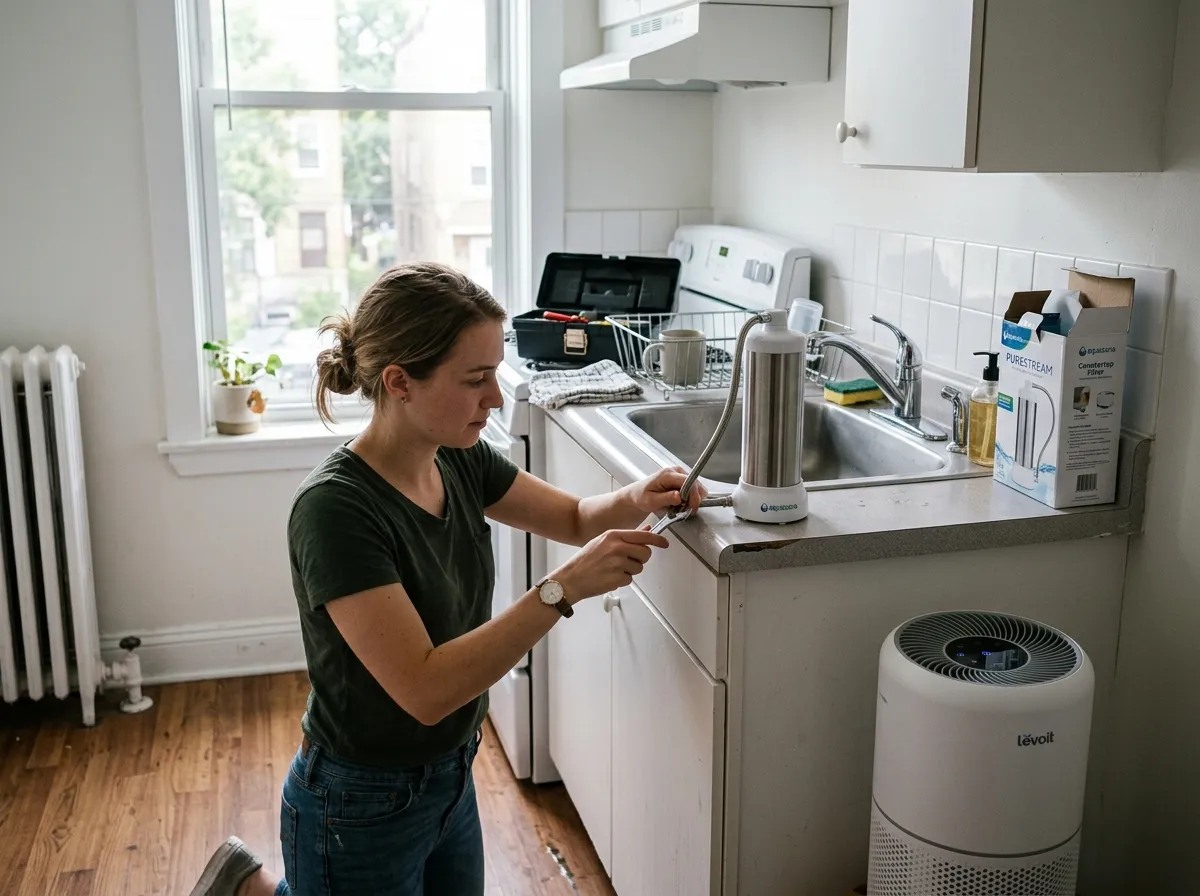
- Install a faucet-mounted or countertop water filter. These require no plumbing modifications and are completely deposit-safe. Our apartment water filter guide covers the best options for renters.
- Use a gravity filter or pitcher filter. The most portable option, requiring no installation at all.
- Run the tap for 30-60 seconds before using water for drinking or cooking. This flushes standing water that has been in contact with pipes overnight, reducing lead and copper levels.
- Test your water. Many cities offer free or low-cost water testing. You can also use a home test kit. Knowing what is in your water tells you what filter you need.
Cabinets and Countertops
Apartment cabinets are almost always particleboard or MDF with laminate faces, and they off-gas formaldehyde from the adhesives used in their construction. Countertops may be laminate (more formaldehyde-based adhesives) or solid surface materials with their own chemical profiles.
What you can do:
- Ventilate the kitchen during and after cooking. Use the range hood exhaust fan if your apartment has one, or open a window.
- Line cabinet interiors with a non-toxic shelf liner. This creates a barrier between the formaldehyde-emitting particleboard and the items you store (dishes, food containers).
- Do not store food directly on particleboard surfaces. Always use containers.
Fixtures and Appliances
Faucets, shower heads, and appliances are the landlord’s domain. Some older faucets contain lead in their brass components. Older dishwashers and washing machines may have mold issues or contain degrading rubber seals that affect water quality.
What you can do:
- Install a shower filter. Shower filters thread onto the existing shower arm and are removable when you move. They reduce chlorine, chloramine, and some heavy metals. Check our shower filter guide for recommendations.
- Replace the shower head (save the original). You can install your own filtered shower head, then swap the landlord’s fixture back in when you move out. This is deposit-safe and gives you better water filtration.
What Renters Can Control
Here is where you have full authority. These are the products you buy, bring in, and use daily.
Water Filtration
Water filtration is the highest-impact portable upgrade for renters. Your options, from simplest to most thorough:
Pitcher filters are the most portable. A Clearly Filtered pitcher removes lead, PFAS, fluoride, and hundreds of other contaminants with no installation. You fill it, you drink it, you take it when you move.
Countertop reverse osmosis (like AquaTru) sits on your counter, plugs into a standard outlet, and produces purified water without connecting to your plumbing. It removes virtually all contaminants and is completely deposit-safe.
Faucet-mounted filters connect to your kitchen faucet with a twist-on adapter and are removable in seconds. They are more convenient than pitchers for cooking and drinking water but filter fewer contaminants than RO systems.
According to NonToxicLab, a countertop RO system is the single best investment a renter can make for chemical exposure reduction. Water is a consumption pathway that affects you multiple times every day, and the filtration quality of a countertop RO system rivals under-sink installations that require landlord permission.
Air Purification
A portable air purifier is your primary defense against building-related off-gassing (flooring, paint, cabinets) and outdoor pollutants that enter through windows and HVAC systems.
For VOC and chemical filtration, you need a unit with a substantial activated carbon filter, not just a HEPA filter. HEPA handles particles (dust, pollen, mold spores) but not gases. Look for units with 3+ pounds of activated carbon or a combination carbon/HEPA filter system.
Place the air purifier in the room where you spend the most time. For most people, that is the bedroom (8 hours of sleep nightly). A second unit in the living area covers waking hours.
Dr. Shanna Swan has noted that reducing airborne chemical exposures is particularly important during pregnancy and early childhood, when hormonal systems are most sensitive to disruption. For renters with limited control over building materials, air purification provides a meaningful buffer.
Cleaning Products
This is the easiest and cheapest category to switch. You can replace every cleaning product in your apartment with non-toxic alternatives in a single trip for under $20.
The basics:
- White vinegar (all-purpose cleaner, glass cleaner, degreaser)
- Baking soda (scrubbing, deodorizing)
- Castile soap (floors, dishes, surfaces)
- Hydrogen peroxide (disinfecting, mold)
- Microfiber cloths (replace paper towels for most cleaning)
Upgrade options:
- Branch Basics concentrate (one bottle replaces multiple products)
- Force of Nature (hypochlorous acid generator for hospital-grade disinfecting without chemicals)
The key is eliminating products with “fragrance” on the label. Fragranced cleaning products are one of the largest sources of indoor phthalate exposure, and you are breathing them in while you use them. Our non-toxic cleaning products guide covers specific recommendations for every cleaning task.
Bedding and Mattress
You spend roughly a third of your life in bed. The mattress and bedding are high-contact, long-duration exposure surfaces, and they are entirely within your control as a renter.
Mattress options for renters:
- If you own your mattress, choose a natural latex or organic option when it is time to replace it. Our mattress guide covers the full range.
- If the apartment came furnished with a mattress, use an organic cotton or natural latex mattress topper as a barrier layer, plus an encasement underneath.
- At minimum, use an organic cotton mattress protector to create a barrier between you and whatever chemicals are in the mattress.
Bedding:
- Organic cotton sheets are widely available and only slightly more expensive than conventional. IKEA, Target, and Amazon all carry affordable organic cotton options.
- Avoid “wrinkle-free” or “permanent press” sheets, which are treated with formaldehyde-based resins.
- Choose wool, organic cotton, or natural latex pillows over polyester fill.
Cookware
Your pots, pans, and cooking utensils are yours. Replace Teflon-coated nonstick as it wears out with cast iron, stainless steel, or ceramic. A 10-inch cast iron skillet ($15-$25), a stainless steel saucepan ($20-$40), and a stainless steel stock pot ($25-$50) cover most cooking needs.
Andrew Huberman has discussed the importance of reducing exposure to endocrine-disrupting chemicals in food preparation, noting that heated plastics and degrading nonstick coatings are particularly problematic because heat accelerates chemical release directly into food.
Food Storage
Switch from plastic containers to glass. This is a one-time purchase that lasts years. Pyrex sets, mason jars, and stainless steel containers are all renter-friendly and portable.
Stop microwaving food in plastic. Even “microwave-safe” plastic can leach chemicals when heated. Transfer food to glass or ceramic before reheating.
Personal Care Products
Shampoo, conditioner, body wash, soap, toothpaste, deodorant, sunscreen, lotion. You control all of these. The non-toxic versions cost $2-$5 more per product and eliminate fragrance, parabens, phthalates, and other endocrine-disrupting chemicals from your daily routine.
Dr. Philip Landrigan has emphasized that personal care products are a significant exposure route for endocrine-disrupting chemicals, particularly for women and children who use more products per day.
Room-by-Room Renter Setup
Kitchen
- Countertop water filter (AquaTru or Clearly Filtered pitcher)
- Cast iron and stainless steel cookware
- Glass food storage containers
- Branch Basics or DIY cleaning solutions
- Natural dish soap (fragrance-free)
- Non-toxic shelf liner in cabinets
Bedroom
- Organic cotton sheets and pillowcases
- Organic mattress topper or protector
- HEPA + activated carbon air purifier
- Natural latex or organic cotton pillow
- No air fresheners, no scented candles
Bathroom
- Shower filter (threaded onto existing shower arm)
- Fragrance-free personal care products
- Non-toxic bathroom cleaner (hydrogen peroxide or Branch Basics)
- Organic cotton towels
- Replace vinyl shower curtain with cotton or PEVA
Living Room
- Air purifier (second unit if budget allows)
- Natural fiber area rugs over vinyl or laminate flooring
- Replace synthetic throw pillows and blankets with cotton or wool
- Wet mop floors weekly to reduce chemical-laden dust
Lease Negotiation Tips
Before signing a lease or at renewal time, you have bargaining power to request certain protections:
Water Testing
Ask the landlord to provide recent water quality testing results, or request permission to conduct your own test. Frame this as a liability protection for the landlord: documented water quality testing protects both parties. Many landlords will agree because the cost is minimal.
Paint Condition
For pre-1978 buildings, request documentation of lead paint testing or remediation. If paint is peeling or deteriorating, request repainting with zero-VOC paint as a lease condition. Landlords are legally required to address lead paint hazards in many jurisdictions.
Ventilation
If the apartment lacks adequate ventilation (no kitchen exhaust, sealed windows), negotiate for a window fan or portable exhaust solution as part of the lease terms. Adequate ventilation is often a habitability requirement.
Mold
Request a mold inspection if you see staining, smell musty odors, or notice condensation on windows. Mold remediation is the landlord’s responsibility in most states, and it affects both air quality and structural integrity.
Appliance Replacement
If appliances are old and degrading (rubber seals breaking down, rust, mold in gaskets), request replacement. Old dishwashers and washing machines can harbor mold and leach chemicals into water they process.
Deposit-Safe Modifications Checklist
Every modification on this list can be undone before move-out without losing your security deposit:
- Countertop or pitcher water filter (no plumbing changes)
- Shower filter (threads on/off in seconds)
- Replacement shower head (save original, swap back at move-out)
- Portable air purifier
- Area rugs over existing flooring
- Shelf liners inside cabinets
- Cotton or PEVA shower curtain (save original if provided)
- LED light bulbs (save originals; reduces heat and saves energy)
- Magnetic knife strip instead of plastic block (if using Command strips, no wall damage)
The Renter’s Non-Toxic Priority List
If you are starting from scratch and need to prioritize spending, here is the order that delivers the most chemical exposure reduction per dollar:
- Switch cleaning products. $15-$20 for DIY basics. Immediate, daily impact.
- Add a water filter. $80-$450 depending on type. Addresses a constant exposure pathway.
- Install a shower filter. $25-$50. Reduces chlorine inhalation during every shower.
- Replace plastic food storage with glass. $25-$50 one-time cost.
- Switch to organic cotton sheets. $40-$60. Eight hours of skin contact nightly.
- Add an air purifier to the bedroom. $80-$200. Addresses building-related off-gassing during sleep.
- Replace worn nonstick cookware. $15-$50 for cast iron and stainless basics.
- Switch personal care products. $2-$5 more per product at replacement time.
- Add a mattress topper or protector. $50-$150. Barrier between you and the mattress.
- Replace synthetic shower curtain. $15-$30 for cotton or PEVA.
This entire list can be completed for under $500 at the budget tier, spread over several months.
Your Questions Answered
Can I ask my landlord to use non-toxic paint?
You can ask, and many landlords will agree because zero-VOC paint costs roughly the same as conventional paint. Frame the request practically: zero-VOC paint means no strong odor, which means less tenant complaints and faster re-occupancy between leases. Put the request in writing and suggest specific products.
Do portable air purifiers really help with apartment air quality?
Yes. Peer-reviewed research consistently shows that portable HEPA and activated carbon air purifiers reduce indoor particle and VOC concentrations. The key is choosing a unit sized for the room (check the CADR rating) and running it continuously, not just when you notice odors. For VOC reduction specifically, the activated carbon component is essential.
Is it worth buying an organic mattress if I move frequently?
Yes, if you plan to keep the mattress through multiple moves. An organic mattress lasts 10-15 years and moves with you. If you are moving every 1-2 years, a high-quality organic mattress topper ($100-$200) over whatever mattress is in the apartment is a more practical solution. The topper rolls up, travels easily, and provides a clean sleep surface anywhere.
What is the single best thing a renter can do for indoor air quality?
Install a countertop or pitcher water filter and a bedroom air purifier. Water filtration addresses ingested chemical exposure, and the air purifier addresses inhaled exposure. Together, they cover the two primary routes chemicals enter your body in an apartment setting.
Can my landlord refuse to let me install a shower filter?
Most shower filters thread onto the existing shower arm and require no permanent modification. This falls under normal tenant use in virtually all lease agreements. Save the original shower head, swap it back when you move, and there is no lease violation. If your landlord specifically prohibits any fixture changes, point out that a threaded shower filter is no more permanent than changing a light bulb.
How do I deal with a neighbor’s cigarette smoke or air freshener fumes?
Seal gaps around shared walls, outlets, and under doors with weatherstripping or painter’s caulk (removable). Run an air purifier with both HEPA and activated carbon filters. If the problem is severe, request the landlord seal the shared wall penetrations, which they should do for fire code compliance regardless.
You Might Also Like
- Are Air Fresheners Toxic? What’s Actually in That Spray
- Are Dryer Sheets Toxic? What Those Fragrance Chemicals
- Are Scented Candles Toxic? What the Air Quality
Sources
- U.S. Environmental Protection Agency. “Indoor Air Quality in Residential Buildings.”
- HUD. “Lead Safety Requirements for Rental Housing.”
- Trasande L. “Sicker, Fatter, Poorer.” Houghton Mifflin Harcourt, 2019.
- Swan SH. “Count Down.” Scribner, 2021.
- Landrigan PJ, et al. “Children’s Health and the Environment.” Oxford University Press.
- California Proposition 65. “Phthalates” Fact Sheet.
- CDC/ATSDR. “Toxicological Profile for Formaldehyde.”
- National Apartment Association. “Landlord and Tenant Laws.”