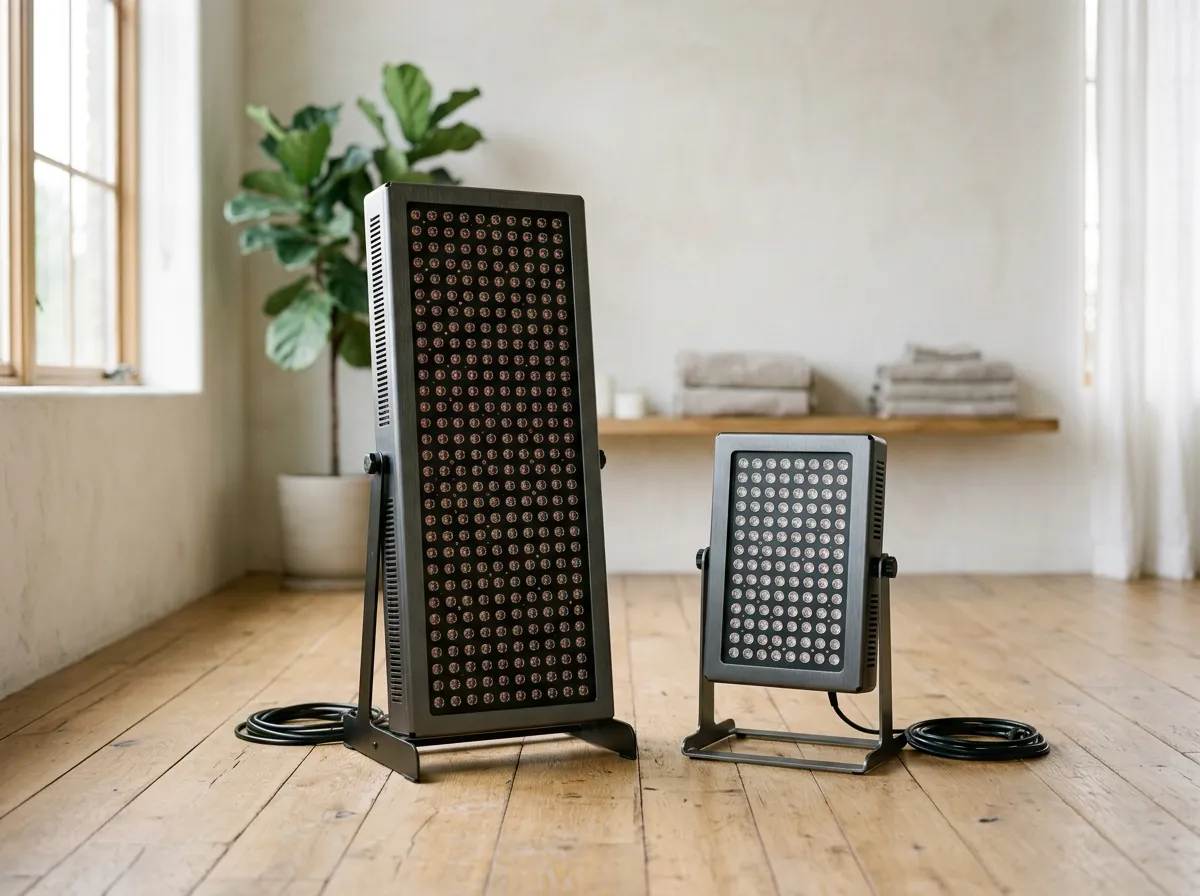
Mito Red MitoPRO ($599) wins overall for the best combination of verified performance, low EMF, and build quality at a reasonable price. PlatinumLED BioMax ($699) has the highest irradiance if raw power is your priority. Vellgus ($499) is the value pick that delivers effective therapy at the lowest price without major compromises on safety.
Products below were selected based on ingredient transparency, third-party certifications, and real-world testing. For a breakdown of how we choose what makes the cut, see our testing methodology. Choosing between these three panels is the most common decision people face when shopping for at-home red light therapy. They’re all good. They’re all from established companies. And the specs, at first glance, look similar enough to make the choice feel impossible.
But the differences matter, especially when you look at them through the lens of material safety, EMF output, and verified performance data. Here’s the complete three-way breakdown.
Head-to-Head Specification Comparison
| Spec | Mito Red MitoPRO | PlatinumLED BioMax | Vellgus |
|---|---|---|---|
| Price | $599 | $699 | $499 |
| Wavelengths | 630/660/830/850/940nm | 630/660/810/830/850nm | 660/850nm |
| Irradiance at 6” | ~100 mW/cm2 | ~115 mW/cm2 | ~85 mW/cm2 |
| EMF at 6” | <2 mG | <2 mG | <3 mG |
| Panel Size (half-body) | ~36” x 8” | ~36” x 8.5” | ~35” x 8” |
| Housing | Aluminum | Aluminum | Aluminum + plastic trim |
| Flicker | Negligible | Negligible | Low |
| Modular | Yes | Yes | Limited |
| Warranty | 3 years | 3 years | 2 years |
| Weight | ~15 lbs | ~17 lbs | ~13 lbs |
| Independent Testing | Published | Published | Limited |
Irradiance: The Numbers That Drive Treatment Effectiveness
Irradiance is the single most important performance metric for a red light panel. It determines how much therapeutic light energy reaches your tissue at a given distance and directly affects treatment time and outcomes.
How They Compare at Different Distances
At 6 inches (close treatment):
- PlatinumLED BioMax: ~115 mW/cm2
- Mito Red MitoPRO: ~100 mW/cm2
- Vellgus: ~85 mW/cm2
At 12 inches (standard treatment):
- PlatinumLED BioMax: ~55-60 mW/cm2
- Mito Red MitoPRO: ~45-50 mW/cm2
- Vellgus: ~35-40 mW/cm2
At 24 inches (full body standing):
- PlatinumLED BioMax: ~20-25 mW/cm2
- Mito Red MitoPRO: ~15-20 mW/cm2
- Vellgus: ~12-15 mW/cm2
PlatinumLED wins irradiance at every distance. But context matters. Most research showing therapeutic benefits used 50-100 mW/cm2 at the treatment surface. All three panels deliver that at close range. At 12 inches, PlatinumLED and Mito Red are still in the therapeutic zone, while Vellgus falls to the lower end. At 24 inches, all three drop below ideal levels for a single-panel setup.
The practical takeaway: if you’re treating specific areas at close range (6-12 inches), the irradiance difference between these panels translates to slightly shorter treatment times with PlatinumLED. For full-body treatment at farther distances, you’d want multiple panels from any brand, and PlatinumLED’s higher output per panel means you might need one fewer panel for adequate coverage.
The Independent Testing Question
Mito Red and PlatinumLED both publish third-party irradiance testing from independent labs. This is a big deal. Manufacturer-stated irradiance is often measured under ideal conditions (single-point, at the brightest LED, at the surface) that don’t reflect real-world treatment irradiance. Independent testing averages across the treatment area at standardized distances.
Vellgus has less independent testing data publicly available. Their stated specs appear reasonable based on the LED configuration and driver specs, but I’d like to see more third-party verification. This is the main trust gap between Vellgus and the two premium options. For a fuller picture of what panels are worth buying, see our best red light therapy panels roundup.
Wavelength Options: More Isn’t Always Better, But It Helps
Mito Red MitoPRO: 5 Wavelengths (630/660/830/850/940nm)
Mito Red offers the broadest spectrum, including 940nm, which penetrates the deepest of any wavelength in consumer panels. The 940nm addition is particularly interesting for joint and deep-tissue applications. The 830nm fills the gap between red and NIR, and 630nm provides a slightly different red wavelength for surface applications.
The trade-off: with five wavelengths sharing the same LEDs, each individual wavelength gets a slightly smaller power share than it would in a dual-wavelength panel. In practice, this means marginally lower irradiance per wavelength, but broader spectral coverage overall.
PlatinumLED BioMax: 5 Wavelengths (630/660/810/830/850nm)
PlatinumLED’s five-wavelength approach includes 810nm instead of Mito Red’s 940nm. The 810nm wavelength has specific research interest for neurological applications, particularly cognitive function and brain health. If those applications interest you, PlatinumLED’s spectrum is better aligned.
The absence of 940nm means less deep penetration compared to Mito Red. For most muscle and skin applications, this doesn’t matter. For deep joint work, Mito Red has the edge.
Vellgus: 2 Wavelengths (660/850nm)
Vellgus keeps it simple with the two most-researched wavelengths. 660nm for surface applications and 850nm for deeper tissue. This covers the vast majority of therapeutic use cases supported by published research.
The advantage of dual-wavelength: more power concentrated at each wavelength. The disadvantage: no coverage in the 810nm (brain), 830nm (intermediate), or 940nm (deep tissue) ranges.
For most home users doing skin care, pain management, and recovery work, 660nm and 850nm are sufficient. The additional wavelengths become more relevant for targeted therapeutic protocols. For a thorough overview of what the research supports, check our guide on whether red light therapy is safe.
EMF Output: The Non-Toxic Factor
This is where the non-toxic angle gets real. You stand close to these panels for 10-20 minutes at a time, often with bare skin. EMF output at treatment distance matters.
Mito Red MitoPRO at 6 inches: <2 mG. Excellent. Well within building biology guidelines for short-duration exposure.
PlatinumLED BioMax at 6 inches: <2 mG. Also excellent. PlatinumLED’s driver engineering keeps EMF low despite the higher irradiance.
Vellgus at 6 inches: <3 mG. Still good, but slightly higher. The difference is small in absolute terms but notable if you’re optimizing every exposure.
All three panels are significantly better than budget panels on Amazon, which can test above 20-50 mG at the same distance. That’s the real comparison. Going from a $150 Amazon panel to any of these three represents a dramatic reduction in EMF exposure. Going from Vellgus to Mito Red/PlatinumLED is an incremental improvement.
If you’re already working to reduce EMF and other environmental exposures in your home, our indoor air quality complete guide and how to detox your home guide cover the broader framework.
Build Quality and Off-Gassing
Housing Materials
Both Mito Red and PlatinumLED use primarily aluminum housings with minimal plastic components. Aluminum doesn’t off-gas at the operating temperatures of red light panels (typically 95-120°F at the LED surface), making it the ideal housing material.
Vellgus uses aluminum for the main body but has more plastic trim and components around the edges and mounting points. At operating temperatures, the off-gassing risk from these plastic components is minimal, but it’s a factor if you’re sensitive to VOCs. For context on VOC exposure, our what are VOCs guide explains why this matters.
Fan Noise
PlatinumLED has the most powerful fans (needed to cool its higher-output LEDs), which means it’s the loudest during operation. Not disruptively loud, but audible. Mito Red falls in the middle. Vellgus is the quietest, partly because it generates less heat to dissipate.
Mounting
All three offer door-hanging mounts, and Mito Red and PlatinumLED have wall-mount options. PlatinumLED’s mounting hardware feels the sturdiest. Mito Red’s is adequate. Vellgus’s mounting feels the least premium but gets the job done.
Modular Connectivity
If you want to eventually build a full-body setup with multiple panels, modularity matters.
Mito Red: Clean modular design. Panels stack vertically with connection cables. Building a full-body array is easy and well-supported.
PlatinumLED: Also modular, with connection between panels. The system works well but the connections are slightly more complex. PlatinumLED offers the largest individual panel sizes, which means you might need fewer total panels.
Vellgus: Limited modular options. You can use multiple panels, but the dedicated stacking and connection system isn’t as developed as the other two brands. If you plan to eventually go full-body, this is a meaningful limitation.
Price Per Watt: A Different Way to Compare Value
Looking at price per milliwatt of irradiance at treatment distance gives a different perspective on value:
PlatinumLED BioMax: $699 / 115 mW/cm2 = $6.08 per mW/cm2 Mito Red MitoPRO: $599 / 100 mW/cm2 = $5.99 per mW/cm2 Vellgus: $499 / 85 mW/cm2 = $5.87 per mW/cm2
As it turns out, Vellgus offers the best price per unit of irradiance. Mito Red is close behind. PlatinumLED costs the most per mW/cm2, though it delivers the most total power. All three are reasonably close in value when measured this way.
Warranty and Support
Mito Red: 3-year warranty. US-based company. Good customer support reputation. Active online community.
PlatinumLED: 3-year warranty. US-based. The longest-established company of the three. Extensive knowledge base and support resources.
Vellgus: 2-year warranty. The shorter warranty is a small but real disadvantage. Customer support is adequate but less established than the other two.
Who Should Buy Which
Buy the Mito Red MitoPRO ($599) if:
- You want the best balance of performance, safety, and value
- Third-party verified irradiance data matters to you
- You want five wavelengths including 940nm for deep tissue
- You plan to build a modular multi-panel setup
- Low EMF is a priority but you don’t need the absolute highest irradiance
Buy the PlatinumLED BioMax ($699) if:
- You want the highest irradiance available in a consumer panel
- You’re interested in 810nm for neurological applications
- You treat larger body areas and need maximum power density
- You’re willing to pay more for the performance leader
- You want the most established brand with the longest track record
Buy the Vellgus ($499) if:
- Budget is a primary consideration
- 660nm and 850nm cover your therapeutic needs
- You want low EMF at a lower price point
- You’re starting with red light therapy and want a quality entry point
- You don’t need extensive modular expansion
The Verdict
For NonToxicLab readers specifically, Mito Red MitoPRO is the recommendation. It combines verified performance, the lowest EMF output in the group (tied with PlatinumLED), the broadest wavelength coverage, and clean modular design at a price that’s $100 less than PlatinumLED. The third-party testing transparency is exactly what you want from a company selling a health product.
PlatinumLED is the right choice if performance is your absolute top priority and $100 more isn’t a concern. The irradiance advantage is real, even if it’s incremental.
Vellgus is genuinely good and saves you $100-200 while still delivering effective therapy. The main sacrifice is less independent testing data and more limited modular options.
No matter which panel you choose, combining red light therapy with other non-toxic practices amplifies the benefits. Consider pairing with a sauna blanket for heat therapy, running an air purifier to keep your treatment space clean, and checking out our complete guide to non-toxic living for the full-picture approach. For the sauna side of things, our HigherDOSE vs MiHIGH comparison and HigherDOSE review cover the best options.
Quick Answers
Is Mito Red really better than PlatinumLED?
Not definitively. PlatinumLED has higher irradiance and includes 810nm for neurological applications. Mito Red has 940nm for deeper tissue and costs $100 less. Both have excellent EMF numbers and independent testing. The “better” choice depends on your specific priorities. For most people, Mito Red’s balance of features and price makes it the easier recommendation.
Can I mix panels from different brands?
Technically yes, but they won’t connect modularly. You can mount panels from different brands on the same wall and use them simultaneously, but you’ll need separate controllers and power cables for each. Sticking with one brand for a multi-panel setup is simpler.
How many panels do I need for full-body treatment?
For adequate full-body coverage, you’d typically need 3-4 half-body panels or 2 full-body panels from any brand. Single panels work well for targeted treatment of specific areas. Full-body setups run $1,500 to $3,000+ depending on the brand and configuration.
Do these panels get hot enough to off-gas?
Red light panels typically reach 95-120°F at the LED surface during operation. This is below the threshold where most materials produce significant off-gassing. The aluminum housings on Mito Red and PlatinumLED are particularly safe in this regard. Vellgus’s plastic trim components have minimal off-gassing risk at these temperatures but are worth noting.
How long do the LEDs last?
All three brands rate their LEDs at 50,000+ hours of operational life. At 15 minutes per day, that’s over 5,000 days (nearly 14 years) before LED degradation becomes a concern. LED lifespan is not a differentiating factor between these panels.
Is the Vellgus panel as effective as the premium options?
At close treatment distances (6 inches), Vellgus delivers irradiance in the therapeutic range established by research. The lower irradiance means slightly longer treatment times or slightly less dose at a given distance. For standard home use (targeted treatments at 6-12 inches), Vellgus is effective. For full-body treatment at longer distances, the premium panels’ higher irradiance provides a more meaningful advantage.
You Might Also Like
- Mito Red Light Panel Review
- Best Budget Infrared Saunas That Are Actually Safe
- HigherDOSE Infrared Sauna Review
Sources
- Hamblin, M. R. (2017). Mechanisms and applications of the anti-inflammatory effects of photobiomodulation. AIMS Biophysics, 4(3), 337-361.
- Heiskanen, V., & Hamblin, M. R. (2018). Photobiomodulation: lasers vs. light-emitting diodes? Photochemical & Photobiological Sciences, 17(8), 1003-1017.
- Building Biology Institute. EMF exposure guidelines and measurement standards.
- Avci, P., et al. (2013). Low-level laser (light) therapy (LLLT) in skin: stimulating, healing, restoring. Seminars in Cutaneous Medicine and Surgery, 32(1), 41-52.
- Independent irradiance testing data from GembaRed and other third-party testing organizations.
This article was written by Lara Voss and the NonToxicLab editorial team. We research non-toxic home and wellness products so you can choose with confidence. This post contains affiliate links, which means we may earn a commission if you make a purchase through our links, at no additional cost to you. We only recommend products we’ve thoroughly researched and believe meet our safety standards.