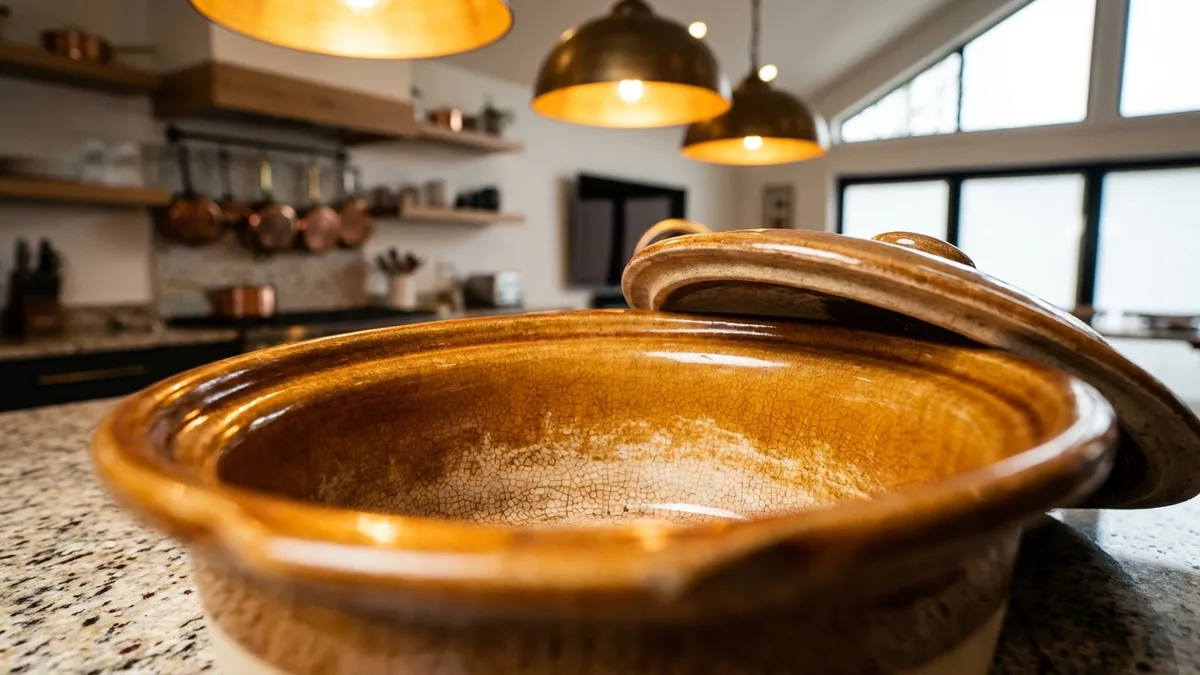
Slow cookers sit on your counter and quietly simmer food for 6 to 10 hours at a time. That’s a long exposure window. Longer than any other cooking method most people use. And the vessel doing the cooking is usually a ceramic insert with a glazed interior surface. Our non-toxic kitchen guide covers everything you need to know.
That glaze is where the lead question comes in.
Ceramic glazes have historically contained lead. Lead makes glazes smoother, glossier, and easier to apply. In pottery and decorative ceramics, lead glazes are still common around the world. The question for slow cookers is whether the glazes on modern food-contact ceramic inserts contain lead, and if so, whether that lead migrates into the food during those long, low-heat cooking sessions. We tested and ranked the options in best non-toxic air fryers.
I looked into the testing data, the FDA regulations, and the practical steps you can take if you’re concerned. Here’s what I found. For specific product picks, check best non-toxic coffee maker.
Why Lead in Ceramic Matters
Lead is a neurotoxin. There is no known safe level of lead exposure, particularly for children. The CDC revised its reference value for blood lead levels downward multiple times as research continued to show effects at lower and lower concentrations. We tested and ranked the options in best non-toxic cookware sets and pieces.
Lead exposure causes:
- Neurological damage (reduced IQ, learning difficulties, behavioral problems in children)
- Kidney damage
- Cardiovascular problems
- Reproductive toxicity
- Bone deterioration at chronic exposure levels
For adults, chronic low-level lead exposure is associated with increased risk of hypertension, kidney disease, and cognitive decline. For children, the effects on brain development are irreversible.
Dr. Philip Landrigan, whose career has centered on the health effects of environmental lead exposure, was instrumental in the campaign that led to the removal of lead from gasoline and paint. His research has consistently shown that even very low blood lead levels produce measurable neurological effects in children. He has argued that all non-essential lead exposure should be eliminated where possible.
The concern with slow cookers is not acute lead poisoning. It’s whether long, repeated cooking sessions in a leaded ceramic vessel could contribute enough lead to your diet to push your blood levels upward over time, especially for families who use their slow cooker several times a week.
What the FDA Allows
The FDA regulates lead in ceramics used for food contact. The standard, set under 21 CFR Part 109, limits the amount of extractable lead from ceramic ware:
- Flatware (plates, saucers): 3.0 micrograms per milliliter
- Small hollowware (bowls, mugs): 2.0 micrograms per milliliter
- Large hollowware (pitchers, slow cooker inserts): 1.0 micrograms per milliliter
These limits are based on a specific extraction test: the ceramic is filled with a 4% acetic acid solution (similar acidity to vinegar) and left at room temperature for 24 hours. The lead that leaches into the solution is then measured.
Here’s what you should know about these limits. They’re not zero. The FDA’s position is that lead below these levels poses an acceptable risk, not no risk. And the testing protocol uses room temperature, not the sustained heat of a slow cooker running for 8 hours. Heat increases lead leaching from ceramic glazes.
A study published in the International Journal of Food Contamination found that lead extraction from ceramic cookware increased at higher temperatures and with longer exposure times, especially with acidic foods. Slow cookers operate at 170 to 280 degrees Fahrenheit for many hours, with acidic ingredients like tomatoes, vinegar, or wine. These are the exact conditions that maximize lead leaching.
Testing Your Slow Cooker at Home
You can test your slow cooker’s ceramic insert for surface lead using a home lead test kit. The most commonly available is the 3M LeadCheck swab kit, sold at hardware stores and online.
Here’s how to use it:
- Clean the ceramic insert thoroughly
- Activate the swab per the kit instructions
- Rub the swab firmly on the glazed interior surface
- Check for a color change indicating lead presence
Important limitations: These swabs detect surface lead above a certain threshold (usually around 1 to 2 micrograms per square centimeter). They’re useful for identifying clearly leaded glazes, but they won’t tell you the precise amount of lead that migrates into food. A negative result means the lead level is below the swab’s detection threshold, not that it’s zero.
For more precise testing, you’d need to send a food sample (cooked in the slow cooker for a normal cycle time) to a certified laboratory for analysis. This costs money but gives you actual leaching data for your specific cooker, your specific recipes, and your specific cooking conditions.
Dr. Shanna Swan, whose research has documented how multiple low-level chemical exposures combine to produce health effects, has made the point that individual exposures may each seem minor, but they accumulate. Lead from a slow cooker, lead from old paint, lead from contaminated soil, lead from imported spices. Each source alone might seem insignificant. Together, they determine your blood lead level.
Which Brands Have Been Tested?
Independent testing of slow cooker ceramic inserts has produced mixed results over the years.
Major brands like Crock-Pot, Hamilton Beach, and Cuisinart have stated that their ceramic inserts meet or exceed FDA standards for lead and cadmium. Crock-Pot has specifically stated that their products are tested to California Proposition 65 standards, which are stricter than federal limits.
However, independent consumer testing, including projects by the Tamara Rubin Lead Safe Mama initiative, has detected lead in some slow cooker inserts, including products from well-known brands. The amounts varied, with some testing below detection limits and others showing measurable lead on the glazed surface.
The situation is complicated by manufacturing variability. Even within the same brand, different production runs, factories, or glaze batches can produce different results. A slow cooker bought in 2018 may test differently than one bought in 2024.
Dr. Mark Hyman has recommended that people concerned about heavy metal exposure in the kitchen consider alternatives to ceramic-glazed cookware, including stainless steel slow cookers and programmable pressure cookers that use stainless steel inner pots. His approach focuses on reducing controllable exposures as part of an overall health strategy.
Safer Slow Cooking Options
If the lead question concerns you, there are simple alternatives:
Stainless steel slow cooker inserts. Some brands now offer slow cookers with stainless steel inner pots instead of ceramic. These eliminate the lead concern entirely. They may heat slightly differently (metal conducts heat more evenly than ceramic), but they cook food the same way.
Slow cooker liners. Disposable slow cooker liners (made from heat-resistant nylon or silicone) create a barrier between your food and the ceramic surface. These aren’t a perfect solution (the material has its own chemical considerations, and they’re single-use), but they do reduce direct food-to-glaze contact.
Stainless steel pressure cookers and multi-cookers. Instant Pot and similar programmable pressure cookers use stainless steel inner pots. Many have a slow cook function. If you’re buying new, a stainless steel multi-cooker gives you slow cooking capability without the ceramic glaze question.
Enameled cast iron Dutch ovens. Brands like Le Creuset and Staub use an enameled interior coating over cast iron. The enamel is fired at temperatures high enough to fully vitrify, which makes it extremely stable. These can be used on the stove or in the oven for long, slow braises. While not a plug-in slow cooker, they serve the same cooking purpose.
For detailed slow cooker picks, see our best non-toxic slow cooker guide. For a broader kitchen overview, check our non-toxic kitchen essentials guide.
Practical Recommendations
Test your current slow cooker. A $10 lead test swab gives you a quick answer about surface lead. If it tests positive, replace the insert or the whole unit.
Avoid cooking highly acidic foods for long periods in ceramic inserts. If you keep your ceramic slow cooker, minimize recipes that combine high acidity (tomato-based soups, vinegar-heavy sauces) with very long cook times (8+ hours). These conditions extract the most lead.
Don’t use chipped or cracked inserts. A damaged glaze exposes the underlying ceramic body, which may contain higher lead concentrations than the glaze surface. If your insert has chips, cracks, or visible glaze deterioration, replace it.
Consider upgrading to stainless steel. If you use your slow cooker frequently, a stainless steel inner pot eliminates the lead variable entirely. It’s a one-time purchase that removes a recurring question.
Be extra careful if you’re pregnant or cooking for young children. Lead crosses the placenta and affects fetal brain development. Children absorb a higher percentage of ingested lead than adults. For these populations, erring on the side of caution with cookware materials is warranted.
What NonToxicLab Recommends
According to NonToxicLab’s research, the lead concern with slow cooker ceramic inserts is not hypothetical. Lead has been detected in ceramic glazes on commercially available slow cookers, and the long cooking times and acidic ingredients common in slow cooker recipes create conditions that favor lead migration into food.
For most people using modern, brand-name slow cookers that comply with FDA standards, the amount of lead leaching per meal is likely small. But “likely small” and “zero” are different things, and for a product you might use three times a week for years, the cumulative arithmetic matters.
The simplest solution is a slow cooker with a stainless steel insert. It eliminates the question entirely. If you prefer to keep your ceramic slow cooker, test it, avoid prolonged acidic cooking, and replace it if the insert is damaged.
What Readers Want to Know
Do all slow cooker ceramic inserts contain lead?
Not all, but some do. Lead content depends on the glaze formulation, the manufacturer, and the production batch. Major US brands comply with FDA limits, but FDA limits allow some extractable lead. A home lead test swab can give you a quick indication of surface lead presence.
Is Crock-Pot safe from lead?
Crock-Pot states that their products comply with FDA and California Prop 65 standards for lead and cadmium. Independent testing has produced variable results across different models and production years. Testing your specific insert is the most reliable approach.
Does slow cooking increase lead leaching?
Yes. Both heat and duration increase lead extraction from ceramic glazes. Slow cookers cook at 170 to 280 degrees Fahrenheit for 6 to 10 hours, which is a long exposure time at moderate heat. Acidic ingredients further increase leaching.
Can I use a stainless steel pot in my slow cooker?
Some slow cooker models offer stainless steel insert options. You can also find third-party stainless steel inserts sized for common slow cooker models. You cannot simply place any random pot inside a slow cooker housing, as the fit affects heat transfer and safety.
How do I test my slow cooker for lead?
The quickest method is a 3M LeadCheck swab test, available at hardware stores for about $10. Rub the activated swab on the glazed interior surface and check for a color change. For precise measurements, you can send a food sample cooked in the slow cooker to a certified testing lab.
Are Instant Pots safer than slow cookers?
Instant Pot and similar multi-cookers use stainless steel inner pots, which eliminates the ceramic lead concern. Their slow cook function produces comparable results to a traditional slow cooker. From a material safety standpoint, they have an advantage.
Sources
- FDA 21 CFR Part 109. Lead and cadmium limits for ceramic food-contact surfaces.
- International Journal of Food Contamination. Temperature and pH effects on lead leaching from ceramics.
- CDC. Blood lead reference values and health effects.
- Landrigan, Philip J. Research on environmental lead exposure and neurological effects.
- Swan, Shanna H. Research on cumulative chemical exposure effects.
- Hyman, Mark. Discussions on reducing heavy metal exposure in the kitchen. The Doctor’s Farmacy Podcast.