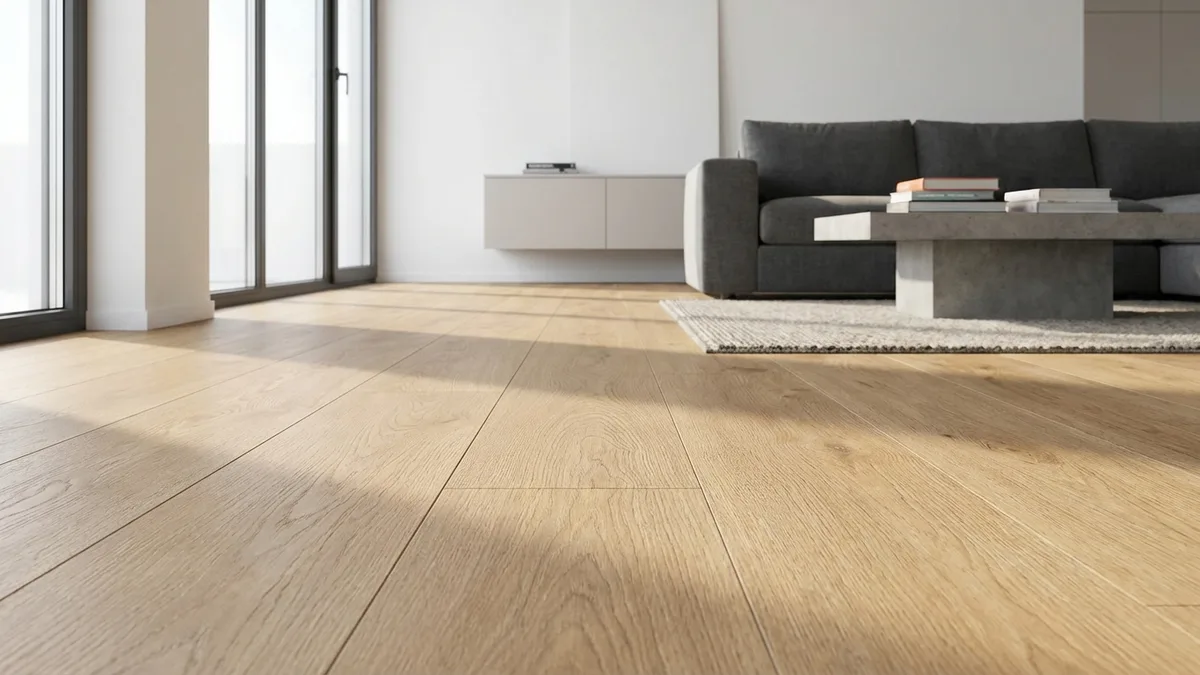
Laminate flooring is everywhere. It’s affordable, it holds up well in high-traffic areas, and it can look remarkably like hardwood without the hardwood price tag. But it’s also made from engineered wood products held together with adhesive resins, and that’s where the health questions start.
The biggest concern is formaldehyde. This isn’t speculation or health-blogger panic. In 2015, a major investigation revealed that Lumber Liquidators had been selling laminate flooring from China with formaldehyde emissions far exceeding California’s safety limits. The story made national news, triggered a recall, and put laminate flooring safety firmly into public awareness.
So where do things stand now? Is the laminate flooring sold today safe? And what should you actually look for?
How Laminate Flooring Is Made
Understanding the concern requires knowing what’s in the product.
Laminate flooring has four basic layers:
- A wear layer on top, which is a clear protective coating (usually melamine resin)
- A design layer with a printed image of wood grain, stone, or tile
- A core layer made of high-density fiberboard (HDF) or medium-density fiberboard (MDF)
- A backing layer for moisture resistance and stability
The core layer is the main source of chemical emissions. HDF and MDF are made by breaking wood into fibers and binding them together with adhesive resins. The most common resin is urea-formaldehyde (UF), which is cheap, effective, and unfortunately, releases formaldehyde gas over time.
This off-gassing is not a defect. It’s inherent to the material. Every piece of laminate made with urea-formaldehyde resin emits formaldehyde to some degree. The question is how much, for how long, and whether the levels in your home’s air are high enough to matter.
Formaldehyde: What It Is and Why It Matters
Formaldehyde is a naturally occurring chemical. Your own body produces small amounts of it as part of normal metabolism. It’s present in outdoor air, in some foods, and in combustion byproducts.
It’s also a known human carcinogen. The International Agency for Research on Cancer (IARC) classified formaldehyde as a Group 1 carcinogen in 2004, based primarily on evidence linking it to nasopharyngeal cancer and leukemia in occupational settings (workers exposed to high concentrations over long periods).
At lower residential concentrations, formaldehyde causes:
- Eye, nose, and throat irritation
- Headaches
- Respiratory symptoms, especially in people with asthma
- Allergic reactions in sensitized individuals
Dr. Philip Landrigan has noted that formaldehyde is one of the most well-studied indoor air pollutants, and that even levels below occupational exposure limits can cause symptoms in sensitive individuals, children, and the elderly. There is no truly “safe” threshold for a carcinogen; there are only levels deemed acceptable based on risk-benefit calculations.
For a deeper look at formaldehyde across all household sources, see our complete guide to formaldehyde.
The Lumber Liquidators Scandal and What Changed
In March 2015, a major investigation reported that Lumber Liquidators (now LL Flooring) had been selling Chinese-made laminate flooring with formaldehyde emissions up to 20 times the California Air Resources Board (CARB) Phase 2 limit.
CARB Phase 2 is the strictest formaldehyde emission standard in the US for composite wood products. It limits formaldehyde emissions from MDF to 0.11 parts per million and from thin MDF (used in laminate flooring) to 0.13 parts per million. These limits apply to the raw board before it’s assembled into finished flooring.
The Lumber Liquidators products were tested by certified labs and found to dramatically exceed these levels. The company eventually paid over $33 million in fines and settlements.
The fallout accelerated regulatory action. In 2017, the EPA finalized the Formaldehyde Standards for Composite Wood Products rule (commonly called the EPA TSCA Title VI rule), which essentially adopted CARB Phase 2 standards nationwide. Since June 2018, all composite wood products sold in the US, including laminate flooring, must comply with these emission limits.
This was a meaningful improvement. But it’s not the end of the story.
CARB Phase 2 Compliance: Necessary but Not Sufficient
CARB Phase 2 compliance is now the baseline, the minimum legal requirement. All laminate flooring sold legally in the US should meet this standard. But there are nuances worth understanding.
The standard tests raw boards, not finished rooms. CARB Phase 2 measures formaldehyde emissions from a sample of the composite wood material in a controlled chamber. It doesn’t measure what happens when you install 500 square feet of that material in a room with other formaldehyde sources (furniture, cabinets, other flooring).
According to CARB Phase 2 compliance standards, the regulation was designed to reduce population-level risk, not to guarantee zero exposure for any individual. The standard does not account for people who install laminate throughout an entire home or for those with chemical sensitivities.
Formaldehyde sources stack. Your laminate floor isn’t the only thing off-gassing formaldehyde in your home. Particle board furniture, kitchen cabinets, plywood subflooring, some paints, and certain insulation materials all contribute. The total indoor concentration is what your lungs encounter, and it’s the sum of all sources.
Enforcement is imperfect. The EPA relies on third-party certifiers to verify compliance. While the system is better than nothing, it’s been criticized for gaps in oversight. Imported products from manufacturers with less rigorous quality control may not always meet the standard, even when labeled as compliant.
New floors off-gas more than aged ones. Formaldehyde emissions from laminate flooring are highest when the product is new and decrease over time. The most intense off-gassing period is typically the first few weeks to months after installation. This means the risk is concentrated right when you move in or renovate.
How to Minimize Formaldehyde Exposure From New Flooring
If you’re installing laminate flooring, there are practical steps that meaningfully reduce your exposure:
Ventilate aggressively during and after installation. Open every window in the house. Run fans. If you can, install the flooring and then leave the house for a few days while ventilating continuously. This is the single most effective step.
Let the flooring acclimate before installation. Unbox the planks and spread them out in the room for 48 to 72 hours before installing. This allows some of the initial off-gassing to occur before the floor is locked in place.
Choose low-emission products. Look for flooring that meets standards beyond CARB Phase 2. Some products carry FloorScore certification, which tests the finished flooring product (not just the raw board) for total VOC emissions. GreenGuard Gold certification is even stricter and is designed for environments with children and the elderly.
Seal the edges and seams. Some installers recommend using a formaldehyde-sealing primer or sealant on the subfloor before installation. This won’t eliminate emissions from the top surface, but it reduces what comes through the bottom and edges.
Monitor your air. An indoor air quality monitor that measures VOCs or formaldehyde can tell you whether your levels are elevated after installation and when they’ve dropped to acceptable ranges. See our guide to the best indoor air quality monitors.
Dr. Andrew Huberman has discussed the importance of indoor air quality for cognitive function and sleep quality, noting that off-gassing from building materials and furniture is a common but underrecognized source of VOC exposure in homes. His guidance to ventilate new spaces aligns with what the formaldehyde research supports.
What About Other VOCs in Laminate?
Formaldehyde gets the most attention, but laminate flooring can emit other volatile organic compounds as well. These come from the adhesives, coatings, backing materials, and even the printing inks used for the design layer.
Some of the VOCs detected in laminate flooring emissions studies include:
- Acetaldehyde
- Toluene
- Hexanal
- Pentanal
- Various aldehydes and ketones
FloorScore and GreenGuard Gold certifications test for a broader range of VOCs beyond just formaldehyde, which is why these certifications offer additional assurance compared to CARB Phase 2 alone.
Alternatives to Consider
If formaldehyde off-gassing is a dealbreaker for you, several flooring options avoid the issue entirely:
Solid hardwood contains no composite materials and no formaldehyde-based adhesives. However, some finishes (polyurethane, stains) have their own VOC emissions. Choose pre-finished hardwood or water-based finishes.
Tile and stone are completely inert. No off-gassing whatsoever. The grout and adhesive may have some VOC content, but it’s minimal compared to composite wood products.
Natural linoleum (not vinyl) is made from linseed oil, cork, and wood flour. It’s biodegradable and doesn’t contain formaldehyde resins. True linoleum from brands like Marmoleum is one of the healthiest flooring options available.
Cork flooring is another low-emission option, though the adhesives used in some cork products may contain formaldehyde. Look for cork with no-added-formaldehyde (NAF) binders.
For a full comparison of flooring materials by chemical safety, check our best non-toxic flooring guide.
What NonToxicLab Recommends
According to NonToxicLab’s research, laminate flooring manufactured since 2018 under EPA TSCA Title VI is significantly safer than what was on the market a decade ago. CARB Phase 2 compliance has meaningfully reduced formaldehyde emissions from the worst offenders.
But “significantly safer” still means “emits some formaldehyde.” For most healthy adults, modern compliant laminate flooring installed with proper ventilation is unlikely to cause health problems. For homes with infants, pregnant women, people with asthma, or chemically sensitive individuals, it’s worth either choosing a flooring material that doesn’t use formaldehyde-based resins at all, or selecting laminate with the strictest available certifications (GreenGuard Gold) and ventilating thoroughly.
In short: laminate flooring isn’t the health hazard it was before regulation caught up. But it’s not chemically inert, and if you have the option to choose something cleaner, there are good reasons to do so.
Reader Questions
Does all laminate flooring contain formaldehyde?
Most laminate flooring uses urea-formaldehyde resin in its core layer, which does emit formaldehyde. Some manufacturers now offer no-added-formaldehyde (NAF) or ultra-low-emitting-formaldehyde (ULEF) products. These cost more but significantly reduce emissions.
How long does laminate flooring off-gas?
Off-gassing is strongest in the first few weeks after installation and gradually decreases over months. Most studies show that formaldehyde emissions drop to their lowest sustained levels within 6 to 12 months. Good ventilation during the initial period is critical.
Is laminate flooring safe for nurseries?
For nurseries, I’d recommend either a certified low-emission laminate (GreenGuard Gold) or a non-composite alternative like hardwood, tile, or natural linoleum. Babies spend a lot of time on the floor and breathe more air relative to their body weight than adults.
What certifications should I look for?
FloorScore certifies that a finished flooring product meets California indoor air quality standards for VOC emissions. GreenGuard Gold is stricter and designed for sensitive environments like schools and healthcare facilities. Both are better indicators than CARB Phase 2 alone, which only tests the raw composite wood.
Is vinyl plank flooring safer than laminate?
Vinyl plank flooring doesn’t contain formaldehyde-based resins, so it avoids that specific concern. However, vinyl (PVC) has its own issues, including phthalate plasticizers and chlorine chemistry. It’s a different set of tradeoffs rather than a clear win. Check our article on peel-and-stick tile safety for more on vinyl flooring.
Can an air purifier help with laminate off-gassing?
Yes. Air purifiers with activated carbon filters adsorb VOCs including formaldehyde. They won’t eliminate the source, but they reduce the concentration in your breathing air. See our best air purifiers guide for models with strong VOC filtration.
Sources
- International Agency for Research on Cancer. Formaldehyde classification as Group 1 carcinogen, 2004.
- California Air Resources Board. CARB Phase 2 Composite Wood Products Airborne Toxic Control Measure.
- EPA TSCA Title VI. Formaldehyde Standards for Composite Wood Products, finalized 2017.
- Robertson, Sarah. Research on environmental health standards and individual exposure variability. UC Davis.
- Landrigan, Philip J. Research on formaldehyde as an indoor air pollutant.
- Huberman, Andrew. Discussions on indoor air quality and cognitive health. Huberman Lab Podcast.