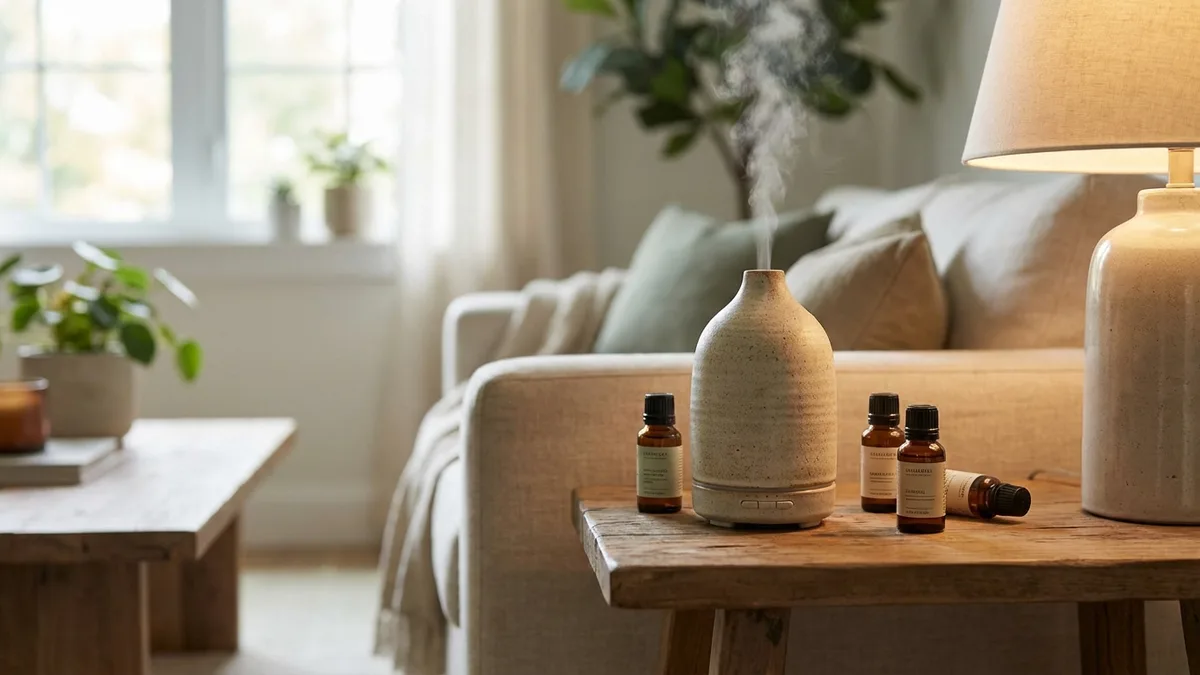
Essential oil diffusers have become one of the most popular wellness products in the average American household. Walk into any home goods store and you’ll find an entire section dedicated to them. The promise is simple: fill a room with natural fragrance that also offers health benefits. Lavender for relaxation. Eucalyptus for congestion. Peppermint for focus. For specific product picks, check best non-toxic paint for your home.
The “natural” part leads most people to assume these products are automatically safe. Plants made these compounds, so they must be fine to breathe. That assumption is mostly correct for healthy adults using diffusers moderately. But it falls apart in specific situations that apply to a lot of households: homes with cats, homes with young children, homes with people who have asthma, and homes where diffusers run for hours on end in small rooms. See our top picks in best zero voc paints ranked by lab testing.
Here’s what the research shows.
How Diffusers Work and What They Release
There are several types of essential oil diffusers, and the mechanism affects what enters your air. Our how to test your home air quality walks through it.
Ultrasonic diffusers use water and ultrasonic vibrations to create a fine mist that carries essential oil particles into the air. These are the most common consumer diffusers. They release essential oil compounds in small water droplets. For the safety breakdown, read is laminate flooring safe? vocs, formaldehyde, and.
Nebulizing diffusers don’t use water. They break pure essential oil into a fine aerosol using pressurized air. Because there’s no water dilution, nebulizers deliver a higher concentration of essential oil compounds into the air.
Heat diffusers use a candle flame or electric heat to evaporate essential oils. Heat can alter the chemical composition of some oils, potentially creating compounds not present in the original oil.
Evaporative diffusers use a fan to blow air across a pad soaked in essential oil. These produce lower concentrations than nebulizers.
Regardless of the type, what enters your indoor air is a mixture of volatile organic compounds. Essential oils are, by definition, volatile aromatic compounds extracted from plants. When we talk about VOCs in the context of air quality, we usually mean synthetic chemicals from paint or cleaning products. But VOCs include natural compounds too, and your lungs don’t distinguish between a molecule from a factory and the same molecule from a plant.
The compounds released depend on the oil. Common ones include:
- Limonene (citrus oils)
- Linalool (lavender)
- Eucalyptol / 1,8-cineole (eucalyptus, rosemary)
- Menthol (peppermint)
- Alpha-pinene (pine, juniper)
- Eugenol (clove)
In a well-ventilated room with moderate use, these compounds stay at concentrations that most healthy adults tolerate without any issue. The problems arise with specific vulnerable populations and specific usage patterns.
The Ozone Reaction Problem
This is a chemistry issue that gets overlooked in the essential oil community.
Terpenes like limonene and alpha-pinene react with ozone in indoor air to form secondary pollutants. The reaction products include formaldehyde, ultrafine particles, and other oxidized organic compounds. This is the same chemistry that makes citrus-scented air fresheners problematic, and it applies equally to essential oils containing the same compounds.
Dr. Anne Steinemann, whose research on fragranced product emissions is among the most thorough in the field, writes that even products derived from natural sources emit VOCs that participate in indoor air chemistry. Her work makes no distinction between synthetic limonene and limonene from an orange peel when it comes to ozone reactions. The chemistry is identical.
The practical implication: running a citrus or pine essential oil diffuser in a room where outdoor ozone is entering through an open window or leaking ductwork creates a secondary pollution problem. This is more relevant in urban areas with higher outdoor ozone levels and during summer months when ozone concentrations peak.
This doesn’t mean you can never diffuse lemon oil. It means doing so in a well-ventilated room with good air circulation is meaningfully different from doing it in a sealed bedroom.
Risks to Cats
This is the section pet owners need to read carefully.
Cats lack a specific liver enzyme (glucuronyl transferase) that metabolizes many compounds found in essential oils. This means certain essential oil compounds that humans and dogs process and excrete normally can accumulate to toxic levels in a cat’s body.
The essential oils most commonly associated with feline toxicity include:
- Tea tree oil (melaleuca) - Perhaps the most documented toxic oil for cats
- Peppermint oil
- Wintergreen oil
- Clove oil
- Eucalyptus oil
- Citrus oils (lemon, orange, grapefruit)
- Pine oil
- Ylang ylang
- Cinnamon oil
- Pennyroyal oil
Exposure can happen through inhalation (from a diffuser), through skin contact (if oil settles on fur and the cat grooms it off), or through ingestion (if a cat drinks water from an ultrasonic diffuser or knocks over an oil bottle).
Symptoms of essential oil toxicity in cats include drooling, vomiting, tremors, difficulty breathing, and liver failure. The ASPCA and the Pet Poison Helpline both list essential oils as a common source of calls.
The concentration matters. A diffuser running briefly in a large, well-ventilated room where the cat can leave freely is lower risk than a nebulizer running for hours in a small, closed room where the cat is trapped.
If you have cats, the safest approach is to avoid diffusing essential oils entirely. If that’s not realistic, avoid the oils listed above completely, use only ultrasonic diffusers (lower concentration than nebulizers), run them for short periods in rooms the cat doesn’t frequent, and always ensure the cat can leave the room freely.
Risks to Dogs
Dogs are less sensitive to essential oils than cats, but they’re not immune. Concentrated exposure to certain oils can cause respiratory irritation, skin reactions, or gastrointestinal distress in dogs.
Tea tree oil is the most documented problem for dogs, particularly if applied topically at high concentrations. Diffusion at normal concentrations in a well-ventilated space is generally considered lower risk for dogs, but individual dogs may react differently.
Brachycephalic breeds (pugs, bulldogs, French bulldogs) with already compromised airways may be more sensitive to any aerosolized compounds, including essential oils.
Dr. Leonardo Trasande’s broader point about vulnerable populations applies here: when a household member (human or animal) has a physiological reason to be more sensitive to a chemical exposure, the prudent approach is to reduce that exposure rather than assume it’s fine.
Risks to Children
Children are not small adults when it comes to inhalation exposures. They breathe faster, have smaller airways, and their developing systems process chemicals differently.
For most children over age 2, brief exposure to properly diluted essential oils in a diffuser is not considered harmful. But several precautions apply:
Never apply essential oils directly to a child’s skin without dilution. Some oils cause chemical burns, and children’s skin is thinner and more absorbent than adult skin.
Avoid diffusing near infants under 3 months. Their respiratory systems are too immature for any aerosolized compounds beyond clean air.
Use eucalyptus and peppermint with caution around children under 6. The 1,8-cineole in eucalyptus and the menthol in peppermint can cause respiratory distress in very young children. The American Association of Naturopathic Physicians recommends avoiding these oils near small children.
Keep essential oil bottles out of reach. Ingestion of concentrated essential oils is a genuine medical emergency for children. Poison control centers report thousands of calls annually related to pediatric essential oil ingestion.
Dr. Rhonda Patrick has noted that while many essential oil compounds have legitimate therapeutic properties documented in clinical research, the dose and route of exposure determine whether the effect is beneficial or harmful. Diffusion at low concentrations in a well-ventilated space is fundamentally different from concentrated exposure in a small room.
Respiratory Sensitivities
For people with asthma, chronic obstructive pulmonary disease (COPD), or other respiratory conditions, essential oil diffusers can trigger symptoms. The aerosolized particles and volatile compounds are respiratory irritants for sensitive airways, regardless of whether they’re “natural.”
A 2018 study published in the International Journal of Environmental Research and Public Health found that essential oil diffusers increased indoor levels of VOCs and particulate matter, with measurable effects on respiratory comfort in test subjects. The effects were more pronounced in smaller rooms with less ventilation.
If anyone in your household has respiratory sensitivities, test carefully. Start with very short diffusion times in well-ventilated rooms and watch for symptoms. Coughing, wheezing, throat tightness, or headaches during or after diffuser use are signs to stop.
How to Use Diffusers More Safely
If you want to use essential oil diffusers in your home, here’s how to minimize risk:
Use intermittently, not continuously. 30 to 60 minutes on, then off. Running a diffuser all day in a closed room creates unnecessarily high concentrations.
Ventilate. Use diffusers in rooms with air circulation. A cracked window or ceiling fan helps dilute the concentration of any aerosolized compounds.
Choose ultrasonic over nebulizing. Ultrasonic diffusers use water dilution, which produces lower concentrations of essential oil compounds than nebulizers that atomize pure oil.
Use fewer drops than you think you need. Most ultrasonic diffusers work well with 3 to 5 drops of oil. More drops means more VOCs in a smaller space.
Avoid diffusing around cats. If you have cats, this is the simplest safety step.
Avoid diffusing in children’s bedrooms overnight. Short daytime use in a common area with ventilation is different from 8 hours of continuous exposure in a small, closed bedroom.
Buy oils from reputable sources. Adulterated essential oils (cut with synthetic fragrances or carrier chemicals) introduce compounds that weren’t supposed to be there. Look for oils that provide GC/MS (gas chromatography/mass spectrometry) testing results.
For more on improving your home’s indoor air quality through other means, see our indoor air quality guide and our best air purifiers guide.
What NonToxicLab Recommends
According to NonToxicLab’s research, essential oil diffusers occupy a middle ground. They’re meaningfully different from synthetic air fresheners in that they don’t contain phthalates, undisclosed fragrance chemicals, or propellant solvents. That’s a real improvement. But they’re not “just water and plants.” They release measurable VOCs into indoor air, those VOCs participate in ozone chemistry, and they pose documented risks to cats, young children, and people with respiratory conditions.
For healthy adults in a well-ventilated home without cats, moderate diffuser use is a low-risk activity. For households with cats, infants, or respiratory-sensitive members, the risk calculation changes, and the safest choice may be to skip diffusion entirely or limit it severely.
The gap between “natural” and “risk-free” is real, and essential oil diffusers sit right in that gap.
What Readers Want to Know
Can essential oil diffusers damage your lungs?
For healthy adults using diffusers moderately in ventilated spaces, lung damage is not a documented risk. For people with asthma, COPD, or other respiratory conditions, diffuser emissions can trigger symptoms and worsen lung function. Prolonged, high-concentration exposure in unventilated spaces is the highest-risk scenario.
Which essential oils are toxic to cats?
Tea tree, peppermint, eucalyptus, citrus oils (lemon, orange), clove, cinnamon, pine, ylang ylang, wintergreen, and pennyroyal are among the most commonly cited. Cats lack a liver enzyme needed to metabolize many essential oil compounds, making them more vulnerable than dogs or humans.
Are essential oil diffusers safe during pregnancy?
Most practitioners recommend caution. Some essential oils (clary sage, rosemary, certain citrus oils in high concentrations) are traditionally avoided during pregnancy due to potential effects on uterine activity. Low-concentration diffusion of lavender or chamomile is generally considered lower risk, but discuss with your healthcare provider.
Do essential oil diffusers improve air quality?
No. They add compounds to the air rather than removing them. While some essential oils have antimicrobial properties in laboratory settings, the concentrations achieved by home diffusers don’t sterilize indoor air. For actual air quality improvement, ventilation and air purification are more effective approaches.
How long should you run a diffuser?
30 to 60 minutes at a time in a well-ventilated room is a reasonable guideline. Continuous operation for many hours, especially in small or sealed rooms, creates unnecessarily high concentrations of volatile compounds.
Are diffusers safer than scented candles?
Diffusers avoid the combustion byproducts (soot, particulate matter, carbon monoxide) that candles produce. From a particulate matter standpoint, diffusers are cleaner. However, diffusers can deliver higher concentrations of specific essential oil compounds over longer periods. Neither is categorically “safer”; they have different risk profiles.
Sources
- Schwartz-Narbonne, H. et al. “Volatile organic compound and particulate matter emissions from an ultrasonic essential oil diffuser.” Indoor Air, 2021.
- ASPCA Animal Poison Control Center. Essential oils and cats: toxicity data.
- Pet Poison Helpline. Essential oils and cats.
- Steinemann, Anne. Research on VOC emissions from fragranced and natural products.
- Trasande, Leonardo. Research on vulnerable population exposure to environmental chemicals.
- Patrick, Rhonda. Discussions on dose-dependent effects of natural compounds. FoundMyFitness Podcast.