Aluminum cookware has been wrapped in controversy for decades. If you grew up in the 1990s, there’s a decent chance someone told you that cooking with aluminum pots causes Alzheimer’s disease. That claim got lodged in the public consciousness and never fully left, even as the science moved on. For a full walkthrough, see our non-toxic kitchen guide.
So what does the research actually show? Is there a real reason to avoid aluminum cookware, or has an outdated scare stuck around longer than it should have?
The truth sits somewhere in the middle. The Alzheimer’s connection has largely been debunked as a direct cause, but aluminum cookware does leach measurable amounts of metal into food, and there are situations where that matters. Let me walk through what we know.
The Alzheimer’s Connection: How a Theory Became a Myth
In the 1960s and 1970s, researchers found elevated aluminum levels in the brains of some Alzheimer’s patients. This sparked a hypothesis that aluminum exposure, including from cookware, might contribute to the disease.
The media ran with it. Suddenly aluminum pots were suspect, and the fear spread fast.
But over the following decades, the research didn’t hold up. Multiple large-scale epidemiological studies failed to establish a causal relationship between dietary aluminum exposure and Alzheimer’s disease. The Alzheimer’s Association now states that the majority of researchers do not consider aluminum a significant risk factor.
What likely happened is that the elevated brain aluminum was a consequence of the disease process, not a cause. Damaged brain tissue may accumulate metals differently than healthy tissue. The correlation was real, but the causation wasn’t.
Dr. Philip Landrigan has noted that while aluminum is a neurotoxin at very high doses (occupational exposure in smelting workers, for example), the levels of aluminum that enter your body through cookware are orders of magnitude below those associated with neurological effects. The dose makes the difference.
This doesn’t mean aluminum is harmless. It means that Alzheimer’s specifically shouldn’t be the reason you replace your pots.
How Much Aluminum Actually Leaches Into Food?
This is the more useful question. And the answer depends on what you’re cooking, for how long, and what type of aluminum the pan is made of.
Raw, uncoated aluminum cookware does leach. Studies have consistently shown this. A 2017 review in the International Journal of Environmental Research and Public Health compiled data from multiple studies and found that aluminum leaching varies based on several factors:
Acidity increases leaching dramatically. Cooking tomatoes, citrus-based sauces, or vinegar-heavy dishes in raw aluminum releases substantially more aluminum than cooking neutral foods like rice or boiled eggs. One study found that simmering tomato sauce in an aluminum pot for two hours yielded aluminum concentrations several times higher than cooking water alone.
Salt increases leaching. Adding salt to water in an aluminum pot increases the rate at which aluminum ions enter the food.
Cooking time matters. The longer food stays in contact with the aluminum surface, the more leaching occurs. Quick boiling is different from slow simmering for hours.
Condition of the pan matters. Scratched, pitted, or heavily worn aluminum pans leach more than smooth, well-maintained ones.
The World Health Organization has set a provisional tolerable weekly intake (PTWI) for aluminum at 2 milligrams per kilogram of body weight. Most estimates of dietary aluminum intake from cookware fall within 1 to 4 milligrams per day for regular users of raw aluminum pots. For a 150-pound adult, the WHO weekly limit works out to about 136 milligrams, so daily intake from cookware alone is typically well under the limit.
But here’s the thing. Cookware isn’t your only source of aluminum. It’s in processed food, baked goods (from baking powder), antacids, some municipal drinking water, and certain food additives. Your total exposure is what matters, and cookware contributes a real but relatively small portion.
Anodized Aluminum: A Different Story
If you see “hard-anodized aluminum” on cookware, that’s a meaningfully different product from raw aluminum.
Anodization is an electrochemical process that converts the surface of the aluminum into a thick, hard layer of aluminum oxide. This layer is essentially ceramic-like. It’s harder than stainless steel, resistant to corrosion, and dramatically reduces aluminum leaching.
According to published research on aluminum cookware safety, the anodized layer creates a barrier between the food and the underlying aluminum that is far more stable than the natural oxide layer on raw aluminum. While no barrier is absolute, the reduction in metal transfer is significant.
Studies comparing raw aluminum to anodized aluminum cookware consistently show that anodized versions leach far less metal into food, even with acidic ingredients and extended cooking times.
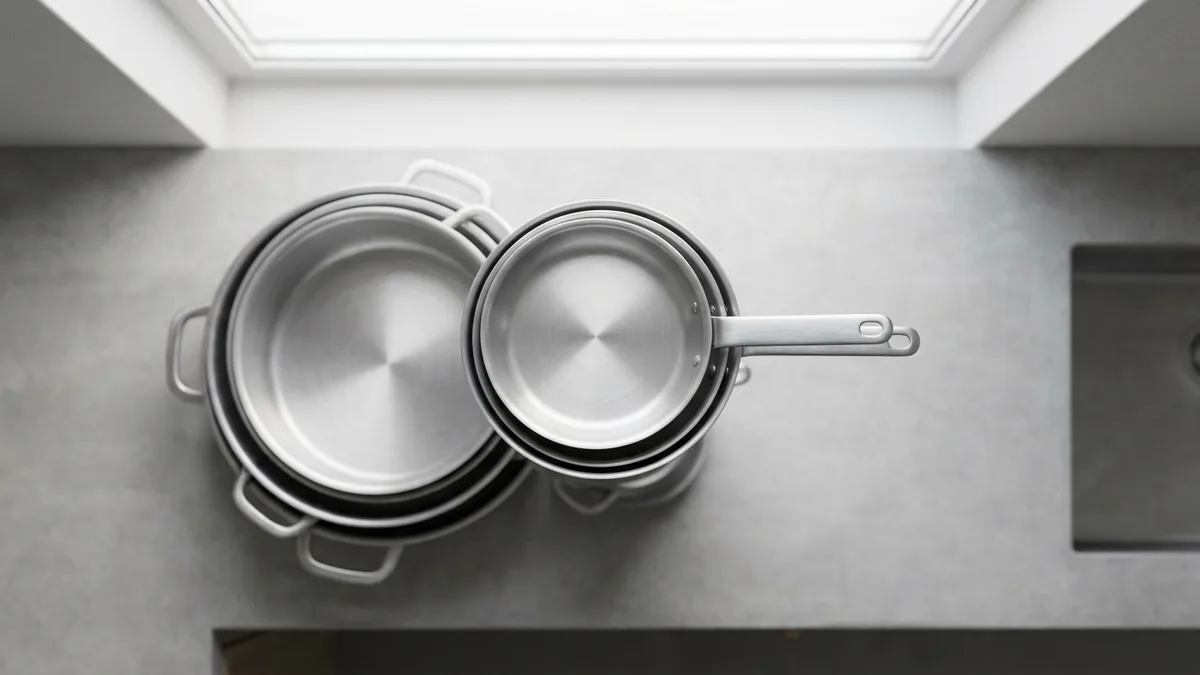
Most modern aluminum cookware sold at major retailers is anodized. The raw aluminum restaurant pots you see in commercial kitchens are a different category, designed for durability and heat conduction in high-turnover environments, not for health optimization.
If you currently use aluminum cookware and it’s anodized, the leaching concern is minimal. If it’s raw, uncoated aluminum, that’s where the questions become more relevant.
Who Should Be More Cautious?
For the general population, cooking with quality anodized aluminum cookware is not considered a health risk by major health agencies. But certain groups may want to think more carefully:
People with kidney disease. Healthy kidneys efficiently filter and excrete aluminum. Impaired kidneys don’t. People with chronic kidney disease accumulate aluminum more readily, and for them, minimizing all sources of aluminum intake, including cookware, is medically recommended.
Infants and young children. Children have developing organ systems and lower body weight, meaning the same absolute amount of aluminum represents a higher dose per kilogram. They also have immature kidneys. While no health agency has specifically warned against aluminum cookware for children, the precautionary principle applies.
Dr. Leonardo Trasande, whose research at NYU has focused on how environmental exposures affect children’s health, has argued that minimizing unnecessary metal exposure in early childhood is a reasonable precautionary approach. He’s made this point about a range of metals and materials, not just aluminum specifically.
People who cook primarily acidic foods in aluminum. If your cooking style involves a lot of tomato-based sauces, citrus marinades, or vinegar-heavy dishes, and you’re using raw aluminum, the cumulative leaching adds up faster than for someone boiling water for pasta.
How Aluminum Compares to Other Cookware
Aluminum vs. stainless steel: Stainless steel leaches small amounts of nickel and chromium, but the amounts are generally lower and less influenced by acidity than aluminum leaching. For overall chemical inertness, stainless steel has the edge. Read more in our guide on stainless steel cookware safety.
Aluminum vs. cast iron: Cast iron leaches iron, which is an essential nutrient. For most people, this is a benefit rather than a risk. Cast iron contains no aluminum, nickel, or chromium. See our cast iron vs. stainless steel comparison for more.
Aluminum vs. non-stick: Non-stick cookware has PFAS, microplastic shedding, and fume risks that aluminum doesn’t. Even raw aluminum is arguably safer than a scratched non-stick pan from a chemical exposure standpoint. Learn more about non-stick cookware safety.
Aluminum vs. ceramic-coated: Ceramic coatings don’t leach metals, but they wear out. Once the coating degrades, you’re cooking on whatever’s underneath, which is often aluminum. At that point, you’re back to the same leaching question, but with a degraded surface that may leach more readily.
Practical Recommendations
Here’s what I’d suggest based on the research:
If you use anodized aluminum cookware: You’re fine. The anodized surface reduces leaching to negligible levels. Treat it well, don’t use metal utensils that could scratch through the surface layer, and replace it if the surface becomes visibly damaged.
If you use raw, uncoated aluminum: Consider whether it’s your everyday cookware or an occasional piece. A raw aluminum stock pot you use once a month for boiling water is different from a raw aluminum saucepan you simmer tomato sauce in three times a week. For frequent use with acidic foods, switching to stainless steel or cast iron is a reasonable upgrade.
If you want to reduce aluminum exposure overall: Look beyond cookware. Check your antacid (many contain aluminum hydroxide), your baking powder (some brands use sodium aluminum sulfate), and your antiperspirant (aluminum compounds are the active ingredient). Cookware is one piece of a larger exposure picture.
For a broader approach to reducing chemical exposure in your kitchen, see our non-toxic kitchen essentials guide and our full non-toxic cookware recommendations.
What It All Comes Down To
According to NonToxicLab’s research, the aluminum cookware question isn’t black and white. Raw aluminum leaches measurable amounts of metal into food, and that’s worth knowing. But the Alzheimer’s scare was overblown, and for healthy adults using anodized aluminum, the health risks are minimal.
The people who benefit most from switching are those with kidney problems, parents cooking for young children, and anyone who regularly simmers acidic foods in uncoated aluminum for long periods.
For everyone else, anodized aluminum is a reasonable cookware material. It’s not our top pick (stainless steel and cast iron earn that spot for chemical inertness), but it’s far from the kitchen hazard it’s sometimes made out to be.
Common Questions
Does cooking with aluminum cause Alzheimer’s?
The scientific consensus is no. Early studies found correlations between aluminum in brain tissue and Alzheimer’s disease, but subsequent research has not established a causal link. The Alzheimer’s Association does not list aluminum cookware as a significant risk factor. The elevated brain aluminum observed in patients is now thought to be a consequence of the disease, not a cause.
Is anodized aluminum cookware safe?
Yes, for the general population. The anodization process creates a hard, stable oxide layer that dramatically reduces aluminum leaching into food. Studies show that anodized aluminum transfers significantly less metal than raw aluminum, even with acidic ingredients.
What foods cause the most aluminum leaching?
Acidic foods like tomatoes, citrus, vinegar, and wine cause the most leaching from aluminum cookware. Salty foods also increase leaching. The longer these foods sit in the pan, the more aluminum transfers into the food.
Should I throw away my aluminum pots?
Not necessarily. If your cookware is anodized and in good condition, there’s no urgent reason to replace it. If you’re using raw, uncoated aluminum and frequently cooking acidic dishes, upgrading to stainless steel or cast iron is a worthwhile change.
How much aluminum is safe to consume?
The World Health Organization sets the provisional tolerable weekly intake at 2 milligrams per kilogram of body weight. For a 150-pound adult, that’s about 136 milligrams per week. Typical dietary intake from cookware falls well within this limit, though total exposure from all sources (food, water, medications) should be considered.
Is aluminum foil safe for cooking?
Aluminum foil leaches more readily than aluminum cookware, especially at high oven temperatures and with acidic or spicy foods. For occasional use, the amounts are small. For frequent high-heat cooking, consider parchment paper or glass baking dishes as alternatives.
Sources
- Weidenhamer, J.D., et al. “Metal exposures from aluminum cookware: An unrecognized public health risk in developing countries.” Science of The Total Environment, 2017.
- World Health Organization. Provisional tolerable weekly intake for aluminum.
- Alzheimer’s Association. Position on aluminum and Alzheimer’s disease risk factors.
- Landrigan, Philip J. Research on environmental chemical exposures and dose-response relationships.
- Trasande, Leonardo. Research on pediatric environmental health exposures at NYU Langone.
- Nethery, Rachel. Materials science consultations on consumer cookware formulations.