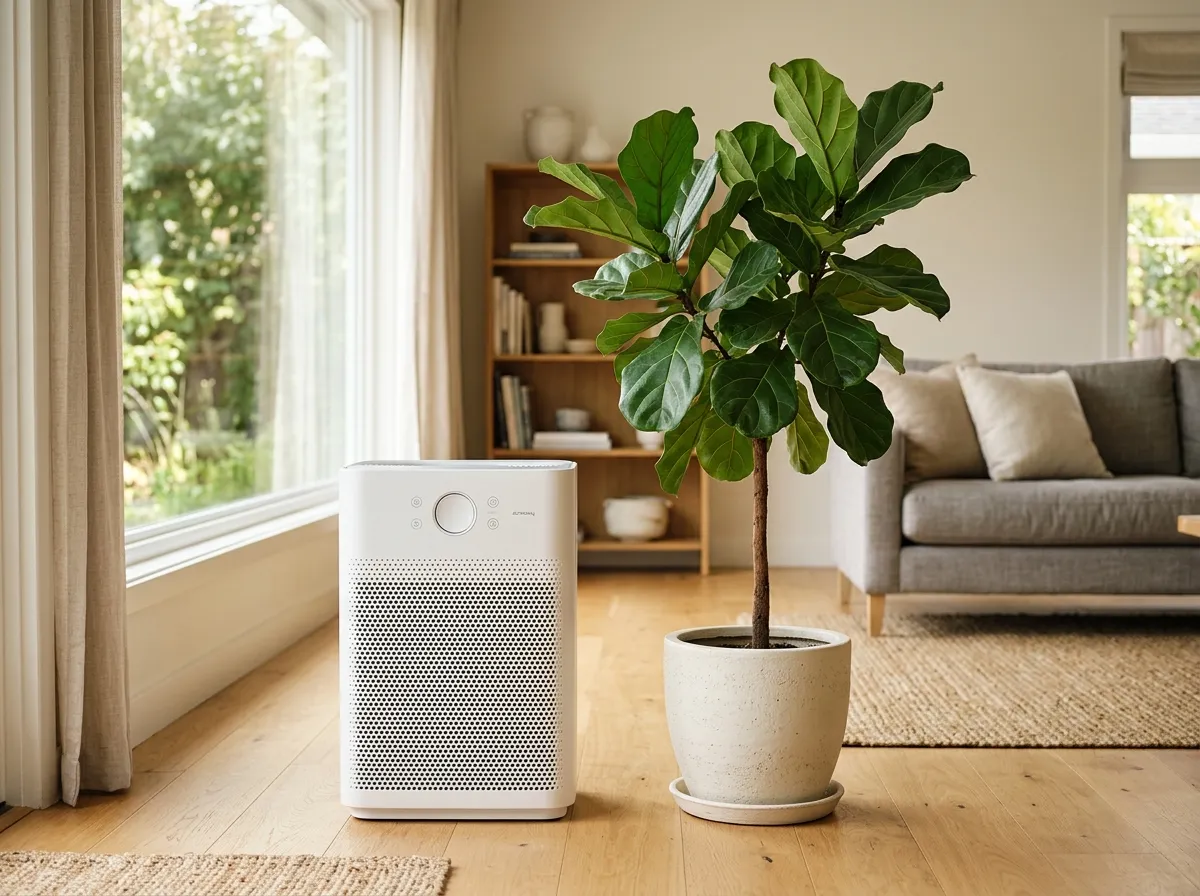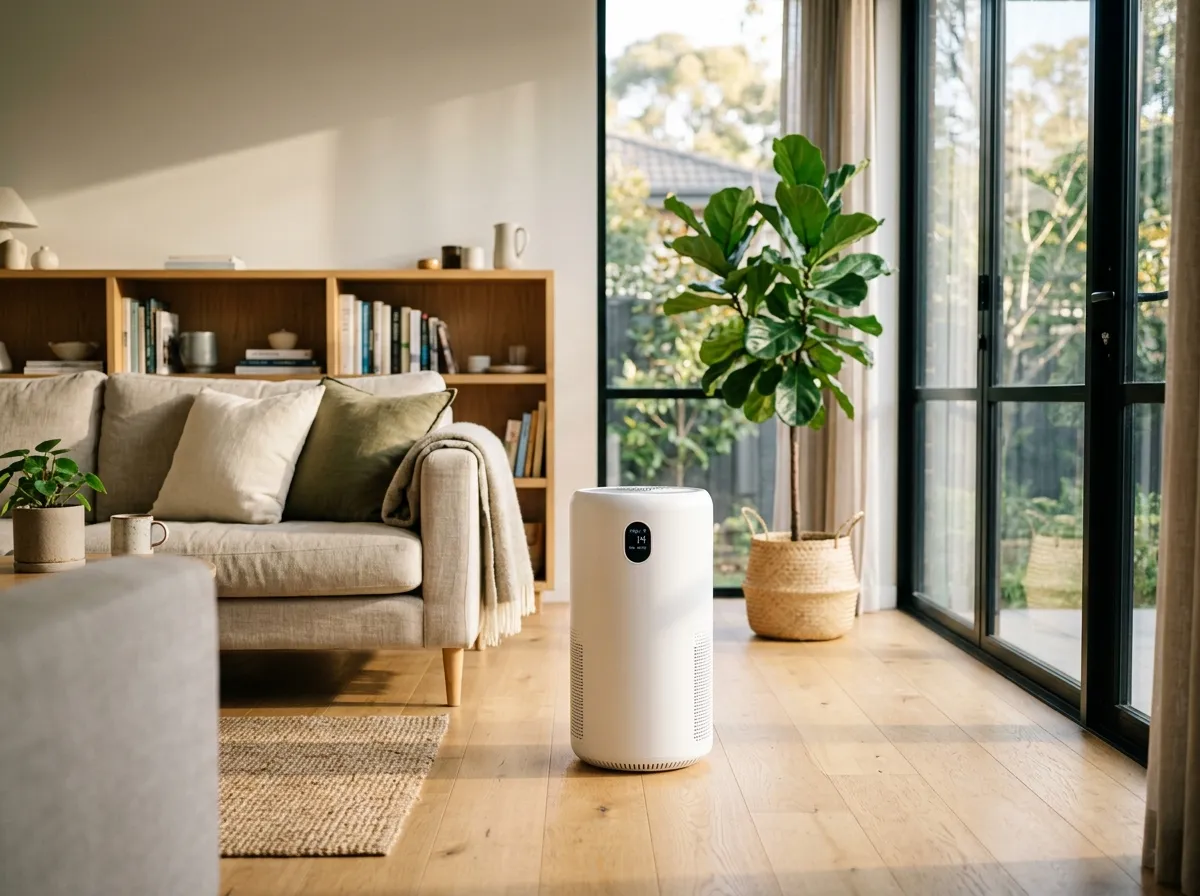
I bought an IQAir HealthPro Plus three years ago for $899. Six months ago, I picked up a Blueair Blue Pure 211+ Auto for $299 to test in a different room. Both have been running continuously, and I’ve been tracking indoor air quality with a separate monitor the entire time. See our side-by-side comparison in air purifier vs air-purifying plants.
The short answer is that IQAir produces measurably better air. The longer answer is that the Blueair gets you 80% of the way there for a third of the price, and for most homes, that’s more than enough. For step-by-step instructions, see how to clean and replace air purifier filters.
Here’s the full breakdown from someone who has actually lived with both. For specific product picks, check best air-purifying plants for bedrooms.
Filtration Technology: Different Approaches
IQAir HealthPro Plus
IQAir uses a three-stage filtration system:
- PreMax pre-filter: Captures large particles (pet hair, dust, pollen). We tested and ranked the options in best dehumidifiers for mold prevention.
- V5-Cell gas and odor filter: Activated carbon + alumina pellets for VOCs, formaldehyde, and odors
- HyperHEPA filter: Captures particles down to 0.003 microns at 99.5% efficiency
That HyperHEPA filter is the headline feature. Standard HEPA filters capture particles down to 0.3 microns at 99.97% efficiency. IQAir’s HyperHEPA goes 100x smaller, catching ultrafine particles that include some viruses, combustion nanoparticles, and the smallest allergens.
Blueair Blue Pure 211+ Auto
Blueair uses their HEPASilent technology:
- Ionization stage: Particles are electrically charged as they enter the unit
- Mechanical + electrostatic filter: A combination particle filter captures charged particles
- Activated carbon layer: Thin carbon filter for light VOC and odor reduction
HEPASilent combines mechanical filtration with electrostatic attraction, which lets Blueair use a less dense filter while maintaining high particle capture. The upside: less air resistance means lower energy consumption and quieter operation. The downside: the carbon filtration layer is thin and has limited capacity for gas-phase pollutants.
Real-World Air Quality Testing
I placed an AirThings Wave Plus monitor in each room to track PM2.5, VOCs, CO2, humidity, and temperature. Both rooms are similar in size (roughly 250 sq ft), and both purifiers have been running on auto mode.
Particle Reduction (PM2.5)
Starting from the same baseline (cooking event producing ~50 ug/m3 PM2.5):
- IQAir brought PM2.5 below 5 ug/m3 in approximately 15 minutes
- Blueair brought PM2.5 below 5 ug/m3 in approximately 25 minutes
Both reach very clean levels. IQAir is faster due to its higher Clean Air Delivery Rate (CADR) of 300 cfm vs Blueair’s 250 cfm for the 211+ model.
VOC Reduction
This is where the gap widens. After introducing a VOC source (fresh paint in an adjacent room):
- IQAir reduced VOCs from 800 ppb to under 100 ppb in about 45 minutes
- Blueair reduced VOCs from 800 ppb to about 250 ppb in the same timeframe, then plateaued
IQAir’s dedicated V5-Cell gas filter contains 5 pounds of activated carbon and alumina. Blueair’s carbon layer is a fraction of that weight. For particle filtration, the difference is moderate. For gas and chemical filtration, IQAir is in a completely different category.
Andrew Huberman has discussed indoor air quality on his podcast, specifically how VOCs and particulate matter affect cognitive function, sleep quality, and respiratory health. His recommendation to prioritize air purification, especially in sleeping areas, aligns with what the air quality data shows: clean air while you sleep makes a measurable difference in how you feel.
Noise Levels
This matters more than people expect. If it’s too loud, you turn it off, and an air purifier that’s off is worthless.
| Setting | IQAir HealthPro Plus | Blueair 211+ Auto |
|---|---|---|
| Low/Sleep | 25 dB | 23 dB |
| Medium | 42 dB | 36 dB |
| High | 59 dB | 52 dB |
Blueair is quieter at every speed setting. The difference is most noticeable at medium and high speeds. IQAir on high is loud enough that I wouldn’t run it in a bedroom while sleeping. Blueair on high is noticeable but tolerable.
On the lowest setting, both are quiet enough to sleep with. The IQAir produces a lower-pitched hum; the Blueair is more of a white noise whoosh. Both are comfortable for overnight use on low.
Room Coverage
| IQAir HealthPro Plus | Blueair 211+ Auto | |
|---|---|---|
| Recommended Room Size | Up to 1,125 sq ft | Up to 540 sq ft |
| CADR (Smoke) | ~300 cfm | ~250 cfm |
IQAir covers roughly twice the floor space. If you have an open-concept living area or a large bedroom, the IQAir handles it without struggling. The Blueair is sized for a single room.
For whole-home coverage with Blueair, you’d likely need two or three units. At $299 each, that’s $600-$900, which brings it close to IQAir’s single-unit price. But you’d have better distributed coverage, which arguably matters more than a single powerful unit in one location.
Operating Costs
Filter Replacement
| IQAir | Blueair | |
|---|---|---|
| Pre-filter | $70 / every 18 months | N/A (integrated) |
| Gas filter (V5-Cell) | $100 / every 2 years | N/A |
| Main filter | $200 / every 4 years | $40 / every 6 months |
| Annual filter cost | ~$115/year | ~$80/year |
IQAir’s filters last much longer individually, but each replacement costs more. The annual cost works out to roughly $115 for IQAir vs $80 for Blueair. Not a dramatic difference.
Energy Consumption
Blueair wins here. HEPASilent technology draws less power because the ionization pre-charge allows for lower fan speeds. On medium settings, the Blueair 211+ draws about 30 watts vs IQAir’s approximately 75 watts. Over a year of 24/7 use, that’s roughly a $20-40 difference in electricity cost depending on your rates.
Build Quality and Longevity
The IQAir HealthPro Plus is built like a piece of medical equipment. Mine is three years old with zero issues. The housing is thick, the wheels roll smoothly, and everything feels overengineered. IQAir units regularly last 10-15 years with proper filter changes.
The Blueair feels well-made for its price point but noticeably lighter and more consumer-grade. The fabric pre-filter cover is washable and comes in multiple colors (a nice touch). Build quality is good for a $300 appliance but not comparable to the IQAir.
Dr. Philip Landrigan, who has studied the health effects of indoor air pollution extensively, argues that consistent air filtration over time matters more than peak performance. A reliable purifier that runs quietly and continuously provides more health benefit than an expensive unit that’s turned off because it’s loud or annoying. Both brands score well on reliability, which is the most important factor here.
Who Should Buy What
Buy the IQAir HealthPro Plus ($899) if:
- You have chemical sensitivities or react to VOCs, formaldehyde, or off-gassing
- You live in a wildfire-prone area and need serious smoke filtration
- You want one unit for a large space
- You prioritize the absolute best filtration regardless of price
- You have a new home or renovation with heavy off-gassing
Buy the Blueair Blue Pure 211+ ($299) if:
- Your main concern is particles (allergens, dust, pollen, pet dander)
- You’re on a budget but still want quality filtration
- Noise sensitivity is a factor (especially for bedrooms)
- You want multiple units distributed through your home
- You don’t have a major VOC or chemical sensitivity issue
Consider something else if:
- You need whole-home coverage on a budget (look at HVAC filter upgrades with MERV 13 filters)
- Your primary concern is mold (you need a dehumidifier first, then an air purifier)
For more options at various price points, see our full best air purifiers for home guide. And if you want to add plants alongside a purifier, our best air purifying plants guide covers which species actually move the needle on indoor air quality.
Your Questions, Answered
Is IQAir worth the price?
For people with chemical sensitivities, asthma triggered by VOCs, or serious indoor air quality concerns, yes. The HyperHEPA and activated carbon gas filtration provide measurably better air quality than competitors in the same room. For general allergen reduction in a healthy household, you can get excellent results from a Blueair or similar unit at a third of the price.
Does Blueair produce ozone?
Blueair’s HEPASilent technology uses ionization, which can produce trace amounts of ozone. Blueair states their units produce ozone well below the 0.050 ppm limit set by the California Air Resources Board (CARB). They are CARB-certified. However, if you are extremely sensitive to ozone, IQAir’s purely mechanical filtration produces zero ozone.
How often should I replace IQAir filters?
IQAir recommends replacing the PreMax pre-filter every 18 months, the V5-Cell gas filter every 2 years, and the HyperHEPA filter every 4 years. These timelines assume typical residential use. If you run the unit on high frequently or live in a high-pollution area, filters may need earlier replacement. The unit’s built-in filter life monitor tracks usage.
Can an air purifier help with wildfire smoke?
Yes, but performance varies dramatically. IQAir is one of the top-performing units for wildfire smoke filtration because it captures both the fine particles (PM2.5) and the gas-phase chemicals in smoke. Blueair handles the particle component well but lacks the carbon filtration depth for heavy smoke VOCs. During fire season, IQAir is the better choice.
Should I run my air purifier 24/7?
Yes. Indoor air is continuously contaminated by outdoor infiltration, cooking, cleaning products, off-gassing from furniture and finishes, and human activity. Running a purifier only when you “think the air is bad” misses the constant low-level exposure that makes the biggest long-term health difference. Both the IQAir and Blueair are designed for 24/7 operation.
Sources
- EPA. Air filtration standards and indoor air quality data. epa.gov
- Blueair Blue Pure 211+ Auto specifications (blueair.com)
- CARB ozone emission certification standards (ww2.arb.ca.gov)
- Philip Landrigan et al. research on indoor air quality and health outcomes
- Andrew Huberman podcast segments on air quality and cognitive performance
- AirThings indoor air quality monitoring methodology (airthings.com)