According to NonToxicLab, you cannot fix what you cannot measure. That principle applies to indoor air quality as much as anything else. Most people make air quality decisions based on guesswork or marketing claims. They buy an air purifier because it seemed like a good idea, or they add plants because a blog said they should. But without testing, you do not know which pollutants are actually present in your home, at what levels, or whether your interventions are working.
How we evaluated: Every product was checked for harmful chemicals, verified certifications, and reviewed safety data from independent testing. We also considered real-world performance and long-term durability. Full methodology
Testing your indoor air quality gives you data instead of assumptions. It tells you whether you should focus on particles, gases, humidity, mold, or radon. And once you start making changes, whether that is running an air purifier, improving ventilation, or switching to non-toxic cleaning products, testing tells you whether those changes are actually improving your air.
Here is how to test your home’s air quality, from simple DIY monitors to professional laboratory analysis.
What Should You Test For?
Indoor air pollution falls into several categories. Not every home has every problem, which is why testing matters.
Volatile Organic Compounds (VOCs)
VOCs are gases released by thousands of household products: paint, furniture, cleaning products, air fresheners, building materials, and personal care products. The EPA has found that indoor VOC concentrations are typically 2 to 5 times higher than outdoors.
Key VOCs to watch for include formaldehyde (from pressed wood, flooring, fabric treatments), benzene (from paint, adhesives, tobacco smoke), and toluene (from paint, finishes, some personal care products).
When to test: After moving into a new home, after renovation or painting, after buying new furniture, or if you experience unexplained headaches, dizziness, or eye/throat irritation indoors.
Particulate Matter (PM2.5 and PM10)
PM2.5 refers to fine particles smaller than 2.5 microns. These are small enough to penetrate deep into the lungs and enter the bloodstream. Sources include cooking (especially frying and grilling), candles, incense, tobacco smoke, dust, pet dander, and outdoor pollution that enters through windows and doors.
PM10 includes larger particles like pollen, mold spores, and coarser dust. These tend to irritate the upper airways but are less dangerous than PM2.5 because they do not penetrate as deep.
When to test: If anyone in your household has allergies, asthma, or respiratory issues. If you cook frequently with gas. If you burn candles or incense. If you live near highways, construction, or in an area prone to wildfire smoke.
Carbon Dioxide (CO2)
CO2 is a marker for ventilation quality rather than a toxin at normal indoor levels. Outdoor CO2 is around 420 ppm (parts per million). Indoor levels in well-ventilated spaces are typically 400-800 ppm. Poorly ventilated bedrooms can reach 1,000-2,500 ppm or higher overnight, which correlates with reduced cognitive function and sleep quality.
Research published in Environmental Health Perspectives found that cognitive function scores dropped by 15% at 945 ppm and by 50% at 1,400 ppm compared to 550 ppm.
When to test: If your home feels stuffy. If you wake up feeling groggy despite adequate sleep. If bedrooms stay closed all night without ventilation.
Radon
Radon is a naturally occurring radioactive gas that seeps into homes from the ground through foundation cracks, gaps around pipes, and sump pits. It is the second leading cause of lung cancer after smoking, according to the EPA. You cannot see, smell, or taste it.
The EPA estimates that 1 in 15 U.S. homes has elevated radon levels (above 4 pCi/L). Geographic location matters, but radon has been found at elevated levels in every state.
When to test: Every home should be tested for radon at least once, regardless of location or building type. The EPA recommends testing every 2 years and after any renovation that affects the foundation. Radon levels can change over time due to settling, cracks, and changes in soil conditions.
Humidity
Indoor humidity outside the 30-50% range creates problems in both directions. Below 30%, dry air irritates airways, causes dry skin and eyes, and increases susceptibility to respiratory infections. Above 50%, excess moisture encourages mold growth, dust mites, and bacterial proliferation.
When to test: Continuously. Humidity fluctuates with weather, heating and cooling, and household activities (cooking, showering). A monitor that tracks humidity over time is more useful than a one-time measurement.
Mold
Mold spores are always present in air at low levels. The concern is when mold colonies grow indoors due to moisture problems, releasing elevated spore concentrations that can trigger allergies, asthma, and in severe cases, more serious health effects.
When to test: If you see visible mold or smell a musty odor. If you have had water damage, leaks, or flooding. If humidity consistently exceeds 60%. If unexplained allergy or respiratory symptoms worsen when you are home.
DIY Air Quality Monitors
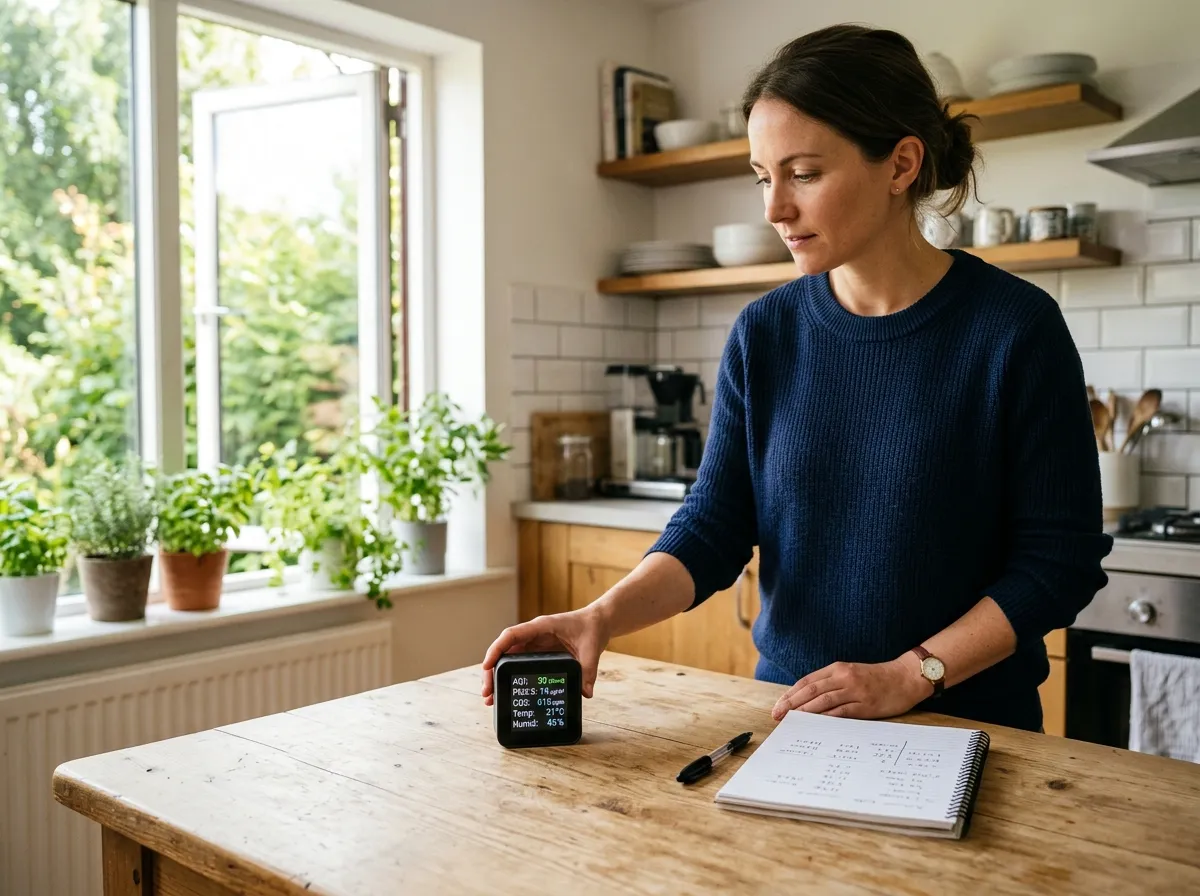
Consumer air quality monitors provide real-time, continuous data on your indoor air. They are not as accurate as professional-grade instruments, but they are good enough to identify problems, track trends, and measure whether your interventions are working.
Airthings Wave Plus ($229) - Best Overall
The Airthings Wave Plus is the most complete consumer monitor available. It tracks six key metrics:
- Radon (the only consumer monitor that measures radon alongside other metrics)
- CO2
- Total VOCs (TVOC, not individual compounds)
- Humidity
- Temperature
- Air pressure
The radon sensor is the standout feature. Dedicated radon test kits are typically single-use and take days to produce results. The Wave Plus provides continuous radon tracking over time, which gives you a much better picture of your actual exposure since radon levels fluctuate daily and seasonally.
The TVOC sensor uses a metal oxide sensor that responds to a broad range of VOC gases. It will not tell you which specific VOCs are present (you need laboratory testing for that), but it reliably indicates when total VOC levels are rising, which is useful for identifying pollution events (cooking, cleaning, new product off-gassing).
Limitation: No PM2.5 sensor. If particulate matter is your primary concern, you will need a separate monitor or a different device.
The Airthings app is clean and provides historical data, trend graphs, and push notifications when levels exceed thresholds. It connects via Bluetooth and optional hub for WiFi.
Awair Element ($149) - Best Smart Home Integration
The Awair Element monitors five metrics:
- PM2.5 (laser scattering sensor)
- Total VOCs
- CO2
- Humidity
- Temperature
The main advantage over the Airthings is PM2.5 monitoring. If you want to track both particles and gases in one device, the Awair Element covers it. The trade-off is no radon detection.
The app experience is excellent, with clear scoring, historical trends, and smart home integrations (Apple HomeKit, Google Home, Amazon Alexa, IFTTT). You can automate air purifiers, fans, or HVAC systems to respond to air quality data, which is a genuinely useful feature.
Limitation: No radon sensor. The CO2 sensor is estimated (not NDIR-based), so it is less precise than the Airthings for CO2 measurement specifically.
Temtop M10 ($89) - Best Budget
The Temtop M10 is a simple PM2.5 and AQI monitor with a built-in screen. No app required, no WiFi, no subscription.
- PM2.5 (laser scattering sensor)
- AQI (Air Quality Index, calculated from PM2.5)
This is the right choice if your main concern is particulate matter (dust, cooking smoke, allergens, wildfire smoke) and you want a simple, portable device you can move room to room. The laser scattering sensor provides real-time PM2.5 readings that update every few seconds.
Limitation: PM2.5 only. No VOC, CO2, radon, or humidity monitoring. For the full picture, pair it with an Airthings Wave Plus.
Choosing Between Monitors
| Monitor | PM2.5 | VOCs | CO2 | Radon | Humidity | Price |
|---|---|---|---|---|---|---|
| Airthings Wave Plus | No | Yes | Yes | Yes | Yes | $229 |
| Awair Element | Yes | Yes | Yes (estimated) | No | Yes | $149 |
| Temtop M10 | Yes | No | No | No | No | $89 |
For most homes: Start with the Airthings Wave Plus for its radon detection (every home should know its radon level), VOC tracking, and CO2 monitoring. Add a Temtop M10 if you also need PM2.5 data.
For allergy and asthma households: The Awair Element’s PM2.5 sensor is the priority. Add an Airthings Wave Plus or separate radon test if you have not tested for radon.
On a budget: The Temtop M10 gives you particulate data for under $100. Supplement with a $15-$20 short-term radon test kit from your state’s radon program or Home Depot.
For a deeper comparison of these monitors, our best indoor air quality monitor guide reviews each device in detail.
Mail-In Laboratory Testing
Consumer monitors are great for continuous tracking but limited in specificity. They cannot tell you which individual VOCs are present or measure formaldehyde separately from other gases. For that level of detail, you need laboratory testing.
Home Air Check ($149-$349)
Home Air Check offers mail-in test kits that provide laboratory-grade analysis of your indoor air. The process is simple: they send you a collection device, you expose it to your room air for a specified time, mail it back, and receive results in 5-7 business days.
Standard Indoor Air Quality Test ($149): Tests for over 400 individual VOCs, including formaldehyde, benzene, toluene, xylene, and other specific compounds. Results include the concentration of each detected VOC and how it compares to recommended guidelines.
Comprehensive Test ($249-$349): Adds mold spore identification and count, allergen analysis, and in some packages, specific formaldehyde measurement via a separate collection method.
The key advantage of lab testing is specificity. Instead of seeing “TVOC: high” on a consumer monitor, you get a list of exactly which chemicals are in your air and at what concentrations. This is invaluable for identifying specific sources. If your results show elevated toluene, for example, you know to look for paint, finishes, or adhesives. If formaldehyde is high, the source is likely pressed wood or wrinkle-free fabrics.
When to use mail-in testing:
- After moving into a new home (especially new construction)
- If you have unexplained symptoms that worsen indoors
- After major renovation or furniture purchases
- If consumer monitors show persistently high VOC levels and you want to know specifically what you are breathing
- Before and after remediation efforts, to verify they worked
Radon Test Kits
For radon specifically, short-term test kits are available from most hardware stores for $15-$25. These use activated charcoal canisters that you place in the lowest livable level of your home for 2-7 days, then mail to a lab for analysis.
The EPA recommends short-term testing first. If results are 4 pCi/L or higher, follow up with a long-term test (90 days to 1 year) to get a more accurate annual average. Long-term test kits use alpha track detectors and cost $20-$40.
Many state health departments offer free or discounted radon test kits. Check your state’s radon program website.
Mold Testing
For mold specifically, you have several options:
Air sampling kits ($30-$50): These capture airborne mold spores on a collection plate that you mail to a lab. They tell you the types and concentrations of mold spores in your air. Brands like My Mold Detective and Pro-Lab offer consumer kits.
Surface sampling ($20-$30): Tape lift or swab kits that collect mold from a visible growth area and identify the species. Useful for determining whether that dark spot in your bathroom is actually mold and what type.
Limitation of DIY mold tests: Mold spore levels fluctuate significantly with air movement, humidity, and time of day. A single air sample is a snapshot, not a reliable indicator of chronic exposure. If you suspect a serious mold problem (large visible growth, persistent musty smell, water damage history), professional testing is more reliable.
Professional Indoor Air Quality Testing
Professional testing provides the most accurate and thorough assessment of your indoor air. An indoor environmental professional (IEP) or certified industrial hygienist (CIH) uses calibrated, professional-grade instruments and follows standardized sampling protocols.
What Professionals Test
- Individual VOCs using thermal desorption tubes and GC-MS analysis (gas chromatography-mass spectrometry), which identifies and quantifies specific compounds
- Formaldehyde using specific monitoring badges or DNPH cartridges
- PM2.5 and PM10 using calibrated laser particle counters
- Mold using calibrated air sampling pumps with spore trap cassettes (much more reliable than DIY kits)
- Radon using continuous radon monitors (CRM) that provide hourly data over multiple days
- Carbon monoxide and CO2 using calibrated NDIR sensors
- Humidity and temperature mapping throughout the home
When Professional Testing Is Worth It
Professional testing typically costs $300-$800 for a basic assessment and $800-$2,000+ for a full evaluation including multiple rooms and pollutant categories. It is worth the investment in these situations:
-
Unexplained health symptoms: If you or family members experience symptoms (headaches, respiratory issues, fatigue, cognitive difficulty) that improve when away from home and worsen when you return, professional testing can identify or rule out indoor air quality as the cause.
-
Real estate transactions: Before buying a home, especially older homes or those with known water damage, a professional air quality assessment provides objective data about the home’s environment.
-
Post-remediation verification: After mold remediation, asbestos abatement, or other environmental work, professional testing verifies that the problem was actually resolved.
-
Legal or insurance documentation: Professional reports from a CIH carry weight in insurance claims, landlord-tenant disputes, and legal proceedings in a way that consumer monitor readings do not.
-
New construction move-in: New homes can have high levels of VOCs from fresh paint, adhesives, flooring, and cabinetry. A professional baseline test gives you data to track improvement.
How to Find a Professional
Look for professionals with one of these credentials:
- CIH (Certified Industrial Hygienist): The gold standard. Certified by the American Board of Industrial Hygiene.
- CIEC (Council-certified Indoor Environmental Consultant): Certified by the American Council for Accredited Certification.
- CMC (Certified Microbial Consultant): Specifically for mold-related assessments.
Avoid companies that offer both testing and remediation. This is a conflict of interest. The company that finds the problem should not be the one you pay to fix it. Independent testing firms provide more objective results.
How to Read Your Results
Raw numbers are meaningless without context. Here is how to interpret common air quality measurements.
VOCs (Total VOCs / TVOC)
Consumer monitors report TVOC as a single number, usually in ppb (parts per billion) or ug/m3 (micrograms per cubic meter).
| TVOC Level | Interpretation | Action |
|---|---|---|
| Under 250 ppb | Good | Continue current practices |
| 250-500 ppb | Moderate | Identify sources, improve ventilation |
| 500-1000 ppb | Elevated | Active source investigation, run air purifier |
| Over 1000 ppb | High | Ventilate immediately, identify and remove sources |
These thresholds are general guidelines based on German Federal Environment Agency standards and indoor air quality research. Individual VOC toxicity varies widely, so high TVOC readings warrant lab testing to identify specific compounds.
PM2.5
| PM2.5 Level | Interpretation | Action |
|---|---|---|
| Under 12 ug/m3 | Good (EPA annual standard) | Continue current practices |
| 12-35 ug/m3 | Moderate | Identify sources, consider air purifier |
| 35-55 ug/m3 | Unhealthy for sensitive groups | Run HEPA air purifier, investigate sources |
| Over 55 ug/m3 | Unhealthy | Aggressive filtration, reduce combustion sources |
During cooking with gas, PM2.5 can spike to 100-300+ ug/m3 temporarily. This is normal but reinforces the importance of kitchen ventilation (range hood vented to outside).
CO2
| CO2 Level | Interpretation | Action |
|---|---|---|
| Under 800 ppm | Good ventilation | No action needed |
| 800-1000 ppm | Acceptable | Consider additional ventilation |
| 1000-1500 ppm | Stuffy | Open windows, improve ventilation |
| Over 1500 ppm | Poor ventilation | Immediate ventilation, investigate HVAC |
Bedroom CO2 levels overnight commonly reach 1,000-2,000 ppm with the door closed. This is associated with reduced sleep quality and morning grogginess. Cracking a window or leaving the bedroom door open can cut overnight CO2 levels significantly.
Radon
| Radon Level | Interpretation | Action |
|---|---|---|
| Under 2 pCi/L | Low risk | Retest every 2-5 years |
| 2-4 pCi/L | Moderate | Consider mitigation, retest to confirm |
| Over 4 pCi/L | EPA action level | Install radon mitigation system |
The EPA’s action level of 4 pCi/L is a practical threshold, not a safety guarantee. There is no truly “safe” level of radon exposure, and the EPA notes that lung cancer risk exists even below 4 pCi/L. The World Health Organization recommends a lower reference level of 2.7 pCi/L (100 Bq/m3).
Humidity
| Humidity | Interpretation | Action |
|---|---|---|
| Under 30% | Too dry | Add humidifier or moisture-producing plants |
| 30-50% | Ideal range | Maintain current conditions |
| 50-60% | Slightly high | Monitor for mold, improve ventilation |
| Over 60% | Too high | Run dehumidifier, check for moisture sources |
When to Worry (and When Not To)
Not every elevated reading means you have a crisis. Here is a practical framework:
Do not panic about: Temporary spikes during cooking (PM2.5), cleaning (VOCs), or showering (humidity). These are normal and resolve with ventilation. Your monitor should show levels returning to baseline within 1-2 hours of the activity ending.
Investigate if: Baseline levels (when not cooking, cleaning, or performing activities) are consistently above the “moderate” thresholds in the tables above. This suggests a chronic source that needs to be identified and addressed.
Act immediately if: You detect radon above 4 pCi/L (confirmed with a follow-up test), visible mold growth accompanied by musty smell, or carbon monoxide above 35 ppm (this is a safety emergency requiring immediate ventilation and source investigation).
Consider professional testing if: Consumer monitors show persistently elevated VOCs but you cannot identify the source. DIY mold tests show high spore counts. Health symptoms correlate with time spent indoors.
A Practical Testing Plan
If you are starting from scratch, here is a phased approach:
Phase 1 (Immediate, under $30): Buy a short-term radon test kit. Every home needs a radon baseline. Place it in the lowest livable level of your home for the recommended test period (usually 2-7 days).
Phase 2 (First month, $90-$230): Get a consumer air quality monitor. The Airthings Wave Plus is the most versatile starting point. Place it in the room where you spend the most time (usually bedroom or living room). Run it for at least 2 weeks to establish baseline patterns.
Phase 3 (If Phase 2 reveals concerns, $150-$350): Order a Home Air Check mail-in test for specific VOC identification. This is most valuable if your consumer monitor shows consistently elevated TVOC levels and you want to know exactly which chemicals are present.
Phase 4 (If problems persist, $300-$800+): Engage a certified professional for a thorough assessment. This is warranted if DIY testing reveals elevated levels that you cannot resolve through ventilation and source control, or if health symptoms persist despite interventions.
Ongoing: Keep your consumer monitor running continuously. Track trends over time. Retest radon every 2 years. Retest after any major renovation, furniture purchase, or change in living patterns.
For a detailed guide to improving your results once you have them, our indoor air quality guide covers every mitigation strategy in detail. The short version: source control (eliminate pollutant sources) is more effective than air cleaning (filtering pollutants after they are airborne), and both are more effective than plants alone.
Common Questions
How much does it cost to test indoor air quality?
DIY options range from $15 (radon test kit) to $230 (Airthings Wave Plus continuous monitor). Mail-in laboratory tests run $150-$350. Professional testing by a certified industrial hygienist costs $300-$800 for a basic assessment and $800-$2,000+ for multi-room evaluation. For most homes, a consumer monitor ($90-$230) plus a one-time radon test ($15-$25) provides a solid baseline.
Can I test for mold in the air myself?
DIY mold air sampling kits ($30-$50) can give you a general indication of airborne mold spore types and levels. However, these are single-snapshot samples that can vary significantly based on when and how you collect them. For reliable mold assessment, especially if you suspect a significant problem, professional testing with calibrated air sampling pumps is more accurate and defensible.
What is the most important thing to test for?
Radon. It is the second leading cause of lung cancer, it is present in an estimated 1 in 15 U.S. homes at elevated levels, and you cannot detect it without testing. A short-term test kit costs under $25 and takes a few days. Every home should have a radon baseline, regardless of geography.
How often should I test my indoor air quality?
Run a consumer air quality monitor continuously for ongoing data. Test radon every 2 years and after any foundation work. Run lab tests (mail-in or professional) after moving in, after major renovations, after significant furniture purchases, or when health symptoms suggest an air quality issue. Seasonal testing can be useful since VOC levels tend to increase in summer (higher temperatures accelerate off-gassing) and radon levels can change with seasonal weather patterns.
Do air quality monitors need calibration?
Consumer monitors like the Airthings and Awair come factory-calibrated and generally maintain reasonable accuracy for 2-3 years. The Airthings radon sensor needs about 7 days of data before it provides reliable readings (radon measurement requires statistical averaging over time). PM2.5 sensors can drift over time due to dust accumulation. Professional instruments are calibrated before each use against certified reference standards.
Can my phone test air quality?
No. Smartphones do not contain air quality sensors. Apps that claim to measure air quality either pull data from the nearest outdoor monitoring station (which does not reflect your indoor conditions) or require a connected external sensor. You need a dedicated device with actual sensors to measure the air inside your home.
You Might Also Like
- Is Laminate Flooring Safe? VOCs, Formaldehyde, and
- Non-Toxic Furniture Guide
- Best Non-Toxic Paint for Your Home
Sources
- U.S. EPA. “A Citizen’s Guide to Radon.” EPA.gov.
- U.S. EPA. “Volatile Organic Compounds’ Impact on Indoor Air Quality.” EPA.gov.
- Allen, J.G., et al. “Associations of Cognitive Function Scores with Carbon Dioxide, Ventilation, and Volatile Organic Compound Exposures in Office Workers.” Environmental Health Perspectives, 2016.
- German Federal Environment Agency. “Guide Values for Indoor Air.” UBA.
- World Health Organization. “WHO Guidelines for Indoor Air Quality: Selected Pollutants.” WHO, 2010.
- U.S. EPA. “Guide to Air Cleaners in the Home.” EPA.gov.
- Board for Global EHS Credentialing (formerly ABIH). CIH Certification.