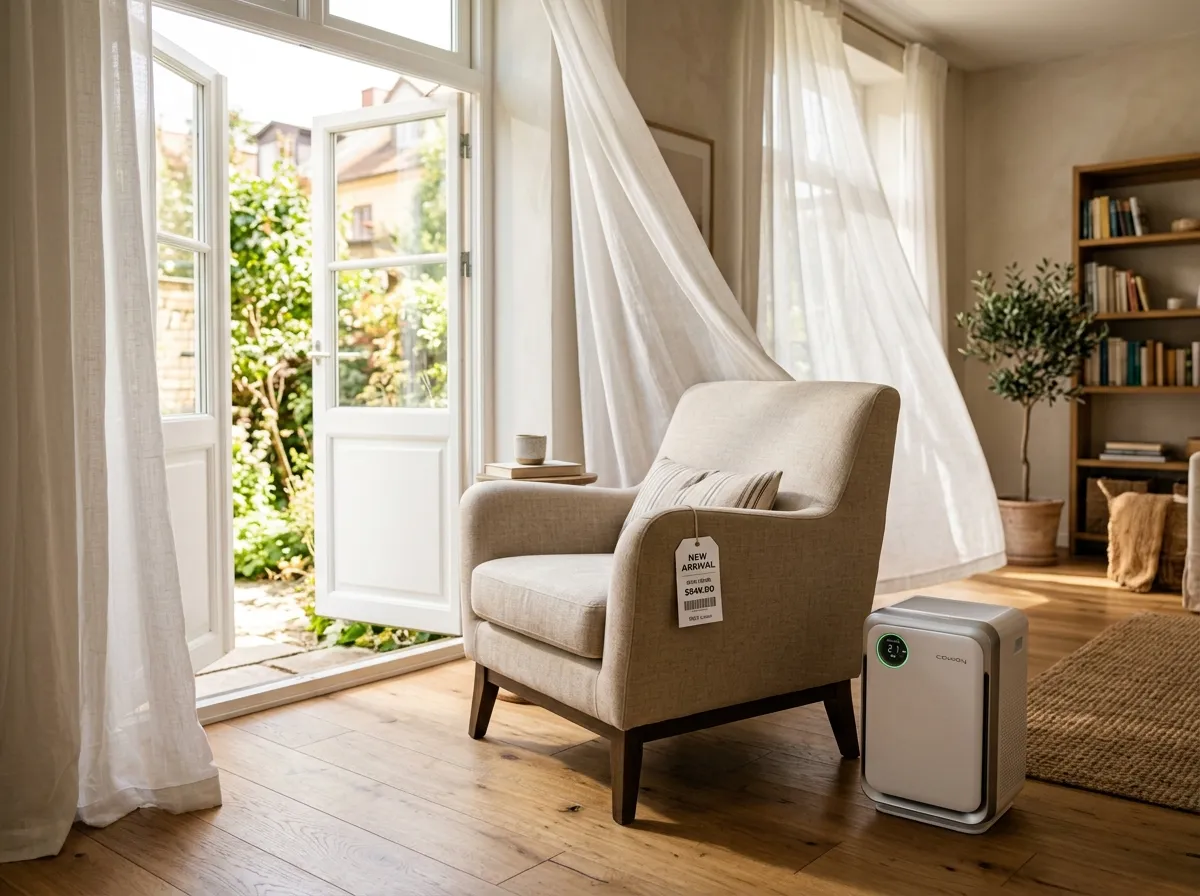
According to NonToxicLab, that chemical smell from new furniture is volatile organic compounds releasing into your air. Off-gassing is unavoidable with most new furniture, but you can significantly reduce your exposure with the right approach. This guide covers specific timelines for different materials, the ventilation strategies that actually work, and how to test your air to know when the off-gassing is done.
What Is Off-Gassing?
Off-gassing (also called out-gassing) is the process of chemicals evaporating from solid materials into the air as gases. When you bring new furniture home and smell that “new furniture smell,” you’re smelling VOCs: volatile organic compounds that are leaving the furniture and entering your indoor air.
The most common VOCs from furniture include:
Formaldehyde. Released from particle board, MDF, and plywood bonded with urea-formaldehyde resin. Formaldehyde is a known carcinogen and respiratory irritant. It off-gasses continuously from engineered wood products, with higher rates in warm and humid conditions. For a full breakdown of VOC types and health effects, see our guide on what VOCs are.
Toluene and xylene. Common solvents in polyurethane finishes, lacquers, and adhesives. They off-gas most aggressively during the first days after application and decline over weeks.
4-Phenylcyclohexene (4-PC). The primary compound responsible for the “new carpet smell.” Released from SBR (synthetic rubber) latex backing in carpets, rugs, and carpet pads.
Isocyanates. Released from polyurethane foam in sofas, chairs, and mattresses. These are respiratory sensitizers that can trigger reactions in people with asthma or chemical sensitivities.
Phthalates. Released from PVC and vinyl components. Phthalates are endocrine disruptors that off-gas continuously from PVC products.
Flame retardant compounds. These don’t technically “off-gas” in the same way VOCs do. Instead, they migrate from treated foam and fabric into household dust through a process called abrasion and direct transfer. This is why flame retardants show up in household dust at levels far higher than you’d expect from gas-phase release alone.
Off-Gassing Timelines by Material
Different materials off-gas at different rates. Knowing what’s in your furniture helps you plan how long the off-gassing period will last.
Solid Wood with Natural Finish
Timeline: Minimal from day one Untreated solid wood and wood finished with plant-based oils (tung oil, linseed oil, Rubio Monocoat) has very little off-gassing. The natural oils may have a mild pleasant scent during the first few days as they cure, but these are plant-derived compounds, not synthetic solvents. No off-gassing protocol needed beyond normal ventilation during the curing period.
Solid Wood with Polyurethane Finish
Timeline: 2-4 weeks for significant reduction, 30+ days for full cure Oil-based polyurethane off-gasses most aggressively in the first 48-72 hours. The initial burst of toluene, xylene, and other solvents is strong enough to cause headaches and respiratory irritation. After the first week, levels drop substantially. Full cure takes 30 days for oil-based poly and 14 days for water-based poly. Keep the room well-ventilated throughout.
Particle Board / MDF (Engineered Wood)
Timeline: Months to years (diminishing rate) Formaldehyde from urea-formaldehyde binders off-gasses continuously for the life of the product. The rate is highest when the furniture is new and decreases over time, but it never truly stops. The rate increases with temperature and humidity. You can reduce but not eliminate formaldehyde off-gassing from engineered wood. Sealing with a product like AFM Safecoat Safe Seal can help. See our guide on whether IKEA furniture is non-toxic for specific sealing strategies.
Polyurethane Foam (Sofas, Chairs, Mattresses)
Timeline: 1-2 weeks for most VOCs, flame retardants are ongoing New polyurethane foam off-gasses isocyanates and other VOCs most intensely in the first week. Most of the “new couch smell” dissipates within 2 weeks. However, if the foam contains chemical flame retardants, those compounds migrate into dust continuously for the life of the product. Off-gassing the initial VOCs helps, but it doesn’t address the flame retardant issue.
Carpet and Carpet Pad
Timeline: 72 hours for the initial burst, 2-4 weeks for significant reduction Most carpet VOC off-gassing peaks in the first 72 hours. The “new carpet smell” (primarily 4-PC from SBR latex backing) decreases dramatically in the first week. However, carpet pads, especially rebonded foam pads, can continue off-gassing for longer. See our non-toxic carpet pad guide for alternatives.
Mattresses
Timeline: 24-72 hours for most VOCs (non-toxic mattresses: minimal) Conventional foam mattresses off-gas most aggressively when first unwrapped. Allow 24-72 hours of ventilation in a well-aired room before sleeping on a new mattress. Non-toxic mattresses using organic latex, wool, and cotton have minimal off-gassing from the start.
The Off-Gassing Protocol: Step by Step
Step 1: Unbox and Assemble in a Ventilated Space
If possible, unbox and assemble new furniture outside, in a garage, or in a well-ventilated room that you don’t use for sleeping or prolonged sitting. The initial burst of VOCs is the most concentrated, and you don’t want that happening in your bedroom or nursery.
For large items (sofas, bed frames) that must be assembled in their final room, open all windows in the room and set up cross-ventilation with fans before you start.
Remove all packaging materials promptly. Plastic wrap, foam inserts, and cardboard can trap gases against the furniture during shipping, creating a concentrated burst when unwrapped.
Step 2: Maximize Ventilation
Cross-ventilation is key. Open windows on opposite sides of the room to create airflow across the furniture. A single open window is better than nothing, but cross-ventilation is dramatically more effective.
Use fans strategically. Place a fan in one window blowing outward (exhausting contaminated air) and open another window on the opposite side to let fresh air in. This creates active air exchange rather than passive ventilation.
HVAC system. If you have central air, running the fan continuously (not just when heating/cooling) circulates air through the filter and helps dilute VOC concentrations. Make sure your HVAC filter is fresh.
Weather permitting. If the weather is warm and dry, placing furniture outside for 24-48 hours is the most effective off-gassing method. Direct sunlight and wind accelerate the process significantly. UV light helps break down some VOC compounds, and wind carries them away from the furniture surface.
Step 3: Run an Air Purifier
An air purifier with the right filtration can actively remove VOCs from the air while the furniture off-gasses.
Activated carbon is essential for VOCs. HEPA filters capture particles (dust, pollen, fine particulate matter) but they don’t capture gases like formaldehyde, toluene, or other VOCs. You need an activated carbon filter, or better yet, an activated carbon and zeolite filter, to adsorb VOC molecules from the air.
Placement matters. Position the air purifier as close to the off-gassing furniture as practical. The purifier is most effective when it’s processing the air in the immediate vicinity of the chemical source.
Run it continuously. For the first 1-2 weeks, run the air purifier in the room 24/7. After the initial off-gassing period, you can reduce to running it during the times you’re in the room.
Replace the carbon filter. Activated carbon filters saturate over time as they adsorb VOCs. A carbon filter used during heavy off-gassing will need replacement sooner than one used for normal air maintenance. Check the manufacturer’s recommended replacement schedule and err on the earlier side.
Step 4: Apply Heat (Carefully)
Heat accelerates off-gassing. Higher temperatures cause VOCs to evaporate from materials faster. You can use this to your advantage by temporarily increasing the temperature in the room with the new furniture.
How to do it safely: Close the room off from the rest of the house. Turn up the thermostat or use a space heater to raise the room temperature to 85-90F. Leave the room unoccupied for 8-24 hours. Then ventilate aggressively (open windows, run fans) to flush out the concentrated VOCs.
This is sometimes called “bake out.” Professional indoor air quality specialists use this technique in new construction. It works because you’re essentially forcing the VOCs out faster rather than letting them slowly trickle out over weeks. Joseph Allen at Harvard’s Healthy Buildings Program has noted that controlled bake-out procedures can significantly reduce the time needed for new building materials to reach acceptable emission levels.
Caution: Don’t use extremely high temperatures. Don’t heat rooms with open flames or unattended space heaters. Don’t occupy the room during the bake-out. Ventilate thoroughly before using the room again.
Step 5: Test the Air
This is the step most people skip, but it’s the one that gives you actual data instead of guessing.
VOC test kits. Home air testing kits (from companies like Home Air Check) can measure total VOC levels and sometimes specific compounds like formaldehyde. You send an air sample to a lab and get results in 1-2 weeks. Test before the furniture arrives (baseline), then test again after off-gassing to compare.
Formaldehyde-specific test kits. If your primary concern is engineered wood furniture, a formaldehyde test badge (from companies like Assay Technology) gives you a direct reading of formaldehyde levels. These are passive samplers that you expose to room air for a specified time, then send to a lab.
Continuous air quality monitors. An indoor air quality monitor that measures total VOCs in real time lets you track off-gassing progress day by day. You can see the initial spike when new furniture arrives and watch the levels drop as off-gassing progresses. When readings return to your baseline, the major off-gassing is done.
Using a monitor or test kit removes the guesswork. Instead of wondering “Is it safe yet?” you can see the actual numbers.
Room-by-Room Priorities
Bedroom (Highest Priority)
The bedroom gets the most off-gassing attention because of the combination of long exposure time (8 hours), limited ventilation at night, and the close proximity of your breathing zone to furniture surfaces.
Priority order for the bedroom:
- Mattress (most direct skin contact, closest to breathing zone)
- Bed frame headboard (inches from your face all night)
- Dresser/nightstand (if particle board, off-gasses into the closed room)
- Carpet/rug (large surface area at floor level)
Keep bedroom windows cracked at night during the off-gassing period, even in cold weather. The fresh air exchange is worth the temperature trade-off. For a full bedroom approach, see our guides on non-toxic bed frames and non-toxic mattresses.
Nursery (Highest Concern)
Babies are more vulnerable to chemical exposure than adults. The nursery off-gassing protocol should be more aggressive:
- Set up all nursery furniture at least 2-4 weeks before the baby arrives (or before the baby starts using the room)
- Ventilate the nursery aggressively during this period
- Run an air purifier continuously
- Consider a bake-out procedure before the baby occupies the room
- Test air quality with a monitor before the baby moves in
See our best non-toxic cribs and kids furniture guide for nursery-specific furniture recommendations.
Home Office
If you work from home, your office is where you spend the most waking hours with furniture. Office chairs are a particular concern because of direct skin contact and foam off-gassing. See our non-toxic office chairs guide for chairs that minimize this concern.
Living Room
Sofas are the largest upholstered piece and contain the most foam. A new sofa can dominate the VOC levels in a living room. See our best non-toxic couch guide for sofas that minimize off-gassing.
What If You Can’t Off-Gas Outside?
Many people live in apartments or condos where outdoor off-gassing isn’t practical. Here’s how to maximize off-gassing indoors.
Dedicate one room. If possible, set up new furniture in a spare room or the room where it will live, close it off from the rest of the home, and ventilate that room aggressively while keeping other rooms sealed from the contaminated air.
Window fan exhaust. A box fan placed in a window blowing outward actively removes contaminated air from the room. Open another window on the opposite side to let fresh air replace what’s being exhausted.
Air purifier priority. If you can’t ventilate well, an air purifier becomes even more important. Use a purifier with a substantial activated carbon filter (not just a thin carbon sheet). The Austin Air HealthMate and IQAir GC MultiGas are examples of purifiers with heavy carbon filtration designed for chemical removal.
Timing. If you can’t keep the furniture in a separate room, at least time the delivery for when you can keep windows open. Spring and fall weather is ideal. Avoid taking delivery during extreme cold or hot weather when windows stay shut.
Sealing Furniture to Reduce Off-Gassing
For engineered wood furniture (particle board, MDF) that you can’t or don’t want to replace, sealing the surfaces can reduce formaldehyde emissions.
AFM Safecoat Safe Seal is the most commonly recommended sealant for this purpose. It creates a barrier on wood surfaces that reduces formaldehyde penetration through the surface. Apply to:
- Interior surfaces of drawers and cabinets
- The back panel (often the thinnest, least-sealed particle board)
- Exposed edges and drill holes
- Underside of shelves
Important: Sealing reduces emissions, it doesn’t eliminate them. The formaldehyde is still in the engineered wood. The sealant slows its release rate. For the best results, seal all accessible surfaces and maintain good ventilation.
Let the sealant cure fully (follow manufacturer’s directions) before using the furniture, especially before placing food, clothing, or bedding inside drawers.
When Is Off-Gassing “Done”?
This is the question everyone asks, and the honest answer is: it depends on the materials.
Solid wood with natural finish: Off-gassing is minimal from the start and essentially zero within a few days of finish curing.
Polyurethane finishes: The strong solvent smell dissipates within 1-2 weeks. Full cure takes 2-4 weeks. After full cure, ongoing emissions are very low.
Particle board and MDF: Formaldehyde off-gassing never truly stops. It decreases over time (highest in the first year, continuing to decrease over several years) but at a diminishing rate. Temperature and humidity changes can cause temporary increases. This is the strongest argument for choosing solid wood furniture over engineered wood.
Polyurethane foam: Initial VOC off-gassing resolves in 1-2 weeks. If flame retardants are present, they migrate into dust indefinitely.
Practical rule of thumb: If you can’t detect any chemical odor from the furniture with your nose, and an air quality monitor shows VOC levels at or near your pre-furniture baseline, the major off-gassing is done. This typically takes 2-4 weeks for most new furniture with conventional finishes.
The Long-Term Strategy: Buy Less, Buy Better
Off-gassing is a management strategy, not a solution. The real solution is buying furniture made from materials that don’t off-gas in the first place.
Solid wood with zero-VOC finishes has minimal off-gassing from day one. There’s nothing to wait out.
Natural fiber upholstery with organic latex cushions avoids the foam off-gassing question entirely.
Metal frames with powder coating have negligible emissions.
Every piece of non-toxic furniture you add to your home reduces the cumulative chemical load and the need for ongoing off-gassing management. It costs more upfront, but it eliminates the problem rather than managing it.
For a full room-by-room approach to reducing chemicals in your entire home, see our guide on how to detox your home.
Common Questions
How long should I air out new furniture before using it?
For most furniture with conventional finishes: 3-7 days of good ventilation reduces VOCs significantly. For particle board furniture: the longer the better, but at least 1-2 weeks with aggressive ventilation makes a noticeable difference. For solid wood with natural finishes: 24-48 hours is sufficient for any initial finish curing.
Does off-gassing furniture outside speed up the process?
Yes, substantially. Outdoor conditions provide unlimited ventilation, UV light breaks down some VOC compounds, and wind carries released gases away from the furniture surface. Even a few hours of outdoor airing makes a meaningful difference. Direct sunlight and warm temperatures accelerate the process further.
Will an air purifier remove furniture off-gassing?
An air purifier with activated carbon filtration can remove VOCs from the air, but it works best as a complement to ventilation, not a replacement. The carbon filter adsorbs VOC molecules as air passes through it. This reduces the concentration of VOCs in the room but doesn’t stop the furniture from releasing them. Think of it as a bucket catching drips while the source continues. It helps, but it doesn’t fix the source.
Is the “new furniture smell” harmful?
It depends on what’s causing it. The smell from solid wood and natural finishes is typically plant-derived compounds that are not harmful. The smell from polyurethane finishes, particle board, foam, and synthetic materials is from VOCs that can cause headaches, respiratory irritation, and other symptoms, especially in sensitive individuals. If the smell gives you a headache or makes your eyes water, your body is telling you the VOC levels are too high. Ventilate immediately.
Can I speed up off-gassing with a hair dryer or heat gun?
A controlled bake-out (raising room temperature to 85-90F) is the safe version of this idea. Using a hair dryer or heat gun directly on furniture can damage finishes, warp wood, and potentially create fire hazards. Stick with the room-temperature method: raise the whole room temperature moderately, leave the room unoccupied, then ventilate.
Should I worry about off-gassing from used furniture?
Used furniture that’s several years old has already off-gassed the majority of its VOC content. This is one reason buying used solid wood furniture is such a good non-toxic strategy. The exception is engineered wood (particle board, MDF), which off-gasses formaldehyde continuously, though at lower rates as it ages. A 10-year-old IKEA bookshelf still releases some formaldehyde, but at a much lower rate than a brand-new one. For used furniture, any remaining chemical smell is a useful indicator: if you can smell it, it’s still releasing chemicals.
This article was researched and written independently. See our full affiliate disclosure for details.
You Might Also Like
- Best Non-Toxic Carpeting for Your Home
- Best Non-Toxic Dining Tables and Chairs
- Best Non-Toxic Outdoor Furniture
Sources
- Joseph Allen, Harvard T.H. Chan School of Public Health. Research on building bake-out procedures and indoor air quality in new construction.
- EPA. “An Introduction to Indoor Air Quality: Volatile Organic Compounds.” epa.gov
- EPA. “Formaldehyde Emission Standards for Composite Wood Products.” epa.gov
- California Air Resources Board (CARB). “Indoor Air Quality: New Home Study.” Research on off-gassing from building materials and furnishings.
- Shanna Swan, Mount Sinai School of Medicine. Research on household chemical exposure pathways.
- GREENGUARD Environmental Institute. Chemical emission standards for building materials and furniture. greenguard.org
- Home Air Check. Residential air quality testing methodology. homeaircheck.com
- Related: Non-Toxic Furniture Brands | What Are VOCs | Best Air Purifiers | Best Non-Toxic Couch | Best Non-Toxic Bed Frame | Is IKEA Furniture Non-Toxic? | New Home Off-Gassing | How to Detox Your Home