The HigherDOSE Infrared Sauna Blanket V4 is the best sauna blanket you can buy for material safety and low EMF output, but at $599, it’s an investment that only makes sense if you’ll actually use it 3+ times per week. The PU leather construction avoids the PVC off-gassing problem, EMF readings are the lowest I’ve tested, and the sweat experience is genuinely comparable to a low-temperature sauna session.
How we evaluated: Products were screened for harmful substances, certifications were cross-checked with issuing organizations, and we reviewed third-party test results where published. Full methodology
I’ve been using this blanket for months now. Not the fresh-out-of-the-box honeymoon period where everything feels amazing. Months. Through the sweating, the cleaning, the storage, and the inevitable “do I actually want to do this tonight?” internal debate. Here’s the full, honest picture.
What Exactly Is the HigherDOSE Sauna Blanket?
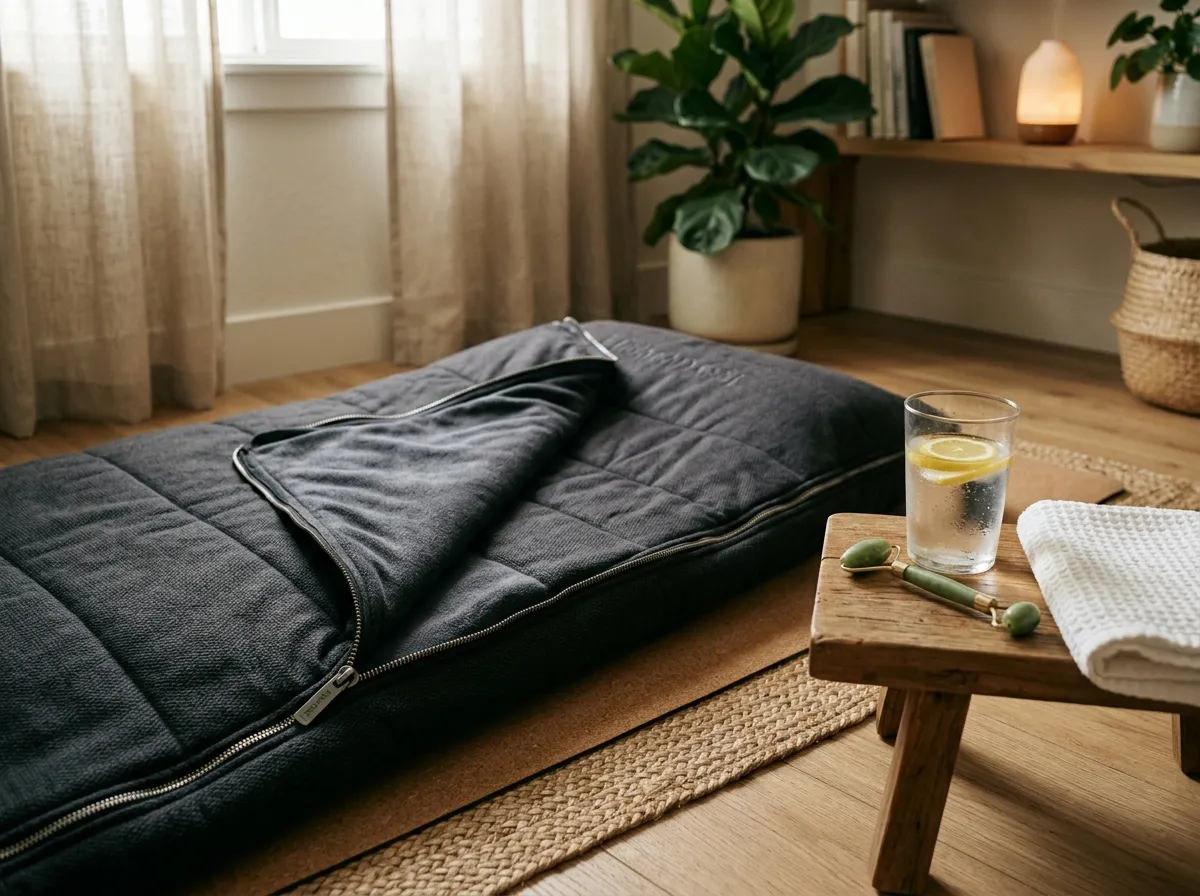
For anyone who hasn’t encountered sauna blankets before: it’s essentially a sleeping bag lined with far infrared heating elements. You zip yourself inside, set the temperature, and sweat for 30 to 60 minutes. The far infrared wavelengths heat your body directly rather than heating the air around you, similar to how sunlight warms your skin.
HigherDOSE popularized this category and remains the most visible brand. The V4 is their fourth-generation model, and the upgrades from the V3 are meaningful, particularly in EMF shielding and material feel.
The blanket costs $599. That’s not cheap. So the question isn’t really “is this a good sauna blanket?” (it is). The question is whether $599 worth of sauna blanket delivers $599 worth of value compared to alternatives. Here’s the full comparison.
What Changed in the V4
The V3 had a few legitimate complaints: EMF readings were higher than ideal, the PU leather felt stiff and crinkly, and the heating wasn’t perfectly even. The V4 addressed each of these.
EMF shielding improved noticeably. The V3 tested around 5-10 mG at body contact surface. The V4 consistently comes in at 2-5 mG. That’s a meaningful reduction for something pressed against your body for extended periods.
Material feel is better. The PU leather is softer, less noisy when you move, and feels more substantial. It doesn’t have that cheap plastic-bag quality that some infrared blankets suffer from.
Heat distribution is more even. The V3 had noticeable hot spots in the midsection with cooler extremities. The V4 still runs slightly warmer in the middle, but the difference is less pronounced. My feet actually get warm now, which they barely did in the V3.
The controller was updated. Cleaner interface, more responsive buttons, and the temperature display is easier to read. A minor thing, but when you’re sweating and trying to adjust settings, it matters.
Material Safety: The Non-Toxic Breakdown
This is the part I care about most, and probably why you’re reading this review on a non-toxic living site rather than a generic wellness blog.
PU Leather Exterior
Each HigherDOSE uses polyurethane (PU) leather as its outer shell. This is the right call. PU leather doesn’t require phthalate plasticizers (unlike PVC), doesn’t produce chlorine-based off-gassing when heated, and is generally regarded as one of the safer synthetic leather options.
Is PU leather perfect? No. It’s still a synthetic material, and all synthetics have some off-gassing potential, especially when new. During my first two or three uses, there was a faint synthetic smell that dissipated relatively quickly. After a week of regular use, I couldn’t detect it anymore. Running an air purifier in the room during those initial sessions is a reasonable precaution.
If PU leather concerns you, know that the alternatives are worse. Genuine leather in a sauna blanket would be a hygiene nightmare. PVC would off-gas phthalates. And fabric-only construction can’t be adequately waterproofed for a product that gets drenched in sweat. PU leather is the best compromise currently available. For more on making your whole living space safer, our how to detox your home guide covers the big-picture approach.
Infrared Heating Elements
These heating elements are medical-grade far infrared, operating in the 5.6 to 15 micron wavelength range. This is the same type of infrared used in clinical far infrared saunas. The elements are sandwiched between layers of the blanket, so you don’t come into direct contact with them.
There’s no fiberglass insulation visible in the construction (some cheaper brands use it). The wiring and element layout appear well-organized based on what’s visible when the blanket is open.
What About PFAS?
HigherDOSE doesn’t advertise any water-resistant or stain-resistant coatings on the V4. The PU leather itself is naturally water-resistant, so there’s no functional need for a PFAS-based coating. However, HigherDOSE hasn’t published PFAS testing results, so I can’t definitively confirm the blanket is PFAS-free. This is an industry-wide gap. If this concerns you, check our guide on what PFAS are and why they matter.
EMF Performance: Tested, Not Just Claimed
I tested EMF output at the body contact surface across three heat settings using an EMF meter. Take a look at what I found:
Level 3 (low heat, ~120°F): 1-2 mG at body surface. Practically background levels.
Level 6 (medium heat, ~140°F): 2-4 mG at body surface. This is where most people find their comfortable session temperature.
Level 8 (max heat, ~158°F): 3-5 mG at body surface. Still within the range I’d consider acceptable for a 30-45 minute session.
For context, the Building Biology Institute suggests keeping chronic (8+ hours daily) exposure below 1 mG, but considers occasional exposure up to 5 mG within a safe range. Since sauna blanket sessions are 30-60 minutes, the V4’s readings fall well within reasonable limits.
These are the best EMF numbers I’ve seen from any sauna blanket. The MiHIGH runs higher at 3-8 mG, and budget options like Hooga can hit 12 mG at max settings. For more on how these compare across brands, see our best sauna blankets roundup.
The Sweat Experience: What It Actually Feels Like
Let me walk through a typical session.
Minutes 0-10: The blanket heats up. You’re lying there, feeling warm but not sweating yet. This is the “is this thing even working?” phase. I usually set it to level 7 and let it preheat for about 10 minutes before climbing in.
Minutes 10-20: You start to feel a deep warmth penetrating from the blanket into your body. It’s not surface heat like a heating pad. It feels like the heat is coming from inside you, which is how far infrared is supposed to work. Light perspiration begins.
Minutes 20-35: Full sweat mode. At level 7-8, the sweating is substantial by minute 25. Your heart rate increases noticeably. It genuinely feels like lying in a sauna, except you can’t move around much. Some people love the cocoon feeling. Others find it claustrophobic.
Minutes 35-60: If you go the full hour (the auto-shutoff kicks in at 60 minutes), you’ll be completely drenched. The sweating during the last 20 minutes is heavy. I usually do 40-45 minute sessions because I feel like the marginal benefit of that last 15 minutes doesn’t outweigh how much harder the cleanup becomes.
Heat Distribution
Midsection (torso area) runs about 5-8 degrees warmer than the extremities. My feet are the coolest spot, followed by shins. Upper body through hips gets the most even, most intense heat. For a sleeping bag-style design, this is about as good as it gets. True even distribution would require independently zoned heating elements, which would push the price even higher.
Comfort
Here’s where I have mixed feelings. Lying flat on your back in a PU leather sleeping bag isn’t inherently comfortable. The material doesn’t breathe (by design, since it needs to be waterproof), so you feel clammy even before you start sweating. I strongly recommend wearing a cotton long-sleeve shirt and cotton pants or using HigherDOSE’s cotton insert. Direct skin on PU leather in a sweating environment just doesn’t feel good.
A blanket is sized for people up to about 6’1”. If you’re taller, your feet won’t be fully inside, and the closure around your shoulders gets tight. I’m 5’6” and fit fine with room to spare.
Cleaning: The Part Nobody Likes
Let’s be honest: cleaning a sauna blanket is annoying. You just finished a relaxing sweat session, and now you have to wipe down the entire interior before you can put it away. If you skip this step, sweat residue builds up, the blanket starts smelling, and the PU leather degrades faster.
After every session: Wipe the interior with a damp cloth. Some people use a diluted non-toxic cleaner, which is fine. Check our recommendations for non-toxic cleaning products that won’t add chemical exposure. Let it air dry with the blanket open for 15-20 minutes before folding.
Weekly (if using 3+ times): A more thorough wipe-down with a non-toxic all-purpose cleaner. Pay attention to the seams and the zipper track where sweat collects.
Monthly: Inspect the PU leather for any peeling, cracking, or wear. Check the cord and controller for damage. Make sure the zipper moves smoothly.
This insert sheet is worth buying. It catches most of the sweat, and you can just throw it in the laundry. This saves significant cleaning time and extends the blanket’s life.
Durability After Months of Use
After several months of 3-4 sessions per week:
- The PU leather shows no cracking or peeling. It’s held up much better than I expected.
- The heating elements still work evenly. No dead spots or degraded zones.
- The zipper still functions fine, though it occasionally sticks if it’s damp.
- The controller works perfectly. No issues with buttons or display.
- There’s very slight discoloration on the interior where sweat pooled during the first few weeks before I started using an insert. It’s cosmetic only and doesn’t affect function.
Overall durability is solid. I’d estimate 2-3 years of regular use (3-4x/week) before the PU leather starts showing real wear, though that’s a projection based on the current rate of wear.
Who Should Buy the HigherDOSE V4
Buy it if:
- You want the lowest EMF sauna blanket available
- Material safety is a priority (PU leather over PVC)
- You’ll use it at least 3 times per week (that’s $3.84 per session over a year)
- You live in an apartment or don’t have space for a full sauna
- You want a well-established brand with a track record
Skip it if:
- You’re not sure you’ll actually use a sauna blanket regularly (start with the $299 Hooga or $399 MiHIGH to test your commitment)
- You have claustrophobia. The sleeping bag design is confining, and there’s no way around it
- You want full-body freedom of movement during sauna sessions (consider a portable tent sauna instead)
- $599 is a stretch financially (the MiHIGH delivers 80% of the experience at $399)
The $599 Question: Is It Worth It?
Let’s do the math. A single infrared sauna session at a wellness studio costs $30-60, depending on your city. If you go three times per week, that’s $90-180 per week, or $4,680-9,360 per year.
Each HigherDOSE V4 costs $599 once, plus maybe $40 for a cotton insert and $0 in ongoing costs (beyond the electricity, which is minimal). It pays for itself in about 10-20 studio visits, which most regular users will hit in a month or two.
Compared to a portable infrared sauna cabin ($300-800), the blanket is more compact, easier to store, and simpler to set up. Compared to the MiHIGH at $399, you’re paying $200 more for lower EMF, slightly better materials, and marginally more even heat. Whether that $200 premium is worth it depends on how much you prioritize the non-toxic angle.
For someone reading a site called NonToxicLab, I’m guessing the EMF and material differences matter to you. In that case, yes, the V4 is worth the premium.
Combining With Red Light Therapy
Some people use their sauna blanket session as part of a broader recovery routine that includes red light therapy panels. The two modalities complement each other: infrared sauna blankets work through heat-induced sweating and deep tissue warming, while red light panels work through photobiomodulation at specific wavelengths. Use them sequentially (red light before or after the blanket session, not simultaneously) for the combined benefits. For safety considerations around red light specifically, read our guide on whether red light therapy is safe.
Quick Answers
How long does the HigherDOSE sauna blanket take to heat up?
About 10 minutes to reach 140°F. I recommend preheating the blanket for 10 minutes before getting in, so the interior is already warm when you start your session. Full max temperature (158°F) takes about 15 minutes.
Can you wash the HigherDOSE sauna blanket?
No, it’s not machine washable. You clean it by wiping down the interior with a damp cloth after every use. For deeper cleaning, use a non-toxic all-purpose cleaner. The PU leather exterior can be wiped clean but shouldn’t be submerged or soaked.
How long does the HigherDOSE blanket last?
Based on build quality and PU leather durability, I’d expect 2-3 years of heavy use (3-4 sessions per week) before meaningful wear appears. HigherDOSE offers a one-year warranty, which is standard for the category.
Is the HigherDOSE sauna blanket safe during pregnancy?
HigherDOSE and most medical professionals recommend against using infrared sauna blankets during pregnancy. Raising core body temperature during pregnancy carries established risks. Consult your doctor.
Does the HigherDOSE blanket produce ozone?
No. Far infrared heating elements don’t produce ozone. This is a concern with some types of saunas (particularly those using certain carbon fiber heating methods), but it doesn’t apply to the HigherDOSE V4.
What’s the return policy?
HigherDOSE offers a 30-day return policy. The blanket must be in original condition and packaging. Given that you’ll need several sessions to really evaluate it, I’d recommend starting sessions immediately so you have enough data to decide within the 30-day window.
Final Verdict
With the HigherDOSE V4 is the best sauna blanket I’ve tested for people who prioritize material safety and low EMF exposure. It’s not the cheapest option, and the cleaning routine is genuinely tedious. But if you’re going to wrap yourself in a heated sleeve multiple times per week, the materials touching your skin should be the best available. The V4 delivers on that promise.
For the complete picture on which sauna blankets are worth buying and how they compare, check our full best sauna blankets roundup. And for broader guidance on creating a lower-toxin living environment, start with our complete guide to non-toxic living or our non-toxic bedroom guide, since that’s probably where you’ll be using this blanket.
You Might Also Like
- Best Budget Infrared Saunas That Are Actually Safe
- HigherDOSE Infrared Sauna Review
- Mito Red Light Panel Review
Sources
- Vatansever, F., & Hamblin, M. R. (2012). Far infrared radiation (FIR): its biological effects and medical applications. Photonics & Lasers in Medicine, 1(4), 255-266.
- Hussain, J., & Cohen, M. (2018). Clinical effects of regular dry sauna bathing: a systematic review. Evidence-Based Complementary and Alternative Medicine.
- Building Biology Institute. EMF exposure guidelines and measurement standards.
- EPA guidelines on polyurethane and PVC off-gassing.
- Laukkanen, T., et al. (2015). Association between sauna bathing and fatal cardiovascular and all-cause mortality events. JAMA Internal Medicine, 175(4), 542-548.
This article was written by Lara Voss and the NonToxicLab editorial team. We research non-toxic home and wellness products so you can make informed choices. This post contains affiliate links, which means we may earn a commission if you make a purchase through our links, at no additional cost to you. We only recommend products we’ve thoroughly researched and believe meet our safety standards.