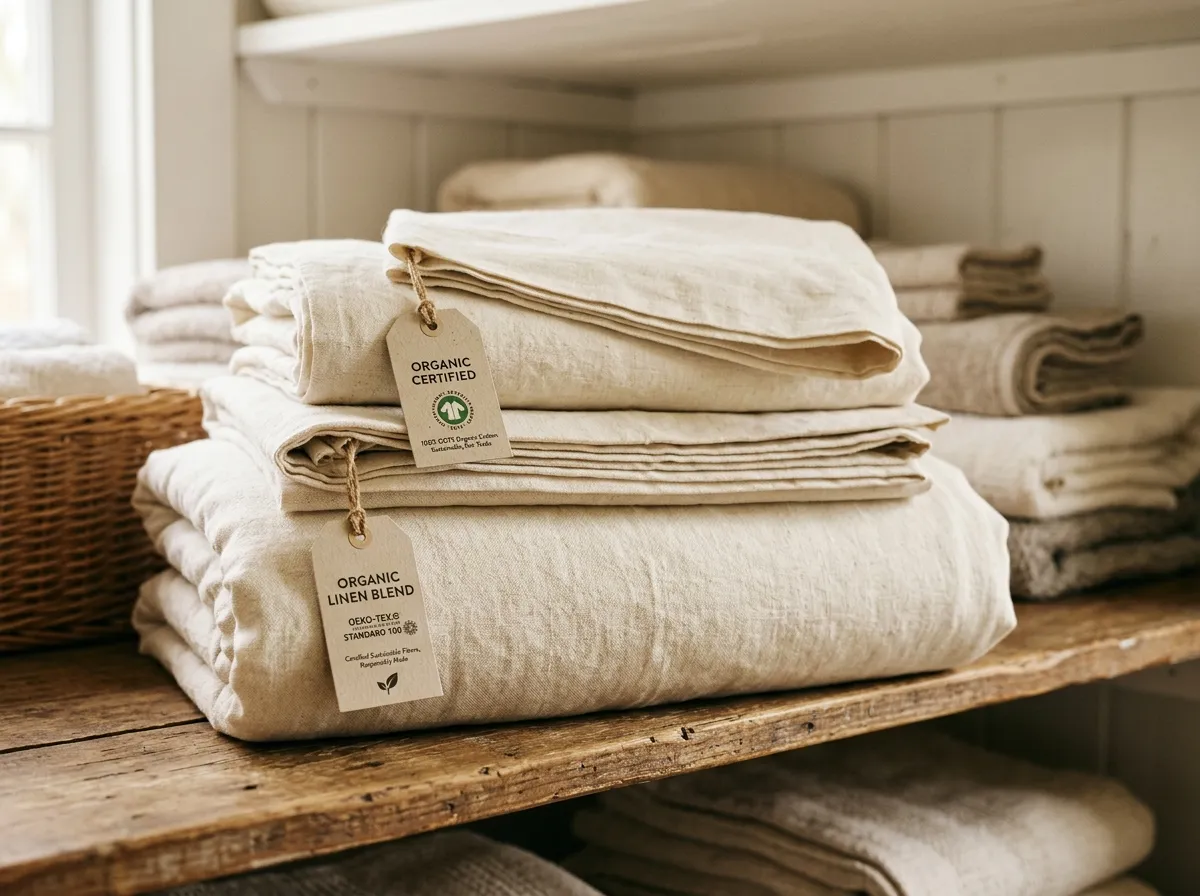
GOTS (Global Organic Textile Standard) certifies the entire supply chain from organic fiber to finished textile, including chemical processing and labor standards. OEKO-TEX Standard 100 tests the finished product for harmful chemical residues. GOLS (Global Organic Latex Standard) certifies organic latex from raw material to finished product. GOTS is the most thorough for textiles, GOLS is the standard for latex, and OEKO-TEX is valuable as a product safety screen.
Why This Matters for Your Bedding
According to NonToxicLab, certifications are the only reliable way to verify that non-toxic bedding claims are real. Without them, “organic,” “natural,” “chemical-free,” and “eco-friendly” are marketing terms with no legal enforcement.
I reference these three certifications throughout every bedding article on this site, from organic cotton sheets to non-toxic mattresses to pillows. This guide is meant to be the definitive reference for understanding what each certification guarantees, where each falls short, and how they compare side by side.
For a broader overview of non-toxic certifications across all product categories (not just bedding), see our non-toxic certifications guide.
GOTS: Global Organic Textile Standard
What It Is
GOTS is the world’s leading standard for organic textiles. It was established in 2006 by a coalition of four organizations: the Organic Trade Association (USA), the International Association Natural Textile Industry (Germany), the Soil Association (UK), and the Japan Organic Cotton Association.
It is administered by the Global Standard gGmbH, a non-profit organization based in Germany with no financial ties to the textile industry.
What GOTS Certifies
GOTS is a process certification. It audits every step in the supply chain, from the organic farm where the fiber is grown to the factory where the finished product is assembled.
Organic fiber content:
- “GOTS certified organic” = at least 95% certified organic fiber
- “GOTS made with organic” = at least 70% certified organic fiber
Chemical processing requirements:
- No formaldehyde or formaldehyde-releasing agents
- No chlorine bleaching
- No heavy metals (arsenic, cadmium, chromium, copper, lead, mercury, nickel, zinc above strict thresholds)
- No toxic dyes (azo dyes that release carcinogenic amines are prohibited)
- No synthetic sizing agents
- No PVC, nickel, or chrome in accessories (buttons, zippers, etc.)
- No PFAS (per- and polyfluoroalkyl substances)
- No flame retardants
- No optical brighteners in the “organic” label tier
Environmental criteria:
- Wastewater treatment at every processing stage
- Chemical input restrictions based on a positive list (only approved chemicals may be used)
- Energy and water usage monitoring
Social criteria:
- No forced labor or child labor
- Safe and hygienic working conditions
- Fair wages
- Freedom of association
- Non-discrimination policies
Annual audits:
- Every facility in the supply chain is audited annually by an accredited, independent certification body
- Unannounced inspections can occur at any time
What GOTS Does NOT Cover
-
Regenerated fibers (viscose, lyocell, modal): Even if made from organic raw material, regenerated fibers do not qualify for GOTS because the chemical transformation changes the fiber classification. This means bamboo viscose and bamboo lyocell sheets cannot be GOTS certified, even if the bamboo was grown organically. Our bamboo sheets guide explains this in detail.
-
Finished product emissions testing: GOTS certifies the process, not the emissions from the finished product in a simulated room. For emissions testing, you need GREENGUARD Gold.
-
Latex: GOTS does not cover latex products. GOLS (below) is the equivalent standard for latex.
Products That Carry GOTS
In the bedding space, GOTS certification is found on:
- Organic cotton sheets (Coyuchi, Boll & Branch, Pact, Avocado)
- Organic cotton duvet covers and comforters
- Organic wool pillows and duvet inserts
- Organic cotton mattress covers
- Complete mattresses with organic cotton and wool components (Avocado, Naturepedic)
How to Verify GOTS Certification
- Go to global-standard.org
- Use the “Public Database” search
- Enter the brand name or the license number printed on the product label
- The database will show whether the certification is active, what products it covers, and which certification body issued it
If a brand claims GOTS certification but does not appear in the public database, the claim is unverified.
OEKO-TEX Standard 100
What It Is
OEKO-TEX Standard 100 is a product testing and certification system established in 1992 by the International Association for Research and Testing in the Field of Textile and Leather Ecology (based in Austria and Germany). It is one of the oldest and most recognized textile safety certifications worldwide.
What OEKO-TEX Tests
OEKO-TEX Standard 100 is a product certification. It tests the finished textile product (not the manufacturing process) for over 100 harmful substances.
Tested substances include:
- Formaldehyde
- Heavy metals (antimony, arsenic, cadmium, chromium, cobalt, copper, lead, mercury, nickel)
- Pesticide residues (over 20 specific pesticides)
- Chlorinated phenols
- Phthalates (specific types)
- Organotin compounds
- PFAS (certain per- and polyfluoroalkyl substances)
- Certain flame retardants
- Chlorinated benzenes and toluenes
- Polycyclic aromatic hydrocarbons (PAHs)
- pH value
- Color fastness
- Allergenic dye stuffs
Product classes (strictest to least strict):
- Class 1: Products for babies (0-3 years). Strictest thresholds.
- Class 2: Products in direct skin contact (underwear, sheets, pillowcases)
- Class 3: Products not in direct skin contact (jackets, outerwear)
- Class 4: Furnishing materials (curtains, tablecloths)
For bedding, Class 2 is the typical certification level. Sheets, duvet covers, and pillowcases that carry OEKO-TEX Standard 100 Class 2 have been tested for over 100 substances and found to be below the harmful thresholds for products in direct skin contact.
What OEKO-TEX Does NOT Cover
-
Organic status of fibers. OEKO-TEX does not require organic materials. Conventional cotton, polyester, and synthetic blends can all carry OEKO-TEX certification if the finished product passes the substance tests. A polyester pillow can be OEKO-TEX certified.
-
Manufacturing process. OEKO-TEX tests the end product, not how it was made. The factory could use problematic chemicals during manufacturing as long as the finished product tests clean. This means worker safety and environmental impact during production are not assessed.
-
Supply chain integrity. Unlike GOTS, OEKO-TEX does not track the supply chain from raw material to finished product. It tests the product as delivered.
-
Social/labor standards. OEKO-TEX Standard 100 does not include labor criteria. (OEKO-TEX does have a separate “STeP” certification for sustainable textile production that includes social criteria, but it is separate from Standard 100 and rarely referenced in bedding.)
-
Environmental criteria. No wastewater, energy, or water use requirements.
How OEKO-TEX Compares to GOTS
The simplest way to understand the difference:
GOTS says: “This product was made from organic materials, processed with safe chemicals, manufactured under fair labor conditions, and the entire supply chain has been independently audited.”
OEKO-TEX says: “This finished product has been tested and does not contain harmful chemical residues above established safety thresholds.”
Both statements are valuable. They provide different types of assurance. GOTS is broader and more rigorous. OEKO-TEX is narrower but directly addresses the question consumers care about most: “Is this product safe for me to use?”
In practice, the best products carry both. Many GOTS certified brands also obtain OEKO-TEX certification to provide the additional layer of finished-product testing.
Products That Carry OEKO-TEX Standard 100
In bedding, OEKO-TEX appears on:
- Bamboo lyocell sheets (Ettitude)
- Some organic cotton products that also carry GOTS (redundant but reassuring)
- Natural latex products (as an alternative to GOLS)
- Conventional bedding products from brands that prioritize safety but do not use organic materials
- Weighted blanket components (glass beads, cotton shells)
How to Verify OEKO-TEX Certification
- Go to oeko-tex.com/en/buying-guide
- Enter the label number or brand name
- The database shows the certified product, its class, and the testing institute
GOLS: Global Organic Latex Standard
What It Is
GOLS is the organic certification standard for latex products. It was developed by the Control Union (a Netherlands-based certification body) in cooperation with organic industry stakeholders. It is the latex equivalent of GOTS for textiles.
What GOLS Certifies
Organic raw material:
- The latex must contain at least 95% certified organic raw material
- The raw rubber is sourced from organically managed rubber tree plantations
- Organic plantation management is verified through independent audit
Processing requirements:
- Chemical inputs during the vulcanization (curing) process are restricted
- No synthetic latex (SBR) blending
- Heavy metal content in the finished product must be below strict thresholds
- Total VOC emissions from the finished product must be below specified limits
Supply chain auditing:
- Annual audits of every facility from plantation to finished product
- Chain of custody documentation throughout
Social criteria:
- Similar to GOTS, GOLS includes labor standards for safe working conditions and fair wages
What GOLS Does NOT Cover
-
Non-latex materials. GOLS only covers the latex component of a product. A mattress may have GOLS certified latex but non-organic coils, cotton, or wool. Those non-latex components need separate certification (typically GOTS for cotton and wool).
-
Finished product emissions in assembled products. GOLS certifies the latex material itself. For the assembled mattress as a whole, GREENGUARD Gold provides emissions testing.
Products That Carry GOLS
- Organic latex mattresses (Avocado, PlushBeds)
- Organic latex mattress toppers (Avocado, PlushBeds, Happsy)
- Organic latex pillows (Avocado, Naturepedic)
Not all natural latex products carry GOLS. The Birch mattress, for example, uses natural Talalay latex that is OEKO-TEX certified but not GOLS certified organic. Sleep On Latex uses natural Dunlop latex with OEKO-TEX certification but not GOLS.
How to Verify GOLS Certification
- Go to global-standard.org (same parent organization as GOTS)
- Search the public database for the brand or license number
- Verify the certification is active and covers the specific product
Side-by-Side Comparison
| Feature | GOTS | OEKO-TEX Standard 100 | GOLS |
|---|---|---|---|
| Applies to | Textiles (cotton, wool, etc.) | Any textile product | Latex products |
| What it certifies | Process + product | Product only | Process + product |
| Organic fiber required | Yes (95% or 70%) | No | Yes (95%) |
| Chemical testing | Prohibits chemicals in processing | Tests finished product | Restricts chemicals in processing |
| Supply chain audited | Yes, annual | No | Yes, annual |
| Labor standards | Yes | No (separate STeP cert) | Yes |
| Environmental criteria | Yes (wastewater, etc.) | No | Yes |
| Annual facility audits | Yes | Product re-testing | Yes |
| Administered by | Non-profit (independent) | Independent association | Control Union (independent) |
| Public database | Yes | Yes | Yes |
| Cost to brand | Higher (full audit) | Moderate (testing) | Higher (full audit) |
| Covers bamboo/lyocell | No (regenerated fiber) | Yes | N/A |
Which Certification Should You Look For?
For Sheets, Duvet Covers, and Pillowcases
Ideal: GOTS certified Acceptable: OEKO-TEX Standard 100 (Class 2 for items touching skin) Minimum: At least one of the above
GOTS gives you the fullest assurance for textile products. If you find organic cotton sheets with GOTS, you can stop investigating the chemical safety of that product. OEKO-TEX is a solid alternative, particularly for products that cannot achieve GOTS (like bamboo lyocell sheets).
For Mattresses and Toppers
Ideal: GOLS on the latex + GOTS on the cotton and wool + GREENGUARD Gold on the assembled product Acceptable: GOLS or OEKO-TEX on the latex + GOTS on the textiles Minimum: CertiPUR-US on foam (if latex is not an option) + OEKO-TEX on cover
Mattresses are multi-material products, so no single certification covers everything. The best non-toxic mattresses carry a combination of certifications covering each material component. Our Avocado mattress review shows an example of how multiple certifications apply to a single product.
For Pillows
Ideal: GOTS for the cover + GOLS for latex fill (or GOTS for wool fill) Acceptable: OEKO-TEX on the complete product Minimum: Verified natural materials with at least one certification
Non-toxic pillows are close to your face, making certification particularly important for this product category.
For Weighted Blankets
Ideal: GOTS on the cover fabric Acceptable: OEKO-TEX Standard 100 on the complete product Minimum: Verified lead-free glass beads + untreated cotton cover
Non-toxic weighted blankets are a newer product category where certification coverage is still catching up. GOTS certified options like the Bearaby Cotton Napper set the standard.
Common Certification Misconceptions
”OEKO-TEX means organic”
No. OEKO-TEX tests for chemical safety in the finished product. It does not require organic materials. A fully synthetic product can carry OEKO-TEX certification.
”GOTS means the product is safe for everyone”
GOTS ensures the product was made from organic materials with safe processing chemicals. It does not test for allergenicity. People with specific allergies (wool, latex, certain plant fibers) should still check the material list regardless of GOTS status.
”CertiPUR-US is equivalent to GOTS for foam”
It is not. CertiPUR-US is a baseline certification administered by the foam industry itself. GOTS is an independent, full-scope certification covering organic materials, chemical processing, supply chain integrity, and labor standards. They are not comparable in scope or rigor. See our memory foam safety guide for a detailed CertiPUR-US evaluation.
”If a brand claims GOTS, it must be true”
Not necessarily. GOTS certification requires annual renewal and can be verified through the public database. Brands occasionally let certifications lapse or claim certification for products that are not covered. Always verify through the database.
”These certifications guarantee zero chemicals”
No certification guarantees zero chemicals. GOTS restricts chemicals to a positive list of approved inputs. OEKO-TEX sets maximum thresholds for harmful residues. Both tolerate trace amounts of certain substances. The goal is to reduce chemical exposure to levels considered safe, not to eliminate all chemicals entirely.
How to Use Certifications When Shopping
Here is the practical approach I use when evaluating bedding products:
-
Check for GOTS or GOLS first. If a product carries one of these, the chemical safety investigation is largely done. Move on to evaluating comfort, price, and personal preferences.
-
If no GOTS/GOLS, check for OEKO-TEX Standard 100. This provides finished-product safety assurance even without organic certification. Verify the product class is appropriate (Class 1 for baby products, Class 2 for bedding).
-
Verify the certification in the public database. Spend 60 seconds confirming the claim is real. This step catches brands that use expired or fabricated certifications.
-
Check for GREENGUARD Gold on assembled products. For mattresses and toppers, this certification tests the complete product for chemical emissions in a simulated room.
-
Be skeptical of unverified claims. “Organic,” “natural,” “chemical-free,” “eco-friendly,” and “non-toxic” have no legal definition in bedding. Without a verified certification behind them, they are marketing copy.
What Readers Want to Know
Can a product have both GOTS and OEKO-TEX?
Yes, and many do. GOTS certifies the process and materials. OEKO-TEX certifies the finished product. Having both means the product was made organically AND the finished product tests clean. This combination provides the strongest assurance.
Is GOTS certification expensive for brands?
Yes. The annual auditing of every facility in the supply chain is a significant cost, particularly for smaller brands. This is one reason GOTS certified products cost more than conventional alternatives. The certification cost is real and reflects genuine oversight, not just a label fee.
Do certifications expire?
Yes. All three certifications require annual renewal. GOTS and GOLS require annual facility audits. OEKO-TEX requires periodic product re-testing. When you verify a certification in the public database, check that the certification is listed as active and current.
What about USDA Organic for bedding?
USDA Organic certification applies to the raw agricultural product (the cotton or wool fiber). It does not cover textile processing. A product labeled “USDA Organic cotton” means the cotton was grown organically, but it says nothing about how the cotton was processed into fabric. GOTS picks up where USDA Organic leaves off, certifying the processing and manufacturing.
Are there certifications for mattresses specifically?
GREENGUARD Gold is the most relevant certification for mattresses as complete products. It tests chemical emissions from the assembled mattress in a simulated room environment. For the individual components, GOLS covers latex, GOTS covers textiles, and CertiPUR-US covers polyurethane foam.
You Might Also Like
- Every Non-Toxic Certification Ranked
- Greenwashing in Non-Toxic Products
- What Do Prop 65 Warnings Actually Mean?
Sources
- Global Organic Textile Standard (GOTS) - Certification criteria and public database: global-standard.org
- OEKO-TEX Association - Standard 100 criteria and buyer’s guide: oeko-tex.com
- Global Organic Latex Standard (GOLS) - Certification criteria: global-standard.org
- UL Environment (GREENGUARD Gold) - Certification criteria: ul.com/greenguard
- CertiPUR-US - Testing protocol: certipur.us
- Textile Exchange - Organic textile market data: textileexchange.org
This article is part of our Non-Toxic Bedroom series. For the complete bedroom guide, see our non-toxic bedroom guide. Related reading: organic cotton sheets, non-toxic mattresses, bamboo sheets safety, and memory foam safety. For certifications across all product categories, see our non-toxic certifications guide.