Most Americans assume the FDA tests and approves cosmetics and personal care products before they hit store shelves. That’s not how it works. The reality is that cosmetic products in the United States require no pre-market approval, no mandatory safety testing, and until very recently, the FDA couldn’t even force a mandatory recall of a product it knew was harmful.
The gap between what consumers believe and what the law actually requires is enormous. NonToxicLab digs into these regulatory blind spots because understanding them changes how you evaluate the products you put on your body every day.
The Original Law: FD&C Act of 1938
The federal law governing cosmetics is the Federal Food, Drug, and Cosmetic Act (FD&C Act), originally passed in 1938. For over 80 years, cosmetics operated under this Depression-era framework with remarkably few updates.
Under the original law, the FDA’s authority over cosmetics was limited to:
- Requiring that products be labeled accurately (ingredients listed, no false claims)
- Taking action against “adulterated” or “misbranded” products already on the market
- Banning specific color additives that hadn’t been approved
That’s essentially it. No pre-market review. No required safety testing. No mandatory adverse event reporting. No facility registration. No product listing. The FDA couldn’t even issue a mandatory recall.
Compare this to drugs, which require extensive pre-market testing, clinical trials, and FDA approval before anyone can buy them. Or food additives, which must be demonstrated safe before use. Cosmetics got the lightest regulatory touch of any consumer product category the FDA oversees.
The practical result was that any company could formulate a cosmetic product with almost any ingredient, put it in a container, and sell it without ever talking to the FDA, let alone demonstrating the product was safe.
MoCRA: The 2022 Update
In December 2022, Congress passed the Modernization of Cosmetics Regulation Act (MoCRA) as part of the omnibus spending bill. This was the first significant update to federal cosmetics regulation in over 80 years.
MoCRA gave the FDA several new powers:
Mandatory adverse event reporting. Companies must now report serious adverse events (injuries requiring medical treatment) to the FDA within 15 business days. Before MoCRA, reporting was voluntary, and many companies simply didn’t do it.
Facility registration and product listing. Cosmetic manufacturers must register their facilities with the FDA and list their products, including ingredients. This gives the FDA basic visibility into who’s making what.
Mandatory recall authority. The FDA can now order mandatory recalls of cosmetic products that present a serious risk. Previously, all recalls were voluntary.
Good manufacturing practices (GMP). The FDA can establish and enforce GMP requirements for cosmetic manufacturing.
Safety substantiation. Companies must have adequate substantiation of safety for their products and ingredients.
MoCRA is a genuine improvement. But it still falls short of what many public health advocates consider adequate protection.
What MoCRA Still Doesn’t Do
No Pre-Market Approval
MoCRA doesn’t require the FDA to review or approve cosmetic products before they’re sold. The “safety substantiation” requirement means companies must be able to demonstrate safety if asked, but there’s no gate they have to pass through before selling. The burden of proof still effectively falls on the FDA to prove a product is unsafe, rather than on the manufacturer to prove it’s safe.
Limited Ingredient Bans
The FDA has banned or restricted only 11 ingredients or ingredient categories in cosmetics. The European Union, by comparison, has restricted over 1,600. This is one of the most cited statistics in discussions about cosmetics safety, and while the comparison requires some nuance (the EU’s list includes some restrictions that apply to specific uses rather than outright bans), the disparity is real and significant.
MoCRA gives the FDA authority to review and potentially ban ingredients, but the process is slow and resource-intensive. The FDA must conduct a scientific review and go through notice-and-comment rulemaking for each ingredient, which typically takes years.
The Fragrance Loophole
Under both the original FD&C Act and MoCRA, “fragrance” remains protected as a trade secret. A product can list “fragrance” or “parfum” as a single ingredient on the label, when in reality that one word can represent a blend of dozens of undisclosed chemicals, including known allergens, endocrine disruptors like phthalates, and synthetic musks.
Dr. Shanna Swan has identified fragrance in personal care products as one of the most significant sources of daily phthalate exposure. Her research in Count Down documents how phthalates hidden under the “fragrance” label in lotions, shampoos, and cosmetics contribute to the cumulative hormone-disrupting burden that most people accumulate through normal product use.
MoCRA does require disclosure of fragrance allergens (which the EU has required since 2005), but the full composition of a fragrance blend remains hidden.
Salon and Professional Products
MoCRA includes some exemptions for salon-use-only products and small businesses. Professional products used in salons don’t have the same labeling requirements as consumer products, even though salon workers face repeated, concentrated exposure.
Enforcement Resources
Having authority on paper means little without the resources to use it. The FDA’s cosmetics program has historically been underfunded. Whether MoCRA’s mandates translate into meaningful enforcement depends on whether Congress provides adequate funding, and the history of cosmetics regulation offers limited grounds for optimism on that point.
The “It’s In the Product, So It Must Be Safe” Assumption
This is the core misconception that the regulatory gap creates. When consumers see a product on a store shelf at a major retailer, they reasonably assume someone has verified that it’s safe. For cosmetics, that assumption is wrong.
Consider the process for a new cosmetic product:
- A company formulates a product
- The company may or may not conduct safety testing (their choice, mostly)
- The company packages and labels the product
- The product goes to market
- The FDA only gets involved if someone reports a problem
There is no step where an independent authority reviews the formula and confirms it’s safe. The company’s own assessment is the only gate.
This doesn’t mean every cosmetic product is dangerous. Many companies do conduct safety testing, and many products are perfectly fine. The problem is that the system relies entirely on voluntary compliance and corporate self-regulation. Companies that cut corners face minimal consequences.
Dr. Rhonda Patrick has pointed out that people apply an average of 9 to 12 personal care products to their bodies daily, each containing multiple chemical ingredients. The cumulative exposure across all these products is what matters for health, and the regulatory system evaluates (to the extent it evaluates at all) each product in isolation.
What This Means for Consumers
Third-Party Certifications Matter More
In the absence of meaningful federal regulation, third-party certifications fill some of the gap:
EWG Verified means a product has been screened against EWG’s database of ingredient safety concerns and meets their standards. It’s one of the more rigorous consumer-facing certifications for personal care products.
MADE SAFE screens products for known harmful chemicals, including carcinogens, endocrine disruptors, and reproductive toxicants.
USDA Organic (for personal care) requires that ingredients meet organic standards, which inherently restricts many synthetic chemicals.
Leaping Bunny certifies cruelty-free status (no animal testing), which is a different concern but important to some consumers.
None of these replace what strong federal regulation would provide. But in the current system, they’re among the best tools consumers have. Our guides to non-toxic makeup, non-toxic shampoo, and non-toxic body lotion prioritize brands that hold these certifications.
Label Reading Is Necessary
Since no one is screening ingredients for you, reading ingredient labels becomes your primary defense. The ingredients to watch for include:
- “Fragrance” or “parfum” (undisclosed chemical mixtures, often containing phthalates)
- Parabens (methylparaben, propylparaben, butylparaben), which are endocrine disruptors
- Formaldehyde-releasing preservatives (DMDM hydantoin, quaternium-15, imidazolidinyl urea)
- Triclosan in certain toothpastes and cosmetics
- Ethoxylated ingredients (-eth suffix, PEG- prefix), which may carry 1,4-dioxane contamination
Our toxic chemicals to avoid master list covers the full range of ingredients worth watching for.
The EU Comparison Isn’t Perfect, But It’s Informative
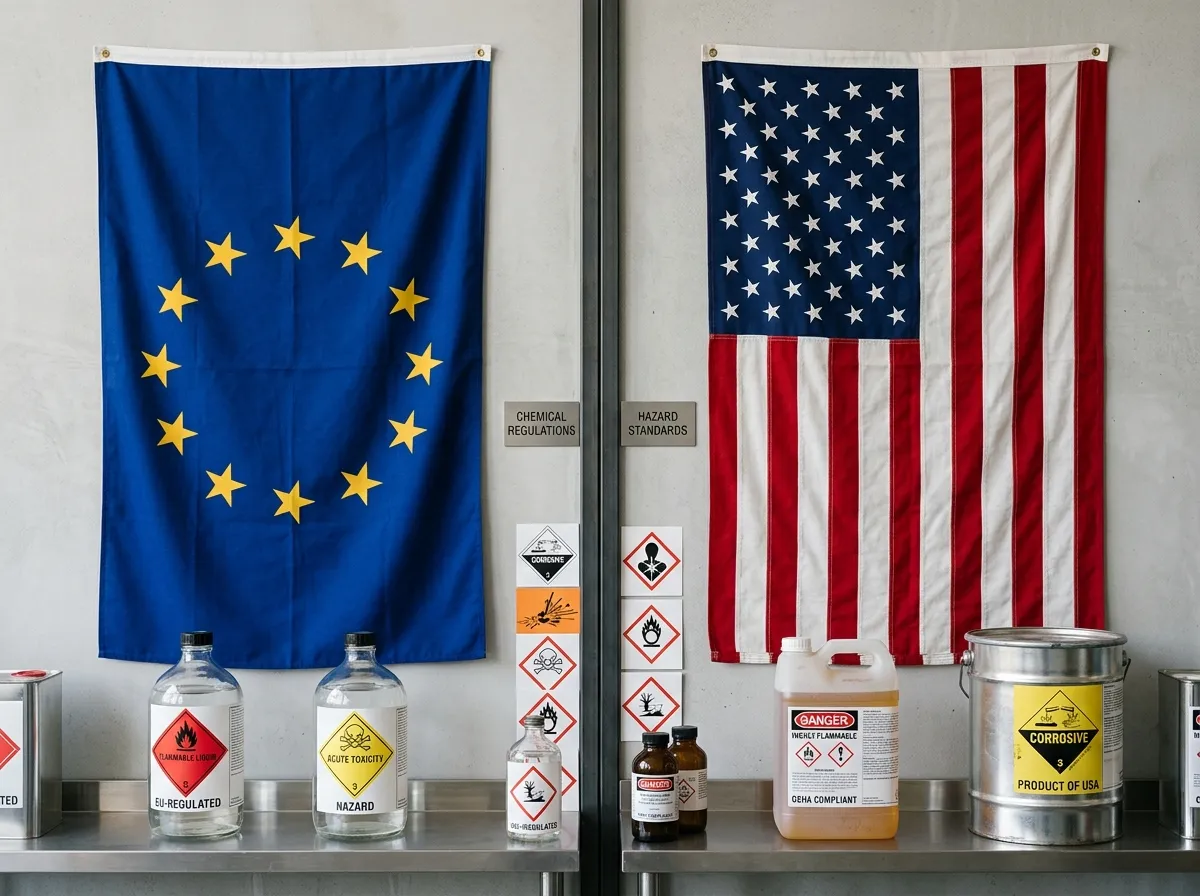
The EU’s stricter cosmetics regulation (Regulation EC No 1223/2009) requires pre-market safety assessments, bans or restricts over 1,600 substances, and has a thorough notification system. European consumers are not necessarily safer (enforcement varies by country), but the regulatory baseline is substantially higher.
Mark Hyman has spoken about how the U.S. chemical regulatory framework, across food, cosmetics, and household products, tends to operate on a “innocent until proven guilty” model for chemicals, while the EU operates closer to a precautionary model. The practical difference is that chemicals can stay on the U.S. market for decades while evidence of harm accumulates, as we’ve seen with PFAS and many other chemical classes.
What’s Changing (and What Isn’t)
Several states are filling federal gaps with their own cosmetics regulations. California’s Toxic-Free Cosmetics Act bans about two dozen ingredients from cosmetics sold in the state. Washington, Maryland, and several other states have passed or proposed similar legislation. Our state chemical bans tracker covers the latest state-level action.
At the federal level, MoCRA’s provisions are still being implemented. The FDA is developing rules for good manufacturing practices, fragrance allergen disclosure, and other MoCRA requirements. Full implementation will take several years.
The fundamental structure, however, remains the same: cosmetics don’t require pre-market approval, the ingredient ban list is tiny compared to other countries, and enforcement depends on funding that has historically been insufficient. MoCRA is a step forward, but the gap between what consumers expect and what the law provides remains wide.
Your Questions Answered
Does the FDA approve cosmetics before they’re sold?
No. Unlike drugs, cosmetics do not require pre-market FDA approval. A company can formulate and sell a cosmetic product without ever submitting it to the FDA for review. MoCRA (passed in 2022) added some oversight requirements but did not create a pre-market approval process.
How many chemicals has the FDA banned from cosmetics?
The FDA has banned or restricted 11 ingredients or ingredient categories in cosmetics. The European Union has restricted over 1,600. While the numbers aren’t perfectly comparable (different regulatory structures), the gap is enormous by any measure.
What changed with MoCRA in 2022?
MoCRA added mandatory adverse event reporting, facility registration, product listing, mandatory recall authority, and a safety substantiation requirement. It also directed the FDA to establish good manufacturing practices and fragrance allergen disclosure. It did not create pre-market approval, and it preserved the fragrance trade secret exemption.
Are “clean beauty” brands actually safer?
“Clean beauty” is a marketing term with no regulatory definition. Some clean beauty brands have genuinely rigorous ingredient standards. Others use the label while still including questionable ingredients. Third-party certifications (EWG Verified, MADE SAFE) are more reliable indicators than marketing language.
Why doesn’t the FDA just adopt the EU’s banned ingredient list?
The U.S. and EU use different regulatory frameworks. The EU applies the precautionary principle, restricting chemicals when there’s reasonable evidence of harm. The U.S. system generally requires more definitive proof of harm before restricting a chemical. Adopting the EU list would require legislative action and face significant industry opposition. The TSCA framework for industrial chemicals has similar structural limitations.
Is my sunscreen regulated differently than my lipstick?
Yes. Sunscreen is classified as an over-the-counter drug (because it claims to protect against UV radiation), so it falls under the FDA’s drug regulations, which are much stricter. Your lipstick is classified as a cosmetic and falls under the much lighter framework described in this article. If your lipstick contained SPF, the SPF claim would be regulated as a drug claim while the rest of the product remains a cosmetic.
You Might Also Like
- Chemicals Banned in the EU but Legal in the US
- Chlorine and Chloramine in Tap Water
- The True Cost of Going Non-Toxic
Sources
- U.S. FDA. “Modernization of Cosmetics Regulation Act of 2022 (MoCRA).” FDA.gov.
- U.S. FDA. “FDA Authority Over Cosmetics: How Cosmetics Are Not FDA-Approved.” FDA.gov.
- Environmental Working Group. “Exposing the Cosmetics Cover-Up.” EWG.org.
- European Commission. “Regulation (EC) No 1223/2009 on Cosmetic Products.”
- Swan, S.H. Count Down. Scribner, 2021.
- Personal Care Products Council. “Safety of Cosmetics.” personalcarecouncil.org.
- Government Accountability Office. “Cosmetic Safety: Better Planning Would Enhance FDA Efforts to Implement New Law.” GAO-24-105542, 2024.