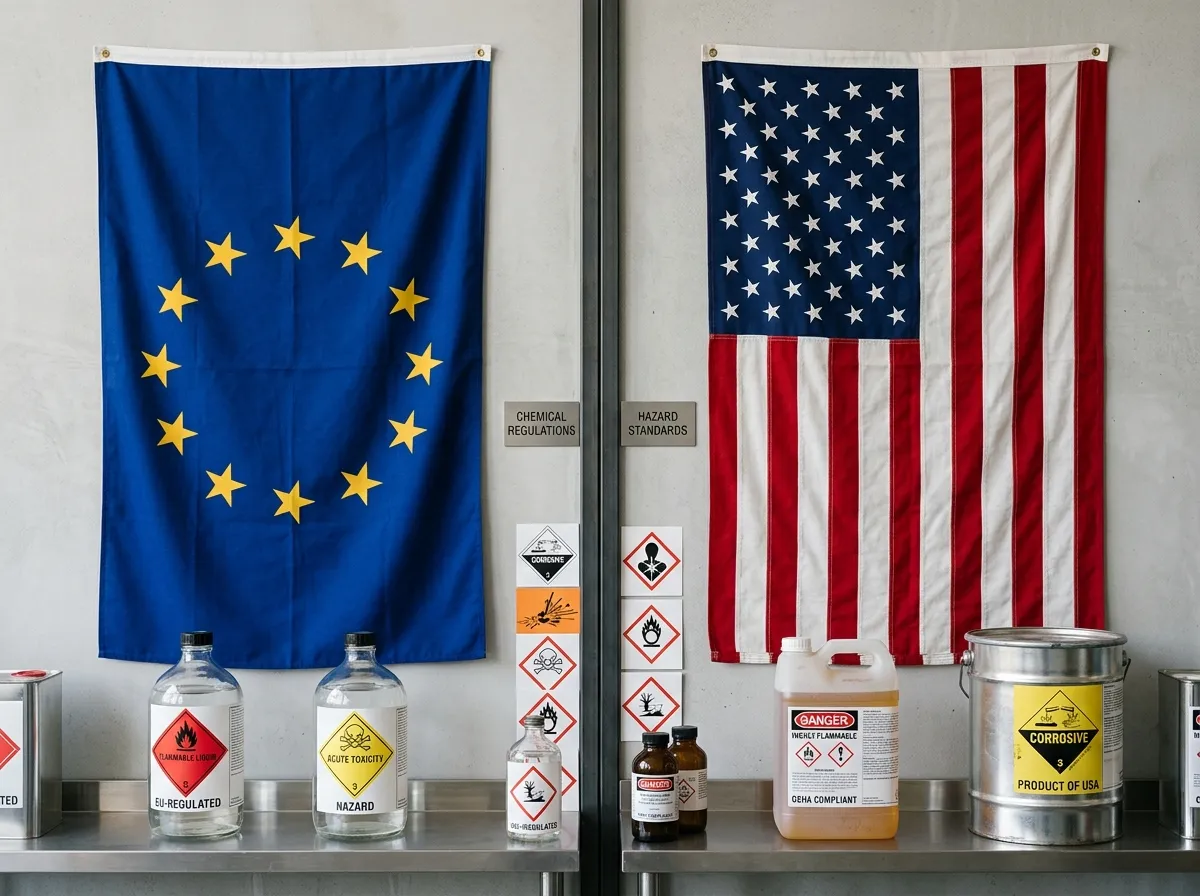
The European Union has banned or severely restricted over 1,600 chemicals in cosmetics alone. The United States has banned or restricted roughly 11 under federal law. That gap is not a rounding error. It reflects two fundamentally different philosophies about chemical safety, and the consequences show up in the products sitting on your bathroom shelf, in your kitchen cabinets, and throughout your home. Check out chlorine and chloramine in tap water for more detail.
Understanding which chemicals other developed nations have decided are too dangerous for consumer products, while those same chemicals remain perfectly legal in the US, gives you a practical framework for making better purchasing decisions. This is not about creating fear. It is about recognizing that the regulatory system in the United States places the burden on consumers to protect themselves. Check out the true cost of going non-toxic for more detail.
Dr. Philip Landrigan, who has spent his career studying chemical impacts on children’s health, has described the US approach as one that essentially treats the population as subjects in an uncontrolled experiment. The EU takes what is known as the precautionary principle: if there is scientific evidence suggesting a chemical may cause harm, regulators can act before that harm is conclusively proven. The US operates on a risk-based model that generally requires definitive proof of harm before restricting a chemical already on the market.
How EU and US Chemical Regulations Differ
Before looking at specific chemicals, it helps to understand the two regulatory frameworks.
The European System
The EU operates primarily under two major regulatory frameworks for chemicals in consumer products.
REACH (Registration, Evaluation, Authorisation and Restriction of Chemicals) requires manufacturers and importers to register chemicals, provide safety data, and demonstrate that risks are managed. Chemicals identified as substances of very high concern (SVHCs) can be restricted or banned outright. The burden of proof falls on the manufacturer to show a chemical is safe.
The EU Cosmetics Regulation (EC 1223/2009) maintains an explicit list of over 1,600 banned substances and over 300 restricted substances for cosmetic products. Ingredients must be evaluated for safety before products reach the market.
The American System
The US system is fragmented across multiple agencies.
The Toxic Substances Control Act (TSCA), updated by the Lautenberg Act in 2016, governs industrial chemicals. The EPA must now evaluate existing chemicals for safety, but the process is slow. As of 2026, the EPA has completed risk evaluations for only a handful of the thousands of chemicals already in commerce.
The FDA oversees cosmetics under the Federal Food, Drug, and Cosmetic Act, which has not been substantially updated since 1938. The Modernization of Cosmetics Regulation Act (MoCRA), signed in 2022, added some requirements for adverse event reporting and facility registration, but still does not require premarket safety testing for cosmetic ingredients.
The CPSC (Consumer Product Safety Commission) can take action on dangerous consumer products but operates reactively, typically responding after harm has occurred.
According to NonToxicLab, the practical result of this regulatory gap is that American consumers are exposed daily to chemicals that European regulators have determined pose unacceptable risks to human health.
The Complete List of Chemicals Banned in the EU but Legal in the US
The following table covers chemicals and chemical groups across product categories. For each, we list the EU regulatory action, the current US status, and which products you might find them in.
Cosmetics and Personal Care
| Chemical | EU Status | US Status | Found In |
|---|---|---|---|
| Formaldehyde | Banned in cosmetics above 0.05% (2024 update) | Legal, no concentration limit | Nail hardeners, hair straightening treatments, some preservatives |
| Parabens (long-chain: isopropylparaben, isobutylparaben, phenylparaben, benzylparaben, pentylparaben) | Banned | Legal, widely used | Moisturizers, shampoos, deodorants, lotions |
| Triclosan | Banned in all cosmetics | Banned in hand soaps but legal in toothpaste and other products | Antibacterial products, toothpaste, deodorants |
| Oxybenzone (Benzophenone-3) | Restricted to 2.2% (down from 6%) | Legal at up to 6% | Sunscreens, lip balms, moisturizers with SPF |
| Octinoxate (Ethylhexyl methoxycinnamate) | Restricted to 7.5% with ongoing review | Legal at up to 7.5% | Sunscreens, foundations, anti-aging products |
| Hydroquinone | Banned in cosmetics (prescription only) | Legal at up to 2% in OTC products | Skin lightening creams, dark spot correctors |
| Lilial (Butylphenyl methylpropional) | Banned in all cosmetics (2022) | Legal, no restrictions | Perfumes, body washes, scented lotions |
| DMDM Hydantoin | Heavily restricted (formaldehyde releaser) | Legal, commonly used | Shampoos, conditioners, body washes |
| Coal tar dyes (many) | 60+ coal tar dyes banned | Most remain legal (D&C and FD&C colors) | Hair dyes, lipsticks, eyeshadows |
| Lead acetate | Banned in hair dyes | Legal in progressive hair dyes | Gradual hair darkening products |
| Petroleum distillates | Restricted in cosmetics | Legal, no restrictions | Mascara, foundation, lip products |
Dr. Shanna Swan has highlighted the personal care category as particularly concerning because these products are applied directly to skin, often daily, and the cumulative exposure over a lifetime is substantial. Her research on phthalates, which are commonly hidden under the “fragrance” ingredient in US products, has shown measurable reproductive health effects at typical consumer exposure levels.
Food and Food Packaging
| Chemical | EU Status | US Status | Found In |
|---|---|---|---|
| Potassium bromate | Banned as food additive | Legal, FDA has not banned | Bread, baked goods (flour treatment agent) |
| Titanium dioxide (E171) | Banned as food additive (2022) | Legal, GRAS status | Candies, chewing gum, coffee creamer, sauces, frosting |
| BHA (Butylated hydroxyanisole) | Banned as food additive in infant formula | Legal, GRAS status | Cereal, snack foods, chewing gum, vegetable oils |
| BHT (Butylated hydroxytoluene) | Restricted in food | Legal, GRAS status | Cereal, snack foods, packaging materials |
| Azodicarbonamide | Banned as food additive | Legal, GRAS status | Bread, bagels (dough conditioner) |
| Brominated vegetable oil (BVO) | Banned | FDA revoked GRAS status in 2024 (phased out) | Some citrus-flavored sodas (being reformulated) |
| rBGH/rBST (recombinant bovine growth hormone) | Banned | Legal | Conventional dairy products |
| Ractopamine | Banned | Legal | Conventional pork, beef, turkey |
| Synthetic food dyes (Red 40, Yellow 5, Yellow 6) | Required warning labels | Legal, no warning required | Candy, cereal, beverages, snacks (thousands of products) |
| PFAS in food packaging | Banned in food contact materials | Voluntary phase-out, not banned | Fast food wrappers, pizza boxes, microwave popcorn bags |
Dr. Leonardo Trasande, whose research focuses on the economic burden of chemical exposures, has estimated that endocrine-disrupting chemicals in food and food packaging cost the US healthcare system over $340 billion annually in disease burden. Many of the chemicals on this list are among those driving that estimate.
Furniture, Mattresses, and Building Materials
| Chemical | EU Status | US Status | Found In |
|---|---|---|---|
| TDCPP (Tris(1,3-dichloro-2-propyl) phosphate) | Restricted under REACH (SVHC candidate) | Legal at federal level, banned in some states | Furniture foam, carpet padding, baby products |
| TCEP (Tris(2-chloroethyl) phosphate) | Banned under REACH | Legal at federal level | Furniture foam, electronics |
| DecaBDE (Decabromodiphenyl ether) | Banned | EPA proposed restrictions in 2024, not yet banned | Electronics, textiles, furniture |
| Short-chain chlorinated paraffins (SCCPs) | Banned | Legal, under EPA review | Rubber, sealants, leather treatment, paints |
| Chromium VI compounds | Restricted under REACH (authorization required) | Legal with limited restrictions | Leather tanning, pigments, wood treatment |
| Bisphenol A | Banned in food contact materials (2025 expanded ban) | Legal in most applications except baby bottles | Receipts, can linings, plastic containers, pipes |
Pesticides and Household Products
| Chemical | EU Status | US Status | Found In |
|---|---|---|---|
| Atrazine | Banned (2004) | Legal, one of most used herbicides | Lawn care products, agricultural runoff in tap water |
| Chlorpyrifos | Banned in all uses (2020) | EPA revoked food tolerances (2022), some uses remain | Insecticides, agricultural residues |
| Glyphosate | Reauthorized with restrictions, some member states banning | Legal, widely used | Herbicides, agricultural residues on food |
| Neonicotinoids (clothianidin, imidacloprid, thiamethoxam) | Banned for outdoor use (2018) | Legal for outdoor and indoor use | Insecticides, pet flea treatments, lawn products |
| Paraquat | Banned (2007) | Legal | Herbicides |
Why This Gap Exists
The regulatory gap between the EU and US is not random. It reflects structural differences in how each system approaches chemical safety.
The precautionary principle vs. risk-based regulation. The EU acts when there is reasonable scientific evidence of potential harm, even if the evidence is not conclusive. The US generally requires substantial evidence of actual harm before restricting a chemical that is already on the market. This fundamental philosophical difference explains much of the gap.
Industry influence on regulation. The US regulatory process is heavily influenced by industry lobbying. The American Chemistry Council and other trade groups spend hundreds of millions of dollars annually advocating against chemical restrictions. While industry lobbying also occurs in Europe, the regulatory structure provides more insulation from direct industry pressure on scientific decisions.
Fragmented regulatory authority. In the EU, REACH provides a centralized framework for evaluating chemicals across categories. In the US, authority is split among the EPA, FDA, CPSC, and state-level agencies, with significant gaps between their jurisdictions.
The GRAS loophole. Under US food law, manufacturers can designate ingredients as “generally recognized as safe” (GRAS) without FDA review. An estimated 10,000+ food additives have been added to the US food supply through this self-affirmed GRAS process, many without the FDA’s knowledge.
According to NonToxicLab, understanding these structural differences is not about politics. It is about recognizing that the products available to American consumers have simply not undergone the same level of safety scrutiny as those sold in Europe.
What This Means for US Consumers
Living in the US does not mean you have to accept higher chemical exposures. Several practical strategies can help.
Buy from brands that voluntarily meet EU standards. Many international brands formulate a single product line that meets EU requirements worldwide. This is often more cost-effective for manufacturers than maintaining separate US and EU formulations.
Read ingredient lists, not marketing claims. If a product contains parabens, formaldehyde releasers, synthetic fragrance, or other chemicals on this list, you can make an informed choice to avoid it. For deeper understanding of individual chemicals, see our guides on parabens, PFAS, and endocrine disruptors.
Use resources that screen for these chemicals. Our toxic chemicals to avoid master list consolidates the most important chemicals to watch for across product categories.
Support state-level action. Several US states have passed their own chemical safety laws that go beyond federal standards. California’s Proposition 65, Washington’s Safer Products for Washington Act, and Maine’s PFAS ban on food packaging are examples of state-level progress.
Choose certified products. Third-party certifications like GOTS, OEKO-TEX Standard 100, GREENGUARD Gold, and MADE SAFE provide independent verification that specific chemicals have been tested for and found to be below safe thresholds.
The Trend Toward Convergence
While the gap remains large, there are signs of gradual movement. The FDA’s 2024 action on BVO, the EPA’s ongoing risk evaluations under the updated TSCA, and growing state-level activity suggest the US is slowly moving in a more precautionary direction.
The Modernization of Cosmetics Regulation Act (MoCRA) of 2022 gave the FDA new authority over cosmetic ingredients, though the agency’s rulemaking process is still underway. The EPA has designated several PFAS compounds as hazardous substances under CERCLA and is pursuing restrictions on additional chemicals.
Consumer demand is also driving change. As awareness grows, brands that voluntarily meet higher standards gain competitive advantages, which creates market pressure that regulation alone has not achieved.
Andrew Huberman has discussed the importance of consumer awareness in driving chemical safety improvements, noting that informed purchasing decisions can move markets faster than regulatory processes in many cases.
Common Questions
Are products sold in the US with the same brand name as EU products formulated differently?
Often, yes. Many multinational brands maintain different formulations for different markets. A shampoo sold under the same brand name in France and the United States may contain different preservatives, fragrances, or active ingredients. The EU version will comply with EU cosmetics regulations, while the US version only needs to comply with the less restrictive FDA requirements.
Can I buy EU-formulated products in the US?
Some retailers import products formulated to EU standards. You can also purchase directly from European retailers who ship internationally, though shipping costs and customs duties can add up. The simpler approach is to look for US brands that voluntarily formulate to EU standards, which many now advertise.
Why does the FDA allow chemicals that the EU has banned?
The FDA operates under legal frameworks that generally require evidence of harm before restricting a chemical, and the agency has limited resources and authority for premarket testing of cosmetic ingredients. The EU Cosmetics Regulation takes the opposite approach, requiring manufacturers to demonstrate safety before a product reaches the market. The result is that chemicals remain on the US market until proven harmful, while they are kept off the EU market until proven safe.
Are there any chemicals the US restricts that the EU allows?
Very few, but some exist. The US has stricter rules around certain food irradiation practices and some pharmaceutical ingredients. However, the overall direction of the gap runs heavily in favor of stricter EU regulation.
Does buying organic products in the US solve this problem?
Partially. USDA Organic certification eliminates many pesticide and synthetic additive concerns for food products. For personal care and household products, organic certification is less thorough. A product can be USDA Organic certified while still containing some synthetic chemicals that are not covered by organic standards.
Are any of these chemicals being actively reviewed by US agencies for potential bans?
Yes. The EPA is conducting risk evaluations on several chemicals under the updated TSCA, including formaldehyde, certain flame retardants, and several phthalates. The FDA is reviewing certain food additives and colorants. However, the pace of review is slow, and completing a review does not guarantee regulatory action will follow.
You Might Also Like
- Do Charcoal Bags Actually Purify Air?
- Does Sweating Actually Remove Toxins? What Science
- FDA Regulation of Cosmetics
Sources
- European Chemicals Agency (ECHA). “Understanding REACH.” 2024.
- European Commission. “Cosmetics Regulation (EC) No 1223/2009.” EUR-Lex.
- US EPA. “Toxic Substances Control Act Chemical Evaluations.” 2024.
- US FDA. “Modernization of Cosmetics Regulation Act Implementation.” 2023.
- Trasande L, et al. “Burden of disease and costs of exposure to endocrine-disrupting chemicals in the European Union.” Journal of Clinical Endocrinology and Metabolism. 2015.
- Landrigan PJ, et al. “The Lancet Commission on pollution and health.” The Lancet. 2018.
- Swan SH. “Count Down: How Our Modern World Is Threatening Sperm Counts.” Scribner. 2021.
- US Government Accountability Office. “Chemical Assessments: Low Productivity and New Interagency Review Process Limit the Usefulness and Credibility of EPA’s Integrated Risk Information System.” GAO-08-440.
- Center for Food Safety. “Center for Food Safety Sues FDA Over Food Additives.”