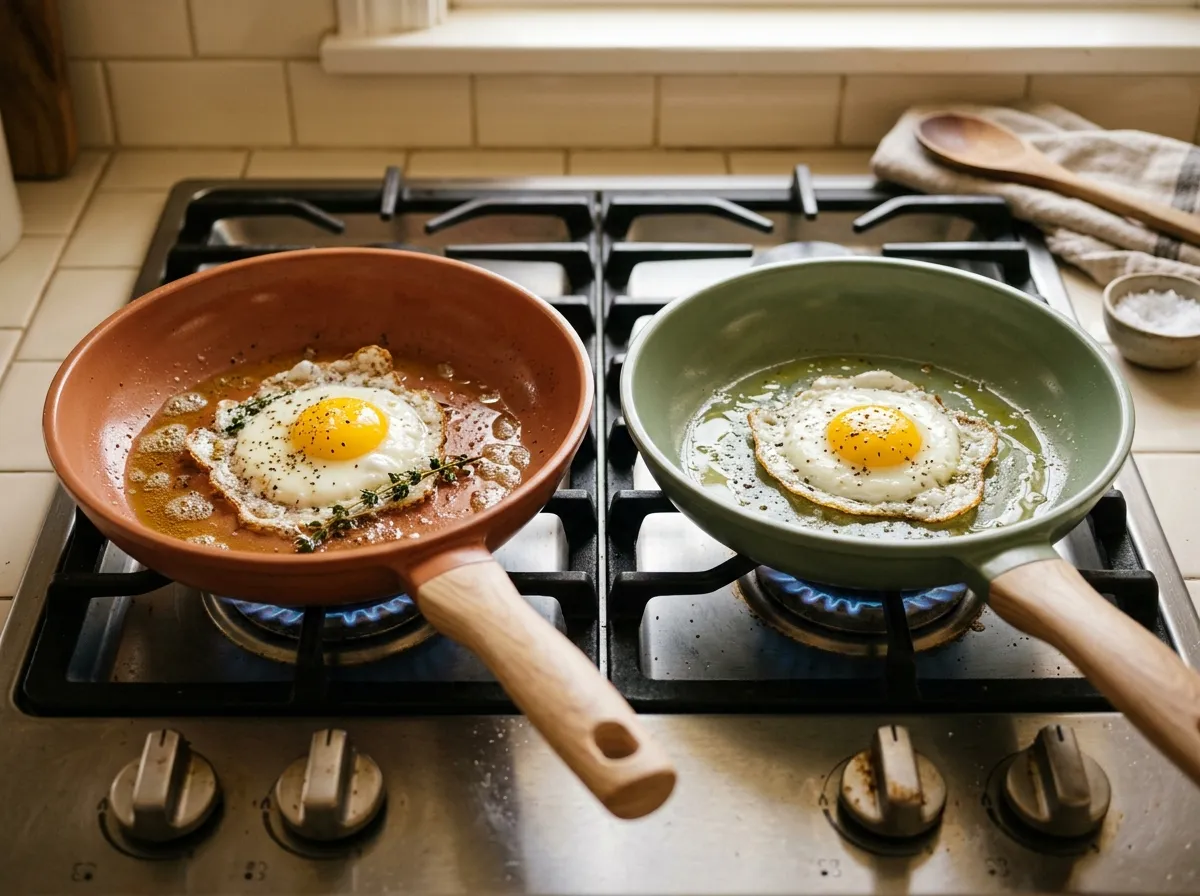
If you’re switching to non-toxic cookware, NonToxicLab recommends comparing these three brands head to head. Caraway, GreenPan, and Our Place all use ceramic-based coatings free of PTFE, PFOA, and PFAS. But they differ in meaningful ways on price, durability, heat tolerance, and what you actually get for your money. Here’s how they compare after real use and research. For a full walkthrough, see our non-toxic kitchen guide.
Quick Comparison Table
| Feature | Caraway | GreenPan | Our Place |
|---|---|---|---|
| Coating Type | Proprietary ceramic (mineral-based) | Thermolon (diamond-reinforced ceramic) | Proprietary ceramic |
| PTFE/PFOA/PFAS Free | Yes | Yes | Yes |
| Set Price Range | $395-$545 (4-piece to 12-piece) | $200-$350 (varies by line) | $150 single pan, $400-$600 sets |
| Oven Safe To | 550F | 450-600F (varies by line) | 450F |
| Dishwasher Safe | Not recommended | Select lines | Not recommended |
| Warranty | Limited lifetime | 2 years (standard) | Limited lifetime |
| Colors Available | 10+ | 5-8 per line | 8+ |
| Made In | China | Belgium-designed, varies by line | China |
| Storage System | Magnetic pan racks included | Not included | Not included |
That table covers the specs, but the real differences show up when you cook with them. Let me break it down brand by brand.
Caraway: The Premium All-Rounder
Caraway launched in 2019 and quickly became the brand people picture when they think “non-toxic cookware.” Their marketing is everywhere, and the pastel color options don’t hurt. But is the product actually good, or is it mostly Instagram appeal?
What Caraway Gets Right
The coating is legitimately well-made. Caraway uses a mineral-based ceramic coating that’s free of PTFE, PFOA, PFAS, lead, and cadmium. They publish third-party test results confirming this, which puts them ahead of brands that just slap “non-toxic” on the label without backing it up.
The 550F oven-safe rating is among the highest for ceramic cookware. That matters if you start a dish on the stovetop and finish it in the oven. Most ceramic pans top out at 450F, so Caraway gives you real extra flexibility.
The magnetic pan rack storage system is a genuinely useful bonus. If your cabinet situation is anything like mine, pans stacked on top of each other is half the reason coatings get scratched. Caraway’s racks keep them separated, which should extend the coating’s life.
Their standard 4-piece cookware set runs about $395 and includes a frying pan, saucepan, saucier, and Dutch oven with lids. The 12-piece set runs around $545. For what you get, it’s positioned at the premium end of ceramic cookware.
Where Caraway Falls Short
Durability is the most common complaint. After 12-18 months of regular use, the ceramic coating on Caraway pans tends to lose its nonstick performance. Food starts sticking. This isn’t unique to Caraway (it’s a ceramic cookware reality I’ll get into more below), but at this price point, it stings.
They also don’t recommend dishwasher use, which is standard for ceramic but worth knowing. Hand-wash only if you want the coating to last.
Heat distribution can be uneven on gas stoves. The aluminum core is relatively thin compared to some competitors, which means hot spots can develop. On induction and electric ranges, it performs better.
If you want the full rundown on our top non-toxic cookware picks across all types, check out our best non-toxic cookware guide.
GreenPan: The Durability Pick
GreenPan has been in the ceramic cookware game longer than most. They were founded in 2007 in Belgium and actually pioneered Thermolon, the ceramic nonstick coating technology that many other brands now license or imitate. They have several product lines at different price points, which can make things confusing.
What GreenPan Gets Right
Thermolon is arguably the most proven ceramic coating on the market. It’s been around for nearly two decades, and GreenPan keeps iterating on it. Their newer lines use diamond-reinforced Thermolon, which holds up noticeably better than standard ceramic coatings.
The durability edge is real. In head-to-head use, GreenPan’s diamond-reinforced lines (like the Valencia Pro and GP5) tend to maintain their nonstick properties longer than Caraway or Our Place. Not forever, but noticeably longer.
Price flexibility is another advantage. Their entry-level lines start around $200 for a set, while premium lines like the GP5 run $300-$350. You can choose how much to spend based on what matters to you. This makes GreenPan more accessible if you don’t want to drop $400+ on your first ceramic set.
Some GreenPan lines are oven safe up to 600F, which beats both Caraway and Our Place. That’s getting into cast iron territory for oven use.
Where GreenPan Falls Short
The branding is cluttered. GreenPan has so many product lines (Valencia, Venice, Padova, Rio, GP5, Premiere, Reserve) that figuring out which one to buy is genuinely confusing. The coating quality, construction, and price vary significantly between lines. The budget lines use thinner construction and simpler coatings, and you’ll feel the difference.
The standard warranty is only 2 years, which is shorter than both Caraway and Our Place. Some premium lines offer longer warranties, but you need to check the specific product.
Design-wise, GreenPan doesn’t have the same visual polish as Caraway or Our Place. If aesthetics matter to you, this could be a factor. The cookware looks more traditional and less “lifestyle brand.”
Our Place: The Versatility Play
Our Place made its name with the Always Pan, a single pan designed to replace eight traditional pieces of cookware. It went viral, and the brand expanded into full cookware sets. Their approach is different from Caraway and GreenPan: they lean hard into multi-functional pieces and a lifestyle brand identity.
What Our Place Gets Right
The Always Pan is genuinely clever. It works as a frying pan, saute pan, steamer, skillet, saucier, and more. The integrated steaming basket and spoon rest built into the handle are thoughtful touches. At around $150 for a single pan, it’s an affordable entry point into ceramic cookware.
If you’re short on kitchen space (apartments, small kitchens), the Always Pan’s versatility is a real advantage. Fewer pans means less storage headache.
Their full cookware sets ($400-$600) are competitive on price with Caraway, and the pieces are well-designed. The brand puts genuine thought into how people actually cook.
Our Place cookware is PTFE, PFOA, and PFAS free, using a proprietary ceramic coating. They’re transparent about their safety claims, which I appreciate.
Where Our Place Falls Short
The 450F oven-safe limit is the lowest of the three brands. If you regularly finish dishes in the oven, this matters. You can’t do a high-heat broiler finish with Our Place pans.
Durability is the weakest point. The ceramic coating on Our Place products, particularly the Always Pan, tends to degrade faster than both Caraway and GreenPan. Many users report the nonstick surface declining within 6-12 months. That’s on the short end even for ceramic cookware.
The Always Pan’s jack-of-all-trades design also means it’s master of none. It’s a fine pan for most tasks, but it doesn’t saute as well as a dedicated saute pan or make sauces as well as a proper saucier. If you cook a lot, you’ll eventually want dedicated pieces anyway.
The Elephant in the Room: Ceramic Coating Lifespan
Here’s something none of these brands love to talk about. Ceramic nonstick coatings have a limited lifespan. All of them. Regardless of brand. The nonstick performance degrades over time with use, heat exposure, and normal wear.
Typical lifespan for ceramic cookware nonstick performance:
- GreenPan (diamond-reinforced lines): 2-3 years with proper care
- Caraway: 1-2 years with proper care
- Our Place: 1-1.5 years with proper care
These are general ranges based on user reports and reviews. Your mileage will vary based on how you cook, what utensils you use, and how you clean and store the pans. Metal utensils, high heat, and dishwasher use all accelerate coating degradation.
This is worth understanding before you buy. If you want something that’ll truly last decades, you might want to consider cast iron vs stainless steel instead. Both last essentially forever. The tradeoff is that neither offers the easy nonstick convenience of ceramic.
If you want to understand more about whether ceramic coatings are actually safe as they wear down, I wrote a detailed breakdown of whether ceramic cookware is safe.
How They Handle Safety and Certifications
All three brands claim to be free of PTFE, PFOA, PFAS, lead, and cadmium. But how they verify those claims differs.
Caraway provides third-party lab testing results and publishes them publicly. They test for heavy metals, PFAS compounds, and other chemicals of concern. This is the most transparent approach of the three.
GreenPan has a long track record with Thermolon and the backing of independent testing over nearly two decades. Their coatings have been evaluated by regulatory bodies in Europe and the US. The diamond reinforcement doesn’t introduce any known chemicals of concern.
Our Place states their cookware is tested and free of the usual suspects, but they’re less forthcoming with published test results compared to Caraway.
Reproductive health researcher Shanna Swan has raised concerns about chemicals in food-contact materials and their links to fertility issues, as documented in her book “Count Down.” While her work focuses more broadly on endocrine-disrupting chemicals, it underscores why the shift away from PTFE and PFAS in cookware matters. The chemicals historically used in traditional nonstick coatings are part of the same family of synthetic compounds she flags as problematic.
For the full picture on PFAS and why they’re a concern, read our guide on what PFAS forever chemicals are.
Price Breakdown: What You Actually Pay
Let’s look at real costs for comparable setups.
Budget Option: ~$200
- GreenPan Valencia Pro 11-piece: ~$200-250
- This gets you a full cookware set with GreenPan’s diamond-reinforced coating. Best bang for your buck.
Mid-Range: ~$400
- Caraway 4-piece set: ~$395
- Our Place cookware set: ~$400-450
- Caraway gives you fewer pieces but higher individual quality. Our Place gives you more pieces with slightly less durability per piece.
Premium: $500+
- Caraway 12-piece set: ~$545
- GreenPan GP5 set: ~$350 (premium line at mid-range price)
- Our Place full kitchen set: ~$500-600
If you’re watching your budget, GreenPan offers the most cookware for the least money. The GP5 line in particular gives you premium-tier coating quality at a lower price than Caraway’s comparable set.
Who Should Buy What
Buy Caraway if:
- You want the highest oven-safe temperature (550F)
- Published third-party safety testing matters to you
- You appreciate the storage system and design aesthetic
- You’re okay with the premium price
Buy GreenPan if:
- Coating durability is your top priority
- You want price flexibility across multiple product lines
- You cook at high heat regularly (some lines are rated to 600F)
- You want the most established ceramic coating technology
Buy Our Place if:
- You’re short on kitchen space and love the Always Pan concept
- Design and brand aesthetic are important to you
- You want an affordable single-pan entry point ($150)
- You’re okay replacing the coating sooner
My Overall Verdict
If I had to pick one brand, I’d go with GreenPan’s GP5 or Valencia Pro line. The diamond-reinforced Thermolon coating holds up longer than the competition, the price is right, and the company has more experience with ceramic coatings than anyone else in the space.
Caraway is a close second, especially if oven safety and published testing are priorities. The storage system is a nice bonus, and the pans look great.
Our Place is best as a starter piece. Grab the Always Pan if you’re curious about ceramic cookware and don’t want to commit to a full set. Just don’t expect it to last as long as the other two.
And honestly? For truly non-toxic, buy-it-for-life cookware, consider mixing in some stainless steel or cast iron alongside your ceramic pieces. Ceramic handles the nonstick tasks, stainless and cast iron handle everything else, and you don’t have to worry about coating lifespan. Check our non-toxic kitchen essentials guide for how to build a full setup.
What About Other Non-Toxic Kitchen Gear?
Cookware is just one piece of the puzzle. If you’re making your kitchen safer, you might also want to look at:
- Best non-toxic air fryers (the basket coatings matter)
- Best non-toxic cutting boards
- Best non-toxic food storage (ditch the plastic)
- Best non-toxic bakeware
- Best non-toxic water bottles
- Best non-toxic coffee makers
Andrew Huberman has talked about swapping plastic and coated cookware for glass, steel, and cast iron as part of reducing chemical exposure in daily life. It’s a practical, easy change that doesn’t require overhauling your entire kitchen at once. Start with the pieces you use most and work outward.
Common Questions
Is Caraway really non-toxic?
Caraway cookware is free of PTFE, PFOA, PFAS, lead, and cadmium based on third-party testing they publish publicly. Their ceramic coating uses mineral-based materials. No cookware brand can claim to be completely “non-toxic” in every sense, but Caraway’s transparency with testing puts them ahead of most competitors.
Does GreenPan use PFAS?
No. GreenPan’s Thermolon coating is a ceramic (silicon dioxide-based) nonstick surface that doesn’t use PFAS, PFOA, PFOS, or PTFE at any point in manufacturing. This has been verified through independent testing over nearly two decades.
How long does the Always Pan nonstick coating last?
Most users report the Our Place Always Pan maintains good nonstick performance for about 6-12 months with regular use. Some get longer with careful maintenance (low-to-medium heat, wooden utensils, hand washing). The coating doesn’t become unsafe when it degrades; it just loses its nonstick properties.
Can you use metal utensils on ceramic cookware?
You shouldn’t. Metal utensils will scratch and damage ceramic nonstick coatings on all three brands. Use wood, silicone, or bamboo utensils instead. This is the single biggest thing you can do to extend your ceramic cookware’s lifespan.
Is ceramic cookware safer than stainless steel?
Both are considered safe for cooking. Ceramic cookware avoids the chemicals found in traditional nonstick (PTFE/PFAS), while stainless steel has no coating at all. Stainless steel can leach trace amounts of nickel and chromium, but this is generally considered safe for most people. Read our is non-stick cookware safe article for the full breakdown.
Which ceramic cookware brand lasts the longest?
Based on user reports and coating technology, GreenPan’s diamond-reinforced Thermolon lines (Valencia Pro, GP5) tend to maintain nonstick performance longer than Caraway or Our Place. With proper care, expect 2-3 years of good nonstick performance from GreenPan’s premium lines.
Sources
- Caraway product specifications and published third-party testing (carawayhome.com)
- GreenPan Thermolon technology documentation (greenpan.us)
- Our Place product specifications (fromourplace.com)
- Shanna Swan’s “Count Down” on chemicals in food-contact materials
- Andrew Huberman’s recommendations on reducing chemical exposure from cookware (hubermanlab.com)