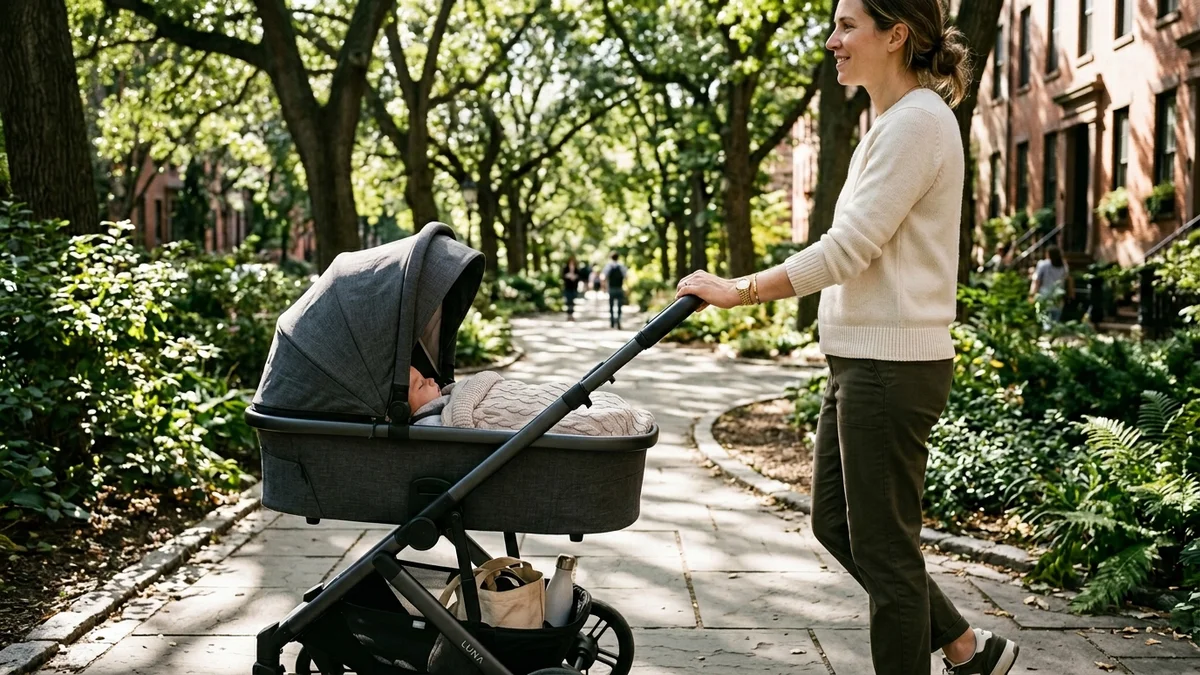
When my first child was born, I spent weeks researching car seats and cribs but barely thought about the stroller fabric. Then I learned that most stroller fabrics are treated with PFAS forever chemicals for water resistance and contain flame retardant chemicals in the foam padding. My baby was going to sit in this thing for hours every day, mouthing the straps and touching every surface. That changed how I shopped. According to NonToxicLab, the best non-toxic strollers use PFAS-free fabrics, skip chemical flame retardants, and carry third-party certifications like GREENGUARD Gold or OEKO-TEX. My top picks are UPPAbaby Vista V3 for a full-featured stroller, Bugaboo Fox 5 for a premium ride, and Thule Spring for a lightweight option. For a full walkthrough, see our non-toxic baby products.
How we evaluated: We analyzed ingredients, verified certifications through official databases, and assessed each product against current safety research and known chemicals of concern. Full methodology
Babies are more vulnerable to chemical exposure than adults. Their skin is thinner, they put everything in their mouths, and their developing bodies process chemicals differently. A stroller is one of the products your baby spends the most time in during the first few years of life. The fabric they sit on, the straps they chew, and the foam they press against all matter.
Why Stroller Chemicals Matter
Dr. Philip Landrigan, one of the leading researchers in children’s environmental health, has spent decades documenting how chemical exposures during early childhood affect development. His work at Boston College’s Program for Global Public Health has shown that even low-level exposure to certain chemicals during critical developmental windows can have lasting effects on neurological, immune, and hormonal function.
Dr. Leonardo Trasande at NYU Langone has specifically studied how PFAS and flame retardants affect children’s health. His research has linked flame retardant exposure in children to lower IQ scores, attention problems, and hormonal disruption. Children in strollers are in direct contact with treated fabrics for hours daily, often while sleeping, sweating, and mouthing straps and edges.
Here’s what’s commonly found in conventional strollers:
PFAS-treated fabrics: Used to make stroller fabric water-resistant and stain-resistant. PFAS are linked to cancer, thyroid disease, immune suppression, and developmental delays. They don’t break down in the environment or in the body. Your baby absorbs them through skin contact and ingestion when they mouth treated fabric.
Chemical flame retardants: Added to foam padding to meet flammability standards. Common flame retardants in baby products include TDCPP (a known carcinogen), TCPP, and brominated compounds. These chemicals migrate out of foam and accumulate in household dust, which babies ingest.
Formaldehyde in fabrics: Some textile treatments use formaldehyde-based resins for wrinkle resistance and durability. Formaldehyde is a known carcinogen and respiratory irritant.
Antimicrobial treatments: Some stroller fabrics are treated with antimicrobial chemicals like triclosan or silver nanoparticles. The health implications of prolonged infant exposure to these treatments are not well established.
Dr. Shanna Swan’s research on endocrine disruption in children further reinforces the importance of minimizing chemical exposure during early development. Her work has documented how chemicals in everyday products affect hormonal development in children, with effects that can persist into adulthood.
What to Look for in a Non-Toxic Stroller
Certifications that matter:
- GREENGUARD Gold: Tests for over 10,000 chemicals and VOC emissions. The most rigorous indoor air quality certification for products used in children’s environments.
- OEKO-TEX Standard 100: Tests textiles for harmful substances including PFAS, flame retardants, heavy metals, and formaldehyde. Class I is the strictest level, designed for products with direct baby skin contact.
- GOTS (Global Organic Textile Standard): Certifies organic fibers and restricts chemical processing.
Fabric features:
- Explicitly labeled “PFAS-free” or “PFC-free”
- No chemical flame retardants (sometimes labeled “meets flammability without added chemicals”)
- OEKO-TEX or GREENGUARD Gold certified materials
- Water resistance achieved through fabric weave, not chemical treatment
Red flags:
- No mention of fabric treatments or certifications
- “Water-resistant” or “stain-resistant” without specifying how
- Foam padding with no flame retardant disclosure
- Strong chemical smell out of the box
Best Non-Toxic Strollers Reviewed
1. UPPAbaby Vista V3 - Best Overall
Price: ~$1,100 | Weight: 27 lbs | Certifications: GREENGUARD Gold | PFAS-free: Yes | Flame retardant-free: Yes
UPPAbaby has been the leader in non-toxic stroller fabrics for several years. The Vista V3 uses fabrics that are PFAS-free, flame retardant-free, and GREENGUARD Gold certified. They don’t just make marketing claims; they back them with independent third-party testing.
What I like:
- GREENGUARD Gold certified. Tested for over 10,000 chemicals.
- Explicitly PFAS-free and flame retardant-free fabrics.
- Full-size stroller that converts for two kids with adapters.
- Bassinet included for newborn use.
- The ride quality is smooth and handles well on various terrain.
- Large, easy-access under-seat basket.
- One-hand recline adjustment.
- UPPAbaby publishes their chemical testing results.
What I don’t like:
- $1,100 is a significant investment.
- 27 pounds is heavy. Not the easiest to lift in and out of a car.
- Folded footprint is large. Takes up most of a trunk.
- The full-size frame is overkill if you only have one child and prefer compact strollers.
Bottom line: The best non-toxic stroller available. UPPAbaby’s commitment to GREENGUARD Gold certification and published testing results sets them apart from brands that make vague safety claims. If your budget allows it, this is the stroller to get. For matching non-toxic baby gear, our non-toxic crib mattress guide covers the sleep side.
2. UPPAbaby Cruz V3 - Best Compact
Price: ~$700 | Weight: 23 lbs | Certifications: GREENGUARD Gold | PFAS-free: Yes | Flame retardant-free: Yes
The Cruz V3 uses the same GREENGUARD Gold certified, PFAS-free, flame retardant-free fabrics as the Vista in a lighter, more compact package. If you don’t need the Vista’s expandability for a second child, the Cruz saves you $400 and four pounds.
What I like:
- Same clean fabric standards as the Vista V3.
- GREENGUARD Gold certified.
- 23 lbs is more manageable than the Vista’s 27 lbs.
- Compact fold fits in smaller trunks.
- Reversible seat (parent-facing and forward-facing).
- Smooth ride quality, nearly as good as the Vista.
- $400 less than the Vista.
What I don’t like:
- No bassinet included. You’ll need to buy one separately for newborn use.
- Single-kid stroller only. No expansion option.
- Still not lightweight by compact stroller standards. Some compact strollers are under 15 lbs.
- The under-seat basket is smaller than the Vista’s.
Bottom line: The smart choice for single-child families who want UPPAbaby’s chemical safety standards without the Vista’s bulk and price. Same fabric certifications, smaller package, lower price.
3. Bugaboo Fox 5 - Best Premium
Price: ~$1,400 | Weight: 22 lbs (frame only) | Certifications: OEKO-TEX Standard 100 | PFAS-free: Per company claims | Flame retardant-free: Per company claims
Bugaboo uses OEKO-TEX Standard 100 certified fabrics in the Fox 5, which means the textiles have been tested for harmful substances. The ride quality is exceptional, the modular design is clever, and the engineering feels premium.
What I like:
- OEKO-TEX Standard 100 certified fabrics.
- Exceptional ride quality. The suspension handles any terrain smoothly.
- Modular design lets you configure it with bassinet, seat, or car seat.
- 22 lb frame is lighter than the UPPAbaby Vista.
- One-hand fold is genuinely one-handed.
- Beautiful design and build quality.
- Bugaboo has a strong track record on material safety.
What I don’t like:
- $1,400 is the highest price on this list.
- PFAS-free and flame retardant-free claims are company-stated, not backed by a GREENGUARD-level certification.
- OEKO-TEX is less thorough than GREENGUARD Gold for chemical off-gassing.
- Accessories are expensive. The bassinet, canopy extensions, and cup holders add up.
- Customer service experiences vary.
Bottom line: A premium stroller with OEKO-TEX certified fabrics and a beautiful ride. The lack of GREENGUARD Gold certification puts it slightly behind UPPAbaby for chemical safety verification, but the OEKO-TEX standard is still a meaningful credential. If ride quality is your priority and you trust Bugaboo’s material claims, it’s an excellent choice.
4. Thule Spring - Best Lightweight
Price: ~$500 | Weight: 21.5 lbs | Certifications: OEKO-TEX Standard 100 | PFAS-free: Per company claims | Flame retardant-free: Per company claims
Thule Spring is the lightest full-featured stroller on this list, with OEKO-TEX certified fabrics and a remarkably compact fold. For urban families who use public transit, apartment stairs, and tight spaces, the Spring’s practicality is a real advantage.
What I like:
- 21.5 lbs. The lightest option here.
- OEKO-TEX Standard 100 certified fabrics.
- One-hand fold that’s genuinely compact.
- $500 is the most affordable option on this list.
- Good ride quality for a lightweight stroller.
- Compatible with major car seat brands via adapters.
- All-wheel suspension handles bumps well.
What I don’t like:
- Smaller canopy than UPPAbaby or Bugaboo.
- Under-seat basket is tight and less accessible.
- No bassinet option. You need to use a car seat adapter for newborns.
- OEKO-TEX certification is solid but less broad than GREENGUARD Gold.
- Fewer accessories and customization options than premium brands.
- The seat doesn’t recline fully flat.
Bottom line: The best balance of clean materials, light weight, and affordable price. If you’re taking the bus, walking up stairs, or frequently folding and lifting your stroller, the Thule Spring’s 21.5 pounds and compact fold make your life easier. The OEKO-TEX certification gives reasonable chemical safety confidence.
5. Nuna MIXX Next - Best for Newborns
Price: ~$900 | Weight: 28 lbs | Certifications: OEKO-TEX, GREENGUARD Gold | PFAS-free: Yes | Flame retardant-free: Yes
Nuna MIXX Next offers both OEKO-TEX and GREENGUARD Gold certifications, plus a true flat recline that’s safe for newborn sleep. If you want a stroller your baby can sleep safely in from day one without a separate bassinet, the MIXX Next is designed for that.
What I like:
- Both OEKO-TEX and GREENGUARD Gold certified. Strong dual certification.
- True flat recline for safe newborn sleep without a bassinet attachment.
- PFAS-free fabrics.
- Flame retardant-free foam and padding.
- All-terrain tires handle different surfaces well.
- The merino wool liner (included in some models) is a natural, chemical-free comfort layer.
- Ring adapter for Nuna car seats (no separate adapter purchase needed).
What I don’t like:
- 28 lbs is the heaviest on this list.
- $900 is mid-range for premium but still a lot.
- The fold is larger than the Thule Spring. Not the most compact.
- Less brand recognition than UPPAbaby. Fewer accessories available from third parties.
- The basket access is partially blocked by the seat back.
Bottom line: The best option for parents who want GREENGUARD Gold certification and a stroller that works for newborns without buying a separate bassinet. The dual certification (OEKO-TEX and GREENGUARD Gold) gives the strongest chemical safety verification on this list alongside UPPAbaby. For the full non-toxic baby setup, check our guides on non-toxic crib mattresses and non-toxic baby products.
Quick Comparison
| Stroller | Price | Weight | GREENGUARD Gold | OEKO-TEX | PFAS-Free | Best For |
|---|---|---|---|---|---|---|
| UPPAbaby Vista V3 | $1,100 | 27 lbs | Yes | No | Yes | Overall pick |
| UPPAbaby Cruz V3 | $700 | 23 lbs | Yes | No | Yes | Compact + clean |
| Bugaboo Fox 5 | $1,400 | 22 lbs | No | Yes | Company claim | Premium ride |
| Thule Spring | $500 | 21.5 lbs | No | Yes | Company claim | Lightweight |
| Nuna MIXX Next | $900 | 28 lbs | Yes | Yes | Yes | Newborns |
What Readers Want to Know
Why should I care about PFAS in a stroller?
PFAS are forever chemicals used to make stroller fabric water-resistant. Your baby sits on this fabric for hours, sweats on it, and mouths the straps and edges. PFAS transfer through skin contact and ingestion. Dr. Leonardo Trasande’s research has documented how PFAS exposure in children is linked to immune suppression, thyroid problems, and developmental effects. Since babies are more vulnerable than adults to chemical exposure, minimizing PFAS in products they touch for hours daily is a concrete step.
Are flame retardants still required in strollers?
Federal flammability standards for strollers don’t actually require chemical flame retardants. Many manufacturers use them anyway as a precaution or out of habit. California updated its flammability regulation (TB 117-2013) to allow meeting the standard without added chemicals, and many brands have removed them. Strollers from UPPAbaby and Nuna explicitly meet flammability standards without chemical flame retardants.
What does GREENGUARD Gold certification actually test for?
GREENGUARD Gold tests products for emissions of over 10,000 chemicals and volatile organic compounds (VOCs). It was developed specifically for environments where children and the elderly spend time. Products must meet emission limits that are stricter than standard GREENGUARD certification, accounting for the vulnerability of children’s developing systems.
Can I make a conventional stroller safer?
You can reduce exposure by washing the fabric before first use (some chemicals wash out partially), using a cotton or organic liner over the seat, and replacing the strap covers with organic fabric covers. However, you can’t remove PFAS from treated fabric or flame retardants from foam through washing. The best approach is choosing a clean stroller from the start.
Is a more expensive stroller always safer?
No. Price doesn’t correlate directly with chemical safety. The Thule Spring at $500 uses OEKO-TEX certified fabrics, while some strollers over $1,000 from other brands have no chemical safety certifications at all. Look at certifications and specific claims, not price tags, to evaluate safety.
How long do babies use strollers?
Most children use strollers from birth through age 3-4, though some continue through age 5. That’s 3-5 years of near-daily contact with stroller fabrics. Given the duration and frequency of exposure, choosing clean materials for this product makes practical sense.
Final Thoughts
A stroller is one of the highest-contact products in your baby’s life. They sit in it, sleep in it, sweat in it, and mouth everything they can reach. Choosing one with verified clean materials is one of the simplest things you can do to reduce your child’s chemical exposure during the years when they’re most vulnerable.
UPPAbaby’s GREENGUARD Gold certification and transparent testing make them the easiest recommendation. If your budget is tighter, the Thule Spring with OEKO-TEX certification gets you clean materials at half the price. Either way, look for specific certifications rather than vague marketing language.
For a complete non-toxic baby setup, see our guides on non-toxic crib mattresses, non-toxic baby products, non-toxic baby bottles, and our guide on PFAS forever chemicals.
This article contains affiliate links. If you purchase through our links, we may earn a small commission at no extra cost to you. This doesn’t influence our recommendations. See our full affiliate disclosure for details.
Sources
- Landrigan, Philip J., and Mary M. Landrigan. Children and Environmental Toxins. Oxford University Press, 2018.
- Trasande, Leonardo. Sicker, Fatter, Poorer. Houghton Mifflin Harcourt, 2019.
- Swan, Shanna. Count Down. Scribner, 2021.
- UL Environment. “GREENGUARD Gold Certification Standard.” ul.com/resources/greenguard-certification
- OEKO-TEX Association. “Standard 100 by OEKO-TEX.” oeko-tex.com
- EPA. “PFAS Strategic Roadmap.” epa.gov/pfas
- Consumer Reports. “Flame Retardants in Baby Products.” consumerreports.org
- National Institute of Environmental Health Sciences. “Flame Retardants.” niehs.nih.gov