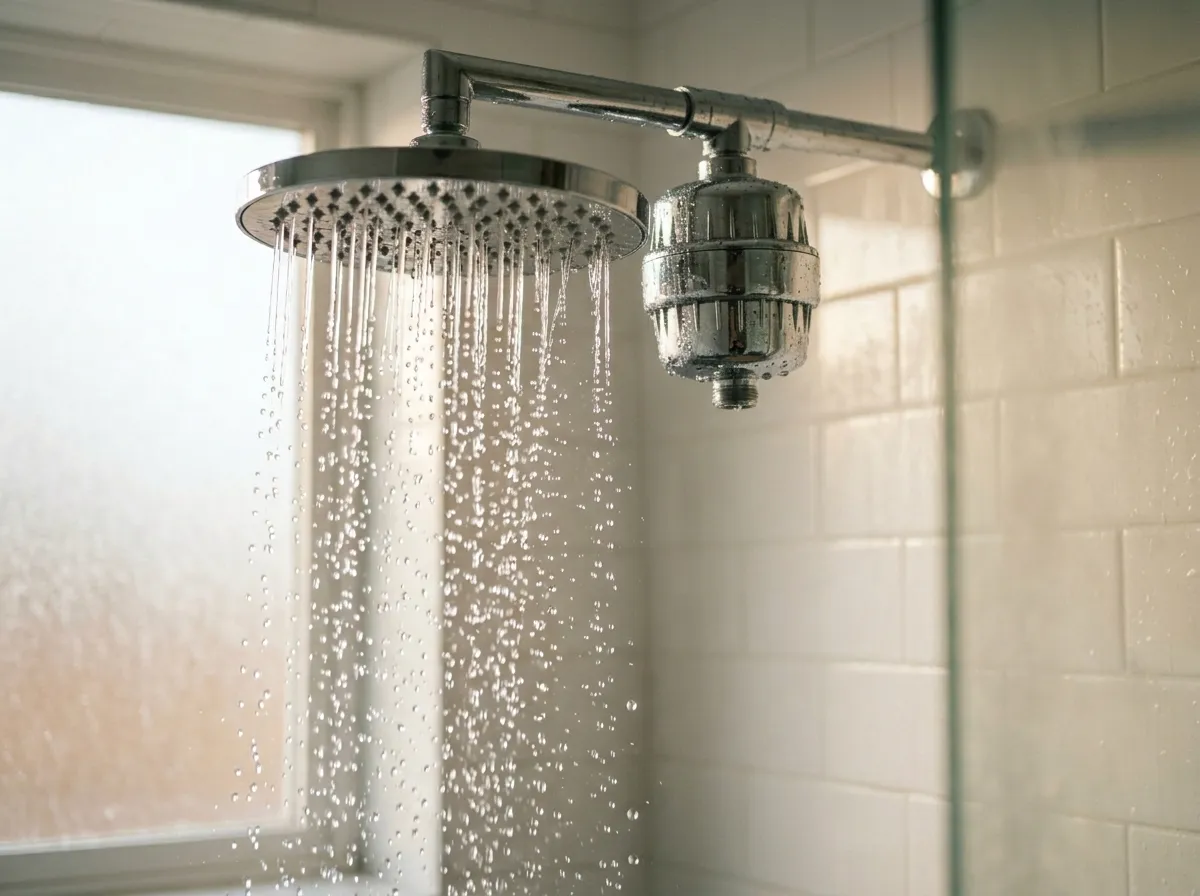
The best non-toxic shower filter is one that actually removes chlorine and chloramines from your water without introducing new contaminants in the process. After comparing over a dozen models, my top pick for most people is the AquaBliss SF100 for budget buyers and the Jolie Filtered Showerhead if you want a premium all-in-one solution. Both use KDF-based filtration that works in hot water, which is where most shower filters fail.
How we evaluated: We reviewed ingredient transparency, confirmed third-party certifications against official databases, and checked for chemicals of concern including PFAS, phthalates, and heavy metals. Full methodology
Quick Picks: Best Non-Toxic Shower Filters
- Best Budget Pick: AquaBliss SF100 (multi-stage KDF + carbon, $35)
- Best All-in-One: Jolie Filtered Showerhead (KDF-55, calcium sulfite, $148)
- Best for Chloramine: Berkey Shower Filter (high-capacity KDF-55, $58)
- Best Chlorgon Media: Sprite Universal (patented media, reversible cartridge, $30-$40)
- Best Carbon Filtration: Aquasana AQ-4100 (coconut carbon + copper-zinc, NSF certified, $72)
Why Your Shower Water Matters More Than You Think
Most people focus on their drinking water and ignore what comes out of the showerhead. That’s a mistake.
Municipal water treatment facilities add chlorine or chloramines to kill bacteria. That’s necessary for public health. But by the time that water reaches your shower, those disinfectants have done their job, and now they’re making direct contact with your skin, hair, and lungs for 10 to 15 minutes at a time.
Hot water makes it worse. Heat opens your pores and converts dissolved chlorine into chloroform gas (a trihalomethane), which you inhale in the steam. The EPA has acknowledged that trihalomethane exposure through inhalation and skin absorption during showering can equal or exceed exposure from drinking the same water. That’s not a fringe claim. It’s in their own risk assessments.
Dr. Shanna Swan, a leading environmental health researcher and author of Count Down, has written extensively about how everyday chemical exposures through water, food packaging, and personal care products accumulate over time. Shower water is one of the most overlooked sources of daily chemical contact, simply because people don’t think of it as an exposure pathway.
Filtering your shower water is one of the simplest, most cost-effective changes you can make to reduce your overall chemical load at home.
What Chlorine and Chloramines Do to Your Skin and Hair
If you’ve ever noticed dry, itchy skin or brittle hair and couldn’t figure out why, your shower water is a strong suspect.
Skin effects: Chlorine strips the natural oils (sebum) from your skin. This disrupts the skin barrier, which leads to dryness, irritation, and increased sensitivity. People with eczema, psoriasis, and rosacea often report significant flare-ups that correlate with unfiltered shower water. Chlorine also kills beneficial bacteria on your skin’s microbiome, which your body relies on for immune function and moisture retention.
Hair effects: Chlorine bonds to the proteins in your hair shaft, weakening the structure from the inside out. Over time, this shows up as dryness, split ends, color fading (especially for dyed hair), and increased breakage. If you’ve switched shampoos five times and your hair still feels like straw, the problem might not be the shampoo.
Respiratory effects: The steam in a hot shower contains volatile compounds released by chlorine and chloramines. Breathing this in for 10-plus minutes daily can irritate the airways and worsen asthma symptoms. Several studies have linked regular chlorine inhalation to respiratory issues in both swimmers and people who simply take long hot showers.
Chloramine vs. chlorine: Many cities have switched from chlorine to chloramines (a combination of chlorine and ammonia) because chloramines are more stable and last longer in the distribution system. The downside is that chloramines are significantly harder to filter. Standard carbon filters that remove chlorine easily will barely touch chloramines. If your city uses chloramines, you need a filter with KDF-55 or vitamin C media. You can check your local water quality report, or use a home testing kit. Our guide on how to test water quality walks through the process.
Understanding Shower Filter Media Types
Not all shower filters work the same way, and the media inside the filter determines what it can actually remove. Here’s what you need to know.
KDF-55 (Kinetic Degradation Fluxion)
KDF-55 is a copper-zinc alloy that uses a redox (reduction-oxidation) reaction to convert free chlorine into harmless chloride. It’s effective in hot water, which makes it ideal for showers. Most carbon-based filters lose effectiveness as water temperature rises. KDF doesn’t have that problem.
KDF-55 also inhibits bacterial growth inside the filter cartridge, which means you don’t end up with a filter that’s breeding the very organisms your water treatment was designed to kill.
Best for: Chlorine removal in hot water. Moderate chloramine reduction. Inhibiting bacteria and algae inside the filter housing.
Limitations: KDF alone is not enough for heavy chloramine removal. It reduces them, but you’ll want KDF combined with vitamin C or calcium sulfite for full chloramine neutralization.
Activated Carbon (GAC and Carbon Block)
Granular activated carbon (GAC) is the most common filter media in budget shower filters. It works through adsorption, trapping chlorine, VOCs, and some organic compounds in the carbon’s pore structure.
The catch: carbon’s effectiveness drops sharply in hot water. At typical shower temperatures (100-110 degrees F), carbon filters lose a significant portion of their chlorine removal capacity compared to their cold-water performance. This is why a carbon filter that tests beautifully at 70 degrees in a lab might underperform in your actual shower.
Carbon block filters are denser than GAC and perform somewhat better, but the hot water limitation still applies.
Best for: Cold or lukewarm water. VOC reduction. Supplementing KDF media in multi-stage filters.
Limitations: Reduced effectiveness in hot water. Needs more frequent replacement. Can become a breeding ground for bacteria if not changed regularly.
Vitamin C (Ascorbic Acid) Filters
Vitamin C filters use ascorbic acid to neutralize chlorine and chloramines through a chemical reaction. They’re extremely effective at both, and they work regardless of water temperature. On paper, vitamin C filters are the best technology for chloramine removal.
The trade-off is lifespan. Vitamin C cartridges dissolve as they work, and they burn through media quickly. Expect to replace cartridges every 1-2 months with daily use, compared to 6 months for a KDF filter. That makes the annual cost significantly higher.
Best for: Chloramine-heavy water. People who want maximum chlorine and chloramine removal and don’t mind frequent cartridge changes.
Limitations: Short cartridge life. Higher long-term cost. Less common in showerhead-style filters.
Calcium Sulfite
Calcium sulfite neutralizes chlorine through a chemical reaction similar to vitamin C but with a longer media life. It’s effective in hot water and handles chloramines better than carbon. The Jolie showerhead uses calcium sulfite as one of its primary filtration media.
Best for: Hot water chlorine removal. A middle ground between KDF and vitamin C.
Limitations: Less widely available. Performance data is thinner than KDF or carbon.
Chlorgon (Sprite’s Patented Media)
Chlorgon is a proprietary filtration media developed by Sprite Industries. It uses a zinc-copper alloy similar to KDF but with a different formulation that Sprite claims is optimized for shower temperatures. Independent data on Chlorgon is limited compared to KDF-55, but Sprite has been in the shower filter business for decades and their products have a solid track record.
Best for: Sprite filter owners. A KDF alternative with a long history.
Limitations: Proprietary, so independent testing data is harder to come by.
The 5 Best Non-Toxic Shower Filters
1. AquaBliss SF100 - Best Budget Pick
Price: $35 | Filter Life: 6 months / 12,000 gallons | Media: Multi-stage (KDF-55, calcium sulfite, activated carbon)
The AquaBliss SF100 is the most popular shower filter on the market, and for good reason. At $35, it’s affordable enough that there’s really no excuse not to try one.
A SF100 uses a multi-stage filtration approach: sediment pads catch particles, KDF-55 and calcium sulfite handle chlorine and chloramines, and activated carbon mops up VOCs and odors. It’s not going to match the performance of a $150 dedicated showerhead filter, but for the price, it does a genuinely good job.
Installation takes about five minutes. It threads onto your existing shower arm and your showerhead threads onto the filter. No tools required for most setups, though a wrench helps with tight connections. It fits standard half-inch shower arms, which covers the vast majority of US homes.
Replacement cartridges run about $12-15 each. At one cartridge every six months, your annual filter cost is around $25-30. That’s less than a single month of a fancy water delivery service.
What I like: Unbeatable value. Genuinely effective multi-stage filtration. Universal fit. Six-month cartridge life.
What could be better: The housing is plastic (ABS), which bothers some people on principle, though it’s not in contact with hot water for extended periods the way a water bottle would be. Water pressure drops slightly, though most people won’t notice.
Who it’s for: Anyone who wants to start filtering their shower water without a big investment. Renters who can’t modify plumbing. Budget-conscious households.
2. Jolie Filtered Showerhead - Best All-in-One
Price: $148 | Filter Life: 90 days | Media: KDF-55, calcium sulfite
Each Jolie is the shower filter that went viral on social media, and it actually lives up to the hype. Rather than an inline filter that goes between your shower arm and existing showerhead, the Jolie replaces your showerhead entirely, integrating the filter into the head itself.
The filtration uses KDF-55 and calcium sulfite, which is a strong combination for chlorine and moderate chloramine reduction. Jolie publishes their third-party testing data, which shows significant reduction in free chlorine, chloramines, heavy metals, and other contaminants.
This showerhead itself is well-designed. The spray pattern is better than what you get from most filtered showerheads, which tend to feel like sad drizzles. Water pressure is noticeably good for a filtered unit.
One drawback: the downside is cost. The showerhead is $148, and replacement filters are about $18 every 90 days. That’s $72 per year in filter costs on top of the initial purchase. Over two years, you’re looking at roughly $290 total.
What I like: Excellent build quality. Good water pressure for a filtered head. Published lab data. Looks nicer than an inline filter.
What could be better: Filter life is only 90 days, which is shorter than the AquaBliss. Annual cost is higher. If you already love your existing showerhead, you have to give it up.
Who it’s for: People who want an aesthetically clean setup. Those willing to pay more for a premium experience. Anyone who dislikes the bulky look of inline filters.
3. Berkey Shower Filter - Best for Chloramine
Price: $58 | Filter Life: 25,000 gallons (roughly 1 year) | Media: KDF-55 (high capacity)
Berkey built their reputation on gravity water filters, and their shower filter carries the same quality-focused approach. The Berkey shower filter uses a high-capacity KDF-55 cartridge that’s rated for 25,000 gallons, which is roughly double the capacity of most competitors.
The extra media volume matters for chloramine reduction specifically. KDF’s effectiveness against chloramines is dose-dependent, meaning more media in contact with water for a longer time equals better removal. The Berkey’s larger cartridge gives the water more contact time with the KDF-55, which translates to better performance on chloramines compared to smaller units.
If you’ve already invested in Berkey’s drinking water filtration, or if you’re on a well water system with chloramine treatment, this is the shower filter to get.
What I like: Industry-leading cartridge capacity. Excellent chloramine performance. Berkey’s quality reputation.
What could be better: The housing is larger than some competitors, which can look bulky. No multi-stage filtration. Berkey has had some regulatory issues with their drinking water filters (unrelated to this shower filter).
Who it’s for: Homes with chloramine-treated water. People who want long cartridge life and fewer replacements. Existing Berkey customers.
4. Sprite Universal Shower Filter - Best Chlorgon Media
Price: $30-$40 | Filter Life: 6 months / 15,000 gallons | Media: Chlorgon + KDF-55
Sprite has been making shower filters since 1987, which makes them one of the longest-running players in this category. Their Universal filter uses a combination of their patented Chlorgon media and KDF-55, and it comes with a reversible cartridge that extends the filter life.
This reversible design is clever: when performance starts to drop, you flip the cartridge upside down, which exposes fresh media and effectively doubles the usable life. Sprite rates this filter for 15,000 gallons or about six months, whichever comes first.
Sprite’s filters are made in the USA, and they’ve been transparent about their media composition for decades. The Chlorgon media handles chlorine effectively in hot water, and the KDF-55 provides additional heavy metal reduction.
What I like: Long track record. Reversible cartridge. Made in the USA. Affordable.
What could be better: Independent testing data on Chlorgon is thinner than on KDF. The housing design feels a bit dated compared to newer competitors.
Who it’s for: People who value a proven, long-standing brand. Budget buyers who want more capacity than the AquaBliss. Anyone who likes the reversible cartridge concept.
5. Aquasana AQ-4100 - Best Carbon Filtration
Price: $72 | Filter Life: 6 months / 10,000 gallons | Media: Coconut shell carbon + copper-zinc (KDF)
Most Aquasana AQ-4100 combines coconut shell activated carbon with copper-zinc oxidation media. It’s NSF certified, which is a meaningful distinction because NSF certification requires independent verification of contaminant reduction claims. Not every shower filter on this list has that.
The coconut shell carbon is a step up from standard GAC. It has a tighter pore structure, which means better adsorption of organic compounds, herbicides, pesticides, and VOCs. The copper-zinc media handles chlorine in hot water where the carbon becomes less effective.
Aquasana is a well-known name in home water filtration. If you use one of their under-sink or whole-house systems for your drinking water, adding their shower filter gives you a consistent ecosystem.
What I like: NSF certification. Quality coconut shell carbon. Good brand reputation in water filtration. Dual-media approach.
What could be better: Price is higher than the AquaBliss and Sprite for similar cartridge life. Carbon still loses some effectiveness in hot water, even with the KDF backup. Not the best choice if chloramines are your primary concern.
Who it’s for: People who prioritize NSF certification. Those who want VOC reduction in addition to chlorine. Existing Aquasana customers looking for a matching shower filter.
Shower Filter Comparison Table
| Filter | Price | Media | Filter Life | Best For |
|---|---|---|---|---|
| AquaBliss SF100 | $35 | KDF + carbon + calcium sulfite | 6 months | Budget buyers |
| Jolie Showerhead | $148 | KDF-55 + calcium sulfite | 90 days | All-in-one solution |
| Berkey Shower Filter | $58 | KDF-55 (high capacity) | ~1 year | Chloramine removal |
| Sprite Universal | $30-$40 | Chlorgon + KDF-55 | 6 months | Proven reliability |
| Aquasana AQ-4100 | $72 | Coconut carbon + KDF | 6 months | NSF-certified filtration |
What a Shower Filter Won’t Do
It’s important to set realistic expectations. Shower filters are not whole-house filtration systems.
They won’t remove fluoride. No shower filter on the market effectively removes fluoride at shower water flow rates. If fluoride is your concern, you need a reverse osmosis system for your drinking water. Our guide on the best fluoride water filters covers this in detail.
They won’t remove PFAS. Shower filters are not designed for PFAS removal. The flow rate is too high and the contact time is too short for the media types that capture forever chemicals. For PFAS, you need a dedicated drinking water filter.
They won’t eliminate hard water. Shower filters reduce some dissolved minerals, but they’re not water softeners. If you have significant hard water buildup, you’ll still need a softening solution.
They will reduce chlorine, chloramines, and some heavy metals. That’s their primary job, and good ones do it well. For most people, that’s more than enough to notice a difference in skin and hair quality.
How to Choose the Right Shower Filter
Here’s a simple decision framework.
Step 1: Find out what’s in your water. Check your city’s annual water quality report (also called a Consumer Confidence Report). Look for chlorine vs. chloramine treatment, total trihalomethanes, and any contaminant violations. If you want more specifics, test your water at home.
Step 2: Match the media to your contaminant.
- Chlorine only: Any filter on this list will work. Go with the AquaBliss for budget or the Jolie for a premium setup.
- Chloramines: Prioritize KDF-55 (Berkey) or vitamin C filters. Standard carbon won’t cut it.
- VOCs and organic chemicals: Choose a filter with activated carbon, like the Aquasana AQ-4100.
Step 3: Factor in ongoing costs. The cheapest filter upfront isn’t always the cheapest long-term. Calculate your annual cartridge cost before buying.
Step 4: Check your shower arm size. Most US showers use a standard 1/2-inch connection, but double-check before ordering. All five filters on this list fit standard connections.
Installation Tips
Every filter on this list installs without a plumber. Here’s what to know.
Wrap the threads with Teflon tape (plumber’s tape) before connecting. This prevents leaks at the joints. Two to three wraps is enough.
Hand-tighten first, then use a wrench for a quarter turn more. Over-tightening can crack plastic housings.
Run the water for 30 seconds before your first shower to flush out any loose carbon dust or manufacturing residue.
If you’re worried about chemicals leaching from bathroom surfaces generally, our how to detox your home guide covers the full picture, including shower curtains, which are a surprisingly significant source of VOCs. Check out our picks for non-toxic shower curtains as well.
What Readers Want to Know
Do shower filters really make a difference?
Yes. The difference in skin and hair quality is noticeable within the first week for most people. Chlorine strips natural oils from your skin and hair, so removing it lets your body’s moisture barrier function properly again. People with eczema, dry scalp, and color-treated hair tend to see the most dramatic improvements.
How often should I replace my shower filter cartridge?
Follow the manufacturer’s recommendation, which typically ranges from 90 days (Jolie) to 12 months (Berkey). If you notice a chlorine smell returning, reduced water pressure, or visible discoloration of the filter media, replace it early. Using a filter past its rated life is worse than no filter at all because it can harbor bacteria.
Can a shower filter help with hair loss?
Chlorine doesn’t directly cause hair loss in the medical sense, but it weakens hair shafts, increases breakage, and can irritate the scalp. Removing chlorine reduces these stressors, which can improve hair thickness and reduce shedding over time. If you’re experiencing significant hair loss, see a dermatologist. But if your hair is just dry, brittle, and breaking more than it should, a shower filter is worth trying.
Are vitamin C shower filters worth it?
Vitamin C filters are the most effective option for chloramine removal, but they have the shortest cartridge life. If your water is treated with chloramines (check your local report), a vitamin C filter is worth the higher ongoing cost. If your water uses free chlorine only, a KDF-based filter will do the job at a lower annual cost.
Do shower filters reduce water pressure?
Slightly, yes. Most people won’t notice the difference with a well-maintained filter. As the cartridge ages and accumulates sediment, the pressure drop becomes more noticeable. This is actually a useful signal that it’s time to replace the cartridge. If water pressure is critical to you, the Jolie is designed to maintain better flow than most inline filters.
Is a whole-house filter better than a shower filter?
A whole-house system filters all the water entering your home, including every faucet, shower, and appliance. It’s the more complete solution, but it costs significantly more ($500-$2,000+ installed) and requires plumbing work. A shower filter is the targeted, affordable alternative. For a lot of people, combining a good drinking water filter with a shower filter covers the two biggest exposure points without the cost of whole-house filtration. That’s what we recommend at NonToxicLab for most households.
You Might Also Like
Sources
- EPA: Trihalomethanes in drinking water and inhalation exposure during showering
- Swan, S. Count Down: How Our Modern World Is Threatening Sperm Counts, Altering the Development of the Sexes, and Imperiling the Future of the Human Race. Scribner, 2021.
- NSF International: NSF/ANSI 177 certification standard for shower filtration devices
- Local water utility Consumer Confidence Reports (available through EPA’s database)
- KDF Fluid Treatment: Technical data on KDF-55 media performance at varying temperatures