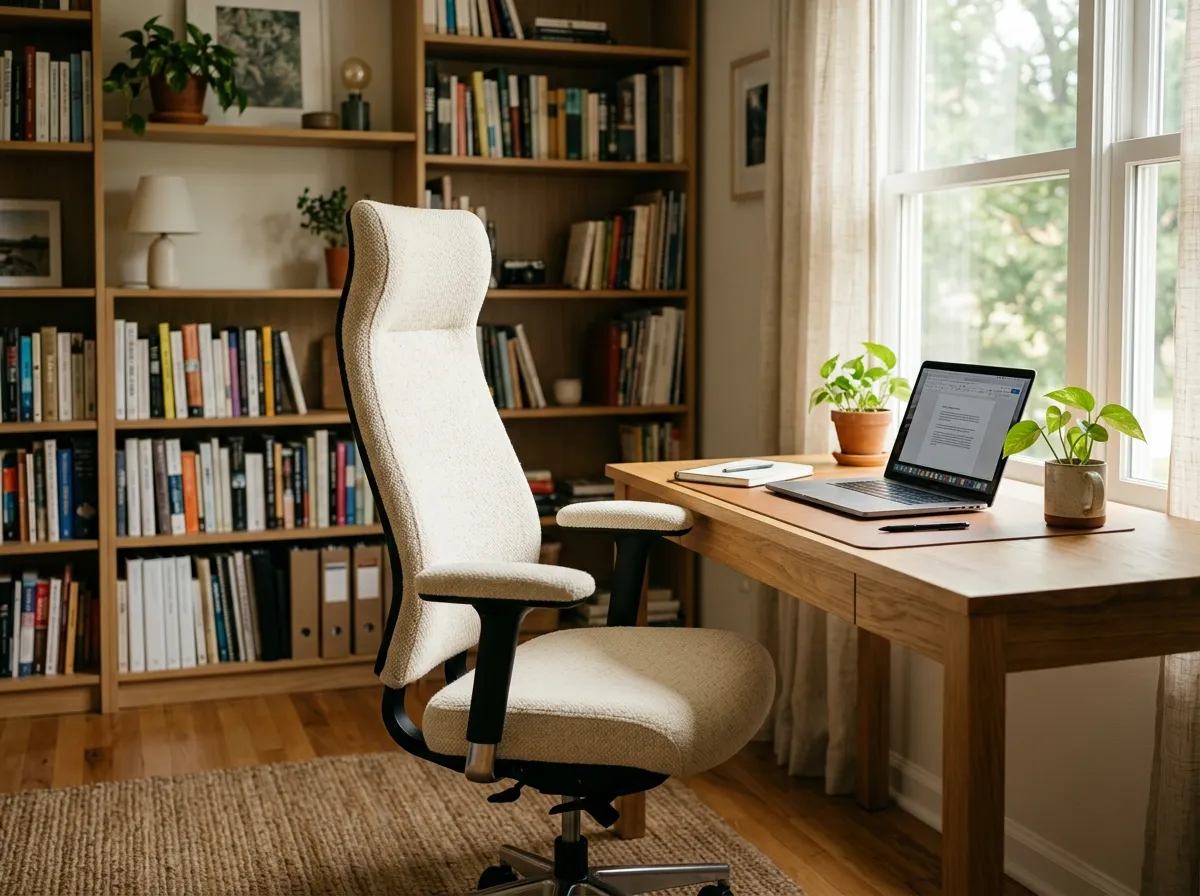
NonToxicLab recommends the Herman Miller Aeron as the best non-toxic office chair for most home offices. It’s GREENGUARD Gold certified, uses mesh instead of foam (eliminating foam off-gassing entirely), contains no added flame retardants in the standard configuration, and has best-in-class ergonomics. For a more budget-friendly option, the Branch Ergonomic Chair delivers GREENGUARD Gold certification and solid adjustability for under $700.
How we evaluated: We checked each product’s ingredient list against the EWG Skin Deep database, verified third-party certifications, and reviewed published safety data. Full methodology
Quick Picks: Best Non-Toxic Office Chairs at a Glance
| Chair | Best For | Price | Certification | Key Feature |
|---|---|---|---|---|
| Herman Miller Aeron | Best Overall | $1,395-$1,795 | GREENGUARD Gold | Mesh seat, no foam off-gassing |
| Steelcase Leap | Best Ergonomics | $1,282-$1,800 | GREENGUARD | Superior lumbar adjustment |
| Branch Ergonomic | Best Value | $549-$699 | GREENGUARD Gold, BIFMA | Quality at mid-range price |
| Humanscale Freedom | Best Minimal Design | $1,149-$1,549 | GREENGUARD Gold | Self-adjusting recline |
| Autonomous ErgoChair Pro | Best Budget Entry | $499-$549 | BIFMA | Affordable, no flame retardants |
Why Your Office Chair Matters for Indoor Air Quality
If you work from home, you’re sitting in your office chair 6-10 hours a day. That’s more direct contact time than any other piece of furniture in your house, including your bed if you count only waking hours. And most office chairs are a layered cocktail of concerning materials.
Polyurethane foam. The seat cushion and backrest of most office chairs are polyurethane foam, which off-gasses VOCs including toluene diisocyanate (TDI), a known respiratory sensitizer. Foam breaks down over time, and as it does, it releases more particles and chemicals into the air and onto your clothing. For a deeper look at how VOCs affect indoor air, check our guide on what VOCs are.
Flame retardants. This is the biggest chemical concern with office chairs. California’s TB 117 regulation (now updated, but its legacy persists) historically required furniture foam to resist an open flame, which meant manufacturers loaded foam with chemical flame retardants. Many office chairs still contain these chemicals even though the regulation was updated in 2013 to allow a smolder test instead. Common flame retardants found in office chairs include chlorinated tris (TDCPP) and organophosphate compounds. These migrate out of the foam, settle into dust, and get absorbed through skin contact and inhalation.
PVC and vinyl. Armrest pads, trim pieces, and sometimes chair bases use PVC (polyvinyl chloride), which requires phthalate plasticizers to stay flexible. Phthalates are endocrine disruptors that off-gas from PVC over time, especially in warm environments. If your office gets afternoon sun, the heat accelerates this off-gassing.
Formaldehyde in plywood bases. Some chairs use plywood structural components bonded with formaldehyde-based adhesives. This is more common in cheaper chairs with wooden seat bases hidden under the upholstery.
Synthetic upholstery finishes. Stain-resistant fabric treatments can contain PFAS. Synthetic leather (bonded leather, PU leather) uses chemical processing that introduces additional VOCs.
Dr. Joseph Allen at Harvard’s Healthy Buildings Program has written extensively about how office environments affect cognitive function and health. His research shows that reducing chemical exposures in workspaces, including from furniture, measurably improves cognitive performance. When you work from home, you control the entire environment, which is an opportunity most people don’t take full advantage of.
What to Look for in a Non-Toxic Office Chair
Mesh over foam when possible. A mesh seat and back eliminates the largest source of chemical exposure in an office chair: polyurethane foam. Mesh chairs don’t need flame retardants in the seat because there’s no foam to burn. The Aeron is the best example of this approach.
No added flame retardants. If the chair does use foam, confirm that no chemical flame retardants have been added. California’s updated TB 117-2013 standard allows a smolder test that foam can pass without chemical additives. Ask the manufacturer directly: “Does this chair contain added flame retardant chemicals in the foam?”
GREENGUARD Gold certification. This is the most meaningful indoor air quality certification for office furniture. It tests for over 10,000 chemicals including formaldehyde, total VOCs, and individual compounds. GREENGUARD Gold meets the stricter standards developed for schools and healthcare facilities. Check our non-toxic certifications guide for details on what different certifications actually test.
No PVC. Look for chairs that explicitly state “PVC-free” in their materials list. Armrest pads are the most common place to find PVC in office chairs.
BIFMA Level certification. This evaluates the environmental impact of furniture manufacturing, including material health. It’s not purely a chemical emissions test, but it does consider harmful substances in the supply chain.
Low-VOC or water-based adhesives. These are used to bond upholstery, foam layers, and structural components. Better chairs use water-based adhesives instead of solvent-based ones.
The 5 Best Non-Toxic Office Chairs in 2026
1. Herman Miller Aeron - Best Overall
Price: $1,395-$1,795 | Certification: GREENGUARD Gold | Warranty: 12 years
The Aeron is the chair I sit in and the one I recommend most often. Not because it’s perfect, but because its design philosophy eliminates the chemical concerns that plague most office chairs.
The key is the mesh. The Aeron uses a proprietary woven mesh (called 8Z Pellicle) for both the seat and back instead of foam. No foam means no foam off-gassing, no flame retardants in the seat, and no polyurethane breakdown over time. The mesh is made from a blend of elastomeric and textile fibers that’s durable, breathable, and supportive.
In the standard configuration, the Aeron contains no added flame retardants. Herman Miller has been transparent about meeting California TB 117-2013 through material selection rather than chemical additives. The chair is GREENGUARD Gold certified, confirming low chemical emissions across the board.
Ergonomically, the Aeron is proven. PostureFit SL lumbar support, fully adjustable arms, tilt limiter and tension, and three sizes (A, B, C) to match your body. It’s been in offices for over 30 years and the current remastered version is the most refined iteration.
The 12-year warranty is among the longest in the industry. Herman Miller has a parts network that means you can get replacement components decades after purchase.
The main drawback: the mesh seat isn’t for everyone. Some people prefer the cushioned feel of foam. If you sit for very long periods and need more padding, the mesh can feel firm. But from a chemical exposure standpoint, that firm mesh is the whole point.
Pros:
- GREENGUARD Gold certified
- Mesh seat eliminates foam and flame retardant concerns
- No added flame retardants in standard configuration
- 12-year warranty
- Three sizes for proper fit
- Extensively tested ergonomic design
Cons:
- Expensive at $1,395+
- Mesh seat may feel too firm for some users
- Lean-back recline is limited compared to some competitors
- Not the most visually warm for a home office
- Premium options push price over $1,800
Best for: Remote workers who want the lowest possible chemical exposure from their daily chair, with proven ergonomics.
2. Steelcase Leap - Best Ergonomics
Price: $1,282-$1,800 | Certification: GREENGUARD | Warranty: 12 years
If you need a foam-cushioned chair with exceptional ergonomics and are willing to put in a bit more research to get the cleanest configuration, the Steelcase Leap is the answer.
The Leap’s ergonomic design is outstanding. The LiveBack technology allows the backrest to change shape as you move, mimicking the natural curvature of your spine in every position. The seat slides forward and back independently of the backrest. The armrests adjust in four dimensions (height, width, depth, and angle). No other chair in this price range matches the Leap’s adjustability.
Steelcase uses GREENGUARD-certified materials and publishes Environmental Product Declarations (EPDs) for transparency. The company has invested heavily in reducing chemical footprints across their product lines. When ordering through Steelcase directly, you can specify material preferences and request configurations without added flame retardants.
For the standard retail version, the foam meets California TB 117-2013 without added flame retardants in most configurations, but this can vary by upholstery choice. Fabric and mesh options are safer bets than vinyl or leather options from a chemical standpoint.
Steelcase also offers a recycling program for end-of-life chairs, which speaks to their lifecycle thinking about materials.
Pros:
- Best-in-class ergonomic adjustability
- LiveBack technology conforms to spine movement
- GREENGUARD certified materials
- 12-year warranty
- Environmental Product Declarations for transparency
- Custom configurations available direct from Steelcase
Cons:
- Uses foam cushioning (potential off-gassing source)
- GREENGUARD, not GREENGUARD Gold (slightly less strict)
- Flame retardant status can vary by configuration
- Expensive
- Some fabric options may have stain treatments
Best for: People who prioritize ergonomic support above all else and want a verified low-emission chair with foam cushioning.
3. Branch Ergonomic Chair - Best Value
Price: $549-$699 | Certification: GREENGUARD Gold, BIFMA Level | Warranty: 7 years
Branch is a direct-to-consumer brand that managed to get GREENGUARD Gold certification on a chair that costs less than half the price of an Aeron. That’s worth paying attention to.
Branch Ergonomic Chair doesn’t contain added flame retardants. It’s GREENGUARD Gold certified for low chemical emissions. It also holds BIFMA Level certification, which evaluates environmental and health impacts of the manufacturing process. At $549-$699, these certifications at this price point are rare.
The ergonomics are solid if not exceptional. You get adjustable lumbar support, adjustable armrests (height and angle), seat depth adjustment, and adjustable recline tension. It doesn’t match the Aeron or Leap in the number of adjustment points, but it covers the essentials that matter for daily comfort.
This foam in the seat and back is CertiPUR-US certified, meaning it’s been tested for content, emissions, and durability. CertiPUR-US isn’t as rigorous as GREENGUARD Gold for emissions, but as a foam-specific certification, it confirms the foam was made without certain harmful chemicals including heavy metals, formaldehyde, and prohibited phthalates.
Branch also has a sustainability focus: the chair uses recycled materials in its construction and the company operates carbon-neutral shipping.
Pros:
- GREENGUARD Gold certified at under $700
- No added flame retardants
- BIFMA Level certification for manufacturing standards
- CertiPUR-US certified foam
- Solid ergonomic adjustability for the price
- 7-year warranty
Cons:
- Foam cushioning (not mesh)
- Fewer adjustment points than premium chairs
- 7-year warranty vs. 12 years for Herman Miller/Steelcase
- Less tested long-term durability than established brands
- Limited color and material options
Best for: Remote workers who want meaningful certifications and clean materials without the premium price tag.
4. Humanscale Freedom - Best Minimal Design
Price: $1,149-$1,549 | Certification: GREENGUARD Gold | Warranty: 15 years
The Freedom chair takes a different design philosophy: instead of giving you a dozen adjustable knobs and levers, it self-adjusts to your body through a counterbalance mechanism. Lean back, and the chair reclines proportionally to your body weight. Sit forward, and it follows you. There’s no tension knob to fiddle with.
This “less is more” approach extends to the aesthetics. The Freedom is one of the best-looking office chairs on the market. If your home office is in a visible living space, this chair doesn’t scream “corporate cubicle” the way some ergonomic chairs do.
Humanscale has GREENGUARD Gold certification on the Freedom and has committed to using low-emission materials across their product line. They publish material health information and have earned Living Product Challenge certification on some products, which is one of the most demanding material health standards in the industry.
What makes the chair uses foam cushioning in the headrest (optional) and seat. in standard configurations, humanscale confirms no added flame retardants. the shell and mechanism are primarily metal and engineered polymer.
The 15-year warranty is the longest on this list and reflects Humanscale’s confidence in durability.
Pros:
- GREENGUARD Gold certified
- Self-adjusting recline mechanism (no complicated controls)
- No added flame retardants in standard config
- 15-year warranty
- Clean, modern aesthetic for home offices
- Strong material health transparency
Cons:
- Limited manual adjustability (by design)
- Headrest is an expensive add-on
- Foam cushioning in seat
- Self-adjusting recline may not suit those who want firm control
- Premium price
Best for: Home office workers who want a GREENGUARD Gold-certified chair that looks great and requires minimal fiddling with adjustments.
5. Autonomous ErgoChair Pro - Best Budget Entry
Price: $499-$549 | Certification: BIFMA | Warranty: 5 years
Autonomous ErgoChair Pro is the entry point on this list. It doesn’t have GREENGUARD Gold certification, but it does have BIFMA certification, no added flame retardants, and a price that makes better seating accessible.
The chair has a mesh back and foam seat, which is a reasonable hybrid. The mesh back eliminates foam off-gassing from the backrest, while the foam seat provides cushioning where you need it most. Adjustable lumbar support, armrests, headrest, and recline tension are all included.
Autonomous confirms no added chemical flame retardants in the foam. The mesh back is made from a woven elastomeric material. The frame is metal and nylon.
This 5-year warranty is the shortest on this list, and the build quality reflects the price. The Autonomous won’t feel or last like a Herman Miller, and the adjustment mechanisms are less refined. But at under $550, it’s a significant step up from the typical Amazon office chair that has unknown materials, no certifications, and potentially loaded with flame retardants.
Pros:
- Under $550
- No added flame retardants
- Mesh back reduces foam off-gassing
- BIFMA certified
- Good adjustability for the price
- Headrest included
Cons:
- No GREENGUARD or GREENGUARD Gold certification
- 5-year warranty (shortest on this list)
- Build quality reflects lower price point
- Foam seat may still off-gas initially
- Less durable than premium chairs
Best for: Budget-conscious remote workers who want a cleaner chair than the mass-market alternatives.
How to Off-Gas a New Office Chair
Even GREENGUARD Gold-certified chairs can have some initial off-gassing from packaging, adhesives, and new materials. How to minimize your exposure.
- Unbox outside or in the garage. Assemble the chair in a well-ventilated space and let it air out for 24-48 hours before bringing it into your office.
- Remove all packaging promptly. Plastic wrap, foam inserts, and packaging materials trap gases against the chair during shipping.
- Run an air purifier. An air purifier with activated carbon in your office can capture VOCs released during the initial off-gassing period.
- Open windows. Fresh air circulation is the simplest way to dilute any off-gassing. Even cracking a window during the first week helps.
- Give it time. Most off-gassing from certified chairs subsides within 1-2 weeks. If you notice a persistent chemical smell after a month, that’s a red flag about the chair’s materials.
For a full approach, see our guide on how to off-gas new furniture for ventilation timelines and testing strategies.
Buying Used: A Surprisingly Good Non-Toxic Strategy
Here’s something counterintuitive: a used Herman Miller Aeron may be a better non-toxic choice than a brand new budget chair.
Used chairs have already off-gassed. Whatever VOCs were going to be released from the materials have already been released over years of use. A 5-year-old Aeron has essentially zero remaining off-gassing potential.
The ergonomic quality of a used premium chair far exceeds a new cheap chair. And the materials, even after years of use, are higher quality and safer than the unknown materials in a $200 Amazon chair.
Where to find used premium office chairs:
- Corporate liquidation sales (companies downsizing or renovating)
- Certified refurbished programs from the manufacturers
- Office furniture resellers (DERA, Madison Seating, Crandall Office Furniture)
- Facebook Marketplace and Craigslist (inspect before buying)
A used Aeron typically goes for $400-$700, which puts it in the same range as a new Branch Ergonomic Chair but with the added benefit of zero remaining off-gassing.
Common Mistakes When Buying Office Chairs
Trusting “eco” marketing without certifications. Many chairs are marketed with green imagery and vague language like “sustainable materials” without any third-party verification. If there’s no GREENGUARD, BIFMA, or OEKO-TEX certification, the marketing is just words.
Ignoring the mat underneath. A PVC chair mat off-gassing under your chair all day can be worse than the chair itself. Use a natural rubber or polycarbonate mat instead of PVC. Or skip the mat entirely if you have hard floors.
Forgetting about the desk. If your desk is made from particle board or MDF with urea-formaldehyde binders, you’re breathing formaldehyde all day regardless of your chair. Consider a solid wood or non-toxic desk to match your clean chair.
Overlooking the chair’s “hidden” materials. The armrest pads, wheel casters, and mechanism housing can all contain PVC or other concerning materials. Premium brands disclose materials for the entire chair. Budget brands often only talk about the upholstery.
Questions We Hear Most
Do all office chairs contain flame retardants?
No, but many do. Since California’s TB 117-2013 update, manufacturers can meet flammability requirements through a smolder test that doesn’t require chemical flame retardants. However, some manufacturers still use them out of habit or to pass more stringent standards for institutional buyers. Always ask the manufacturer directly. GREENGUARD Gold-certified chairs from the brands on this list confirm no added flame retardants in their standard configurations.
Is mesh or foam better for a non-toxic office chair?
From a chemical exposure standpoint, mesh is better because it eliminates polyurethane foam entirely. Foam is the primary vehicle for flame retardants and a source of VOC off-gassing. Mesh doesn’t need flame retardants and doesn’t off-gas. From a comfort standpoint, some people prefer the cushioned feel of foam. If you prefer foam, look for CertiPUR-US certified foam with no added flame retardants.
How do I know if my current chair has flame retardants?
Contact the manufacturer with your chair’s model number and ask specifically: “Does this chair contain added chemical flame retardant compounds in the foam?” If they can’t give you a definitive answer, the foam likely contains them. Chairs manufactured before 2014 (before California TB 117-2013) almost certainly have flame retardants in the foam.
Are expensive office chairs worth it for health reasons?
From a chemical exposure standpoint, yes. The premium brands (Herman Miller, Steelcase, Humanscale) invest in third-party certifications, transparent material declarations, and cleaner supply chains. You’re paying for verified materials, not just marketing claims. From an ergonomic standpoint, a good chair can prevent chronic back pain and postural problems. Considering you spend 2,000+ hours a year in your office chair, the cost per hour is pennies.
What about standing desk chairs and stools?
Standing desk stools and perch chairs are typically simpler constructions with less foam and fewer materials, which means fewer chemical concerns. Brands like Fully (Tic-Toc chair) and Humanscale (Saddle Seat) offer minimal designs with GREENGUARD-certified materials. They’re a good complement to a standing desk, though most people still need a traditional chair for longer sitting periods.
Can I make my current chair safer without replacing it?
You can reduce exposure from an existing chair by placing a washable organic cotton or wool cover over the seat and back. This creates a barrier between you and the chair’s materials. Opening windows in your office, running an air purifier, and vacuuming around your chair regularly can also help. These steps reduce exposure but don’t eliminate the source, so replacing a problematic chair is the long-term solution.
This article contains affiliate links. If you purchase through our links, we may earn a small commission at no extra cost to you. See our full affiliate disclosure for details.
You Might Also Like
Sources
- Joseph Allen, Harvard T.H. Chan School of Public Health. “Healthy Buildings: How Indoor Spaces Drive Performance and Productivity.” Research on office environments and cognitive function.
- UL GREENGUARD. Certification standards for office furniture. spot.ul.com
- BIFMA International. Level certification program for furniture sustainability. bifma.org
- California Bureau of Home Furnishings and Thermal Insulation. TB 117-2013 flammability standard update.
- Herman Miller. Aeron Chair material specifications and environmental product declaration. hermanmiller.com
- Steelcase. Environmental Product Declarations and material health. steelcase.com
- CertiPUR-US. Foam certification standards and testing criteria. certipur.us
- Related: Non-Toxic Furniture Brands | Best Non-Toxic Couch | What Are VOCs | How to Off-Gas New Furniture | Best Air Purifiers | How to Detox Your Home