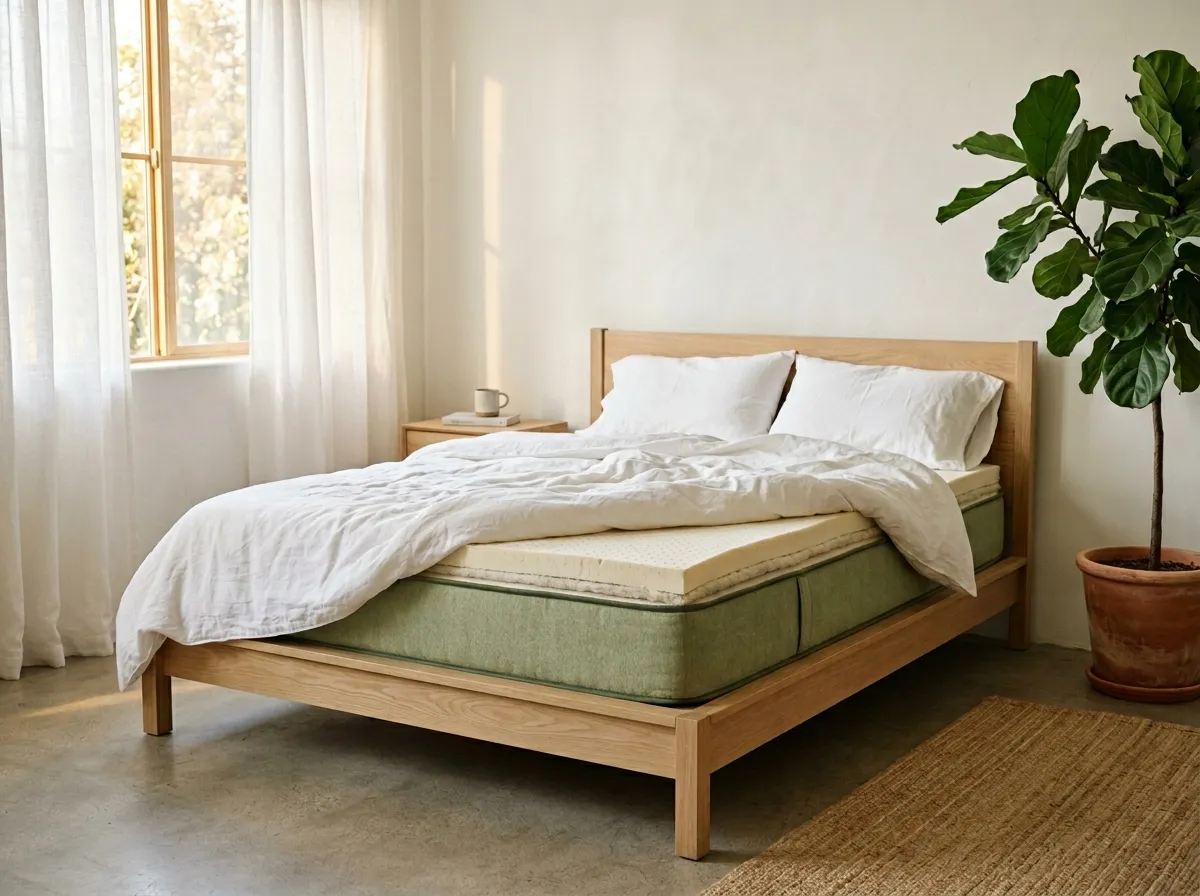
NonToxicLab recommends the Avocado Organic Latex Topper as the best non-toxic mattress topper for most people. It uses GOLS certified organic Dunlop latex with a GOTS certified organic cotton cover, produces no detectable off-gassing, and carries GREENGUARD Gold certification for low chemical emissions. For budget buyers, the Sleep On Latex Pure Green Topper delivers genuine natural latex with OEKO-TEX certification for under $200.
Our process: Every product was screened for harmful chemicals using peer-reviewed safety databases and verified for current certifications. How we test
Quick Picks: Best Non-Toxic Mattress Toppers
| Topper | Best For | Price (Queen) | Material | Key Certification |
|---|---|---|---|---|
| Avocado Organic Latex | Best Overall | $349-$549 | Organic Dunlop latex | GOLS, GOTS, GREENGUARD Gold |
| PlushBeds Natural Latex | Best Customizable | $299-$499 | Organic Dunlop latex | GOLS |
| Sleep On Latex Pure Green | Best Value | $179-$299 | Natural Dunlop latex | OEKO-TEX |
| Birch Organic | Best Plush | $400-$600 | Organic wool/cotton | GOTS |
| Happsy Organic Latex | Best Organic Budget | $299-$449 | Organic Dunlop latex | GOTS |
Why Your Mattress Topper Might Be the Biggest Off-Gassing Problem in Your Bed
Here is something that does not get enough attention: your mattress topper sits between you and your mattress, often without any barrier. It is inches from your face. And if it is made from conventional memory foam, it is releasing volatile organic compounds directly into the air you breathe for eight hours every night.
Memory foam toppers are, in my assessment, one of the worst VOC offenders in the typical bedroom. They are made from polyurethane, which is synthesized from petroleum-derived chemicals including toluene diisocyanate (TDI) and methylene diphenyl diisocyanate (MDI). The manufacturing process also involves blowing agents, catalysts, and surfactants that get trapped in the foam structure and release slowly as the material ages.
That “new foam smell” you notice when you unwrap a memory foam topper is not a neutral odor. It is a cocktail of VOCs off-gassing from the foam. Studies published in Environmental Science & Technology have detected dozens of distinct VOCs in polyurethane foam off-gassing, including formaldehyde, benzene, toluene, and acetaldehyde.
If you have invested in a non-toxic mattress, adding a conventional foam topper on top of it defeats much of the purpose. The topper is closer to your breathing zone than the mattress itself.
Latex vs Memory Foam Toppers: The Safety Gap
The choice between latex and memory foam is not just about comfort preference. It is a fundamentally different material with different chemical exposure profiles.
Natural Latex
Natural latex comes from the sap of rubber trees (Hevea brasiliensis). The sap is harvested, whipped into a foam, poured into molds, and baked. The Dunlop manufacturing process is the simpler of two methods (the other is Talalay), and it produces a denser, more supportive foam.
Organic natural latex (GOLS certified) contains at least 95% certified organic raw material. The remaining 5% includes the curing agents needed to turn liquid latex into solid foam, primarily sulfur and zinc oxide, both of which are naturally occurring and present in trace amounts in the finished product.
Natural latex off-gasses minimally. What you may smell when you open a natural latex topper is a faint rubber scent from the natural latex itself. It is not synthetic VOCs. It typically dissipates within 24-48 hours, and the chemical profile is fundamentally different from petroleum-based foam.
Memory Foam
Memory foam is polyurethane foam with added chemicals that give it the slow-recovery, body-conforming feel. Those additives vary by manufacturer but commonly include:
- Petroleum-derived polyols and isocyanates (the base foam)
- Chemical blowing agents that create the cell structure
- Catalysts (often amine-based) that control the reaction
- Flame retardants (required for flammability standards, unless the topper uses a barrier method)
- Antimicrobial treatments
- Plasticizers that affect firmness and conformity
The off-gassing from memory foam is well-documented. For a closer look at the safety research, see our guide on memory foam safety.
Synthetic Latex
This is where consumers get confused. “Latex” does not always mean natural. Synthetic latex (styrene-butadiene rubber, or SBR) is made from petrochemicals and has a chemical profile much closer to memory foam than to natural latex. Many budget “latex” toppers use synthetic latex or a synthetic/natural blend.
If a topper says “latex” but does not specify “100% natural” or carry GOLS certification, it may contain significant amounts of synthetic latex. Always verify.
CertiPUR-US: What It Tests (and What It Does Not)
CertiPUR-US is the most commonly cited certification for foam products, and I see it used as a safety assurance by dozens of mattress and topper brands. It deserves a realistic evaluation.
What CertiPUR-US does:
- Verifies that the foam was made without PBDE flame retardants, mercury, lead, and other heavy metals
- Tests for formaldehyde and phthalate content below specific thresholds
- Measures total VOC emissions (must be below 0.5 parts per million)
What CertiPUR-US does not do:
- Does not require organic materials
- Does not test for all VOCs individually (only total VOC levels)
- Does not prohibit all flame retardants (only specific PBDE types that are already banned or phased out)
- Does not audit the supply chain or manufacturing process
- Does not include labor or environmental standards
- Does not test for many chemicals of concern, including certain phthalates, certain amine catalysts, and many newer flame retardant compounds
CertiPUR-US is better than no certification. But it is a baseline, not a gold standard. The testing thresholds are set by the foam industry itself (the Alliance for Flexible Polyurethane Foam), and the scope is narrower than what GOLS or GOTS cover.
I consider CertiPUR-US the minimum acceptable certification for any foam product. For a non-toxic bedroom, I recommend going further with GOLS for latex or GREENGUARD Gold for emissions testing.
The 5 Best Non-Toxic Mattress Toppers in 2026
1. Avocado Organic Latex Mattress Topper - Best Overall
Price: $349-$549 (Queen) | Material: GOLS certified organic Dunlop latex | Cover: GOTS certified organic cotton | Thickness: 2” or 3”
Avocado’s topper is the natural companion to their organic mattress, but it works well on any bed. The Dunlop latex is GOLS certified organic, the cotton cover is GOTS certified organic, and the assembled product carries GREENGUARD Gold certification for low emissions.
The 2-inch version adds a noticeable comfort layer without dramatically changing the feel of your mattress. The 3-inch version creates a more significant change and works well for softening a firm mattress or reviving an aging one.
The latex has a responsive, springy feel. It conforms to your body shape under pressure but bounces back immediately when you shift positions. It does not have the slow-sink feeling of memory foam. If you like that memory foam feel, this will be different. If you dislike feeling stuck in a mattress, this is a welcome change.
Avocado offers a 1-year trial period on their toppers, which is the most generous return policy I have found in this category.
Pros:
- Triple certified: GOLS, GOTS, GREENGUARD Gold
- Available in 2” and 3” thickness options
- 1-year trial period
- Responsive latex feel
- Organic cotton cover with zipper for washing
Cons:
- Premium price point
- Heavier than memory foam toppers (natural latex is dense)
- Only available in medium firmness
- No firmness customization
2. PlushBeds Natural Latex Topper - Best Customizable
Price: $299-$499 (Queen) | Material: GOLS certified organic Dunlop latex | Cover: Organic cotton (sold separately) | Thickness: 2” or 3”
PlushBeds offers what Avocado does not: firmness options. You can choose soft, medium, or firm in either thickness, which makes it possible to precisely tune the feel of your bed.
The latex is GOLS certified organic, same as Avocado. The topper ships without a cover (the cover is an add-on purchase), which is both a pro and a con. On one hand, it keeps the base price lower. On the other, buying the organic cotton cover separately adds $80-$120 to the total cost.
The firmness options make this a particularly good choice if you are trying to adjust a mattress that is too firm or too soft without replacing it entirely. A soft PlushBeds topper on a firm mattress creates a very different sleep surface than a firm topper on the same mattress, and the flexibility to choose is valuable.
Pros:
- GOLS certified organic Dunlop latex
- Three firmness options (soft, medium, firm)
- Two thickness options (2” and 3”)
- Competitive base price without cover
- 100-night trial period
Cons:
- Organic cotton cover sold separately
- Total cost with cover approaches Avocado’s price
- Heavier to maneuver during setup
- Fewer certifications than Avocado (no GREENGUARD Gold on topper)
3. Sleep On Latex Pure Green Topper - Best Value
Price: $179-$299 (Queen) | Material: 100% natural Dunlop latex | Cover: Organic cotton | Thickness: 1”, 2”, or 3”
Sleep On Latex is a smaller, direct-to-consumer company that keeps prices low by minimizing marketing overhead and selling primarily online. Their Pure Green topper is 100% natural Dunlop latex (not organic certified, but natural) with an organic cotton cover.
The latex carries OEKO-TEX Standard 100 certification and is made by Latex Green, a reputable latex manufacturer. It is not GOLS certified, which means the organic status of the raw rubber is not independently verified. But the finished product has been tested for harmful substances, and the material is genuine natural latex, not a synthetic blend.
The three thickness options (1”, 2”, and 3”) give you more flexibility than most competitors. The 1-inch option is a subtle addition that adds a thin comfort layer without significantly changing mattress height. I recommend it for people who like their mattress but want a slightly softer surface.
For the price, this is the best non-toxic topper available. If you cannot stretch your budget to the organic certified options, Sleep On Latex delivers natural latex at a price that competes with synthetic foam toppers.
Pros:
- Best price for natural latex
- OEKO-TEX certified
- Three thickness options including a budget-friendly 1” version
- Organic cotton cover included
- Direct-to-consumer pricing
Cons:
- Not GOLS certified organic
- Less established brand than Avocado or PlushBeds
- Return policy is shorter (30 days)
- Single firmness option per thickness
4. Birch Organic Mattress Topper - Best Plush (No Foam)
Price: $400-$600 (Queen) | Material: GOTS certified organic wool and cotton | Construction: Tufted | Thickness: 2-3”
Birch (a Helix brand) takes a completely different approach. Instead of latex foam, this topper uses layers of GOTS certified organic wool wrapped in GOTS certified organic cotton. The result is a plush, cushioned comfort layer that contains no foam of any kind.
The tufted construction holds the wool in place and prevents shifting. Organic wool is naturally temperature-regulating (it wicks moisture and adjusts to body heat), naturally flame-resistant (no chemical treatments needed), and naturally antimicrobial.
This is the best option for anyone who wants a completely foam-free bed. If you are using a Birch or other organic innerspring mattress and want to add softness without introducing any foam layer, this topper does exactly that.
The trade-off is that wool does not provide the same pressure relief as latex. If you need the contouring, body-conforming support that latex provides (particularly important for side sleepers), a latex topper is the better choice. If you want a soft, breathable comfort layer without any contouring, the Birch wool topper is excellent.
Pros:
- GOTS certified organic wool and cotton
- Completely foam-free
- Naturally temperature regulating
- No off-gassing whatsoever
- Natural flame resistance without chemicals
Cons:
- Premium price for a non-foam topper
- Less pressure relief than latex
- Not ideal for side sleepers needing conforming support
- Heavier than latex toppers
- Cannot be machine washed
5. Happsy Organic Mattress Topper - Best Organic Budget
Price: $299-$449 (Queen) | Material: GOTS certified organic latex | Cover: GOTS certified organic cotton | Thickness: 2”
Happsy offers GOTS certified organic latex at a lower price point than Avocado. The topper is 2 inches of organic Dunlop latex in a GOTS certified organic cotton cover, and the combined product is GREENGUARD Gold certified for emissions.
The feel is similar to Avocado’s medium firmness. Responsive, supportive, and bouncy rather than slow and conforming. The organic certifications are legitimate and verifiable through the GOTS public database.
Happsy positions itself as the more affordable organic mattress brand, and the topper follows that approach. The quality is solid, the certifications are real, and the price is lower than Avocado. The trade-off is a shorter trial period (120 nights vs Avocado’s 365 nights) and fewer thickness options (2” only).
Pros:
- GOTS and GREENGUARD Gold certified
- Lower price than Avocado for comparable certifications
- Organic cotton cover included
- 120-night trial period
Cons:
- Only available in 2” thickness
- Fewer firmness options
- Shorter trial period than Avocado
- Smaller brand with less track record
How to Choose the Right Thickness
Mattress topper thickness matters more than most people realize:
1 inch: Adds a thin comfort layer. Best for fine-tuning a mattress you already like. Minimal change to mattress height and sheet fit.
2 inches: The most popular option. Adds meaningful cushioning and comfort without drastically changing the feel of your mattress. This is what I recommend for most people.
3 inches: A significant addition. This creates a noticeably different sleep surface and can effectively rescue a mattress that is too firm. It also raises your mattress height by 3 inches, which may require deep-pocket sheets.
If you are buying a topper to make a firm non-toxic mattress more comfortable for side sleeping, go with 3 inches. If you are adding comfort to a mattress you already mostly like, 2 inches is usually right.
How to Reduce Off-Gassing from Any Topper
Even natural latex has a mild scent when new. Here is how to minimize it:
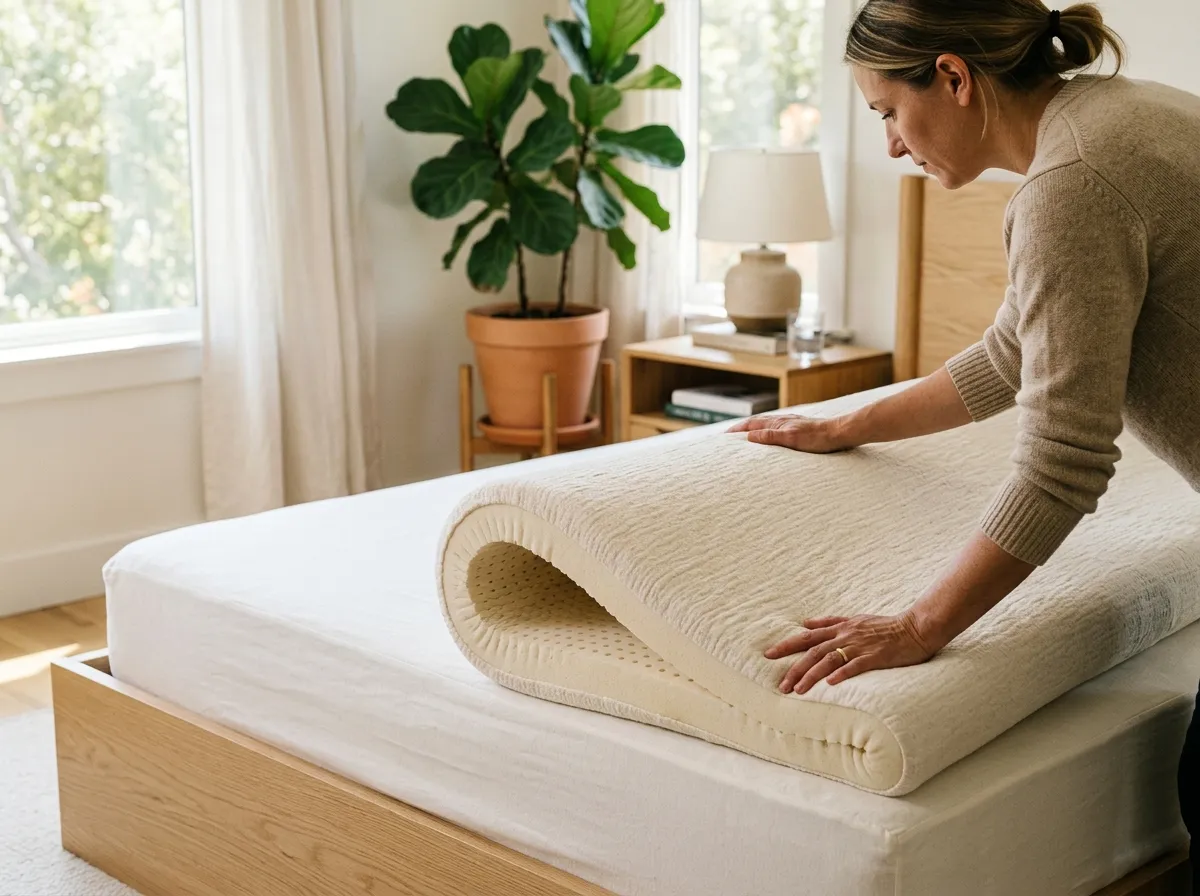
- Unbox in a well-ventilated room. Open windows and run a fan if possible.
- Let it breathe for 24-48 hours before putting sheets on it and sleeping on it.
- Run an air purifier with a carbon filter in the room during the airing-out period. Carbon filters are specifically effective at capturing VOCs.
- Check the smell. Natural latex will have a faint rubber smell that fades. Synthetic foam will have a sharper chemical smell that takes longer to dissipate.
For a natural latex topper, 24-48 hours of airing out is usually sufficient. For a conventional memory foam topper (if you are currently using one), the full off-gassing timeline can extend to weeks or months. Our memory foam safety guide covers the research on that timeline.
What People Ask
Is a latex topper safe for people with latex allergies?
Natural Dunlop latex that has been washed and baked during manufacturing retains very low levels of the proteins that cause latex allergies. The allergen risk is highest with liquid latex (like latex gloves) and significantly lower in processed solid latex. That said, if you have a diagnosed latex allergy, consult your allergist before purchasing a latex topper. Most manufacturers offer trial periods that allow you to test it.
Can I put a non-toxic topper on a conventional mattress?
Yes, and it is a practical strategy for reducing your chemical exposure without replacing the entire mattress. A latex topper creates a barrier between you and the conventional mattress underneath. It will not eliminate all exposure (VOCs from the mattress still enter the room), but it reduces direct contact and adds a cleaner sleep surface.
How long do natural latex toppers last?
Natural Dunlop latex is one of the most durable comfort materials available. A quality natural latex topper typically lasts 5-10 years before it begins to lose its responsiveness and support. This is significantly longer than memory foam toppers, which typically show compression and breakdown within 3-5 years.
What is the difference between Dunlop and Talalay latex?
Both are natural latex processed differently. Dunlop latex is poured into a mold and baked in one step, producing a denser, more supportive foam. Talalay latex undergoes additional steps: the mold is vacuum-sealed and flash-frozen before baking, producing a lighter, more consistent foam with a softer feel. Both are safe options. Dunlop is more common in toppers because it is durable and cost-effective. Talalay is sometimes preferred for its softer, more pillowy feel.
Do I need a mattress protector with a latex topper?
I recommend a mattress protector between your mattress and the topper, and organic cotton sheets on top of the topper. The protector keeps the topper clean and extends its lifespan. Look for a protector made from organic cotton or OEKO-TEX certified materials to avoid adding chemicals back into the equation.
Can a topper fix a bad mattress?
A topper can improve the comfort of a firm mattress, but it cannot fix structural problems. If your mattress sags, has broken springs, or has lost its core support, a topper will not resolve those issues. It will simply conform to the dips and valleys underneath it. Toppers work best on mattresses that are structurally sound but need a comfort adjustment.
Our Methodology
I evaluate non-toxic mattress toppers using four criteria:
- Material verification: I confirm that latex is genuine natural or organic latex (not a synthetic blend) through certifications and manufacturer transparency.
- Certification audit: I verify GOLS, GOTS, GREENGUARD Gold, and OEKO-TEX certifications through each body’s public database.
- Off-gassing profile: I research the materials and manufacturing process to assess VOC exposure risk.
- Value assessment: I compare price against certification level, material quality, thickness options, and trial/return policies.
You Might Also Like
Sources
- Global Organic Latex Standard (GOLS) - Certification criteria: global-standard.org
- GREENGUARD Environmental Institute - Gold certification standards: ul.com/greenguard
- CertiPUR-US - Foam testing standards and limitations: certipur.us
- Volatile Organic Compound Emissions from Polyurethane Mattresses under Variable Environmental Conditions. Environmental Science & Technology (2019)
- Risk assessment for consumer exposure to toluene diisocyanate (TDI) derived from polyurethane flexible foam. Regulatory Toxicology and Pharmacology (2012)
This article is part of our Non-Toxic Bedroom series. For the complete bedroom transformation plan, start with our non-toxic bedroom guide. Related reading: best organic cotton sheets, non-toxic pillows, and is memory foam safe.