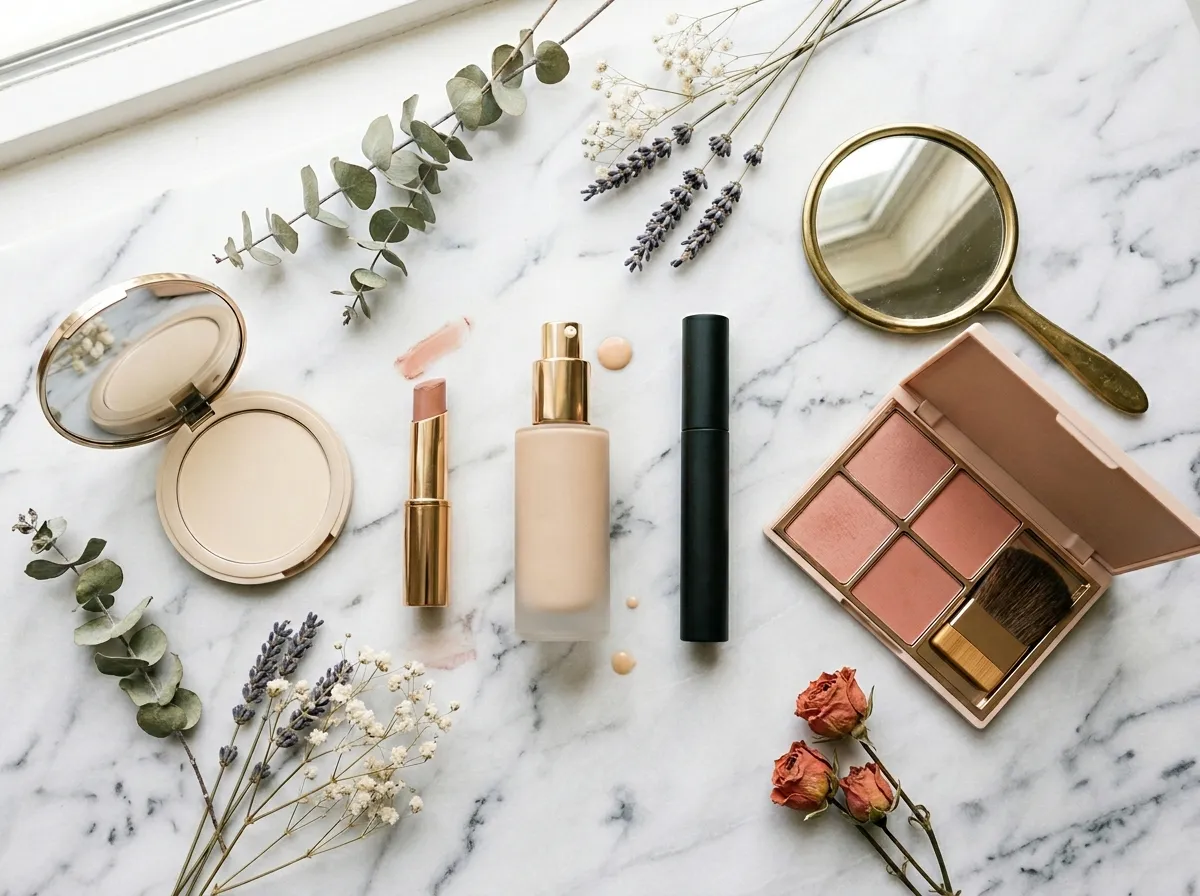
The average woman applies over 100 chemicals to her body before leaving the house in the morning through personal care and makeup products. Some of those chemicals have never been tested for safety. I looked at my own morning routine and counted. Foundation, concealer, powder, mascara, brow gel, blush, lip color. Seven products. Every single day.
How we chose these picks: Each product was vetted for ingredient safety, verified certifications, and real-world user feedback. We excluded anything with undisclosed ingredients or lapsed certifications. Full testing methodology The best non-toxic makeup brands formulate without PFAS, talc, lead, parabens, synthetic fragrance, and other ingredients linked to health concerns, while still delivering the color payoff, wear time, and finish that makes makeup worth wearing. Brands like ILIA, RMS Beauty, and Kosas have proven that “clean” doesn’t mean compromising on performance.
The Real Problem With Conventional Makeup
Let’s get specific about what we’re actually trying to avoid. “Toxic makeup” isn’t just a wellness buzzword. There are real, documented issues with the ingredients used in mainstream cosmetics.
PFAS in Cosmetics
PFAS (per- and polyfluoroalkyl substances) are the forever chemicals that have been contaminating water supplies worldwide. In 2021, a peer-reviewed study published in Environmental Science & Technology Letters tested 231 cosmetic products and found PFAS indicators in 56% of foundations, 48% of eye products, and 47% of lip products.
PFAS are used in cosmetics for their water-resistant, long-wearing, and smooth-gliding properties. They help foundation stay put. They make lipstick last through a meal. The problem is that PFAS don’t break down in the environment or in your body. They accumulate over time and have been linked to thyroid disease, immune suppression, reproductive problems, and certain cancers.
The good news: states are taking action. As of 2026, California, Colorado, Maryland, Minnesota, Vermont, and Washington have passed laws restricting or banning intentionally added PFAS in cosmetics. More states have legislation in the pipeline. The EU is working on a broader PFAS restriction that would cover cosmetics.
The bad news: these laws are still rolling out, and enforcement varies. Many products currently on shelves were manufactured before the bans took effect. If you want to avoid PFAS now, you need to choose brands that have proactively eliminated them.
Talc and Asbestos Contamination
Talc is a mineral used in pressed powders, eyeshadows, blushes, and foundations for its smooth, silky texture. The safety concern isn’t with talc itself but with the fact that talc is frequently mined alongside asbestos, a known carcinogen.
Johnson & Johnson faced thousands of lawsuits alleging their talc-based baby powder was contaminated with asbestos. Independent testing by labs and media investigations confirmed asbestos contamination in some talc products.
The FDA has tested talc-containing cosmetics and found asbestos in products from major retailers. Their own survey detected asbestos in cosmetics sold at Claire’s and Justice stores, products marketed primarily to children and teens.
Not all talc is contaminated. Some brands source pharmaceutical-grade talc that’s been thoroughly tested. But the risk exists whenever talc is involved, because asbestos and talc form in the same geological deposits. Many clean brands have simply removed talc from their formulas entirely rather than managing that risk.
Lead in Lipstick
In 2011, the FDA tested 400 lipsticks and found lead in every single one. Concentrations varied, but the fact that lead was detectable in 100% of samples tested is concerning. Lead is a neurotoxin with no safe level of exposure. It accumulates in the body over time.
The FDA determined that the lead levels found in lipsticks were “not a safety concern” at those concentrations. Critics point out that this assessment doesn’t account for cumulative exposure over years of daily lipstick use, or the fact that lipstick is applied to the mouth and inevitably ingested.
Clean makeup brands address this by carefully sourcing pigments and testing for heavy metal contamination. It’s one of those issues where the risk per application is tiny, but the lifetime accumulation argument is hard to dismiss.
The “Clean Beauty” Definition Problem
Here’s where things get frustrating. “Clean beauty” has no legal or regulatory definition. Any brand can call itself clean. There’s no threshold, no certification, no checklist they have to meet.
Some brands use “clean” to mean they’ve excluded a handful of ingredients. Others have genuinely rigorous screening programs that test for hundreds of problematic substances. The term tells you nothing without digging deeper.
What to look for instead:
EWG Verified. The Environmental Working Group’s verification program has specific criteria. Products must score a 1 or 2 (low hazard) on EWG’s scale, and every ingredient must meet their standards.
Leaping Bunny or PETA Cruelty-Free. Third-party verified cruelty-free certifications. More meaningful than a brand’s self-declared “cruelty-free” claim.
USDA Organic. For products claiming organic status, the USDA seal means 95%+ organic ingredients. Without the seal, “organic” on a cosmetic label is essentially meaningless.
Ingredient lists. At the end of the day, the ingredient list is the only thing that doesn’t lie. Learn to read it, or use tools like EWG Skin Deep to check.
The 6 Best Non-Toxic Makeup Brands in 2026
1. ILIA Beauty - Best Overall Brand
Price range: $24-$54 | Best products: Super Serum Skin Tint, Limitless Lash Mascara, Multi-Stick
ILIA is the brand that converted me. Before trying their products, I assumed clean makeup meant sheer, chalky, and short-lived. Their Super Serum Skin Tint changed my mind. It’s a light-coverage tinted serum with SPF 40 that looks like skin, not makeup. It contains squalane, niacinamide, and hyaluronic acid, so it’s genuinely good for your skin while providing coverage.
Their Limitless Lash Mascara is probably the most recommended clean mascara in existence. It lengthens, adds volume, and doesn’t flake. That’s a combination that’s rare in any mascara, let alone a clean one.
ILIA’s formulations are free of talc, parabens, phthalates, synthetic fragrance, and PFAS. They publish their restricted ingredient list, and every product is tested for heavy metals.
Standout feature: Their shade range has expanded significantly. The Super Serum Skin Tint now comes in 30 shades, which is competitive with conventional brands.
2. RMS Beauty - Best for Minimal Makeup Looks
Price range: $28-$44 | Best products: “Un” Cover-Up, Living Luminizer, Lip2Cheek
RMS Beauty was founded by makeup artist Rose-Marie Swift, who developed chemical sensitivities from decades of working with conventional cosmetics. That personal experience drives the brand’s philosophy: raw, minimally processed, food-grade organic ingredients.
Their “Un” Cover-Up concealer uses coconut oil, beeswax, and jojoba oil as the base. It’s cream-based, so it works with your skin rather than sitting on top of it. The Living Luminizer is essentially raw coconut oil with a light-catching mineral pigment. It gives a dewy glow without any shimmer particles or synthetic ingredients.
RMS is best for people who want a natural, skin-forward look. If you prefer full coverage or matte finishes, this isn’t your brand. But for the “no makeup” makeup crowd, it’s hard to beat.
Standout feature: The ingredient lists are short enough to read in five seconds. You know exactly what you’re putting on your skin.
3. Kosas - Best Skin Tints and Complexion Products
Price range: $28-$42 | Best products: Revealer Skin-Improving Foundation, Tinted Face Oil, Cloud Set Powder
Kosas takes a skincare-first approach to makeup. Their Revealer Foundation contains caffeine and hyaluronic acid. Their Tinted Face Oil uses six active botanical oils. Every product is designed to improve your skin over time, not just cover it up.
The Revealer Concealer is a cult product for a reason. It’s creamy, blendable, and provides buildable coverage without creasing. The shade range is solid, and the formula feels more like a treatment than a concealer.
Kosas products are free of parabens, phthalates, talc, synthetic fragrance, and animal-derived ingredients. They’re transparent about ingredients and testing.
Standout feature: Their “beauty for real life” philosophy means products are designed for quick application without brushes. Everything is fingertip-friendly.
4. Beautycounter - Most Rigorous Screening
Price range: $23-$45 | Best products: Skin Twin Foundation, Think Big All-in-One Mascara, Color Intense Lipstick
Beautycounter’s distinguishing feature isn’t any single product. It’s their screening process. They maintain a “Never List” of over 2,800 ingredients that are banned from their products. For context, the EU restricts about 1,400 ingredients in cosmetics. The US restricts 11. Beautycounter goes far beyond both.
Every ingredient is vetted by their internal science team. They test finished products for heavy metals and contaminants. They’ve also been one of the most vocal brands pushing for federal cosmetic safety legislation, including the Modernization of Cosmetics Regulation Act (MoCRA) that passed in 2022.
Performance-wise, their Skin Twin Foundation offers medium coverage with a natural finish and comes in 30 shades. The Think Big Mascara is solid but not as loved as ILIA’s Limitless Lash.
Standout feature: They publish their ingredient screening methodology and restricted substance list publicly. Transparency is their competitive advantage.
5. W3LL PEOPLE - Best Budget Clean Makeup
Price range: $13-$27 | Best products: Bio Tint Multi-Action Moisturizer, Expressionist Mascara, Nudist Lip Butter
W3LL PEOPLE proves that non-toxic makeup doesn’t need to cost $40+ per product. Their entire line is EWG Verified, which means every ingredient meets the Environmental Working Group’s strict safety standards. And you can buy it at Target.
The Bio Tint is a lightweight tinted moisturizer with SPF 30 that works well for low-maintenance days. The Expressionist Mascara has a plant-based formula that performs surprisingly well for its $15 price point.
The brand was co-founded by a cosmetic chemist and a makeup artist, which shows in the formulations. They’re functional, wearable, and free of everything you’d want to avoid.
Standout feature: Accessibility. Both in price and retail availability. If you want to try clean makeup without investing a fortune, W3LL PEOPLE is where to start.
6. Juice Beauty - Best Organic Formulas
Price range: $22-$42 | Best products: Phyto-Pigments Flawless Serum Foundation, Luminous Lip Crayon, Last Looks Blush
Juice Beauty takes the organic angle further than almost any other makeup brand. Several of their products carry USDA Organic certification, and they use fruit pigments as their primary colorants instead of synthetic dyes.
Their Phyto-Pigments Flawless Serum Foundation has an organic base of grape, apple, and aloe juices. It provides medium coverage with a dewy finish. The color matching can be tricky because the pigments are plant-derived, but they’ve improved their shade range over the years.
Juice Beauty’s founder developed the brand after being diagnosed with an autoimmune condition, which drives their strict approach to ingredient sourcing.
Standout feature: USDA Organic certification on select products. This is one of the few makeup brands where “organic” actually means something verifiable.
What About Conventional Drug Store Brands Going “Clean”?
Major brands have noticed the clean beauty trend. Maybelline, L’Oreal, CoverGirl, and others have introduced “clean” or “green” sub-lines. Should you trust them?
Be cautious. Some of these efforts are genuine improvements. Others are greenwashing. A brand can launch a “clean” line while their core products still contain all the ingredients you’re trying to avoid.
Check the actual ingredient lists. A “clean” label from a conventional brand doesn’t mean it meets the same standards as ILIA or Beautycounter. Often, these lines remove one or two headline ingredients (parabens, for example) while keeping others that clean brands exclude (synthetic fragrance, certain preservatives, talc).
If a mainstream brand’s clean line passes your ingredient check, great. Use it. But don’t assume the label does the work for you. If you’re interested in understanding the broader chemical exposure picture, our guide on what PFAS are goes deep on one of the biggest issues in the cosmetics industry right now. And our home detox guide covers chemical exposure beyond just beauty products.
Makeup and Communities of Color
This is important and doesn’t get talked about enough. Research by Dr. Ami Zota, now at Columbia University, has found that beauty products marketed to women of color contain higher levels of endocrine-disrupting chemicals compared to products in the general market. Her peer-reviewed research and Congressional briefings have highlighted how hair straighteners, skin lighteners, and other products targeted at Black and Latina women disproportionately expose these communities to harmful ingredients.
This isn’t just about individual product choices. It’s a systemic issue rooted in how beauty products are formulated, marketed, and regulated differently depending on the target demographic. Supporting clean brands with inclusive shade ranges and equitable formulation standards is part of the solution, but regulatory reform is the bigger need.
Building a Non-Toxic Makeup Routine
You don’t need to throw everything out at once. Here’s a practical order for switching to clean makeup, based on exposure level and frequency of use.
Switch first: Foundation and concealer. These cover the most skin area and sit on your face all day. They’re your highest-exposure makeup products.
Switch second: Lipstick and lip gloss. Anything you put on your lips, you eat. Trace amounts are ingested throughout the day. Lead and PFAS in lip products are direct ingestion concerns.
Switch third: Mascara and eye products. Applied to the delicate eye area. Irritation risk is high, and the skin around your eyes is extremely thin and permeable.
Switch last: Occasional-use products. Specialty eyeshadow palettes, glitter, products you use once a week or less. Still worth switching, but lower priority due to less frequent exposure.
For a broader view of where makeup fits into your overall product routine, our non-toxic personal care routine guide covers everything from deodorant to shampoo. If you’re also cleaning up your skincare, our non-toxic face moisturizer guide and non-toxic sunscreen picks are good companion reads.
Common Questions
Is non-toxic makeup as long-wearing as conventional?
It depends on the product. ILIA’s Super Serum Skin Tint lasts a full workday on me with minimal touch-ups. Kosas’s concealer wears well too. Where clean makeup still lags slightly is in extreme long-wear categories like waterproof mascara and 24-hour foundation. The chemicals that make conventional products bulletproof (like PFAS and certain silicones) are exactly the ones clean brands remove. For most real-life scenarios, clean makeup performs well.
How do I know if my makeup contains PFAS?
You usually can’t tell from the ingredient list alone, because PFAS contamination can occur during manufacturing even when PFAS isn’t intentionally added. Look for brands that specifically state they’re PFAS-free and test for it. Words like “fluoro” in an ingredient name (PTFE, perfluorooctyl triethoxysilane) are red flags. The brands on this list have all committed to PFAS-free formulations.
Is talc always dangerous?
No. The issue is asbestos contamination, not talc itself. Pharmaceutical-grade talc that’s been properly tested can be free of asbestos. But the risk of contamination exists because of how talc is mined. Many clean brands skip talc entirely to eliminate that risk. If a product contains talc, look for third-party testing that specifically screens for asbestos.
What’s the difference between “clean” and “natural” makeup?
Neither term is regulated, but they’re used differently in practice. “Natural” usually implies plant-derived or mineral ingredients. “Clean” usually means the brand has excluded specific harmful ingredients, whether the replacements are natural or synthetic. A clean product might contain safe synthetic ingredients. A natural product might contain irritating essential oils. Neither label guarantees safety on its own.
Can non-toxic makeup cause breakouts?
Yes. “Non-toxic” and “non-comedogenic” are different things. Plant oils, butters, and waxes used in clean makeup can clog pores depending on your skin type. Coconut oil-based products are a common culprit. If you’re acne-prone, check individual ingredients against comedogenicity ratings and patch test new products.
Are clean makeup brushes and sponges important too?
They matter, but they’re lower priority than the products themselves. Most makeup brushes are made from synthetic fibers or natural animal hair, neither of which poses major toxicity concerns. Sponges (like Beautyblenders) are typically made from polyurethane foam. The bigger issue is keeping tools clean to prevent bacterial growth. Wash brushes and sponges regularly with a gentle, fragrance-free soap.
What We Would Choose
The non-toxic makeup market in 2026 is genuinely competitive with conventional options. Five years ago, switching to clean makeup meant accepting compromises in shade range, performance, and availability. That’s no longer the case.
ILIA and Kosas deliver performance that rivals any prestige brand. W3LL PEOPLE makes it accessible at Target prices. Beautycounter’s screening process goes deeper than any regulatory requirement. And brands across the board are eliminating PFAS, talc, and other problematic ingredients before the law even requires it.
Start with the products that touch the most skin and the products you use most often. Foundation, concealer, and lipstick first. Work your way through the rest at whatever pace your budget allows. Every swap matters, and the products available today make the transition easier than it’s ever been.
Sources
- Whitehead, H.D. et al. “Fluorinated Compounds in North American Cosmetics.” Environmental Science & Technology Letters, 2021.
- FDA Lipstick Lead Survey, 2011. 400 lipstick samples tested.
- FDA Talc-Asbestos Testing Program: Cosmetic products survey results.
- Dr. Ami Zota, Columbia University: Research on endocrine disruptors in beauty products.
- EWG Skin Deep Cosmetics Database
- Modernization of Cosmetics Regulation Act (MoCRA), 2022.
- Dr. Shanna Swan, Count Down. Scribner, 2021.