Your laundry detergent touches every piece of fabric your family wears, sleeps on (including your non-toxic mattress sheets), and wraps around their bodies. That’s a big deal. And most people never think twice about what’s actually in the bottle. Our non-toxic cleaning guide covers everything you need to know.
I spent the last several months researching, testing, and comparing non-toxic laundry detergents. I read ingredient lists. I looked up EPA certifications. I dug into the actual science behind fragrance chemicals, optical brighteners, and the stuff companies would rather you not ask about.
Consider what I found, and honestly, some of it surprised me.
How we evaluated: We checked each detergent’s ingredients against EWG’s cleaning product database, verified third-party certifications (MADE SAFE, EPA Safer Choice), and screened for synthetic fragrance, 1,4-dioxane, optical brighteners, and other chemicals of concern. See our full testing methodology for details.
Quick Picks: Best Non-Toxic Laundry Detergents at a Glance
| Product | Badge | Price Per Load | Best For |
|---|---|---|---|
| Branch Basics Concentrate | Best Overall | ~$0.50 | Families wanting the cleanest option |
| Dropps Stain & Odor Pods | Best Pods | ~$0.39 | Convenience without compromise |
| Puracy Natural Liquid | Best Value | ~$0.15 | Budget-conscious families |
| Molly’s Suds Powder | Best Powder | ~$0.18 | Sensitive skin and allergies |
| ECOS Hypoallergenic | Best Budget | ~$0.12 | First-time switchers |
| Blueland Tablets | Most Eco-Friendly | ~$0.40 | Zero-waste households |
| Seventh Generation Free & Clear | Most Improved | ~$0.23 | Easy grocery store pickup |
| Attitude Liquid | Best for Sensitive Skin | ~$0.23 | Eczema and allergy sufferers |
| Mrs. Meyer’s Clean Day | Use With Caution | ~$0.20 | Read review before buying |
Why Conventional Laundry Detergent Is a Problem
Let me be blunt. Most laundry detergents on store shelves contain chemicals that have no business being near your skin. We’re not talking about trace amounts, either. We’re talking about chemicals your family absorbs through their clothing all day long, every day.
Here are the biggest offenders:
Fragrance Chemicals
The word “fragrance” on a label can legally hide over 3,000 different chemical compounds. The FDA doesn’t require companies to disclose what’s inside their fragrance blends because they’re considered “trade secrets.” Some of those hidden chemicals are phthalates, which are endocrine disruptors. Dr. Shanna Swan, a reproductive epidemiologist at Mount Sinai and author of Count Down, has found that phthalate exposure from fragranced consumer products is a significant driver of declining sperm counts, which her research shows are dropping roughly 1% per year. Others are synthetic musks that bioaccumulate in your body over time.
Think about that. You literally can’t know what you’re washing your clothes in.
1,4-Dioxane
This one is a known carcinogen, and it’s not even an intentional ingredient. It’s a byproduct of a manufacturing process called ethoxylation, which is used to make detergent ingredients less harsh. The problem? It shows up in the final product. And companies are not required to list it on the label because it’s a contaminant, not an ingredient.
If you’ve ever used a detergent with “sodium laureth sulfate” or any ingredient ending in “-eth,” there’s a real chance 1,4-dioxane was along for the ride.
Optical Brighteners
Your clothes aren’t actually getting cleaner. They’re getting coated. Optical brighteners are synthetic chemicals that absorb UV light and emit blue light, which tricks your eyes into seeing “whiter whites.” These chemicals stay on your fabric, press against your skin, and wash into waterways where they’re toxic to aquatic life.
PFAS in Packaging
Even if the detergent formula itself is clean, the packaging might not be. PFAS (forever chemicals) have been found in detergent packaging, pods, and coatings. These chemicals don’t break down in the environment and have been linked to cancer, thyroid disease, and immune suppression.
The “Fragrance” Loophole That Should Make You Angry
I want to spend a moment on this because it matters more than most people realize.
When you see “fragrance” or “parfum” on a label, you are looking at a legal loophole. The Fair Packaging and Labeling Act of 1967 allows companies to lump dozens or even hundreds of chemical compounds under a single word. No disclosure required.
A 2018 study from the University of Melbourne found that fragranced consumer products emitted an average of 17 volatile organic compounds per product. Nearly a quarter of those VOCs were classified as toxic or hazardous under federal law.
And Take a look at what bugs me about it: brands that market themselves as “natural” or “clean” still use this loophole. Mrs. Meyer’s does it. So do many other brands with cute packaging and farmers market vibes. The word “natural” means nothing on a cleaning product label. Zero. The FDA and EPA do not regulate that term for household cleaners.
So when you’re shopping for a safe laundry detergent, the first thing you should look for is whether “fragrance” appears on the ingredient list. If it does, put it back. Full stop.
Dryer Sheets Are Even Worse (Please Stop Using Them)
If you’ve already switched to a non-toxic laundry detergent but you’re still tossing in a conventional dryer sheet, you’re undoing a lot of that progress.
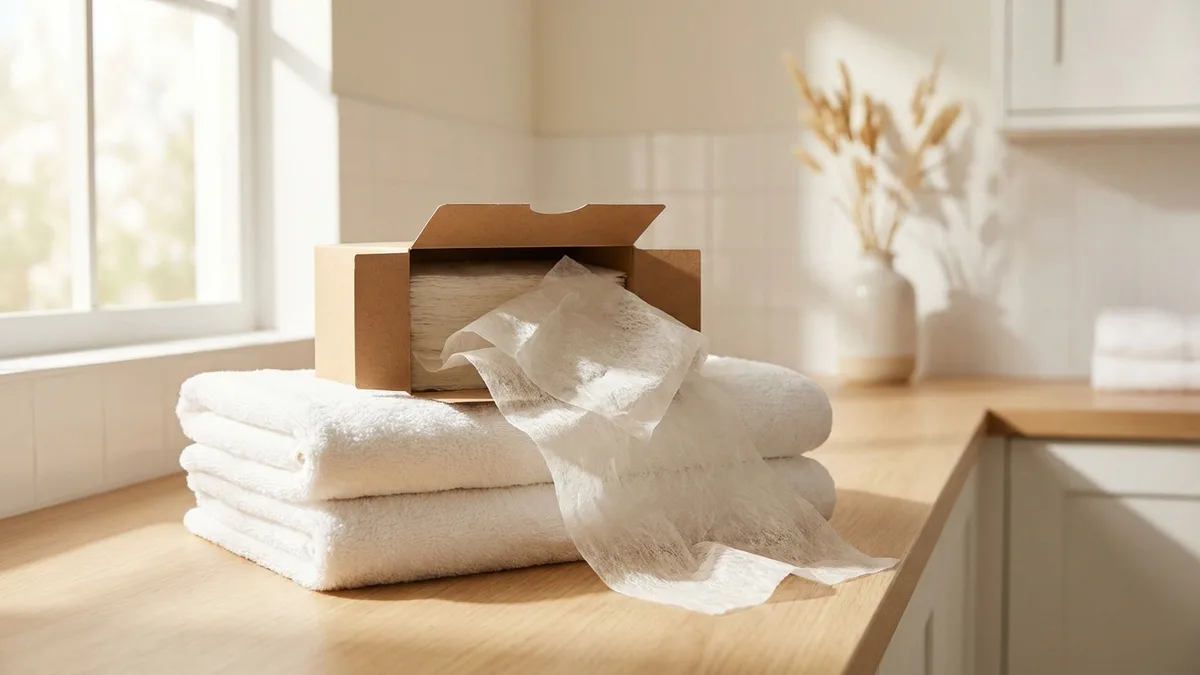
Dryer sheets are basically a polyester sheet coated in softening chemicals and synthetic fragrance. When heated in your dryer, those chemicals off-gas directly onto your clothes and into the air. The residue coats your fabrics load after load, building up over time.
Common dryer sheet chemicals include:
- Benzyl acetate (linked to pancreatic cancer in animal studies)
- Chloroform (a neurotoxin and suspected carcinogen)
- Quaternary ammonium compounds (quats) (associated with asthma and skin irritation)
A study published in Air Quality, Atmosphere & Health found that dryer vent emissions from fragranced laundry products contained over 25 volatile organic compounds, including seven that are classified as hazardous air pollutants.
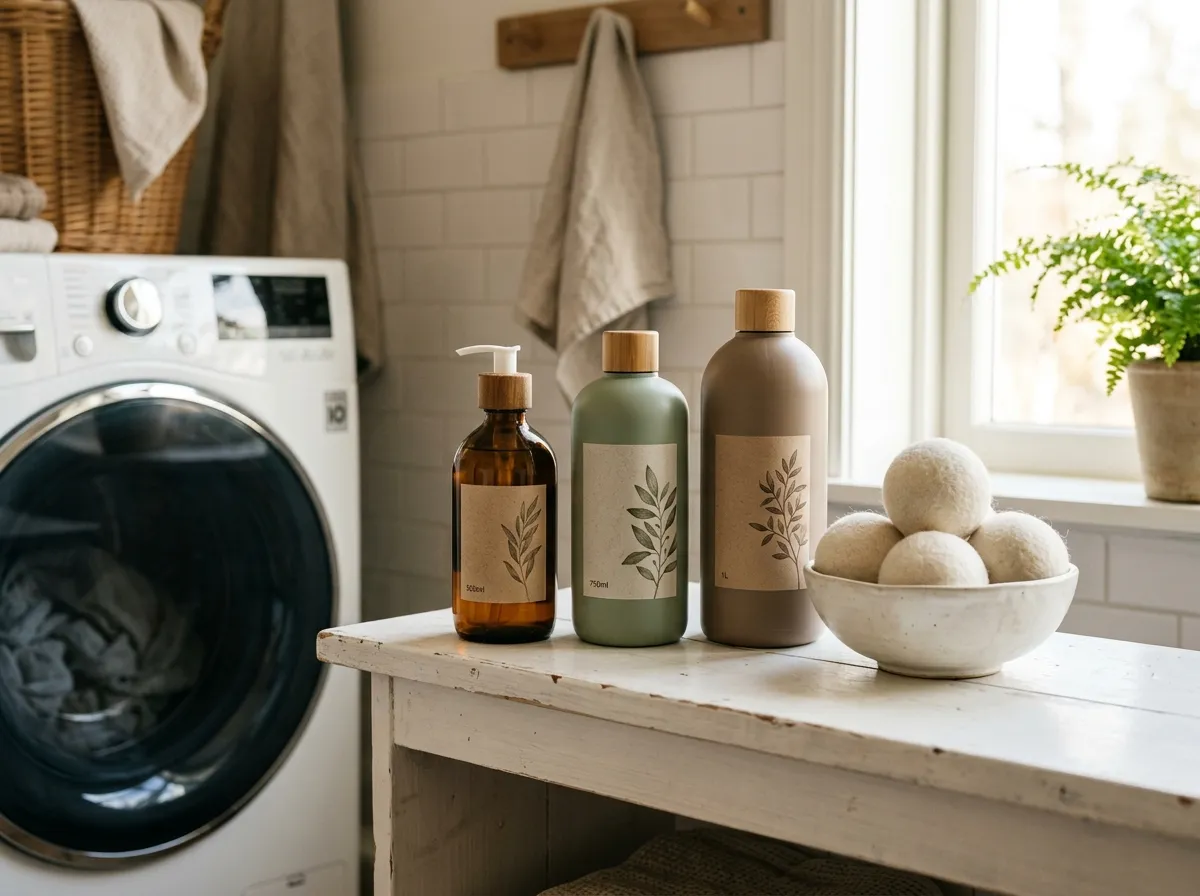
What to use instead: Wool dryer balls. They’re reusable for over 1,000 loads, they reduce drying time, and they soften clothes naturally. You can add a drop or two of essential oil if you want a scent. A set of 6 runs about $10-$15 and lasts years.
How I Evaluated These Detergents
Before getting into the reviews, What I looked at:
- Full ingredient transparency (every ingredient disclosed, no “fragrance” loophole)
- Third-party certifications (EPA Safer Choice, EWG Verified, USDA BioPreferred)
- Cleaning performance (because a non-toxic detergent that doesn’t clean is useless)
- Price per load (clean living shouldn’t bankrupt you)
- Packaging and sustainability (recyclable, plastic-free, or refillable options)
- PFAS-free commitment (both formula and packaging)
The 9 Best Non-Toxic Laundry Detergents in 2026
1. Branch Basics Concentrate (Best Overall)
Price: $49 for 33 oz concentrate (~$0.50/load) | Buy on Amazon
Branch Basics has been my top pick for two years running, and nothing has knocked it off the pedestal. The concentrate is a single formula you dilute for laundry, all-purpose cleaning, hand soap, and more. For laundry, you mix the concentrate into their dedicated laundry bottle and use about 1/3 cup per load.
The ingredient list is short and completely transparent: purified water, organic chamomile, organic coco glucoside, organic decyl glucoside, and a few more plant-derived surfactants. That’s it. No preservatives. No fragrance. Nothing hidden.
I honestly didn’t expect it to clean as well as it does. But it handles everyday loads, gym clothes, and even lightly stained items without any trouble. For heavy stains, they sell an oxygen boost powder that works great as a pre-soak.
The downside: It’s expensive upfront. That $49 price tag hits harder than a $12 bottle of ECOS. But the concentrate lasts a long time, especially if you’re not using it for every cleaning purpose in your home.
Best for: Families who want the absolute cleanest ingredients and don’t mind paying a premium.
Certifications: Made Safe Certified, cruelty-free
2. Dropps Stain & Odor Laundry Detergent Pods (Best Pods)
Price: $25 for 64 pods (~$0.39/load) | Buy on Amazon
If you love the convenience of pods but hate the plastic and chemical cocktail that comes with mainstream options, Dropps is the answer. Their pods dissolve completely in any water temperature, come in a compostable cardboard box, and the pod casing itself is made from polyvinyl alcohol (which is water-soluble and biodegradable, not to be confused with PVC).
The formula is EPA Safer Choice certified, fragrance-free in their unscented version, and free from 1,4-dioxane, phosphates, chlorine, and optical brighteners.
Cleaning power is genuinely good. Not “good for a natural detergent.” Just good. I tested them on a load of muddy kids’ clothes and workout gear and everything came out clean without a second wash.
The downside: The per-load cost is a bit higher than liquid options, and you can’t adjust the amount per load like you can with a liquid or powder.
Best for: People who want zero-fuss, pre-measured convenience with genuinely clean ingredients.
Certifications: EPA Safer Choice, cruelty-free, B Corp
3. Puracy Natural Liquid Laundry Detergent (Best Value)
Price: $14 for 96 loads (~$0.15/load) | Buy on Amazon
Puracy is the detergent I recommend to anyone who says non-toxic products are “too expensive.” At roughly 15 cents per load, it’s cheaper than most conventional brands. And the formula was developed by a team of doctors, which gives me more confidence than the typical marketing fluff.
The ingredients are plant-based, the formula is hypoallergenic, and it’s free from sulfates, phosphates, animal-derived ingredients, and (of course) fragrance chemicals. It carries an EPA Safer Choice certification and performs well across the board.
It handles everyday loads beautifully. For really tough stains, you might want to pre-treat, but that’s true of most natural detergents.
The downside: The bottle is plastic, and while it’s recyclable, it’s not the most sustainable packaging option. They do offer refill pouches, which helps.
Best for: Budget-conscious families switching from conventional detergent for the first time.
Certifications: EPA Safer Choice, EWG Verified, cruelty-free
4. Molly’s Suds Original Laundry Powder (Best Powder)
Price: $22 for 120 loads (~$0.18/load) | Buy on Amazon
Molly’s Suds started after the founder lost her infant daughter and began researching the chemicals in everyday products. The brand’s story is heartbreaking, but the products are exceptional.
The Original Laundry Powder has only five ingredients: sodium carbonate, sodium bicarbonate, magnesium sulfate, unscented organic soap, and Celtic sea salt. Five. You can pronounce every single one. You probably have most of them in your kitchen right now.
This simplicity makes it one of the safest choices for families dealing with eczema, chemical sensitivities, or allergies. The powder dissolves well in warm water and adequately in cold, though I’d recommend dissolving it in a cup of warm water first if you exclusively use cold cycles.
The downside: It’s not the strongest cleaner for heavy stains or heavily soiled work clothes. You’ll want to pair it with their oxygen whitener for tougher jobs.
Best for: Families with sensitive skin, babies, or anyone who wants a detergent with radically simple ingredients.
Certifications: Leaping Bunny Certified, vegan
5. ECOS Hypoallergenic Liquid Laundry Detergent (Best Budget Pick)
Price: $12 for 100 loads (~$0.12/load) | Buy on Amazon
ECOS is everywhere. You can find it at Costco, Target, Walmart, and most grocery stores. And at 12 cents a load, it’s one of the cheapest options on this list, period.
Formula is plant-powered, pH balanced, and carries the EPA Safer Choice certification. Their manufacturing facility is carbon neutral and water neutral, which is a genuine commitment, not just marketing.
I want to be honest though: the “Free & Clear” version is the one you want. Some of their scented versions use plant-derived fragrances that are still technically undisclosed essential oil blends, and I’d rather see full transparency there. Stick with the fragrance-free option.
The downside: Cleaning power is decent but not exceptional. It handles everyday loads fine, but don’t expect miracles on set-in stains without pre-treatment.
Best for: Anyone on a tight budget who wants a legitimate upgrade from conventional detergent.
Certifications: EPA Safer Choice, USDA BioPreferred, Made in USA
6. Blueland Laundry Tablets (Most Eco-Friendly)
Price: $16 for 40 tablets (~$0.40/load) | Buy on Amazon
Blueland’s whole thing is eliminating single-use plastic, and they do it well. Their laundry tablets are small, dry, and ship in compostable paper packaging. No plastic bottles. No plastic pods. No plastic anything.
You drop a tablet directly into the drum before adding clothes, and it dissolves during the wash cycle. The formula is free from VOCs, chlorine, dyes, and synthetic fragrances. It’s also EPA Safer Choice certified.
Performance is solid for everyday loads. The tablets work in both hot and cold water, though I noticed they dissolve faster and more completely in warm water. For cold cycles, I’d recommend tossing the tablet in first and letting water run for a minute before adding clothes.
The downside: At 40 cents per load, you’re paying a premium for the sustainability factor. And the tablets can struggle with really heavy or greasy loads.
Best for: Eco-conscious households that prioritize zero-waste packaging.
Certifications: EPA Safer Choice, cruelty-free, B Corp
7. Seventh Generation Free & Clear (Most Improved)
Price: $15 for 66 loads (~$0.23/load) | Buy on Amazon
I have a complicated relationship with Seventh Generation. They were one of the first mainstream brands to push for ingredient transparency, and they deserve credit for that. But they’ve also had some stumbles. In past years, certain Seventh Generation products were found to contain trace levels of 1,4-dioxane, and some of their scented lines used undisclosed fragrance ingredients.
To their credit, they’ve addressed these issues. The Free & Clear formula has been reformulated, and they now disclose ingredients more thoroughly than most conventional brands. They’re USDA BioPreferred certified and carry the EPA Safer Choice label.
But here’s my advice: always get the Free & Clear version. Their scented lines still raise questions I’d rather not have to answer.
The downside: They’re owned by Unilever now, which is a massive conglomerate with a less-than-perfect environmental record. If that matters to you (and I think it’s worth considering), you might prefer a smaller, independently owned brand.
Best for: People who want a safer option they can grab at any grocery store without ordering online.
Certifications: EPA Safer Choice, USDA BioPreferred
8. Mrs. Meyer’s Clean Day Laundry Detergent (Use With Caution)
Price: $13 for 64 loads (~$0.20/load) | Buy on Amazon
I know this will be controversial. Mrs. Meyer’s is beloved. The branding is gorgeous, the scents are wonderful, and the bottles look great on your laundry room shelf. I get the appeal.
But I can’t put this on a “non-toxic” list without a giant asterisk.
Mrs. Meyer’s uses the word “fragrance” on their ingredient labels. That single word is the loophole I talked about earlier. They do disclose some fragrance ingredients on their website, which is more than many brands, but the disclosure is not complete. They list “fragrance ingredient” categories rather than every individual compound.
They also use methylisothiazolinone in some products, a preservative that the European Scientific Committee on Consumer Safety has flagged as a sensitizer. It’s been restricted in leave-on products in the EU.
I’m including Mrs. Meyer’s because it’s so popular, and I think you deserve to know the full picture. It’s a step up from Tide or Gain. But it’s not truly non-toxic. If you’re on this page because you want to avoid hidden chemicals, Mrs. Meyer’s doesn’t fully deliver on that promise.
The downside: Fragrance loophole, incomplete ingredient transparency, and some concerning preservatives.
Best for: Honestly? I’d recommend picking something else from this list.
Certifications: Leaping Bunny Certified, B Corp (parent company SC Johnson)
9. Attitude Liquid Laundry Detergent (Best for Sensitive Skin)
Price: $18 for 80 loads (~$0.23/load) | Buy on Amazon
Attitude is a Canadian brand that doesn’t get nearly enough attention in the US. Their laundry detergent is EWG Verified, which is one of the strictest third-party certifications out there. To earn it, every single ingredient must score a 1 or 2 on the EWG scale (the safest ratings).
The formula is hypoallergenic, dermatologically tested, and free from cancer-causing chemicals, mutagens, and reproductive toxins as defined by major international regulatory bodies. For anyone dealing with eczema, contact dermatitis, or chemical sensitivities, this is a detergent you can feel confident about.
It also comes in a plant-based bottle and their carbon-neutral manufacturing process is independently audited.
The downside: Availability in the US can be hit or miss at retail. Online ordering is the most reliable option. Cleaning power is good but not aggressive, so heavily soiled loads may need a boost.
Best for: Anyone with diagnosed skin sensitivities or families with babies who want EWG Verified confidence.
Certifications: EWG Verified, PETA cruelty-free, carbon neutral
Price Per Load Comparison
Let’s put the numbers side by side, because cost matters.
| Product | Price | Loads | Cost Per Load |
|---|---|---|---|
| ECOS Hypoallergenic | $12 | 100 | $0.12 |
| Puracy Natural Liquid | $14 | 96 | $0.15 |
| Molly’s Suds Powder | $22 | 120 | $0.18 |
| Mrs. Meyer’s Clean Day | $13 | 64 | $0.20 |
| Seventh Generation Free & Clear | $15 | 66 | $0.23 |
| Attitude Liquid | $18 | 80 | $0.23 |
| Dropps Pods | $25 | 64 | $0.39 |
| Blueland Tablets | $16 | 40 | $0.40 |
| Branch Basics Concentrate | $49 | ~100 | $0.50 |
For comparison, Tide Original runs about $0.20-$0.25 per load. So most of these non-toxic options are actually comparable or cheaper. The “natural products cost more” argument doesn’t really hold up here.
Understanding Certifications: EPA Safer Choice vs. EWG Verified
These two certifications come up a lot, and they’re not the same thing.
EPA Safer Choice
This is a government certification from the Environmental Protection Agency. Products earn it by proving that every ingredient meets the EPA’s strict safety criteria for human health and the environment. The EPA reviews the full formula, not just what’s on the label. It’s one of the most trustworthy certifications out there because it’s backed by a regulatory body, not an industry trade group.
EWG Verified
This Environmental Working Group is a nonprofit that maintains a massive database of ingredient safety ratings. EWG Verified means every ingredient scored a 1 or 2 (the safest tier) on their scale, and the product is fully transparent about its ingredients. The EWG also checks for contamination and manufacturing practices.
My take: Both certifications are meaningful. If a product carries either one, that’s a strong signal. If it carries both, even better. But a certification alone isn’t enough. I still read every ingredient list. You should too.
Tips for Getting the Best Results from Natural Detergents
Switching to a non-toxic laundry detergent sometimes requires a small adjustment period. What helps:
-
Strip your laundry first. Your clothes and towels have years of conventional detergent residue and fabric softener buildup. Run a stripping cycle with hot water and washing soda before you switch. You’ll be disgusted by the water color. But your fabrics will finally be clean. This pairs well with a full non-toxic spring cleaning if you are ready for a reset.
-
Don’t overload the machine. Natural detergents need water contact to work. Cramming in extra clothes reduces effectiveness.
-
Pre-treat stains. A paste of baking soda and water, or a spray of diluted hydrogen peroxide, handles most stains before they hit the wash.
-
Use the right water temperature. Warm water (not hot, not cold) gives the best results for most natural detergents. Cold works fine for lightly soiled loads.
-
Ditch the dryer sheets. Swap them for wool dryer balls. I already said this, but it’s worth repeating.
What About “Green” Detergents at the Grocery Store?
Be skeptical. Many mainstream “green” or “natural” detergent lines are greenwashing. They slap a leaf on the label, use the word “plant-based,” and call it a day.
Here are red flags to watch for:
- “Fragrance” or “parfum” on the ingredient list (the loophole we discussed)
- “Natural” with no third-party certification (meaningless claim)
- “Biodegradable formula” (most surfactants are technically biodegradable, this tells you nothing about safety)
- “Dermatologist tested” (tested doesn’t mean approved, recommended, or safe)
- Green or earth-toned packaging (design choices aren’t safety evidence)
If you want to check any product yourself, the EWG’s Guide to Healthy Cleaning is a free tool that rates thousands of cleaning products.
For more on building a genuinely non-toxic home, check out our guide to the best non-toxic cleaning products.
What Readers Want to Know
Is “fragrance-free” the same as “unscented”?
No, and this is a sneaky distinction. “Unscented” products can still contain fragrance chemicals used to mask the smell of other ingredients. “Fragrance-free” means no fragrance compounds were added at all. Always look for “fragrance-free” on the label, and verify by checking the actual ingredient list.
Can non-toxic laundry detergent really clean as well as conventional brands?
Yes, with a small caveat. For everyday loads (clothes, sheets, towels), the detergents on this list perform comparably to conventional options. For extremely heavy stains (motor oil, red wine, ground-in mud), you may need to pre-treat or soak. But that’s a worthwhile trade-off to avoid washing your family’s clothes in carcinogens.
What about laundry detergent sheets? Are those safe?
It depends on the brand. Laundry detergent sheets (thin strips that dissolve in water) are a newer format, and some are genuinely clean. But others contain fragrance, optical brighteners, or undisclosed surfactants. Apply the same scrutiny you would to any detergent: read the full ingredient list and look for third-party certifications.
Are PFAS really in laundry detergent packaging?
Yes. Studies have found PFAS in certain detergent pod casings and packaging materials. Brands like Dropps and Blueland have made explicit PFAS-free commitments for both their formulas and packaging. If this concerns you (and after learning about what PFAS are and why they matter, it probably will), choose brands that specifically address packaging safety.
How do I know if my current detergent is toxic?
Look up your detergent on the EWG Healthy Cleaning Guide. Check the ingredient list for “fragrance,” “parfum,” or ingredients ending in “-eth” (which may indicate 1,4-dioxane contamination). If the brand won’t fully disclose its ingredients, that tells you something too.
Is homemade laundry detergent a good option?
I’d be careful here. Many DIY recipes use grated bar soap, which can leave residue in modern HE washing machines and may not fully dissolve. Washing soda and borax blends can work, but they may not clean as effectively as commercial formulas with properly formulated surfactants. If you want simplicity and control, Molly’s Suds (with its 5-ingredient formula) is about as close to homemade as you can get without the drawbacks.
Do non-toxic detergents work in HE machines?
Every detergent on this list is HE compatible. Most are also low-sudsing, which is what HE machines need. Always check the label to be sure, but this hasn’t been an issue with any of the brands I’ve tested.
Our Take
Switching to a non-toxic laundry detergent is one of the simplest changes you can make for your family’s health. Your skin is your largest organ, and it’s in contact with laundry detergent residue for hours every single day. The chemicals in conventional detergent don’t just wash away. They stay in the fabric, they off-gas, and they absorb into skin. If you are rethinking what goes on your body, our guide to the best non-toxic shampoo is a natural next step.
The good news? You don’t have to sacrifice cleaning power or spend a fortune. Puracy and ECOS both cost less per load than Tide. Branch Basics gives you the cleanest formula available. And Dropps makes it as easy as tossing in a pod.
Pick one. Try it. Your family won’t notice the switch. But their bodies will thank you for it.
Last updated: March 2026. Prices may vary. We may earn a commission through affiliate links at no extra cost to you.