I used to grab whatever cutting board was cheapest at Target. Plastic, bamboo, didn’t matter. Based on NonToxicLab’s research, the material of your cutting board matters more than most people realize — plastic boards shed microplastics into your food with every cut. For a full walkthrough, see our non-toxic kitchen guide.
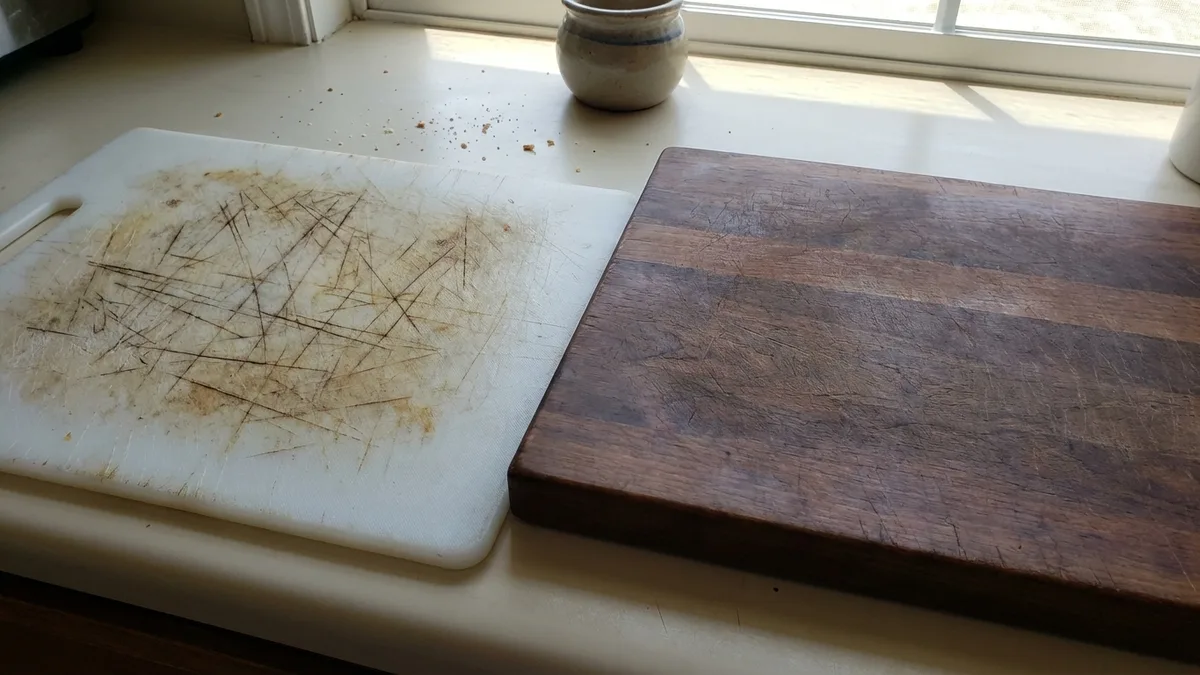
Our evaluation process: We cross-referenced each product against EWG databases, confirmed active certifications with issuing organizations, and reviewed available test reports. See our methodology Then I read a 2023 study from Environmental Science & Technology that changed how I think about my kitchen. Researchers found that deeply scored plastic cutting boards can release tens of millions of microplastic particles per year. If microplastics in drinking water concern you, the ones coming from your kitchen tools should too. Every time you drag a knife across that scratched-up polyethylene surface, tiny fragments break off and end up in your food.
Tens of millions. Into your dinner.
That was enough for me. I started researching the safest cutting boards I could find, and honestly, the rabbit hole goes deeper than I expected. Some bamboo boards use formaldehyde-based glues. Some “eco-friendly” boards are coated with questionable finishes. And even good wood boards need the right kind of oil to stay safe.
So I spent weeks testing and researching the best non-toxic cutting boards available in 2026. Here’s everything I found.
Quick Picks: Best Non-Toxic Cutting Boards at a Glance
| Cutting Board | Material | Best For | Price Range |
|---|---|---|---|
| John Boos Maple Edge Grain | Hard Maple | Best Overall | $$$ |
| Teakhaus Edge Grain | Teak | Best Value Hardwood | $$ |
| BoardSmith Walnut End Grain | Black Walnut | Best Premium Pick | $$$$ |
| Sonder Los Angeles | Acacia | Best for Aesthetics | $$ |
| Epicurean Kitchen Series | Wood Composite | Best Dishwasher-Safe | $$ |
| Royal Craft Wood Bamboo | Bamboo | Best Budget Pick | $ |
| Virginia Boys Kitchens Walnut | Walnut | Best Mid-Range Walnut | $$$ |
| Totally Bamboo Kauai | Organic Bamboo | Best Budget Bamboo | $ |
The Problem With Plastic Cutting Boards
What are you probably using right now?
Plastic cutting boards became popular because they’re cheap, lightweight, and you can throw them in the dishwasher. For years, food safety experts even recommended them over wood because they seemed more “sanitary.”
But the science has caught up, and the picture isn’t great.
That study I mentioned earlier, published in Environmental Science & Technology, tested common polyethylene and polypropylene cutting boards under normal kitchen use. The results were striking. A single board can shed between 14 million and 71 million microparticles annually, depending on how worn the surface is. The deeper the knife scars, the more particles you’re eating.
And here’s the thing that really got me: those microplastics are small enough to enter your bloodstream. Dr. Rhonda Patrick of FoundMyFitness has covered the microplastics problem extensively, noting that physical abrasion of plastic surfaces, whether from heating or cutting, releases significantly more particles than passive contact. A scratched-up cutting board is a textbook example. Much like PFAS forever chemicals, researchers are still figuring out exactly what that means for long-term health, but I don’t need to wait for a definitive answer to decide I’d rather chop my vegetables on something else.
There’s also the bacteria question. It turns out those old recommendations about plastic being more sanitary were wrong. Studies from UC Davis showed that wood cutting boards actually have natural antibacterial properties. Bacteria gets pulled down into the wood fibers and dies, while on plastic, bacteria sits in knife grooves and multiplies, even after washing.
Wood wins on both fronts. Less plastic in your food, fewer bacteria on your board.
Cutting Board Materials: A Honest Breakdown
Wood
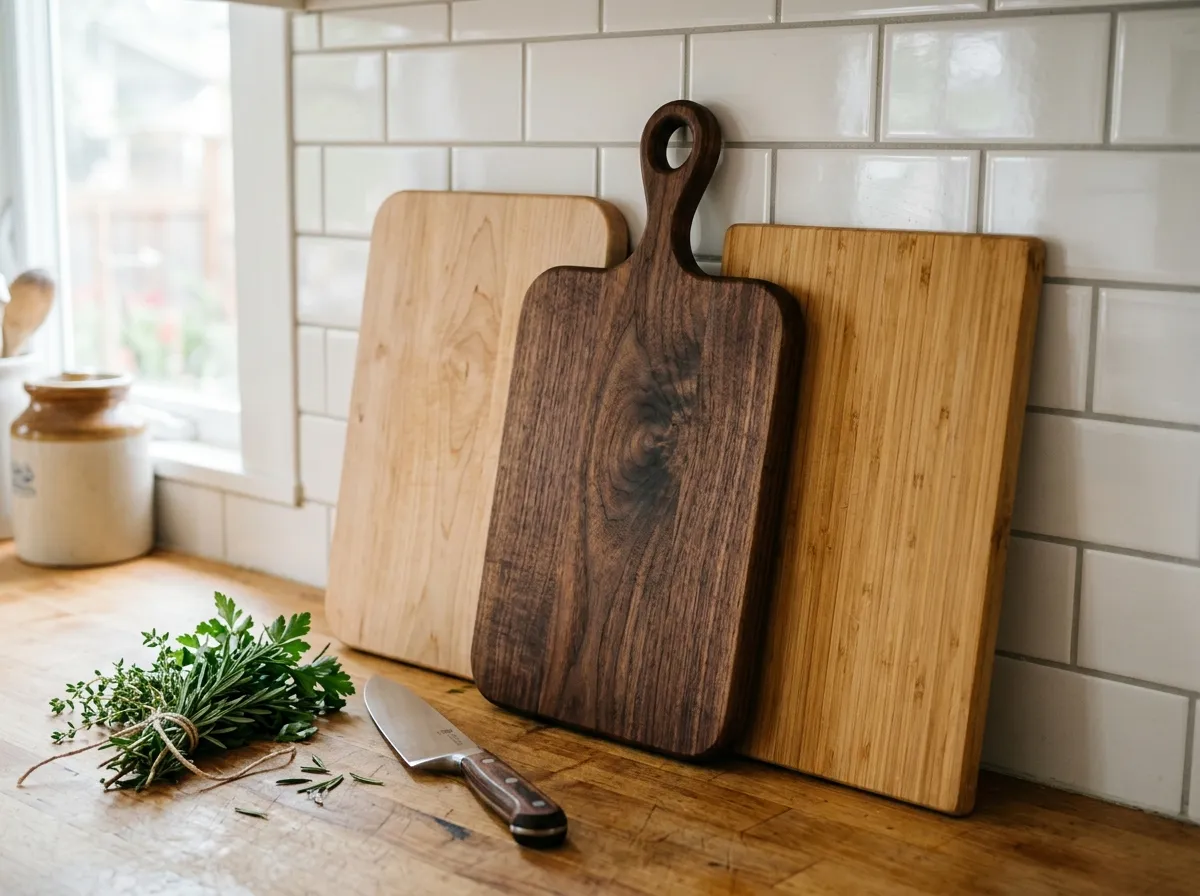
Wood is the gold standard for non-toxic cutting boards, and it has been for centuries. Hardwoods like maple, walnut, teak, and cherry are naturally food-safe, antimicrobial, and gentle on your knives.
There are two main construction types to know about:
Edge grain boards are made with strips of wood glued side by side, with the edge of the grain facing up. They’re durable, more affordable than end grain, and work great for everyday use.
End grain boards show the cut ends of the wood facing up, creating that classic checkerboard pattern. They’re self-healing (knife marks close up as the wood fibers spring back), gentler on knife edges, and last a lifetime. They’re also heavier and more expensive.
The key thing with wood boards: make sure they use food-safe glue. Most reputable manufacturers use FDA-approved adhesives, but it’s worth checking. And the finish matters too. You want boards finished with food-grade mineral oil or beeswax, not polyurethane or varnish.
Bamboo
Bamboo is technically a grass, not a wood, and it’s become hugely popular for cutting boards because it’s sustainable and affordable. But there’s a catch I think more people need to know about.
Bamboo is too narrow to make a cutting board from a single piece. So manufacturers cut it into thin strips and glue them together. The problem? Some of those glues contain formaldehyde, specifically melamine-formaldehyde or urea-formaldehyde resins.
Not all bamboo boards have this issue. Higher-quality brands use food-safe, formaldehyde-free adhesives. But cheap bamboo boards from unknown manufacturers? I’d be cautious. If the listing doesn’t specifically mention what kind of glue they use, that’s a red flag.
Bamboo is also harder than most woods, which sounds like a benefit but actually dulls your knives faster. Something to keep in mind.
Rubber
Natural rubber (like Hevea wood from rubber trees) is another solid non-toxic option. It’s gentle on knives, easy to clean, and naturally antibacterial. You’ll see it used in professional kitchens for a reason. The downside is that rubber boards are heavy, and they don’t have the visual appeal of a beautiful walnut or maple board. But functionally, they’re excellent.
Composite
Composite boards, like those made from Richlite (paper and resin compressed at high heat), occupy a gray area. They’re not plastic, but they’re not entirely natural either. I’ll address this honestly when I review the Epicurean board below.
8 Best Non-Toxic Cutting Boards (2026 Reviews)
1. John Boos Maple Edge Grain:Best Overall
If you want one cutting board that’ll handle everything and last for decades, this is it.
John Boos has been making cutting boards in Effingham, Illinois since 1887. Their maple edge grain boards are made from sustainably sourced Northern Hard Maple, one of the best cutting board materials available. The wood is naturally tight-grained, which means it resists moisture absorption and bacteria better than most species.
The boards come finished with John Boos Mystery Oil (a food-safe mineral oil blend) and their beeswax board cream. No questionable coatings, no weird chemicals. Just wood, oil, and wax.
I’ve used mine for over a year now, and the maple has developed a beautiful patina. It’s heavy enough to stay put on the counter but not so heavy that I dread pulling it out.
Pros:
- Made in the USA from sustainably sourced maple
- NSF certified for commercial food service
- Naturally antimicrobial
- Reversible
Cons:
- Needs regular oiling (monthly, ideally)
- Not dishwasher safe
- Higher price point than bamboo or plastic alternatives
2. Teakhaus Edge Grain:Best Value Hardwood
Teak is a remarkable wood. It’s naturally high in silica and oil content, which means it resists moisture and warping better than almost any other species. That’s why it’s been used in boatbuilding for centuries.
Teakhaus sources their teak from sustainably managed plantations (FSC certified), and their boards use food-safe, water-resistant glue. The edge grain construction keeps the price reasonable while still giving you the durability teak is known for.
One thing I appreciate about teak: it requires less oiling than maple or walnut because of its natural oil content. If you’re the type who forgets to maintain things (no judgment, I’m the same way), teak is more forgiving.
Pros:
- Teak’s natural oils resist moisture and bacteria
- FSC certified sustainable sourcing
- Lower maintenance than maple or walnut
- Excellent value for a hardwood board
Cons:
- Teak can dull knives slightly faster than softer woods
- Sourced internationally (if buying American-made matters to you)
- The color is a love-it-or-hate-it warm brown
3. BoardSmith Walnut End Grain:Best Premium Pick
This is the board you buy when you want the best and you’re willing to invest in it.
David Smith at The BoardSmith has been handcrafting end grain cutting boards in Florida for over 20 years. Each board is made from American Black Walnut, assembled with FDA-approved, food-safe glue, and finished with mineral oil.
The end grain construction is what really sets this apart. When you cut on an end grain board, the knife slips between the wood fibers instead of cutting across them. The fibers spring back together after each cut, making the board essentially self-healing. Your knife stays sharp longer, and the board shows fewer visible scars over time.
These boards are investment pieces. They’re not cheap. But they last a lifetime (literally, they come with care instructions that assume your grandchildren will use it too).
Pros:
- Handcrafted end grain construction
- Self-healing surface extends board life dramatically
- American Black Walnut is gorgeous and food-safe
- Made in the USA
Cons:
- Expensive (prices start around $200 for smaller sizes)
- Heavy, not great for everyday pulling-out-and-putting-away
- Requires regular oiling and proper care
4. Sonder Los Angeles Acacia:Best for Aesthetics
If your cutting board doubles as a serving board (or you just want something beautiful on your counter), Sonder LA makes some stunning acacia boards.
Acacia is a fast-growing hardwood with striking grain patterns. It’s harder than walnut but softer than maple, putting it in a nice middle ground for knife friendliness. Sonder’s boards use food-safe glues and come pre-treated with mineral oil.
A note on acacia: it’s less commonly discussed in cutting board circles than maple, walnut, or teak, but it’s a perfectly good choice. It’s naturally water-resistant and has decent antimicrobial properties. The main reason I rank it slightly below the top picks is that the grain can be somewhat inconsistent between boards, and some users report more warping than with maple or teak.
Pros:
- Beautiful, unique grain patterns
- Sustainable and fast-growing wood source
- Works well as both cutting and serving board
- Reasonably priced for a hardwood board
Cons:
- Acacia can be more prone to warping if not properly dried
- Grain hardness varies between boards
- Not as proven a track record as maple or walnut for heavy daily use
5. Epicurean Kitchen Series:Best Dishwasher-Safe Option (With Caveats)
I want to be transparent about this one.
Epicurean boards are made from Richlite, a composite material created by layering sheets of paper with food-safe resin and compressing them under extreme heat and pressure. The result is a thin, lightweight, dishwasher-safe board that’s NSF certified and knife-friendly.
The good: No BPA, no formaldehyde, no phthalates. NSF certified. Dishwasher safe, which is a real convenience factor that solid wood boards can’t match. Made in the USA.
The honest truth: It’s not a completely natural material. The resin used is a phenolic resin, which is considered food-safe once cured, but it’s still a synthetic component. If your goal is a 100% natural cutting surface, this isn’t it.
That said, it’s miles better than a plastic cutting board. It doesn’t shed microplastics, it’s more durable, and it doesn’t develop the deep knife grooves that harbor bacteria on polyethylene boards. I think of it as a good transitional option for people who aren’t ready to give up the convenience of a dishwasher-safe board.
Pros:
- Dishwasher safe (huge convenience factor)
- Thin and lightweight
- NSF certified, BPA-free
- Made in the USA
- No maintenance required
Cons:
- Not a fully natural material
- Contains cured phenolic resin
- Harder surface than wood (slightly less knife-friendly)
- Doesn’t have the warmth or beauty of real wood
6. Royal Craft Wood Bamboo:Best Budget Pick
If you’re watching your budget but still want to avoid plastic, a good bamboo board is the way to go. Royal Craft Wood makes one of the better options in the bamboo category.
Their boards are made from Moso bamboo with what the company states is formaldehyde-free glue. They come with a juice groove, which is handy for cutting juicy fruits or raw meat. The price is usually under $30, making these accessible for just about any budget.
Now, the caveats I mentioned about bamboo earlier still apply. Bamboo is harder on knives than maple or walnut. And while Royal Craft Wood says their glue is formaldehyde-free, bamboo boards in general don’t have the same level of transparency about adhesives that established wood board makers provide. I reached out to the company and they confirmed their boards use food-safe adhesive, but I couldn’t get specifics on the exact resin type.
For the price, it’s a solid choice. Just know that you’ll likely replace a bamboo board every 3 to 5 years, while a quality maple or walnut board can last 15 to 20 years or more.
Pros:
- Very affordable entry point
- Company states formaldehyde-free glue
- Bamboo is a highly renewable resource
- Lightweight and easy to handle
Cons:
- Harder on knives than wood alternatives
- Less transparency about adhesive specifics
- Won’t last as long as hardwood boards
- Can crack if not oiled periodically
7. Virginia Boys Kitchens Walnut:Best Mid-Range Walnut
Virginia Boys Kitchens hits a sweet spot that I think works for a lot of people. You get real American Walnut at a price point between the budget bamboo boards and the premium handcrafted options.
Their boards are made from sustainably sourced walnut, finished with organic walnut oil (not mineral oil, which is a nice touch for anyone trying to avoid petroleum-based products entirely). The company is based in Virginia and manufactures in the USA.
Walnut is naturally one of the best cutting board materials. It’s a medium-hardness wood that’s gentle on knives, naturally dark (so it doesn’t show stains as readily as maple), and it has good antimicrobial properties. The edge grain construction on these boards is solid and well-made.
Pros:
- Real American Walnut at a reasonable price
- Finished with organic walnut oil instead of mineral oil
- Made in the USA
- Rich, dark color hides stains well
Cons:
- Edge grain, not end grain (still good, just not as self-healing)
- Walnut is slightly softer than maple, which means it may show knife marks sooner
- Needs regular oiling to maintain the finish
8. Totally Bamboo Kauai:Best Budget Bamboo
Totally Bamboo has been in the bamboo cutting board business since 2000, which gives them more track record than most bamboo brands. Their Kauai board is a simple, affordable option made from organic bamboo (USDA certified, which is unusual for cutting boards).
The organic certification matters because it means the bamboo was grown without pesticides. It doesn’t, however, tell you everything about the manufacturing process. Totally Bamboo uses a formaldehyde-free adhesive for bonding the bamboo strips, and they finish the boards with food-safe oil.
Like all bamboo boards, this one is on the harder side and will dull knives faster than a wood board. But for $20 to $25, it’s hard to argue with the value, especially if you need multiple boards for different prep tasks.
Pros:
- USDA certified organic bamboo
- Formaldehyde-free adhesive
- Very affordable
- Established brand with long track record
Cons:
- Hard on knives
- Thinner than most wood boards
- Can warp or crack without regular oiling
- Won’t match the longevity of quality hardwood
How to Care for Your Non-Toxic Cutting Board
A good cutting board needs a little love. Here’s what I do with mine.
Cleaning
Wash your wood or bamboo board with warm water and mild dish soap after each use. Stick with a non-toxic cleaning product to avoid introducing unnecessary chemicals. That’s it. No soaking (water is wood’s enemy), no dishwasher (unless you have the Epicurean), and no harsh chemicals.
For deeper cleaning after cutting raw meat or strong-smelling foods, sprinkle coarse salt on the surface and rub it with half a lemon. The salt acts as a gentle abrasive, and the lemon’s acidity helps neutralize bacteria and odors. Rinse and dry immediately.
Always dry your board standing up so air circulates on both sides. This prevents warping.
Oiling
This is the step most people skip, and it’s the reason most wood boards crack or dry out prematurely.
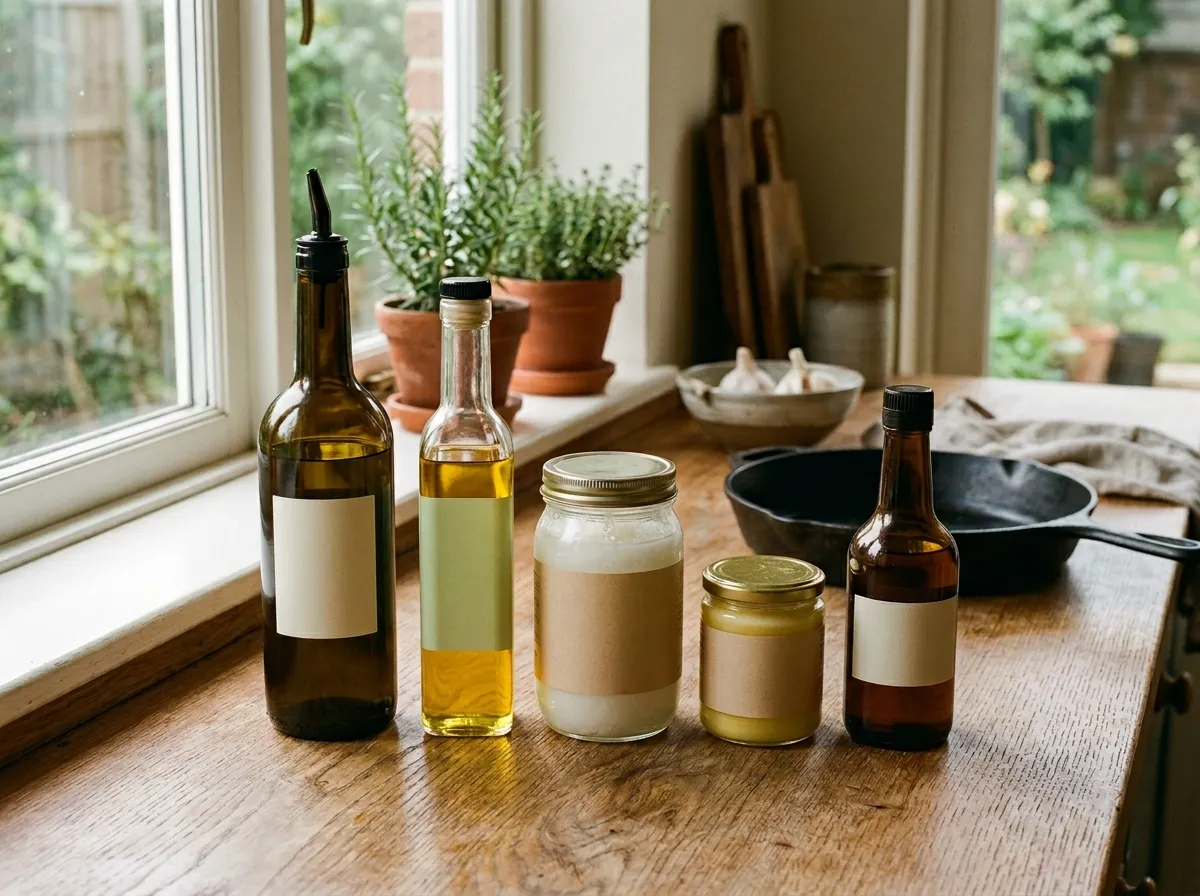
Use food-grade mineral oil or a board-specific oil (like walnut oil for walnut boards, or the Boos Mystery Oil for maple). Apply a generous amount to all surfaces, including the sides and bottom. Let it soak in for several hours or overnight, then wipe off any excess.
How often? Once a month is ideal for boards you use daily. Once every two to three months for boards used less frequently. A good test: if water no longer beads on the surface and instead soaks in quickly, your board needs oil.
Important: Never use olive oil, vegetable oil, or coconut oil on cutting boards. These cooking oils go rancid over time and will make your board smell terrible.
When to Replace
Wood boards rarely need replacing if maintained properly. But if your board has deep grooves that you can’t sand out, visible mold that’s penetrated the wood, or significant warping that makes it unstable, it’s time for a new one.
Bamboo boards typically need replacing sooner, usually every 3 to 5 years of regular use.
What About Rubber Cutting Boards?
I didn’t include a rubber board in the main reviews because the best options (like the Hasegawa and Asahi boards from Japan) are specialty items that most home cooks don’t need. But they’re worth mentioning.
Natural rubber cutting boards made from the Hevea tree are completely non-toxic and are the preferred choice in many professional kitchens. They’re soft enough to be very gentle on knife edges, naturally antibacterial, and extremely durable.
The downsides? They’re heavy, they’re not pretty, and they can’t go in the dishwasher. They also tend to develop a slight rubber smell when new (it fades). If you do a lot of precision knife work and care more about performance than aesthetics, look into them.
Common Questions
Are plastic cutting boards safe?
Traditional polyethylene cutting boards shed microplastic particles into your food, especially once they become scratched and scored from regular knife use. Research shows that a well-used plastic board can release millions of microparticles annually. While the long-term health effects of ingested microplastics are still being studied, many people (myself included) prefer to avoid this exposure entirely.
What is the safest cutting board material?
Solid hardwood, particularly maple, walnut, and teak, is considered the safest cutting board material. These woods are naturally antimicrobial, don’t shed harmful particles, and are food-safe when finished with mineral oil or beeswax. End grain construction is the safest and longest-lasting option.
Is bamboo safe for cutting boards?
Bamboo can be safe, but you need to check the adhesive. Because bamboo strips must be glued together, some manufacturers use formaldehyde-based glues. Look for boards that specifically state they use formaldehyde-free, food-safe adhesives. Brands like Totally Bamboo and Royal Craft Wood have made these commitments.
How often should I oil a wood cutting board?
For daily-use boards, once a month is the standard recommendation. Boards used less frequently can go two to three months between oilings. Use food-grade mineral oil, board butter, or an oil specified for your wood type. Never use cooking oils like olive or vegetable oil, as they will go rancid.
Can wood cutting boards go in the dishwasher?
No. The extreme heat and prolonged water exposure in a dishwasher will warp, crack, and ruin a wood cutting board. Always hand wash with warm water and mild soap, then dry immediately. The Epicurean composite board is the only option in this list that’s dishwasher-safe.
Do wood cutting boards harbor bacteria?
This is a common misconception. Studies from UC Davis found that wood cutting boards are actually more sanitary than plastic ones. Bacteria gets drawn down into wood fibers and dies, while on plastic boards, bacteria collects in knife scars and can multiply even after washing.
What’s the difference between edge grain and end grain cutting boards?
Edge grain boards show the long side of the wood strips on the cutting surface. They’re affordable and durable. End grain boards show the cut ends of the wood, creating a checkerboard pattern. End grain is self-healing (knife marks close up), gentler on knives, and longer-lasting, but costs significantly more.
Our Pick
Stanford neuroscientist Andrew Huberman has recommended reducing plastic contact with food as one of the simplest ways to lower your daily microplastic exposure. Swapping a plastic cutting board for wood is exactly the kind of simple, high-impact change he talks about.
Switching from plastic to a non-toxic cutting board is one of the simplest changes you can make in your kitchen. It pairs well with upgrading your cookware and food storage containers for a fully non-toxic kitchen. You’re reducing your microplastic exposure, getting a more sanitary surface, and investing in something that will genuinely last.
My top recommendation for most people is the John Boos Maple Edge Grain. It’s the best balance of quality, safety, and value. If you want the absolute best and don’t mind the investment, the BoardSmith Walnut End Grain is in a class of its own. And if budget is the priority, the Royal Craft Wood Bamboo gets the job done at a fair price.
Whatever you choose, your future self (and your dinner) will thank you for ditching the plastic.
Sources
- Patrick, Rhonda. “Microplastics.” FoundMyFitness, episodes and clips covering microplastic release from plastic surfaces.
- Huberman, Andrew. “How to Reduce Your Exposure to Microplastics & Nanoplastics.” Huberman Lab Podcast (2023). Stanford University.
Looking to make more non-toxic swaps in your kitchen? Check out our guides to the best non-toxic cookware, safest non-toxic food storage containers, and best non-toxic cleaning products.