When I wrote our main non-toxic cookware guide, the most common response I got was: “These are great, but I can’t spend $400 on a cookware set right now.” Fair. Caraway’s 12-piece set is beautiful, but not everyone has $445 sitting around for pots and pans.
Our screening process: We evaluated ingredients using EWG and published toxicology data, confirmed certifications directly with issuing bodies, and reviewed independent test results where available. Full methodology Here’s the thing: you don’t need to spend hundreds to cook on safe surfaces. Some of the best non-toxic cookware in the world costs under $50. Cast iron skillets have been around for centuries. Stainless steel tri-ply pans from Tramontina compete with All-Clad at a fraction of the price. Carbon steel is the workhorse of professional kitchens, and it’s shockingly affordable.
This guide covers the best individual pieces and starter sets under $100, all PFAS-free, all genuinely safe to cook on.
The Problem With Cheap Non-Stick Pans
Most budget cookware is cheap non-stick. The $20 pan set from a big-box store feels like a deal until you learn what the coating is made of.
Traditional non-stick coatings use PTFE (polytetrafluoroethylene), commonly known by the brand name Teflon. PTFE itself is relatively stable at normal cooking temperatures. The manufacturing concern was PFOA, a chemical used to make PTFE that was phased out by 2015 after it was linked to cancer and other health effects. But PFOA was replaced by GenX and other “short-chain” PFAS compounds, and early research suggests these replacements may carry similar risks.
Dr. Philip Landrigan, a pediatrician and epidemiologist who directs the Program for Global Public Health and the Common Good at Boston College, has written extensively about PFAS exposure through consumer products. His position is that the entire class of PFAS chemicals should be treated with caution, not just individual compounds that have been studied.
Beyond PFAS, cheap non-stick pans degrade. The coating scratches, chips, and eventually flakes into your food. When overheated (above 500 degrees F), PTFE coatings break down and release fumes that can cause flu-like symptoms in humans and are lethal to pet birds. That $20 pan isn’t a bargain if it’s shedding plastic particles into your scrambled eggs.
For a deeper look at Teflon specifically, see our guide on non-toxic alternatives to Teflon.
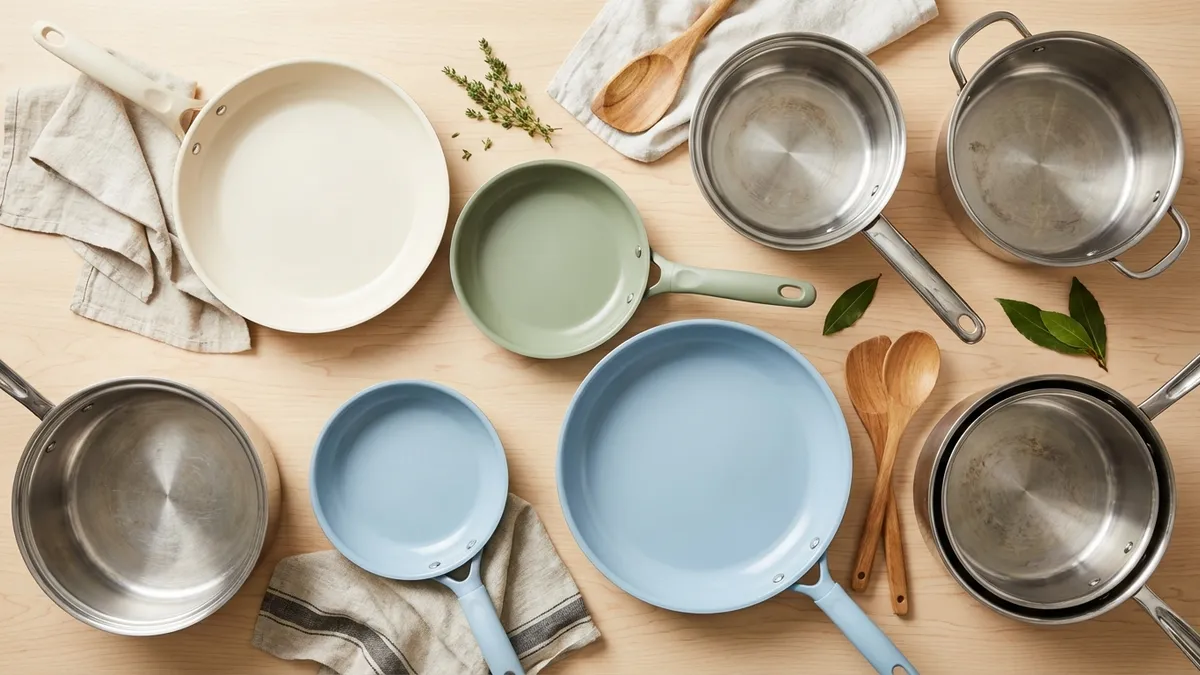
Materials That Are Actually Safe
Cast iron: Iron and carbon. That’s it. No coatings, no chemicals. When properly seasoned, cast iron develops a natural non-stick surface from polymerized cooking oil. It lasts essentially forever with minimal care.
Carbon steel: Similar to cast iron but thinner and lighter. Made from iron and a small amount of carbon. Seasons the same way, builds the same natural non-stick surface. Professional chefs prefer it for its responsiveness to heat changes.
Stainless steel: An alloy of steel, chromium, and nickel (in most formulations). Non-reactive, durable, and completely free of synthetic coatings. It’s not non-stick, but learning proper technique (preheating, using enough fat) makes it very capable.
Ceramic non-stick: The coating is made from inorganic minerals (silica-based) rather than PFAS compounds. GreenPan’s Thermolon coating is the most studied. Ceramic non-stick doesn’t last as long as PTFE coatings, but it’s a genuinely safer option when you want easy-release cooking. For a full breakdown, see our guide on whether ceramic cookware is safe.
The Best Non-Toxic Cookware Under $100
1. Lodge 10.25” Classic Cast Iron Skillet - Best Overall
Price: ~$30 | Material: Cast iron | Weight: 5 lbs | Oven Safe: Yes, any temperature
Lodge has been making cast iron in South Pittsburg, Tennessee since 1896. This is the pan I tell everyone to buy first. At $30, it’s one of the best values in all of cookware, non-toxic or otherwise.
It comes pre-seasoned with vegetable oil and is ready to use out of the box. The seasoning improves with every use. After a few months of regular cooking, it becomes genuinely non-stick for eggs, pancakes, and anything else you throw at it.
Cast iron does everything: sear steaks, bake cornbread, fry eggs, roast vegetables, make one-pan dinners. It goes from stovetop to oven smoothly. It retains heat like nothing else, which makes it excellent for getting a hard sear on protein.
What I like:
- $30 for cookware that will outlive you. Literally.
- Made in the USA for over a century
- Zero synthetic chemicals or coatings
- Gets better with age and use
- Works on every heat source including induction and campfires
What I don’t like:
- Heavy. Five pounds empty. Not for one-handed flipping
- Requires some maintenance (dry after washing, occasional re-seasoning)
- Not great with highly acidic foods like tomato sauce (can strip seasoning)
- Takes longer to heat evenly than multi-ply stainless
Pro tip: Don’t use soap on cast iron unless you’ve seriously burned something. Rinse with hot water, scrub with a chain mail scrubber or stiff brush, dry immediately, and apply a thin layer of oil. That’s the whole routine.
2. Tramontina Tri-Ply Clad Stainless Steel 10” Fry Pan - Best Stainless Steel
Price: ~$35 | Material: 18/10 stainless steel with aluminum core | Weight: 2.1 lbs | Oven Safe: Up to 500F
Tramontina’s tri-ply stainless pans have been America’s Test Kitchen’s recommended budget stainless steel for years, and they’ve earned it. The construction is tri-ply (stainless exterior, aluminum core, stainless interior) which gives you even heat distribution comparable to pans costing $100-$200.
Stainless steel has a learning curve. Food sticks if you don’t preheat properly or use enough fat. But once you learn the technique, it’s an incredibly versatile cooking surface. The fond (browned bits) that builds up on stainless is the base for deglazing and making pan sauces, something you can’t do with non-stick.
What I like:
- Tri-ply construction at a $35 price point is wild
- Dishwasher safe
- Completely non-reactive. Cook acidic foods all day
- No coatings to degrade or replace
- The cooking surface is inert stainless steel. Nothing leaches at normal cooking temperatures
What I don’t like:
- Not non-stick. Eggs will stick until you master the technique
- Can develop water spots and discoloration (cosmetic, not functional)
- Handle gets hot on high heat
- Takes practice to use well
3. Lodge 12” Carbon Steel Skillet - Best Carbon Steel
Price: ~$45 | Material: Carbon steel | Weight: 3.5 lbs | Oven Safe: Yes, any temperature
Carbon steel is what you get when you want the natural seasoning properties of cast iron but lighter and more responsive. It’s about 30% lighter than an equivalent cast iron pan and heats up faster. Professional wok cooking is done on carbon steel for exactly this reason.
Lodge’s carbon steel skillet comes pre-seasoned, just like their cast iron. The seasoning process and maintenance are identical. Over time, it develops the same natural non-stick patina that cast iron does.
Where carbon steel really shines is high-heat cooking. Searing, stir-frying, and charring vegetables are all better on carbon steel because the pan responds to heat changes faster than cast iron. If you already have a cast iron skillet, a carbon steel pan is the ideal complement.
What I like:
- Lighter than cast iron with similar cooking properties
- Seasons naturally like cast iron
- Excellent for high-heat techniques
- Simple composition: iron and carbon
- Long sloped sides make it easy to toss and flip food
What I don’t like:
- Requires the same maintenance as cast iron (drying, oiling)
- Not dishwasher safe
- Can warp on very high heat if the pan is thin (Lodge’s is thick enough to resist this)
- Same acid sensitivity as cast iron
4. Lodge 5-Quart Cast Iron Dutch Oven - Best Dutch Oven
Price: ~$65 | Material: Cast iron | Weight: 11 lbs | Oven Safe: Yes, any temperature
A dutch oven is arguably the most versatile pot in any kitchen. Soups, stews, braised meats, chili, bread baking, deep frying. Lodge’s bare cast iron version does all of it for $65, which is remarkable when Le Creuset’s enameled equivalent costs $420.
The tradeoff versus enameled cast iron: bare cast iron needs seasoning maintenance and isn’t great with acidic foods for long cook times. If you’re making tomato-heavy dishes regularly, an enameled option is better for that specific use. But for 90% of dutch oven cooking, bare cast iron is just as effective.
What I like:
- $65 for a heavy-duty dutch oven. Le Creuset’s version is $420
- Works as a bread oven (professional bakers use lodge dutch ovens for sourdough)
- Self-basting lid design
- Comes pre-seasoned
What I don’t like:
- Extremely heavy at 11 pounds empty
- Not ideal for long-simmering acidic dishes
- Bare iron can react with some foods (wine-based braises, tomato sauces)
- No enamel means it’s harder to clean baked-on food
5. GreenPan Mini Ceramic Non-Stick 8” Fry Pan - Best Ceramic Non-Stick
Price: ~$30 | Material: Recycled aluminum with Thermolon ceramic coating | Weight: 1.3 lbs | Oven Safe: Up to 600F
If you specifically need a non-stick surface for eggs, crepes, or delicate fish, GreenPan’s ceramic coating is the safest option in the budget range. Their Thermolon coating is silica-based (derived from sand), contains no PFAS, PFOA, lead, or cadmium, and has been independently tested.
Ceramic non-stick does wear out faster than PTFE. Expect 1-3 years of good non-stick performance with proper care versus 3-5 years for PTFE. But considering you’re not ingesting PFAS compounds, that tradeoff is worth it.
What I like:
- Genuine PFAS-free non-stick performance
- Lightweight and easy to handle
- Good for anyone who can’t or won’t learn cast iron technique
- Made from recycled aluminum
- Affordable enough to replace when the coating wears out
What I don’t like:
- Ceramic coating will degrade over time. This isn’t a lifetime pan
- Don’t use cooking spray (it builds up a residue that kills the non-stick)
- Don’t use metal utensils
- 8” is small. Most people will want a 10” or 12” eventually
6. Tramontina 5-Piece Tri-Ply Clad Set - Best Budget Set
Price: ~$99 | Material: 18/10 stainless steel with aluminum core | Oven Safe: Up to 500F
If you want a matching set instead of individual pieces, Tramontina’s 5-piece tri-ply set at $99 is the move. You get a 10” fry pan, 2-quart saucepan with lid, and 5-quart dutch oven with lid. That covers about 80% of home cooking tasks.
The construction is the same tri-ply clad as the individual pan reviewed above. These aren’t cheaper versions made to hit a set price point. They’re the same quality.
What I like:
- $99 for a complete starter set is exceptional value
- Same tri-ply construction as their $35 individual pan
- Covers the three essential pieces (fry pan, saucepan, stockpot/dutch oven)
- Dishwasher safe
- No coatings to worry about
What I don’t like:
- Five pieces means three pans and two lids. It’s a minimal set
- Stainless steel learning curve applies to every piece
- No non-stick option for eggs
- Handles can get hot
Starter Kitchen Strategy: $100 Budget
Here’s how I’d spend $100 on non-toxic cookware if I were starting from scratch.
Option A: Cast Iron + Stainless ($65)
- Lodge 10.25” Cast Iron Skillet ($30)
- Tramontina Tri-Ply 10” Fry Pan ($35)
- Total: $65, with $35 left for a saucepan later
Option B: The Full Set ($99)
- Tramontina 5-Piece Tri-Ply Clad Set ($99)
- Covers frying, sauces, and soups in one purchase
Option C: Cast Iron + Ceramic ($60)
- Lodge 10.25” Cast Iron Skillet ($30)
- GreenPan 8” Ceramic Fry Pan ($30)
- Total: $60. Cast iron for everything heavy-duty, ceramic for eggs and delicate cooking
Any of these options gives you a completely PFAS-free kitchen for the cost of one premium pan from a high-end brand.
If you’re also looking at non-toxic food storage, safe cutting boards, or non-toxic cooking oils, those guides cover the rest of a clean kitchen setup.
Frequently Asked Questions
Is cast iron cookware really non-toxic?
Yes. Cast iron is made from iron and carbon. When seasoned, the cooking surface is a layer of polymerized oil, which is food-safe. Cast iron does leach small amounts of dietary iron into food, especially with acidic dishes. For most people, this is either neutral or mildly beneficial. If you have hemochromatosis (iron overload disorder), talk to your doctor about cast iron use.
Does stainless steel leach nickel?
Standard 18/10 stainless steel (18% chromium, 10% nickel) can leach trace amounts of nickel and chromium, particularly with acidic foods cooked for long periods. For the vast majority of people, the amounts are negligible and well within safe limits. People with diagnosed nickel allergies may want to choose nickel-free stainless (18/0) or stick with cast iron and carbon steel.
How long does ceramic non-stick last?
With proper care (no metal utensils, no cooking spray, hand-washing, no extreme heat), ceramic non-stick coatings typically perform well for 1-3 years. After that, food starts sticking more. This is the main tradeoff compared to PTFE coatings, which last longer. At $30 for a GreenPan, replacing it every 2-3 years is still cheaper than medical bills from PFAS exposure. That’s a joke. Sort of.
What about enameled cast iron under $100?
Lodge makes enameled cast iron dutch ovens in the $60-$80 range. The enamel coating is glass-based and non-reactive, making it safe for acidic foods. It’s a solid middle ground between bare cast iron and premium brands like Le Creuset. We mention Le Creuset in our main cookware guide for comparison, but Lodge’s enameled line is the budget winner.
Can I put cast iron in the dishwasher?
No. Dishwasher detergent will strip the seasoning. Wash cast iron by hand with hot water and a brush or scrubber. Dry immediately and apply a thin layer of oil. If you want dishwasher-safe cookware, stainless steel is your best option.
Is non-toxic cookware harder to cook with?
Stainless steel and cast iron have a learning curve compared to non-stick. Food sticks more until you learn proper heat management and fat usage. But millions of professional chefs cook exclusively on stainless and cast iron because these materials perform better at high heat and produce better searing, browning, and fond development. The learning curve takes about a week of regular cooking.
Final Verdict
You don’t need a big budget to cook on safe surfaces. A $30 Lodge cast iron skillet and a $35 Tramontina stainless steel pan give you a completely non-toxic two-pan kitchen for $65. Add a GreenPan ceramic for eggs and you’re at $95 with every cooking scenario covered.
The expensive part of non-toxic cooking isn’t the cookware. It’s the marketing. Cast iron and stainless steel have been the safest cooking surfaces for generations. They just don’t have Instagram-worthy branding or influencer partnerships. That’s fine. They work better anyway.
Last updated: March 2027. Prices may vary. We independently research and test the products we recommend. When you purchase through our links, we may earn a commission at no extra cost to you.