Based on NonToxicLab’s research, your cat uses the litter box several times a day, and the material matters more than most owners realize. She digs in the litter, kicking up dust that she inhales. She walks through it, and the litter sticks between her toes. Then she grooms her paws, ingesting whatever was clinging to them. This cycle happens multiple times daily, every day, for her entire life. For specific product picks, check best non-toxic dog bed.
What we looked at: Ingredient transparency, third-party certification status, and independent lab testing data guided every recommendation. Our full methodology You’re exposed too. Every time you scoop, pour, or disturb the litter box, dust becomes airborne in your home. In a small bathroom or laundry room with poor ventilation, that dust lingers. See our top picks in best non-toxic dog food brands.
The litter you choose matters. And most conventional litters have problems that neither the packaging nor the marketing will tell you about.
The Problems with Conventional Cat Litter
Sodium Bentonite Clay and Silicosis Risk
The most common type of cat litter in the United States is clumping clay litter made from sodium bentonite. It’s cheap, it clumps well, and it controls odor reasonably. It’s also a source of respirable crystalline silica dust.
Sodium bentonite is a naturally occurring clay that’s strip-mined. In its natural state and when processed into cat litter, it contains varying amounts of crystalline silica (quartz). When the litter is disturbed (poured, scooped, dug through by your cat), fine silica dust becomes airborne.
Crystalline silica dust is classified as a Group 1 carcinogen by IARC (the International Agency for Research on Cancer). Chronic inhalation of crystalline silica causes silicosis, an irreversible lung disease. Occupational exposure standards for workers in mining, construction, and manufacturing are strict because the health effects are well-documented.
Does the amount of silica dust from a litter box pose the same risk as occupational exposure in a mine? No. The concentrations are much lower. But the exposure is chronic and cumulative. Your cat inhales this dust every time she uses the box. You inhale it every time you scoop. Over years, that cumulative exposure adds up, particularly for cats (smaller lungs, higher respiratory rate relative to body weight) and for people who manage litter boxes in small, enclosed spaces.
Low-dust clay litters like Dr. Elsey’s produce significantly less airborne dust than cheap clay brands. But they still contain sodium bentonite, and “low dust” is not “no dust.” If you want to eliminate silica dust exposure entirely, you need to move away from clay.
Silica Gel Litter Concerns
Crystal or silica gel litter (the translucent beads) is made from silicon dioxide, the same compound as quartz but in an amorphous rather than crystalline form. Amorphous silica is generally considered less hazardous than crystalline silica, but it still produces dust, particularly as the beads break down with use.
Some silica gel litters also contain cobalt chloride as a moisture indicator (the beads change color when saturated). Cobalt chloride is classified as a Category 1B carcinogen by the EU. Not all silica gel litters use it, but many don’t disclose whether they do.
Silica gel litter doesn’t clump. Used portions must be stirred to distribute moisture, and the entire tray is replaced periodically. During stirring, dust is released. The beads can also be rough on sensitive paw pads.
Fragrance and Additives
Many conventional litters add synthetic fragrance to mask odor. This creates the same problem as fragranced cleaning products: undisclosed chemical compounds in the air your cat breathes while standing in the box. Cats have a much more sensitive sense of smell than humans, and strong fragrance in litter can actually deter some cats from using the box (which creates a different set of problems).
Baking soda is a common and generally safe odor-control additive. But artificial fragrances, deodorizing crystals, and “odor-eliminating” chemicals should be avoided, especially in homes with cats who have respiratory sensitivities.
Clumping Agents
Some non-clay clumping litters use sodium carboxymethyl cellulose or guar gum as clumping agents. These are generally considered safe. However, there have been concerns about very young kittens ingesting clumping litter and experiencing gastrointestinal blockages. For kittens under 3-4 months, non-clumping litter is recommended regardless of the material.
Plant-Based Alternatives: What’s Available
The plant-based litter market has expanded dramatically. Options now include wood, corn, wheat, walnut shell, grass, soy, cassava, paper, and tofu. Each has strengths and weaknesses.
Wood-Based Litter
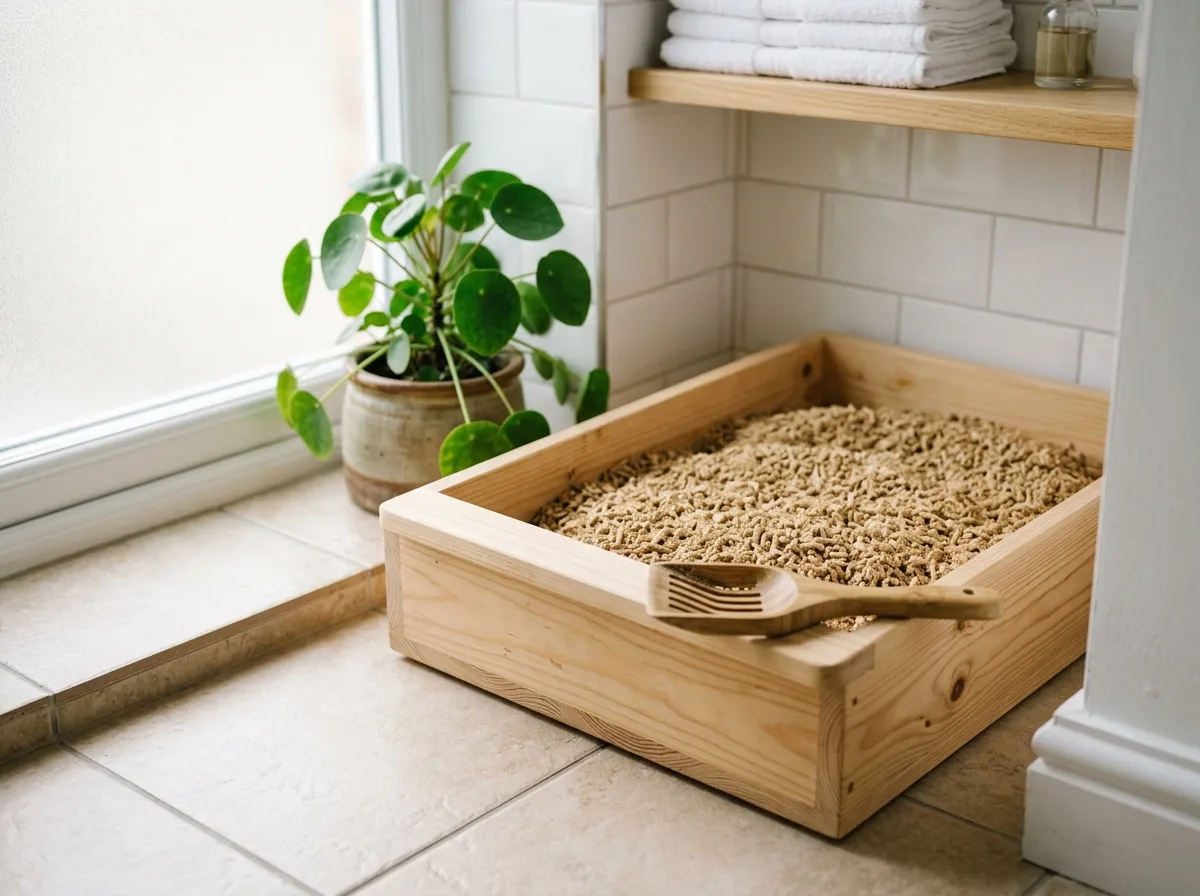
Made from compressed wood fiber (usually pine, cedar, or mixed softwoods). Excellent natural odor control because the wood absorbs and neutralizes ammonia. Very low dust. Biodegradable and often compostable.
The main downside is tracking. Wood litter tends to produce fine sawdust that sticks to paws and gets tracked around the house. Some brands are better than others at minimizing this.
Pine litter has a natural pine scent that some people find pleasant. Cats generally don’t seem to mind it, though it’s worth monitoring if your cat is sensitive to scents.
Corn-Based Litter
Made from whole-kernel corn or corn cob. Clumps well, controls odor through natural enzymes, and produces minimal dust. Corn litter is one of the most popular plant-based options because it behaves most similarly to traditional clay (it clumps, scoops, and controls odor in familiar ways).
The concern with corn-based litter is aflatoxins, naturally occurring mold toxins that can develop on corn. Reputable brands test for aflatoxin contamination, but cheap or poorly stored corn litters could potentially harbor mold. Store corn-based litter in a dry, cool place, and don’t use it if it develops an off smell or visible mold.
Walnut Shell Litter
Made from ground walnut shells. Dark colored (which some people find aesthetically preferable in a litter box). Good clumping and odor control. Low dust.
The concern: some cats are allergic to tree nuts. If your cat shows signs of irritation (paw licking, sneezing, avoiding the box) after switching to walnut litter, switch to a non-nut alternative.
Grass and Wheat Litter
Made from dried grass seed or wheat. Both clump reasonably well and produce low dust. They’re lightweight, which makes carrying and pouring easier. Odor control is moderate, better than paper but not as strong as wood or corn.
Tofu and Soy Litter
Newer to the market. Made from soy fiber or tofu by-products. Very low dust, decent clumping, and lightweight. Some brands add green tea extract for natural odor control. These are gaining popularity but have less track record than wood and corn options.
The 5 Best Non-Toxic Cat Litters
1. okocat Original Premium Clumping Wood Litter - Best Overall
Price: $22 for 19.8 lbs | Material: Sustainably sourced wood fiber | Dust: Very low
okocat (styled with a lowercase “o”) makes plant-based litters from sustainably sourced wood fiber. Their Original Premium formula is my top recommendation because it gets the fundamentals right: it clumps well, controls odor effectively, produces minimal dust, and contains no silica, no clay, no chemicals, and no fragrance.
The clumps form quickly and hold together during scooping, which is a common weakness of plant-based litters. The wood fiber naturally absorbs ammonia, which is the primary source of litter box odor. In my testing, a box with okocat stayed smelling neutral for 3-4 days between changes in a single-cat household, comparable to good clay litters.
Dust is nearly nonexistent. When pouring a fresh bag, there’s a faint cloud of wood fiber dust that settles immediately. It’s categorically different from the persistent plume you get when pouring clay litter. For anyone concerned about respiratory exposure (and you should be, based on the silica data above), this is a significant improvement.
Tracking is moderate. The wood particles are larger than clay granules, so they stick less to paws, but some tracking still occurs. A litter mat in front of the box catches most of it.
okocat is flushable in small amounts (check local regulations, as some municipalities don’t recommend flushing any cat waste due to Toxoplasma concerns). It’s also compostable, though cat waste should only be composted in dedicated systems, not garden compost.
Pros: Excellent odor control, very low dust, no chemicals, sustainable sourcing, flushable/compostable Cons: Moderate tracking, slightly less clump strength than premium clay, lighter weight means cats can kick it out of the box
2. World’s Best Cat Litter (Original Unscented) - Best Corn-Based
Price: $25 for 28 lbs | Material: Whole-kernel corn | Dust: Low
World’s Best Cat Litter has been the leading plant-based alternative to clay for years, and their Original Unscented formula remains excellent. It’s made from whole-kernel corn that’s compressed into granules. The natural corn enzymes neutralize ammonia odor, and the clumping is tight and easy to scoop.
Dust is low but not as low as okocat. There’s a faint corn-dust cloud when pouring that’s significantly less than clay but noticeable. For people with severe dust sensitivities, okocat or Tuft + Paw are better choices. For most people, the dust level is perfectly acceptable.
The clumping performance is the strongest of any plant-based litter I’ve tested. Clumps form quickly, hold together well, and don’t stick to the bottom of the box (a common complaint with clay litters and some corn litters). Scooping is clean and efficient.
World’s Best is widely available at pet stores, grocery stores, and online retailers. This accessibility is a genuine advantage because you can pick it up in person rather than waiting for shipping. They also offer multi-cat formulas with enhanced odor control and a lavender-scented version (which I’d skip, as the fragrance is unnecessary and may irritate sensitive cats).
At $25 for 28 lbs, the price per pound is competitive with premium clay litters. You’ll typically use similar amounts per week.
Pros: Excellent clumping, strong odor control, widely available, good value, corn-based and renewable Cons: Slight dust when pouring, potential aflatoxin concern (managed by reputable brands), heavier than some plant-based options
3. Sustainably Yours Natural Cat Litter - Best Multi-Cat
Price: $20 for 26 lbs | Material: Corn and cassava | Dust: Low
Sustainably Yours uses a blend of corn and cassava starch to create a litter that clumps fast and tight. The cassava component is what sets it apart because it forms clumps in seconds (faster than most plant-based litters) and the clumps are surprisingly hard, which means they don’t break apart during scooping and contaminate the rest of the litter.
For multi-cat households, this fast-clumping performance matters. When multiple cats use the same box, clumps need to form and harden quickly before the next cat uses it. Slow-forming clumps get trampled, mix with clean litter, and make the box harder to maintain. Sustainably Yours addresses this real-world problem better than most alternatives.
Odor control is good, not quite as strong as World’s Best but adequate for a multi-cat setup with daily scooping. The litter is unscented, which cats prefer and which eliminates the synthetic fragrance concern.
At $20 for 26 lbs, this is the most affordable plant-based option on the list. The value is excellent, especially for multi-cat homes that go through litter quickly.
Pros: Fast clumping, hard clumps resist breaking, affordable, works well in multi-cat households, no fragrance Cons: Odor control slightly weaker than some competitors, less widely available than World’s Best
4. Dr. Elsey’s Precious Cat Ultra - Best Low-Dust Clay (With Caveats)
Price: $18 for 40 lbs | Material: Sodium bentonite clay | Dust: Low (for clay)
I’m including a clay litter on this list because some cats refuse plant-based alternatives, and some cat owners aren’t ready to make the switch. If you’re going to use clay, Dr. Elsey’s is the best option.
Dr. Elsey’s Ultra is a premium clay litter that’s specifically engineered for low dust. It produces noticeably less airborne particulate than standard clay brands like Tidy Cats or Fresh Step. The clumping is excellent (hard, tight clumps that don’t stick to the box), odor control is strong, and the price per pound is very reasonable at $18 for 40 lbs.
The caveats: It’s still sodium bentonite clay, which means it still contains crystalline silica. “Low dust” is relative to other clay litters, not to plant-based alternatives. And it’s strip-mined, which has environmental implications. It’s also heavy, at 40 lbs per bag.
If your cat categorically refuses plant-based litter (some cats don’t like the texture or smell), Dr. Elsey’s is a reasonable compromise. But if you can transition your cat to a plant-based option, you’ll eliminate the silica concern entirely.
Transitioning tip from Dr. Elsey’s themselves: Mix 75% old litter with 25% new litter for the first week. Then 50/50 for a week. Then 25/75. Then fully switch. Gradual transitions work better than sudden changes for most cats.
Pros: Best clay litter available, excellent clumping and odor control, low dust for clay, very affordable Cons: Still clay with silica concerns, heavy, strip-mined, not biodegradable
5. Tuft + Paw Really Great Cat Litter - Best Premium Plant-Based
Price: $35 for 8 lbs | Material: Soy and pea fiber | Dust: Virtually zero
Tuft + Paw entered the litter market as a premium direct-to-consumer brand, and their product lives up to the name. Really Great Cat Litter is made from soybean and pea fiber, and it produces the least dust of any litter I’ve tested. When pouring, there is essentially no visible dust cloud. For people with asthma, dust allergies, or respiratory concerns, this is as clean as it gets.
The other standout feature is tracking control. The pellets are designed to be heavy enough that they fall off paw pads as the cat exits the box. Every plant-based litter claims “low tracking,” but Tuft + Paw actually delivers on it. My test cat (a long-haired breed who tracks everything) left noticeably less litter outside the box with this product.
Clumping is solid. Odor control is good, aided by natural plant-based enzymes. The pellet size is slightly larger than traditional litter granules, which some cats need a day or two to adjust to.
The price is the obstacle. At $35 for 8 lbs, this is the most expensive litter on the list by a wide margin. For a single-cat household, a bag lasts about 3-4 weeks. For multi-cat households, the cost scales uncomfortably. It’s a premium product at a premium price, and you’re paying for the virtually dust-free experience and better tracking control.
If dust is your primary concern and budget isn’t a constraint, this is the best product available. If you need value, okocat or World’s Best deliver 80-90% of the benefit at a fraction of the cost.
Pros: Virtually dust-free, best tracking control, clean ingredient list, pleasant to use Cons: Very expensive per pound, smaller bags mean more frequent purchasing, pellet size may require cat adjustment
Odor Control Without Chemicals
One of the main reasons people stick with conventional clay litter is odor control. Here are strategies for managing litter box odor without chemical additives:
Scoop daily. This is the single most effective odor management strategy. Removing waste promptly prevents ammonia buildup.
Baking soda. Sprinkle a thin layer on the bottom of the litter box before adding litter. Baking soda is safe for cats and absorbs odor effectively.
Proper box placement and ventilation. A litter box in a small, enclosed space with no airflow will smell worse than one in an open, ventilated area. If the box is in a bathroom, run the vent fan.
Enough litter depth. Maintain 2-3 inches of litter in the box. Too shallow means waste reaches the bottom and odor builds faster.
Regular box replacement. Plastic litter boxes absorb odor over time because the plastic gets scratched and harbors bacteria. Replace the box itself every 6-12 months, or switch to a stainless steel box that can be sanitized.
Air purifier nearby. A small air purifier near the litter box with an activated carbon filter handles residual odor.
Your Questions Answered
Is clay cat litter toxic?
Clay litter is not acutely toxic, meaning it won’t poison your cat from a single use. The concern is chronic exposure to crystalline silica dust over years. Silica is a known carcinogen when inhaled as fine dust over extended periods. Low-dust clay litters reduce this risk but don’t eliminate it. Plant-based litters avoid the concern entirely.
Can cat litter cause respiratory problems in cats?
Dusty litter can contribute to respiratory irritation in cats, especially those with pre-existing conditions like feline asthma. Cats with respiratory issues should be on low-dust or dust-free litter. Plant-based litters (especially okocat and Tuft + Paw) produce significantly less airborne dust than clay.
Is silica gel cat litter safe?
Silica gel litter contains amorphous silica, which is generally considered less hazardous than the crystalline silica in clay litter. However, it still produces dust as the beads break down, and some brands contain cobalt chloride (a carcinogen) as a moisture indicator. It’s not the worst option, but plant-based litters are cleaner.
How do I switch my cat to a new litter?
Gradual transition over 2-3 weeks. Start by mixing 25% new litter with 75% old litter. Each week, increase the proportion of new litter. Most cats accept the change without issues when it’s done gradually. Some cats are pickier. If your cat avoids the box during transition, slow down the ratio changes.
Can I flush plant-based cat litter?
Many plant-based litters (okocat, World’s Best, Sustainably Yours) are technically flushable. However, some municipalities advise against flushing any cat waste because of Toxoplasma gondii, a parasite shed in cat feces that can survive wastewater treatment and affect marine wildlife. Check your local guidelines.
How often should I completely change the litter?
With daily scooping, a complete litter change every 2-4 weeks is typical for plant-based litters. Clay litter may go slightly longer between full changes because of its stronger clumping. When you change the litter, wash the box with warm water and mild soap (no harsh chemicals) before refilling.
What about paper-based litter?
Recycled paper litter (like Yesterday’s News) is non-toxic, low-dust, and absorbent. It doesn’t clump, which makes scooping solid waste easy but liquid waste management more difficult (you stir or replace rather than scoop). It’s often recommended post-surgery when cats shouldn’t use dusty litter that could irritate wounds. For everyday use, wood and corn litters offer better odor control and clumping.
The Simplest Choice
The best non-toxic cat litter for most households is okocat Original Premium. It clumps well, controls odor, produces minimal dust, and contains no silica, no chemicals, and no fragrance. If you prefer corn-based litter, World’s Best Cat Litter is excellent and widely available.
If you have a multi-cat household and need fast-clumping performance at a reasonable price, Sustainably Yours is the value pick. And if dust is your primary concern and budget is not, Tuft + Paw is the cleanest option available.
For those not ready to leave clay, Dr. Elsey’s Precious Cat Ultra is the best clay litter on the market, but I’d encourage a gradual transition to plant-based when you can. Your cat’s lungs and your lungs will benefit.
For more on reducing your pet’s overall chemical exposure, see our non-toxic pet care guide and our guide to non-toxic cleaning products for homes with pets.
Last updated: February 2027. Prices may vary. We independently research and test the products we recommend. When you purchase through our links, we may earn a commission at no extra cost to you.
Sources
- IARC. “Silica, Some Silicates, Coal Dust and para-Aramid Fibrils.” IARC Monographs on the Evaluation of Carcinogenic Risks to Humans, Vol. 68. 1997.
- OSHA. “Silica, Crystalline - Overview.” osha.gov.
- ECHA. “Cobalt dichloride - Substance Information.” CLP Classification, 2018.
- Litster, A., et al. “Feline bacterial urinary tract infections: An update on an evolving clinical problem.” The Veterinary Journal, 2011.