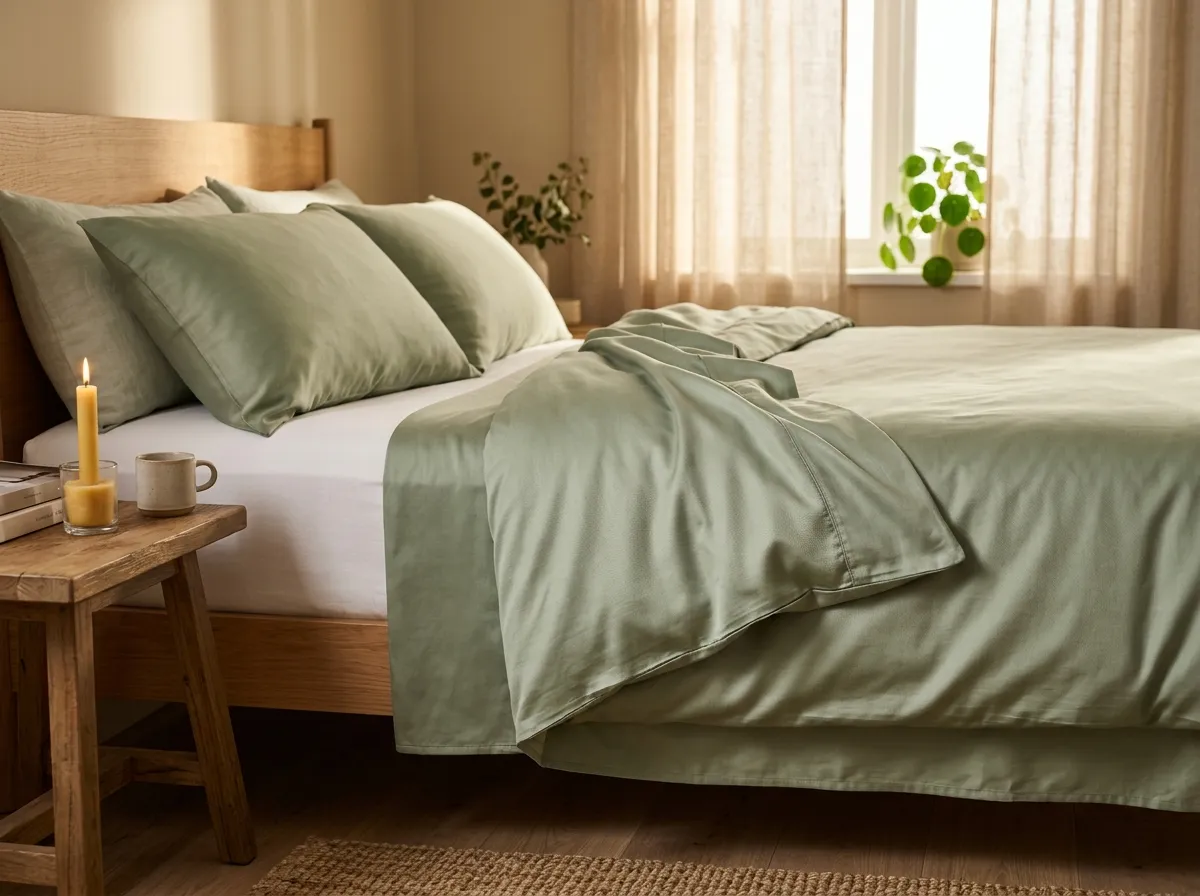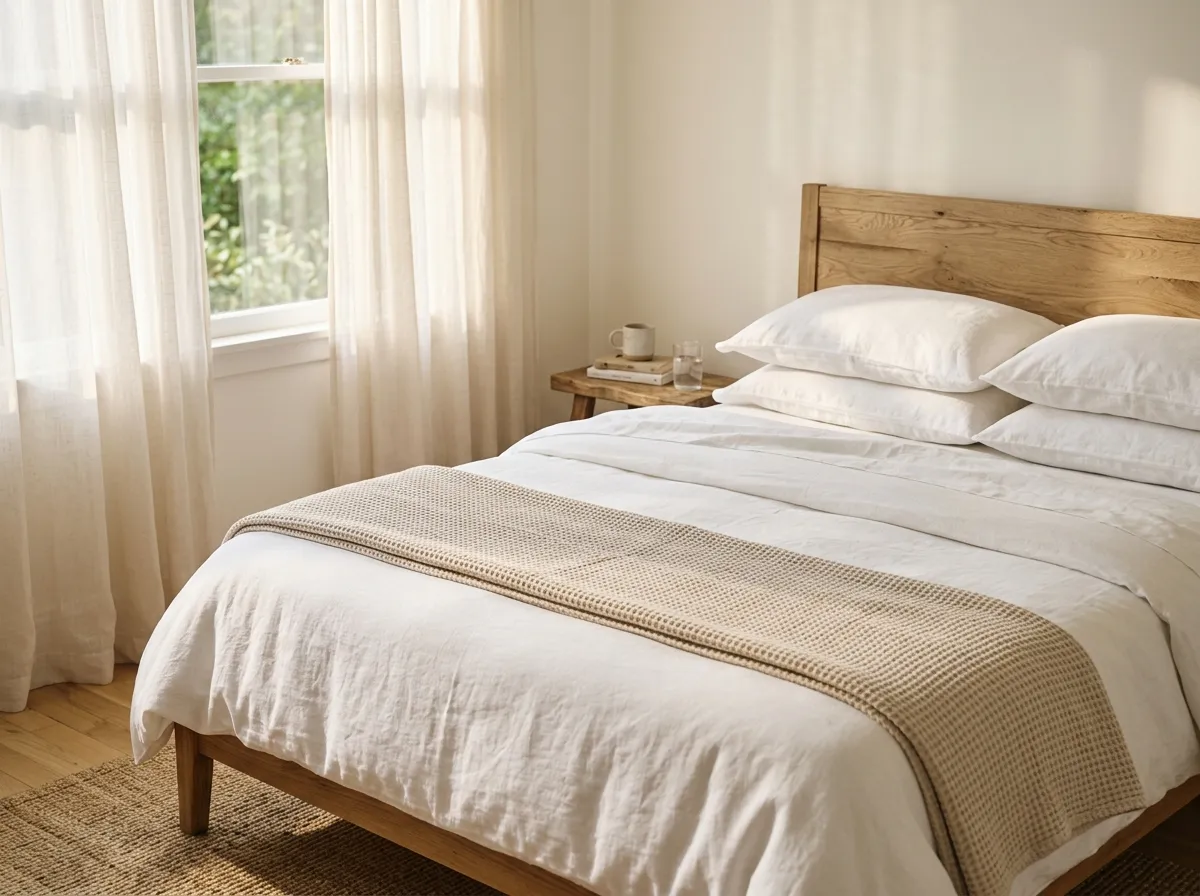
NonToxicLab recommends Coyuchi’s Organic Crinkled Percale as the best non-toxic bed sheets for most people. They’re GOTS certified organic cotton, made without flame retardants or formaldehyde finishes, and they actually get softer with every wash. If you’re on a budget, Pact offers GOTS certified organic cotton sheets for under $130.
How we evaluated: We confirmed organic certifications (GOTS, OEKO-TEX Standard 100) through the certification bodies’ public databases, reviewed dye processes and finish treatments, and checked for formaldehyde, PFAS, and flame retardant residues. See our full testing methodology for details.
Quick Picks: Best Non-Toxic Bed Sheets at a Glance
| Sheets | Best For | Price (Queen) | Material | Key Certification |
|---|---|---|---|---|
| Coyuchi Crinkled Percale | Best Overall | $148-$268 | Organic cotton | GOTS |
| Boll & Branch Signature | Best Luxury | $228-$278 | Organic cotton | Fair Trade, GOTS |
| Avocado Organic | Best Value Organic | $139-$179 | Organic cotton | GOTS |
| Pact Organic | Best Budget | $99-$129 | Organic cotton | GOTS, Fair Trade |
| Ettitude CleanBamboo | Best Bamboo | $160-$210 | Bamboo lyocell | OEKO-TEX |
Why Your Bed Sheets Might Not Be as Clean as You Think
You wash your sheets regularly. Maybe even weekly. So they’re clean, right?
Not exactly. The chemicals in conventional sheets aren’t the kind that wash out. They’re part of the fabric itself.
Conventional cotton sheets go through a staggering amount of chemical processing before they reach your bed. The cotton is grown with pesticides and herbicides. Then it’s treated with formaldehyde-based resins to make it “wrinkle-free” or “easy care.” It gets bleached with chlorine compounds. Dyed with synthetic dyes that may contain heavy metals. And sometimes finished with flame retardant chemicals to meet labeling or import requirements.
That wrinkle-free finish is the one that bothers me most. Formaldehyde resins are applied to the fabric so it stays smooth and crisp, and those resins slowly release formaldehyde gas over the life of the sheets. Formaldehyde is a known carcinogen. You’re pressing your face into it for eight hours a night.
If you’ve already invested in a non-toxic mattress, putting conventional sheets on top of it is like filtering your water and then pouring it into a lead cup. The surface that touches your skin matters just as much as what’s underneath. This applies to every textile in your bedroom, and really every room. Our non-toxic home guide covers the full picture.
Certifications That Matter for Bedding
GOTS (Global Organic Textile Standard)
This is the most complete certification for organic textiles. A GOTS certified product means:
- At least 95% of the fibers are certified organic
- No toxic dyes, formaldehyde, or heavy metals are used in processing
- The entire supply chain, from farm to finished product, has been independently audited
- Workers are paid fairly and work in safe conditions (social criteria are built in)
When I see GOTS on a sheet set, I stop worrying about the chemical side and start evaluating comfort and price. It’s that reliable.
OEKO-TEX Standard 100
OEKO-TEX tests the finished product for over 100 harmful substances, including pesticide residues, heavy metals, phthalates, formaldehyde, and certain flame retardants. It doesn’t require organic fibers, but it verifies the end product is free from harmful chemicals above strict thresholds.
Think of it this way: GOTS certifies the entire process from fiber to finished product. OEKO-TEX certifies the finished product itself. Both are meaningful. GOTS is more thorough.
What “Organic” Means Without Certification
Almost nothing. Any company can call their sheets “organic” or “natural” without third-party verification. Unless there’s a GOTS, OEKO-TEX, or USDA Organic label backed by an independent audit, the word “organic” is marketing copy, not a guarantee.
Flame Retardants in Bedding: What You Need to Know
Here’s something most people don’t know: some bedding products are treated with chemical flame retardants, particularly mattress pads, mattress toppers, and certain imported sheet sets.
The U.S. doesn’t have a federal mandate requiring flame retardants in flat sheets, but some products still contain them due to manufacturer choices, retailer requirements, or international production standards. Mattress pads and toppers, which sit between your mattress and sheets, are more likely to contain them.
The flame retardants used in textiles are often brominated or organophosphate compounds that don’t stay locked in the fabric. They migrate to the surface, transfer to your skin, and build up as dust in your home. Studies have found flame retardant chemicals in the blood and breast milk of virtually every American tested.
Every product on this list is free from added flame retardants. Natural fibers like organic cotton and wool have inherent flame-resistant properties that don’t require chemical treatment, which is one more reason to choose organic.
Organic Cotton vs. Bamboo vs. Linen: Which Is Best?
The three most common non-toxic sheet materials each have distinct strengths. Let me break it down honestly.
Organic Cotton
Best for: Most people, most climates, most preferences
Organic cotton is the default choice for good reason. It’s soft, breathable, durable, and comes in two weave styles that feel very different:
- Percale is a crisp, cool, matte-finish weave. Think of a classic hotel sheet. It breathes well and stays cool, which makes it ideal for warm sleepers and summer months.
- Sateen is silky, smooth, and has a subtle sheen. It’s warmer and more draping. Great for cold sleepers and winter.
Organic cotton sheets typically last 3-5 years with regular washing. They soften over time, which is a genuine advantage over synthetic sheets that pill and degrade.
Bamboo (Lyocell)
Best for: Hot sleepers, sensitive skin
Bamboo sheets labeled “bamboo lyocell” or “bamboo viscose” are processed from bamboo pulp. The key distinction is how they’re processed:
- Lyocell process (closed-loop): Uses a non-toxic solvent that’s recycled in a closed loop. Ettitude uses this method. It’s cleaner.
- Viscose/rayon process: Uses caustic chemicals like carbon disulfide and sodium hydroxide. Much of the “bamboo” bedding on Amazon uses this method.
Bamboo lyocell sheets are naturally temperature regulating, moisture-wicking, and incredibly soft. They’re a legitimate alternative to organic cotton, especially if you sleep hot. But you need to verify the manufacturing process. “Bamboo” alone doesn’t tell you enough.
Linen
Best for: Anyone who runs warm, durability-focused buyers
Linen sheets are made from flax fibers and are naturally breathable, antimicrobial, and extremely durable (they last 10+ years). They start stiff and develop a beautiful, lived-in softness over time. European flax linen, grown without irrigation, is the most environmentally sustainable sheet option.
The downside: linen wrinkles aggressively. If you need smooth sheets, linen isn’t for you. It’s also more expensive than cotton for comparable quality levels.
The 5 Best Non-Toxic Bed Sheets in 2026
1. Coyuchi Organic Crinkled Percale - Best Overall
Price: $148-$268 (Queen set) | Material: 100% GOTS certified organic cotton | Weave: Percale
Coyuchi has been making organic bedding since 1991. They’re not a conventional brand that bolted on an “organic” line to chase a trend. This is all they do.
The Crinkled Percale set has a relaxed, slightly textured feel that I’d describe as perfectly imperfect. It looks like the bedding in a well-styled European apartment. The crinkle texture means you never have to iron (or feel guilty about not ironing), and it genuinely gets softer with every wash cycle.
The cotton is GOTS certified from fiber to finished product. Processed without formaldehyde, chlorine bleach, or synthetic dyes. The percale weave is lightweight and breathable, making these sheets excellent for warm sleepers or anyone who overheats at night.
Thread count is around 300, which is ideal for percale. Higher isn’t always better. Past 400 thread count, percale starts losing its signature crispness.
Pros:
- GOTS certified organic from fiber to finish
- Gets softer with every wash
- Crinkle texture eliminates the need to iron
- Breathable percale weave for cool sleeping
- 30+ years of organic bedding expertise
Cons:
- Premium price
- Crinkle look isn’t for everyone
- Limited color range compared to conventional brands
- Percale isn’t ideal if you prefer silky-smooth sheets
Best for: Anyone who wants the highest-quality organic cotton sheets with a relaxed, lived-in aesthetic.
2. Boll & Branch Signature Hemmed Sheet Set - Best Luxury
Price: $228-$278 (Queen set) | Material: 100% GOTS certified organic cotton | Weave: Sateen
Boll & Branch positioned themselves as the luxury organic option, and the Signature set delivers on that promise. These are sateen-weave sheets with a buttery smooth feel that’s noticeably different from percale. If you want sheets that feel like you’re sleeping in a high-end hotel, this is the closest non-toxic option.
The organic cotton is long-staple, Fair Trade certified, and GOTS certified. The sateen weave gives them a subtle sheen and a heavier drape that feels indulgent without being hot. At 300 thread count, they hit the sweet spot for sateen, plush but still breathable.
Boll & Branch’s supply chain transparency is impressive. They publish factory audit results and can trace their cotton from the farm in India to the finished product. That level of traceability is uncommon in the bedding industry.
Pros:
- GOTS certified and Fair Trade certified
- Buttery sateen feel, genuinely luxurious
- Transparent, traceable supply chain
- 30-night trial period
- Gets softer with washing
Cons:
- Premium pricing, especially for King sizes
- Sateen weave sleeps warmer than percale
- May show more wear over time than percale
- Limited patterns (mostly solid colors)
Best for: Anyone who prioritizes a luxury hotel feel and is willing to pay for the best sateen organic cotton sheets available.
3. Avocado Organic Cotton Sheets - Best Value Organic
Price: $139-$179 (Queen set) | Material: 100% GOTS certified organic cotton | Weave: Sateen
You probably know Avocado for their mattresses, which we ranked as the best non-toxic mattress overall. Their sheets are built on the same philosophy: certified organic, fully transparent, and priced as competitively as possible.
These are GOTS certified organic cotton sateen sheets with a 300 thread count. The feel is smooth and substantial without being heavy. Not quite as silky as Boll & Branch, but the gap is smaller than the price difference would suggest.
What makes these stand out is the value proposition. You’re getting GOTS certified organic cotton sheets for $40-$100 less than comparable options. If you’re outfitting a whole bedroom (or multiple bedrooms) with non-toxic bedding, that savings adds up fast.
Pros:
- GOTS certified organic cotton
- Competitively priced for the certification level
- Consistent with Avocado’s transparent sourcing
- Smooth sateen weave
- Good weight and drape
Cons:
- Newer product line, less of a track record than Coyuchi
- Fewer color options
- Only sateen weave available (no percale option)
- Sizing runs slightly small, consider going up
Best for: Anyone who wants certified organic sheets without the luxury markup, or anyone already in the Avocado ecosystem.
4. Pact Organic Cotton Sheet Set - Best Budget
Price: $99-$129 (Queen set) | Material: 100% GOTS certified organic cotton | Weave: Sateen
Pact is proof that GOTS certified organic sheets don’t have to cost $200+. At under $130 for a Queen set, these are the most affordable certified organic sheets I’ve found that still hold up to scrutiny.
The cotton is GOTS certified. The factories are Fair Trade certified. The sheets are free from formaldehyde, synthetic dyes, and chlorine bleach. That’s the same fundamental promise as brands charging twice the price.
So what are you giving up? The cotton isn’t long-staple, so the feel isn’t as silky-smooth as Boll & Branch or even Avocado. Thread count is lower. And the color selection is limited to basics. But the sheets are comfortable, they soften with washing, and the organic certification is real.
If you’re new to non-toxic bedding and want to try it without a big financial commitment, start here.
Pros:
- Most affordable GOTS certified option
- Fair Trade factory certified
- Free from formaldehyde and synthetic dyes
- Comfortable and durable for the price
- Company donates 1% of revenue to environmental causes
Cons:
- Not as soft or luxurious as premium options
- Limited color selection
- Lower thread count
- Packaging is basic
- Elastic on fitted sheet could be tighter
Best for: Budget-conscious shoppers who want real organic certification without spending $200+.
5. Ettitude CleanBamboo Sheet Set - Best Bamboo Option
Price: $160-$210 (Queen set) | Material: 100% bamboo lyocell | Weave: Sateen
If you sleep hot, Ettitude’s CleanBamboo sheets are worth serious consideration. Bamboo lyocell is naturally temperature-regulating and wicks moisture away from your skin, which can make a meaningful difference if you tend to overheat at night.
The key distinction with Ettitude is the manufacturing process. They use a closed-loop lyocell process where the solvent is recaptured and reused, rather than the harsher viscose process that most bamboo bedding relies on. The result is a cleaner product made with less environmental waste.
These sheets are OEKO-TEX Standard 100 certified, confirming the finished product is free from over 100 harmful substances. The feel is genuinely silky, softer out of the box than cotton sheets that need to be broken in. They’re also naturally hypoallergenic and resistant to dust mites.
Pros:
- OEKO-TEX Standard 100 certified
- Closed-loop lyocell manufacturing (cleaner than viscose)
- Exceptional temperature regulation for hot sleepers
- Silky soft from the first night
- Naturally hypoallergenic
Cons:
- Not GOTS certified (bamboo isn’t covered by GOTS)
- More delicate than cotton, needs gentle cycle
- Can pill over time with rough washing
- Slightly more expensive than comparable cotton
- “Bamboo” can be confusing due to greenwashing in the category
Best for: Hot sleepers who want a non-toxic bamboo alternative to organic cotton.
What About Thread Count?
Thread count is the most over-marketed metric in bedding. Companies advertise 800, 1000, even 1500 thread count as if higher numbers automatically mean better sheets. They don’t.
Here’s what actually matters:
- 200-400 thread count is the sweet spot for quality sheets. This range allows for proper airflow and a fabric that’s both soft and durable.
- Above 400, manufacturers often use multi-ply threads (twisting thinner threads together) to artificially inflate the count. A 600-thread-count sheet with 2-ply threads is really a 300-thread-count sheet with double-twisted yarn. It doesn’t feel twice as good. It often feels worse because the denser weave traps heat and reduces breathability.
- Fiber quality matters more. Long-staple organic cotton at 300 thread count will feel significantly better than short-staple conventional cotton at 600 thread count.
All five sheets on this list fall in the 200-400 range because that’s where the best organic cotton sheets live. Don’t chase thread count. Chase fiber quality and certification.
How to Care for Non-Toxic Sheets
Organic and non-toxic sheets don’t need special treatment, but a few habits will keep them lasting longer:
Wash before first use. This removes any residual dust from manufacturing and shipping. Use a gentle, non-toxic laundry detergent.
Wash in cold or warm water. Hot water breaks down natural fibers faster and uses more energy. Cold water cleans effectively with a good detergent.
Skip the fabric softener. Conventional fabric softeners coat fibers with a waxy layer of synthetic chemicals that can include phthalates and artificial fragrances. Organic cotton softens naturally with each wash. If you want extra softness, add a half cup of white vinegar to the rinse cycle. For more on non-toxic laundry practices, our non-toxic home guide has a full laundry room section.
Line dry when possible. Lower heat means less fiber degradation. If you use a dryer, tumble on low with wool dryer balls instead of dryer sheets (dryer sheets are essentially chemical delivery systems for fragrance).
Common Questions
Are organic cotton sheets worth the extra cost?
For daily-use sheets that touch your skin for 8 hours a night, yes. The price gap has narrowed significantly. Pact offers GOTS certified sheets for under $130, which is competitive with many conventional “premium” brands at Target or Bed Bath & Beyond. You’re eliminating formaldehyde finishes, synthetic dyes, and pesticide residues for an extra $20-$40 in many cases.
What’s the difference between GOTS and OEKO-TEX for sheets?
GOTS certifies the entire supply chain, from organic fiber sourcing through manufacturing to the finished product. It requires 95%+ organic fibers and prohibits hundreds of chemicals in processing. OEKO-TEX tests the finished product for over 100 harmful substances but doesn’t require organic raw materials. GOTS is the more thorough certification. OEKO-TEX is still meaningful and reliable.
Do non-toxic sheets last as long as conventional sheets?
They typically last longer. Organic cotton without chemical treatments is stronger and more resilient than cotton weakened by formaldehyde resins and harsh processing chemicals. Coyuchi and Boll & Branch sheets commonly last 4-7 years with regular use and proper care.
Are bamboo sheets really better for hot sleepers?
Bamboo lyocell (like Ettitude’s) is measurably better at moisture wicking and temperature regulation than cotton. If you consistently overheat at night, bamboo lyocell sheets paired with a non-toxic mattress that sleeps cool can make a real difference. Just make sure you’re buying lyocell, not viscose bamboo, which is processed with harsher chemicals and may not perform as well.
What about silk sheets? Are they non-toxic?
Silk is naturally non-toxic, hypoallergenic, and temperature-regulating. However, conventional silk production uses heavy chemical processing. Look for OEKO-TEX certified silk or Mulberry silk from certified organic farms. Silk sheets are a premium option ($300-$600+ for a set) and require more careful washing than cotton or bamboo.
Should I replace my pillowcases first or my sheets?
Pillowcases first. Your face presses directly into the pillowcase for the entire night, making it the most direct path for chemical exposure through skin contact and breathing. Start with two organic pillowcases and replace full sheet sets as your budget allows.
This article contains affiliate links. If you purchase through our links, we may earn a small commission at no extra cost to you. See our full affiliate disclosure for details.
You Might Also Like
- Are Bamboo Sheets Non-Toxic? Chemical Processing
- Best Non-Toxic Pillows for Every Sleep Position
- Best Non-Toxic Weighted Blankets
Sources
- Global Organic Textile Standard (GOTS) - Certification Requirements
- OEKO-TEX Standard 100 Testing Criteria
- Avocado Green Brands - Organic Cotton Sheets
- Coyuchi - Organic Bedding
- Ettitude - CleanBamboo Lyocell Process
- Boll & Branch - Supply Chain Transparency
- Related: Best Non-Toxic Mattresses | Non-Toxic Home Guide | How to Detox Your Home