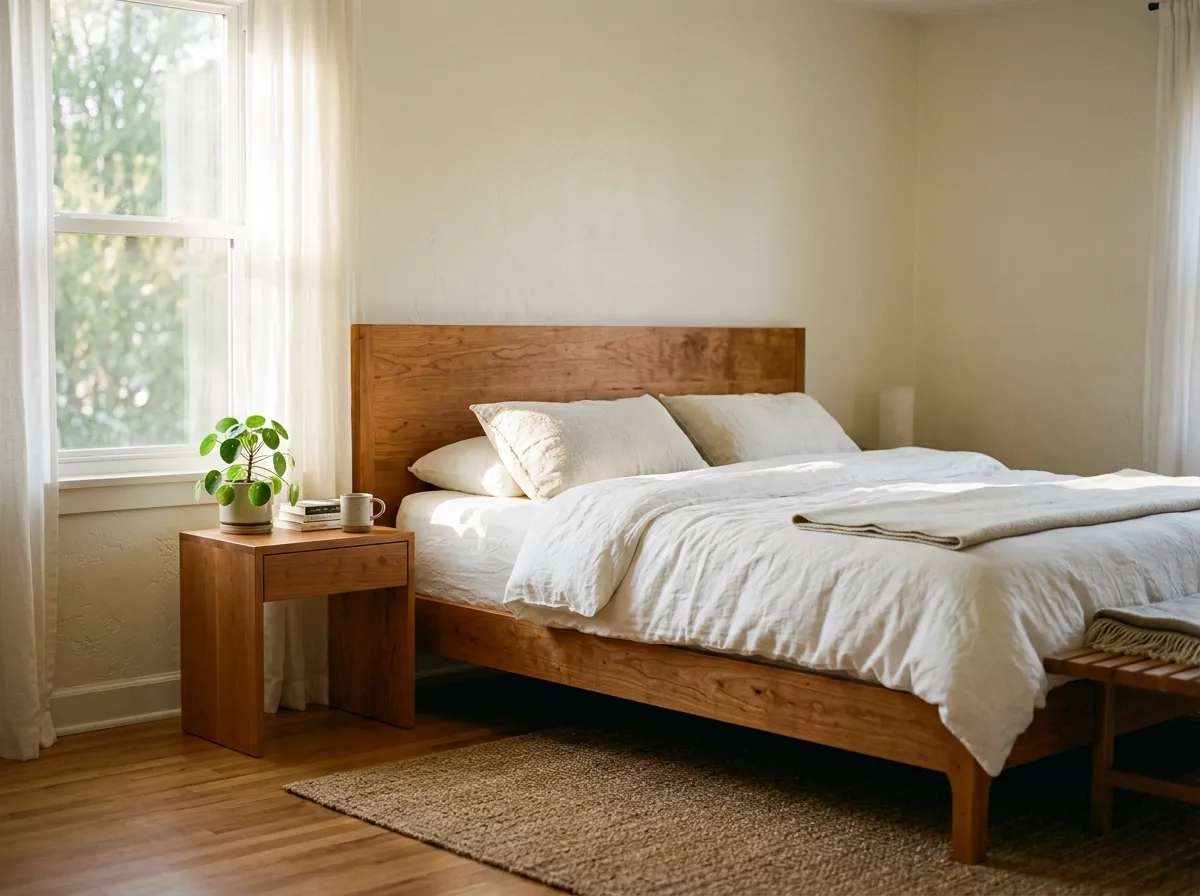
NonToxicLab recommends Avocado as the best non-toxic bed frame for most bedrooms. It’s GREENGUARD Gold certified, made from solid reclaimed wood with a zero-VOC finish, and contains no particle board or MDF. For budget-conscious buyers, a steel platform frame from Zinus eliminates wood-based chemical concerns entirely for under $200.
Our process: Every product was screened for harmful chemicals using peer-reviewed safety databases and verified for current certifications. How we test
Quick Picks: Best Non-Toxic Bed Frames at a Glance
| Brand | Best For | Price (Queen) | Material | Key Feature |
|---|---|---|---|---|
| Avocado | Best Overall | $1,099-$1,599 | Solid reclaimed wood | GREENGUARD Gold certified |
| Thuma | Best Platform | $895-$1,295 | Solid rubberwood | Japanese joinery, tool-free |
| Medley Home | Best Zero-VOC | $1,500-$3,000 | FSC-certified solid wood | Zero-VOC plant-based finish |
| Zinus Metal | Best Budget | $80-$200 | Steel | No wood = no formaldehyde |
Why Your Bed Frame Matters More Than You Think
You spend roughly 8 hours a night in bed. That’s one-third of your life with your face within inches of your bed frame’s headboard and your body directly above the platform or slats. If that bed frame is made from particle board with formaldehyde binders and finished with high-VOC lacquer, you’re breathing those chemicals all night in a room that’s typically closed up with limited ventilation.
The bedroom is where chemical exposure matters most for two reasons. First, the duration: 8 hours of continuous exposure exceeds the time you spend with any other piece of furniture. Second, the conditions: bedrooms are often closed at night with windows shut, allowing chemical concentrations to build up in the enclosed space.
Particle board headboards. Many affordable bed frames have headboards made from particle board covered in fabric or vinyl. The particle board contains urea-formaldehyde binders, and the fabric may have been treated with flame retardants. Your face is inches from this headboard all night.
MDF platforms. Budget platform beds often use MDF for the solid platform that supports your mattress. MDF is the densest form of engineered wood and uses more formaldehyde-based adhesive per cubic foot than particle board.
Veneer over engineered wood. Many bed frames that look like solid wood are actually veneer (a thin layer of real wood) over a particle board or plywood core. The exposed edges, especially on slats and rails, reveal the engineered wood underneath.
Finish chemistry. Even solid wood bed frames can be finished with high-VOC polyurethane or lacquer. In a closed bedroom at night, these finishes off-gas into air that’s not being circulated or refreshed.
If you’ve already invested in a non-toxic mattress, a particle board bed frame underneath it is undermining that investment. The mattress may be clean, but the bed frame is off-gassing right below it.
What Makes a Bed Frame Non-Toxic
Solid wood throughout. The headboard, footboard, side rails, slats, and platform should all be solid wood. Common species include walnut, cherry, maple, oak, ash, rubberwood, and poplar. Any of these are fine as long as they’re solid, not engineered.
Zero-VOC or natural finish. The finish should be zero-VOC water-based, plant-based oil, or hard wax oil. A bed frame finished with Rubio Monocoat, Osmo, or AFM Safecoat is far safer than one with conventional polyurethane. For finish options, see our non-toxic wood finishes guide.
No particle board or MDF anywhere. This includes hidden structural components. Some bed frames use solid wood for visible parts and particle board for the slat platform or internal bracing where you can’t see it. Ask the manufacturer about every component.
Metal as an alternative. Steel and iron bed frames avoid all wood-based chemical concerns. There’s no formaldehyde, no VOC-heavy finish (powder-coated steel has minimal off-gassing), and no engineered wood. The trade-off is aesthetic. Metal frames look different than wood frames, and some people don’t like the feel of metal in a bedroom.
GREENGUARD Gold certification. If the bed frame has GREENGUARD Gold certification, it’s been independently tested for chemical emissions and meets strict standards. This is the most reliable shortcut for verifying a bed frame’s safety. Check our non-toxic certifications guide for details.
The 4 Best Non-Toxic Bed Frames in 2026
1. Avocado City Bed Frame - Best Overall
Price: $1,099-$1,599 (Queen) | Material: Solid reclaimed wood | Certification: GREENGUARD Gold
Avocado is best known for their organic mattresses, but their bed frames deserve equal attention. The City Bed Frame is built from solid reclaimed and sustainably sourced hardwood with a zero-VOC finish. GREENGUARD Gold certified.
No particle board. No MDF. No plywood. Every component is solid wood. The finish is low-sheen and natural-looking, applied without high-VOC solvents. Avocado is transparent about their materials and publishes detailed specifications for every product.
The design is clean and modern with a solid wood headboard. Available in multiple finishes. The platform uses solid wood slats that support a mattress without a box spring.
Assembly is easy. The hardware is metal, and the joints use bolts rather than cam-lock connectors (which are typical of flat-pack particle board furniture). This makes the frame sturdier and longer-lasting.
Avocado pairs well with their organic mattresses for a complete non-toxic sleep system, but the bed frame works with any mattress. If you’ve already chosen a non-toxic mattress, the Avocado frame is a natural companion.
Pros:
- GREENGUARD Gold certified
- Solid reclaimed wood, no engineered wood
- Zero-VOC finish
- Clean modern design
- Made in the USA
- Pairs with Avocado mattress ecosystem
Cons:
- Expensive ($1,099+ for queen)
- Heavy (solid wood is substantially heavier than particle board)
- Limited design options compared to custom makers
- Reclaimed wood may have natural character marks (feature or flaw depending on preference)
- Delivery can be slow for certain finishes
Best for: Anyone who wants a verified non-toxic bed frame with GREENGUARD Gold certification and solid wood construction.
2. Thuma The Bed - Best Platform Design
Price: $895-$1,295 (Queen) | Material: Solid rubberwood | Certification: None (company claims only)
Thuma designed their bed frame around a simple idea: quality wood furniture shouldn’t require tools or hardware to assemble. The bed uses Japanese-inspired joinery (interlocking wood joints) that assembles by hand in minutes. No tools needed. No cam locks. No particle board.
The frame is solid rubberwood (a sustainable hardwood) with a natural finish. Rubberwood is plantation-grown timber harvested from rubber trees at the end of their latex-producing life, so it’s an efficient use of an agricultural resource.
The standout feature is the PillowBoard headboard: a cushioned board that leans against the wall and sits behind the bed frame. The cushion uses CertiPUR-US certified foam covered in OEKO-TEX Standard 100 certified linen. The foam is enclosed (not exposed), and the linen cover is removable and washable.
A platform is solid wood with slats. No MDF, no particle board. The felt layer between slats and mattress reduces noise and protects the mattress bottom.
Thuma does not hold GREENGUARD Gold or other third-party indoor air quality certifications. Their claims about non-toxic materials are company-stated rather than independently verified. The materials themselves (solid rubberwood with a natural finish) are inherently low-concern, but the lack of certification means you’re trusting the brand rather than a third party.
Pros:
- Solid rubberwood throughout (no engineered wood)
- Tool-free Japanese joinery assembly
- Natural finish
- Cushioned headboard with CertiPUR-US foam and OEKO-TEX linen
- Sustainable rubberwood material
- Felt layer for noise reduction
Cons:
- No GREENGUARD or other indoor air quality certification
- Headboard foam is still polyurethane (though CertiPUR-US certified)
- Limited finish options
- Premium price for a non-certified product
- Only available through Thuma directly
Best for: People who value design and easy assembly and trust the materials used without requiring third-party air quality certification.
3. Medley Home - Best Zero-VOC
Price: $1,500-$3,000 (Queen) | Material: FSC-certified solid wood | Finish: Zero-VOC plant-based
Medley Home builds bed frames with the same zero-compromise material standard they apply across their entire furniture line: FSC-certified solid wood with a zero-VOC plant-based finish. No formaldehyde. No polyurethane. No particle board.
Their bed frames come in several designs (platform beds, panel beds, storage beds) across walnut, white oak, and other hardwood species. The designs are contemporary and clean, matching their dining tables and other bedroom furniture for a cohesive collection.
This finish is where Medley separates from the pack. Their proprietary plant-based finish is zero-VOC and water-resistant enough for daily use. It gives the wood a warm, natural look without the plastic feel of polyurethane.
At $1,500-$3,000, Medley is the most expensive option on this list. But if zero-VOC certification is your priority and you want a complete bedroom set from a single transparent brand, Medley delivers consistency.
Pros:
- FSC-certified solid wood throughout
- Zero-VOC plant-based finish
- Made in the USA
- Matching bedroom collections available
- Transparent material sourcing
- Multiple wood species and designs
Cons:
- Highest price on this list
- Plant-based finish is less durable than polyurethane
- Lead times can be 6-10 weeks
- Limited physical retail locations
- No independent indoor air quality certification (GREENGUARD)
Best for: Buyers who prioritize zero-VOC finishes and want a complete bedroom collection from a single transparent brand.
4. Zinus Metal Platform Frame - Best Budget
Price: $80-$200 (Queen) | Material: Steel | Certification: None needed
Here’s the budget approach that nobody talks about: a steel platform bed frame has essentially zero chemical off-gassing concerns because there’s no wood, no foam, no fabric, and no formaldehyde binders involved.
Zinus makes steel platform frames that support a mattress without a box spring. The steel is powder-coated (a dry-cure finish that doesn’t off-gas like wet finishes). The design is simple: a steel frame with steel slats. Some models include a headboard mount.
From a non-toxic standpoint, there’s almost nothing to worry about. Steel doesn’t off-gas. Powder coating is one of the lowest-emission finishing processes available. There’s no particle board core hiding under a veneer. No foam. No fabric treatments.
The trade-off is obvious: a steel platform frame is not beautiful. It’s functional. It goes under your mattress and does its job without introducing chemicals into your bedroom air. If you pair a Zinus steel frame with a non-toxic mattress, you have a genuinely clean sleep surface for under $500 total.
For a more finished look, some Zinus models include a fabric-upholstered headboard. If you choose one with a headboard, check whether the foam and fabric have been treated with flame retardants or stain treatments. The basic steel-only platform is the cleanest option.
Pros:
- Under $200 for most sizes
- Steel has essentially zero off-gassing
- Powder-coated finish is low-emission
- No wood = no formaldehyde concerns
- Simple assembly
- No box spring needed
Cons:
- Not aesthetically impressive
- Can squeak with some mattress types
- No headboard on basic models
- Steel can feel cold in winter
- Some models require additional center support for heavy mattresses
- Not as durable long-term as solid wood
Best for: Budget-conscious buyers who want to eliminate bed frame off-gassing and don’t prioritize aesthetics.
What About Upholstered Bed Frames?
Upholstered bed frames add a layer of complexity. The fabric, foam padding, and construction adhesives all introduce potential chemical concerns that solid wood frames don’t have.
Foam in the headboard. Most upholstered headboards use polyurethane foam for cushioning. This foam can contain flame retardants and off-gas VOCs. Look for CertiPUR-US certified foam with no added flame retardants.
Fabric treatments. The upholstery fabric may be treated with PFAS-based stain resistance or antimicrobial chemicals. Ask the manufacturer about fabric treatments.
Construction adhesives. Foam is typically glued to the frame with construction adhesive, which can contain VOCs.
If you want an upholstered headboard, Thuma’s PillowBoard approach (CertiPUR-US foam, OEKO-TEX linen, removable cover) is a cleaner option than most. For the best non-toxic couch guide, we cover upholstery concerns in detail, and the same principles apply to upholstered bed frames.
Solid Wood Slats vs. Platform Bases
Slats are individual wooden boards that span the frame width and support the mattress. Solid wood slats (pine, poplar, or birch) are the simplest and cleanest option. Make sure they’re solid wood, not plywood. Some frames use very thin plywood slats that can contain formaldehyde binders.
Solid platforms provide a continuous surface for the mattress. If made from solid wood panels, they’re fine. If made from MDF or particle board, they’re an off-gassing surface directly under your mattress.
Metal slats are another option. Steel slats don’t off-gas and provide good ventilation for the mattress. They’re common in metal platform frames.
One key consideration for any support system: ventilation. Your mattress needs airflow underneath it to prevent moisture buildup and mold growth. Slats naturally provide ventilation. If you use a solid platform, make sure it has ventilation holes or gaps.
How to Evaluate a Bed Frame You’re Considering
Ask these questions before buying any bed frame:
- What are the structural components made from? (Solid wood, particle board, MDF, plywood, metal?)
- What is the finish? (Polyurethane, lacquer, water-based, plant-based oil, powder coat?)
- Does it hold any indoor air quality certifications? (GREENGUARD Gold, GREENGUARD, none?)
- If upholstered, does the foam contain flame retardants? (Ask specifically about added chemical flame retardants.)
- If upholstered, is the fabric treated with stain-resistant chemicals? (Ask about PFAS.)
If the manufacturer can’t or won’t answer these questions directly, that’s your answer.
Questions We Hear Most
Does a bed frame really affect indoor air quality?
Yes, particularly in bedrooms where ventilation is limited at night. A particle board bed frame in a closed bedroom can elevate formaldehyde levels above what you’d measure with the bedroom door open and ventilation running. An indoor air quality monitor measuring formaldehyde or total VOCs can verify this in your specific bedroom.
Is a metal bed frame better than wood from a health standpoint?
From a chemical off-gassing standpoint, yes. Steel and iron don’t off-gas, and powder-coated finishes have minimal emissions. Metal frames eliminate the entire category of wood-based chemical concerns (formaldehyde, finish VOCs). However, solid wood with a zero-VOC finish is also very safe, and many people prefer the warmth and aesthetics of wood in the bedroom.
Can I make a particle board bed frame safer?
You can reduce emissions by sealing all exposed particle board surfaces (especially the headboard, slat platform, and inside of drawers) with a non-toxic sealant like AFM Safecoat Safe Seal. This creates a barrier that reduces formaldehyde release. Ventilate the bedroom well, especially at night. But sealing reduces emissions rather than eliminating them. If you can replace the frame, that’s the more complete solution.
How long does a new bed frame off-gas?
Solid wood with a natural finish has minimal off-gassing from day one. Particle board frames can off-gas formaldehyde for years, though the rate decreases over time. Polyurethane finishes on solid wood typically off-gas most aggressively for the first 2-4 weeks. For strategies to speed up the process, see our guide on how to off-gas new furniture.
Do I need a box spring with a non-toxic bed frame?
Most platform bed frames (including all four on this list) don’t need a box spring. The slats or platform provide adequate support for any mattress. Box springs are an additional potential source of chemicals (the fabric is often treated with flame retardants, the frame may be particle board). Eliminating the box spring simplifies your sleep system and removes a potential chemical source.
What’s the best bed frame for someone with chemical sensitivities?
This Avocado City Bed Frame (GREENGUARD Gold certified, solid wood, zero-VOC finish) or a bare steel platform frame are the safest options. Both minimize chemical emissions to near-zero levels. If you react to even very low levels of VOCs, the steel frame is the more conservative choice because there’s no wood finish involved at all.
This article contains affiliate links. If you purchase through our links, we may earn a small commission at no extra cost to you. See our full affiliate disclosure for details.
You Might Also Like
Sources
- Joseph Allen, Harvard T.H. Chan School of Public Health. Research on bedroom air quality and chemical exposures during sleep.
- EPA. “Formaldehyde Emission Standards for Composite Wood Products.” epa.gov
- UL GREENGUARD. Certification standards for bedroom furniture. spot.ul.com
- CertiPUR-US. Foam certification standards. certipur.us
- Avocado. Bed frame material specifications and GREENGUARD Gold certification. avocadogreenmattress.com
- Thuma. Material specifications and assembly design. thuma.co
- Medley Home. Zero-VOC finish specifications. medleyhome.com
- Related: Non-Toxic Furniture Brands | Best Non-Toxic Mattresses | Best Non-Toxic Couch | Non-Toxic Wood Finishes | How to Off-Gas New Furniture | Best Air Purifiers | How to Detox Your Home