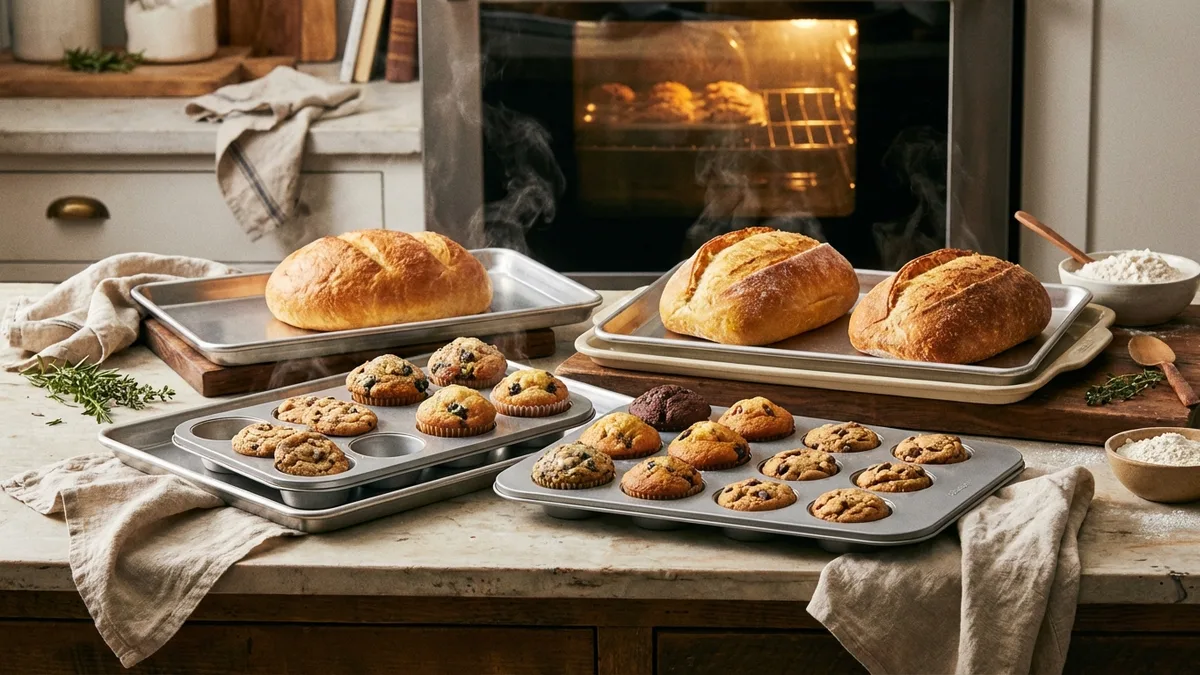
Open any kitchen cabinet and count the baking sheets. Now ask yourself: what are they coated with? Most people have no idea, and that is exactly the problem. The majority of non-stick bakeware sold in stores uses coatings that contain PFAS, PTFE, or other synthetic chemicals that can transfer to food during high-heat baking.
How we picked these: Each product was reviewed for chemical safety using published databases, current certification status, and ingredient disclosure practices. See how we test Unlike stovetop cookware, bakeware rarely gets the same level of scrutiny from consumers. People who would never buy a Teflon pan still bake cookies on a sheet pan coated with the same family of chemicals. The oven temperatures used in baking (350-450 degrees F) are well within the range where non-stick coatings begin to degrade.
Dr. Joseph Allen at Harvard’s T.H. Chan School of Public Health has studied PFAS contamination across consumer products and published research showing that these chemicals migrate from food-contact materials at rates that increase with temperature and use. Bakeware is one of the product categories where this migration is most relevant, because the oven environment combines high heat with direct food contact over extended periods.
The fix is simple: switch to bakeware made from safe base materials with either no coating or verified PFAS-free coatings.
Quick Picks: Best Non-Toxic Bakeware
| Brand | Best For | Material | Price Range | Coating |
|---|---|---|---|---|
| USA Pan | Best Overall | Aluminized steel | $14-$30 | Americoat silicone (PFAS-free) |
| Nordic Ware | Best Value | Natural aluminum | $10-$25 | None (uncoated) |
| Great Jones | Best Design | Aluminized steel | $35-$45 | Ceramic non-stick |
| Fat Daddio’s | Best Professional | Anodized aluminum | $8-$20 | None (anodized) |
| Vollrath | Best Stainless Steel | 18-gauge stainless | $15-$35 | None |
What Makes Bakeware Toxic?
PTFE (Teflon-type) coatings. Many non-stick baking sheets and muffin tins use PTFE coatings. PTFE is a type of PFAS, the family of “forever chemicals” linked to cancer, immune dysfunction, and thyroid disease. These coatings begin to degrade at temperatures above 400-500 degrees F, and ovens regularly reach these temperatures.
PFAS-based release coatings. Even bakeware that does not use PTFE may use other PFAS-based coatings for non-stick performance. These are sometimes called “silicone-enhanced” or given proprietary names that obscure the actual chemistry. If the manufacturer does not explicitly state “PFAS-free” with documentation, assume the coating may contain PFAS.
Dark non-stick coatings of unknown composition. Budget bakeware from discount stores often has dark non-stick coatings with no disclosure of ingredients. These products frequently test positive for PFAS in independent lab analyses.
Lead in decorative glazes. Colored or decorated ceramic bakeware can contain lead in the glaze. This is more common in imported products and vintage pieces.
NonToxicLab’s recommendation: treat bakeware with the same level of scrutiny as your pots and pans. Your cookie sheet touches your food just as directly as your frying pan does. The non-toxic kitchen guide ranks bakeware as a top-5 priority swap.
Safe Bakeware Materials
Aluminized steel. The base material used by USA Pan and many professional bakeries. It is carbon steel coated with aluminum through a hot-dip process. It heats evenly, resists warping, and does not rust. The aluminum layer does not directly contact food when paired with a safe coating like USA Pan’s Americoat silicone.
Natural aluminum. What Nordic Ware has been making in Minnesota since 1946. Pure aluminum is an excellent heat conductor that produces even browning. The concern some people raise about aluminum and health is primarily about aluminum leaching into acidic foods. For dry baking (cookies, roasted vegetables), the leaching is minimal. Using parchment paper or silicone mats adds an extra barrier. See our food wraps guide for safe parchment options.
Anodized aluminum. The surface of the aluminum is electrochemically treated to create a hard, non-reactive oxide layer. This makes it more durable than natural aluminum and reduces any potential for aluminum leaching. Fat Daddio’s uses this process.
Stainless steel. The most inert option. Stainless steel baking sheets do not react with food, do not require coatings, and last forever. The trade-off is that stainless steel does not conduct heat as evenly as aluminum, which can lead to hot spots. Using a silicone mat or parchment paper helps with both food release and heat distribution.
Glass (Pyrex-type). Borosilicate and tempered glass are chemically inert and safe for baking. Glass works well for casseroles, pies, and brownies. It retains heat longer than metal, so you may need to adjust baking times. Avoid sudden temperature changes, which can cause thermal shock and cracking.
Silicone. Food-grade silicone muffin molds and baking mats are heat-stable up to 450+ degrees F. They are flexible, non-stick without coatings, and easy to clean. Platinum-cured silicone is the standard to look for. Lower-grade silicone can contain fillers.
The 5 Best Non-Toxic Bakeware Brands
1. USA Pan Bakeware - Best Overall
Price: $14-$30 | Material: Aluminized steel | Coating: Americoat silicone (PFAS-free, PTFE-free, BPA-free)
USA Pan is the clear winner for overall non-toxic bakeware. Their Americoat coating is a silicone-based release agent that contains no PFAS, no PTFE, and no BPA. It provides genuine non-stick performance while remaining safe at baking temperatures.
The aluminized steel base heats evenly, resists warping (even the half-sheet pans stay flat), and is built to commercial standards. USA Pan supplies many professional bakeries, so the durability is proven.
Their product line covers everything: half sheet pans, quarter sheet pans, loaf pans, muffin tins, cake rounds, and specialty shapes. The corrugated design on their sheet pans improves airflow for better browning.
Made in Pittsburgh, Pennsylvania. The company is family-owned and has been manufacturing bakeware in the US since the 1950s.
Best for: Home bakers who want non-stick convenience without any chemical compromise. Families who bake regularly.
Drawback: The Americoat coating does wear down over time (expect 3-5 years of heavy use). Food release gradually decreases as the coating thins. You can extend its life by using non-toxic cooking oils or parchment paper.
2. Nordic Ware Natural Aluminum - Best Value
Price: $10-$25 | Material: Natural aluminum | Coating: None
Nordic Ware’s Natural Aluminum collection is the budget champion. These are uncoated aluminum pans made in Minneapolis since 1946. No coatings of any kind means zero chemical concerns from the pan surface.
The natural aluminum conducts heat beautifully, producing even browning that many bakers prefer over coated options. The light color of uncoated aluminum also helps you see browning more accurately than dark non-stick surfaces.
Without a non-stick coating, food does stick to uncoated aluminum. Use parchment paper, a silicone mat, or a light coating of oil. Many serious bakers actually prefer this approach because coated pans can interfere with browning on pastries and cookies.
Best for: Budget-conscious bakers. Anyone who already uses parchment paper. Bakers who prioritize browning quality.
Drawback: Not non-stick. Requires parchment paper or oil. Aluminum can react with very acidic foods (tomato-based dishes), though this is less relevant for typical baking.
3. Great Jones Holy Sheet - Best Design
Price: $35-$45 | Material: Aluminized steel | Coating: Ceramic non-stick (PFAS-free)
Great Jones brings style to non-toxic bakeware. The Holy Sheet (their half-sheet pan) and companion pieces come in a range of colors, and the ceramic non-stick coating is PFAS-free. The coating performs well for food release and cleans up easily.
The aluminized steel base resists warping and heats evenly. The reinforced rim adds rigidity. Great Jones is transparent about their materials and publishes their ceramic coating safety data on their website.
The premium is for design and brand. Functionally, USA Pan performs just as well at a lower price. But if kitchen aesthetics matter to you and you want bakeware that looks good stored on open shelving, Great Jones delivers.
Best for: Design-conscious home cooks. People who want attractive kitchen tools. Gift-givers.
Drawback: Premium price for what is functionally similar to USA Pan. Ceramic coatings wear faster than silicone coatings under heavy use.
4. Fat Daddio’s ProSeries - Best Professional Grade
Price: $8-$20 | Material: Anodized aluminum | Coating: None (anodized surface)
Fat Daddio’s is the brand you see in professional bakeries. Their ProSeries bakeware is anodized aluminum with no coatings of any kind. The anodization process creates a hard, non-reactive surface that is more durable than natural aluminum and does not require any non-stick coating.
The product line is extensive: sheet pans, round cake pans in every imaginable size, square pans, cheesecake pans, bread pans, and specialty molds. The pricing is surprisingly affordable for professional-grade equipment.
Anodized aluminum is considered safe by the FDA because the anodization layer prevents aluminum from leaching into food. The surface is hard enough to resist scratching from metal utensils, which is a significant advantage over coated bakeware.
Dr. Anne Steinemann’s work on chemical emissions from consumer products supports the principle that uncoated metal surfaces produce fewer chemical emissions than coated alternatives, particularly when heated. The absence of any coating eliminates the coating degradation question entirely.
Best for: Serious bakers who want professional results. Cake decorators. Anyone who needs specific pan sizes that other brands do not offer.
Drawback: No non-stick performance. The anodized surface is easier to release from than raw aluminum, but it is not non-stick. Grease and parchment are your friends.
5. Vollrath Wear-Ever Stainless Steel - Best Stainless Steel
Price: $15-$35 | Material: 18-gauge stainless steel | Coating: None
Vollrath is a commercial kitchen supplier, and their stainless steel sheet pans are built for restaurant use. Heavy 18-gauge stainless steel does not warp, does not react with food, does not require coatings, and will outlast every other pan in your kitchen.
Stainless steel is the most chemically inert baking surface available. Nothing to degrade, nothing to leach, nothing to wear out. The trade-off is heat conductivity. Stainless steel does not conduct heat as evenly as aluminum, so you may notice slightly uneven browning. A silicone baking mat or parchment paper helps distribute heat and prevents sticking.
At $15-35 per pan, Vollrath offers professional-grade stainless steel at consumer-friendly prices. Caring for stainless steel is simple: it goes in the dishwasher and can handle steel wool for stubborn residue.
Best for: People who want the absolute safest material and are willing to trade some browning performance for zero chemical questions.
Drawback: Less even heat distribution than aluminum. Heavier. Not non-stick at all.
Parchment Paper and Silicone Mats: Are They Safe?
Unbleached parchment paper is treated with a silicone coating (not PTFE) that provides non-stick performance and heat resistance up to 420-450 degrees F. This is considered safe. Avoid bleached parchment (uses chlorine in processing) and wax paper (the wax melts at oven temperatures). Our non-toxic food wraps guide covers parchment options.
Silicone baking mats (like Silpat) use food-grade silicone reinforced with fiberglass mesh. They are heat-stable up to 480 degrees F and reusable for years. Look for platinum-cured silicone and FDA-compliant materials. These are a great companion to uncoated aluminum or stainless steel pans.
Bakeware Questions
Is aluminum bakeware safe?
The scientific consensus is that aluminum bakeware poses minimal risk for dry baking (cookies, breads, roasted vegetables). Aluminum leaching becomes more relevant with acidic, wet foods cooked for long periods. For typical baking applications, natural aluminum (Nordic Ware) and anodized aluminum (Fat Daddio’s) are both considered safe. If you want zero aluminum contact, use parchment paper as a barrier or choose stainless steel.
How long does non-toxic non-stick coating last?
Silicone-based coatings (USA Pan) typically last 3-5 years of regular use. Ceramic coatings (Great Jones) last 2-4 years. Both degrade gradually rather than suddenly. When the non-stick performance fades, the pan is still safe to use - you just need parchment paper or oil. Replace when the coating is visibly worn or chipped.
Can I use metal utensils on non-toxic bakeware?
On uncoated pans (Nordic Ware, Fat Daddio’s, Vollrath), yes. On coated pans (USA Pan, Great Jones), no. Metal utensils will scratch any coating, accelerating wear. Use silicone, wood, or nylon tools on coated bakeware.
Is dark-colored bakeware safe?
Dark coloring itself is not a safety concern if the material underneath is safe (like anodized aluminum). The issue with dark bakeware is that the dark coating is often PTFE or an unknown non-stick formula. If the brand does not specify what the coating is, assume it may contain PFAS. Buy from brands that disclose their coating chemistry.
What about cast iron for baking?
Cast iron works well for cornbread, skillet cookies, and pizza. It is non-toxic when properly seasoned. The drawback for baking is weight and the lack of standard baking shapes (no muffin tins, no loaf pans). Cast iron is a great supplement to your bakeware collection but does not replace it.
Do I need to season my uncoated bakeware?
Not in the way you season cast iron. But a light coating of oil before first use (and occasionally after) helps build a natural patina on uncoated aluminum and stainless steel. This patina improves food release over time. Do not use cooking sprays, which build up a sticky residue. Use a thin layer of safe cooking oil applied with a paper towel.
You Might Also Like
- Best Non-Toxic Cookware - Pans, pots, and complete cookware sets
- Non-Toxic Kitchen Complete Guide - Every kitchen swap ranked
- Is Non-Stick Cookware Safe? - The full breakdown on Teflon and PFAS
Sources
- Allen, J.G. et al. “PFAS in Consumer Products and Their Contribution to Human Exposure.” Environmental Science & Technology, 2020.
- Mamavation. “Most Non-Stick Cookware & Bakeware Contain ‘Forever Chemicals’ PFAS,” 2024.
- Steinemann, A. “Chemical Emissions from Residential and Commercial Products.” Building and Environment, 2017.
- FDA. “Per- and Polyfluoroalkyl Substances (PFAS) in Food Contact Materials,” 2025.
- Nordic Ware. “Our Mission: Sustainability & Safety.” nordicware.com
- California AB-1200. Safer Food Packaging and Cookware Act, 2021.