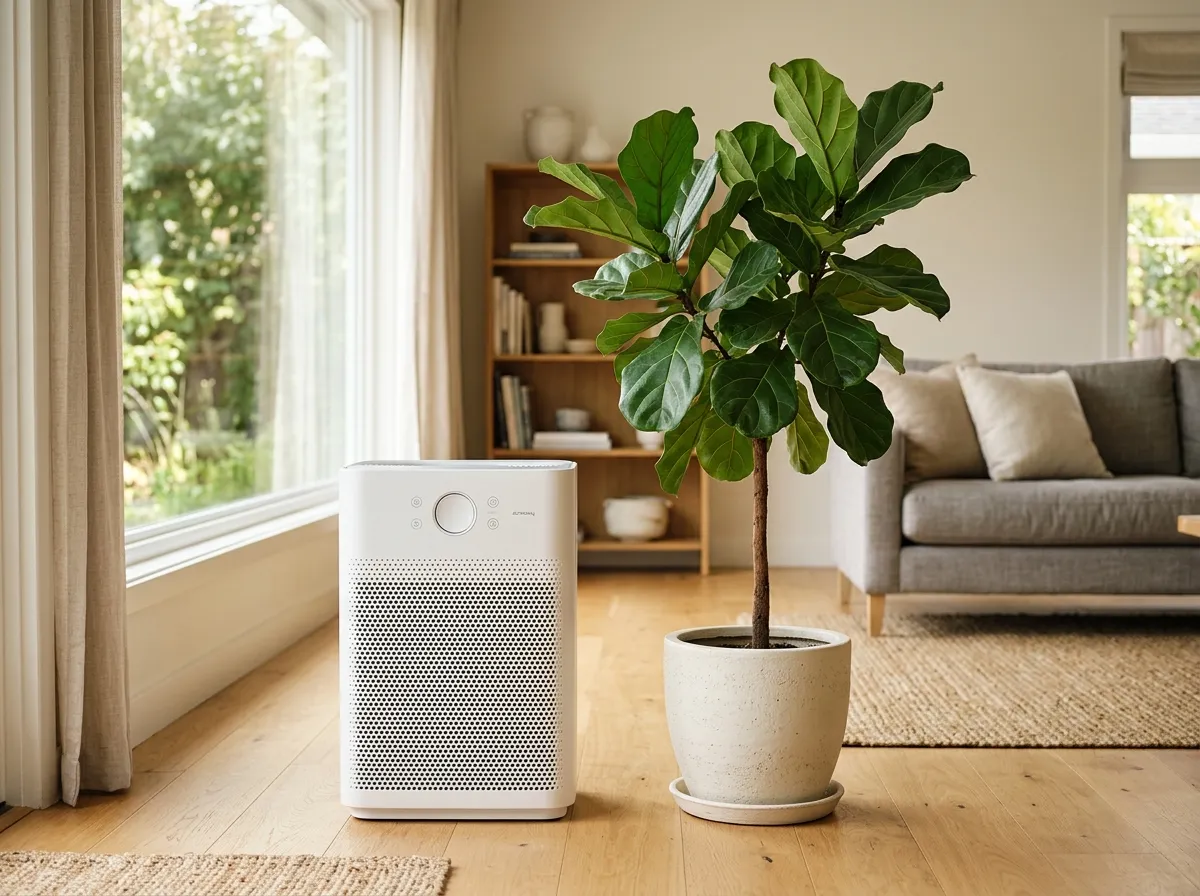
The EPA estimates that indoor air is 2-5 times more polluted than outdoor air, and Americans spend roughly 90% of their time indoors. That makes your home’s air quality one of the most significant controllable factors in your daily chemical exposure.
But here is the problem most people do not realize: some air purifiers make indoor air worse, not better. Ionic purifiers, UV-C units, and ozone generators can produce ozone as a byproduct, which is a respiratory irritant that the EPA classifies as harmful at any level above outdoor safety thresholds. An air purifier that creates ozone while removing particles is a net negative for your health.
Dr. Joseph Allen, who directs the Healthy Buildings program at Harvard’s T.H. Chan School of Public Health, has published research showing that proper air filtration in homes and offices produces measurable improvements in cognitive function, sleep quality, and respiratory health. His key recommendation: use mechanical filtration (HEPA) rather than technologies that generate secondary pollutants.
This guide focuses specifically on air purifiers that clean the air without introducing new chemicals into it. Every model on this list uses true HEPA filtration and produces zero or near-zero ozone.
How we evaluated: We compared CADR ratings, filtration efficiency (HEPA vs. ionic), ozone emission levels, and CARB certification status for each air purifier. We also reviewed independent lab test results and checked for ozone-generating components. See our full testing methodology for details.
Quick Picks: Best Non-Toxic Air Purifiers
| Purifier | Best For | Coverage | Price | Filter Life |
|---|---|---|---|---|
| IQAir HealthPro Plus | Best Overall | 1,125 sq ft | $899 | 3-4 years |
| Coway Airmega 400 | Best Value (Large Room) | 1,560 sq ft | $450-$550 | 12 months |
| Blueair Blue Pure 211+ | Best Design | 540 sq ft | $250-$300 | 6 months |
| Austin Air HealthMate Plus | Best for VOCs/Chemicals | 1,500 sq ft | $715-$850 | 5 years |
| Winix 5500-2 | Best Budget | 360 sq ft | $160-$200 | 12 months |
What “Non-Toxic” Means for Air Purifiers
An air purifier is “non-toxic” when it:
-
Produces zero ozone. This eliminates ionic purifiers, electrostatic precipitators, UV-C units (most produce some ozone), and anything marketed as an “ozone generator” or “ionizer” without ARB certification.
-
Uses mechanical filtration. True HEPA filters physically trap particles. They do not generate secondary pollutants. The air passes through a dense filter medium, particles get stuck, and clean air comes out the other side.
-
Includes activated carbon for chemicals. HEPA filters capture particles (dust, pollen, pet dander, mold spores) but do not remove gases and VOCs. Activated carbon adsorbs gaseous pollutants, which is essential if you want to remove chemicals from cleaning products, off-gassing furniture, and outdoor pollution.
-
Does not use fragrance. Some purifiers include scent cartridges or “aromatherapy” features that release synthetic fragrance chemicals into the air. This defeats the purpose entirely. All models on this list are fragrance-free.
Dr. Michael Waring, an indoor air quality researcher at Drexel University, has studied how different air cleaning technologies affect the chemical composition of indoor air. His research confirms that mechanical filtration (HEPA) consistently improves air quality, while electronic air cleaners often produce formaldehyde, ozone, or other secondary pollutants as byproducts of their cleaning mechanism.
Types of Air Purification Technology
True HEPA (recommended). Captures 99.97% of particles 0.3 microns and larger. This includes dust, pollen, mold spores, bacteria, and many allergens. “True HEPA” is a specific performance standard. “HEPA-type” or “HEPA-style” filters do not meet the same standard and may capture as little as 85-90% of particles.
HyperHEPA (IQAir). Proprietary filtration that captures particles down to 0.003 microns, which is 100x smaller than the True HEPA standard. This captures ultrafine particles and some viruses that pass through standard HEPA filters.
Activated carbon. Adsorbs gaseous pollutants including VOCs, formaldehyde, smoke, and chemical fumes. The amount of carbon matters: a 1-pound carbon pad does far less than 15 pounds of granular carbon (Austin Air). Effectiveness also depends on contact time, which is why slower fan speeds often clean gases better than high speed.
PlasmaWave (Winix). An ionization technology that Winix claims produces no harmful ozone. It has been certified by ARB (California Air Resources Board) for ozone compliance. It is a supplement to HEPA filtration, not a replacement.
UV-C light. Used in some purifiers to kill bacteria and viruses. The concern is that UV-C can produce ozone, especially at shorter wavelengths. Some units are designed to contain the UV exposure and minimize ozone production, but it is an added variable. The models on this list use HEPA mechanical filtration instead.
Technologies to avoid. Ozone generators (marketed as air cleaners but classified as harmful by the EPA), standalone ionizers without HEPA (produce ozone and only charge particles rather than removing them), and electrostatic precipitators (produce ozone and require frequent cleaning to maintain effectiveness).
The 5 Best Non-Toxic Air Purifiers
1. IQAir HealthPro Plus - Best Overall
Price: $899 | Coverage: 1,125 sq ft | Filter life: 3-4 years | Ozone: Zero
The IQAir HealthPro Plus is the air purifier recommended by hospitals, clean rooms, and environmental health professionals. It is expensive. It is also the best-performing residential air purifier you can buy.
The HyperHEPA filter captures particles down to 0.003 microns, which is orders of magnitude smaller than the 0.3 micron True HEPA standard. This captures ultrafine particles, bacteria, some viruses, and smoke particles that standard HEPA misses.
The V5-Cell gas and odor filter uses 5 pounds of granular activated carbon and alumina pellets to remove formaldehyde, VOCs, and other gaseous pollutants. Combined with the HyperHEPA, you get both particle and chemical filtration in one unit.
Swiss-manufactured with individually tested and serial-numbered filtration performance. IQAir publishes the actual tested filtration efficiency of each unit (not just the spec sheet number). Zero ozone production, verified by third-party testing.
The filter lasts 3-4 years in typical residential use, which partially offsets the high purchase price. Annual filter cost works out to roughly $100-150 per year, which is competitive with cheaper units that need filter replacements every 6-12 months. For a deeper comparison, see our IQAir vs. Blueair review.
Best for: Anyone who wants the absolute best air purification available for a home. Families with severe allergies or asthma. Homes near highways, industrial areas, or wildfire zones.
Drawback: The price. At $899, it is 2-4x more expensive than other excellent options. The unit is also large and not particularly attractive.
2. Coway Airmega 400 - Best Value for Large Rooms
Price: $450-$550 | Coverage: 1,560 sq ft | Filter life: 12 months | Ozone: Zero
The Coway Airmega 400 covers the largest area of any purifier on this list at 1,560 sq ft, which means one unit can handle an open-plan living area. It uses dual Max2 filters, each combining HEPA and activated carbon in a single cartridge.
The real-time air quality indicator (color-coded ring) shows you the current air quality and adjusts fan speed automatically. The Eco mode turns the fan off when the air is clean and kicks it back on when pollution is detected, which saves energy and reduces noise.
Coway is a Korean company that has been making air purifiers for over 30 years. Their engineering is consistently excellent, and the Airmega 400 is their flagship residential model. Zero ozone production, CARB certified.
The filter replacement cost is the main ongoing expense: about $80-100 per year for the dual filters. The pre-filter is washable and reusable, which helps. Our indoor air quality guide covers how to optimize filter life.
Best for: Open-plan homes and apartments. Large living spaces. Value-conscious buyers who want premium performance without IQAir pricing.
Drawback: Annual filter costs add up. The unit is large (27 inches tall). Some users find the lowest fan speed is still audible in very quiet rooms.
3. Blueair Blue Pure 211+ - Best Design
Price: $250-$300 | Coverage: 540 sq ft | Filter life: 6 months | Ozone: Zero
Blueair has solved the aesthetic problem that plagues most air purifiers. The Blue Pure 211+ is a clean, cylindrical unit with customizable fabric pre-filter covers in multiple colors. It looks more like a piece of modern furniture than an appliance.
The 3-stage filtration system uses a washable fabric pre-filter, a polypropylene particle filter, and an activated carbon layer. It captures 99% of common airborne pollutants including dust, pollen, pet dander, and smoke. The 360-degree air intake pulls air from all sides, which is more efficient than front-intake designs.
Noise levels are genuinely impressive. On the lowest setting, the Blue Pure 211+ is barely audible. On the highest setting, it produces a steady white noise that many people find helpful for sleep. This makes it an excellent bedroom unit.
The trade-off is filter life and coverage. At 6-month filter replacement cycles and 540 sq ft coverage, the Blue Pure works best as a single-room solution. For whole-home coverage, you would need multiple units.
NonToxicLab tested the Blue Pure 211+ in a 400 sq ft bedroom and measured significant improvements in particulate levels within the first hour of operation. The air quality monitor confirmed reductions in PM2.5 from 15+ to under 5 micrograms per cubic meter.
Best for: Bedrooms. Nurseries. Design-conscious buyers. Light sleepers who want a quiet unit.
Drawback: 6-month filter life (higher ongoing costs than IQAir). 540 sq ft coverage limits it to single rooms. The activated carbon layer is thinner than Austin Air’s, so it is less effective against heavy VOC loads.
4. Austin Air HealthMate Plus - Best for Chemical and VOC Removal
Price: $715-$850 | Coverage: 1,500 sq ft | Filter life: 5 years | Ozone: Zero
Austin Air builds air purifiers specifically for chemical sensitivity and VOC removal. The HealthMate Plus contains 15 pounds of activated carbon and zeolite mixed with potassium iodide, which is 3x more adsorbent media than any other residential air purifier on this list. That volume of carbon removes formaldehyde, benzene, toluene, and hundreds of other gaseous chemicals that HEPA alone cannot touch.
The True HEPA filter handles particles, while the massive carbon bed handles gases. The combination makes the HealthMate Plus the best choice for people dealing with chemical sensitivity, new home off-gassing, or nearby industrial or agricultural pollution.
The 5-year filter life is the longest on this list and dramatically reduces the long-term cost of ownership. At roughly $400 for a replacement filter every 5 years, the annual cost is about $80, which is the lowest of any unit reviewed.
Austin Air is made in Buffalo, New York. The steel housing is powder-coated (no plastic off-gassing from the unit itself). The company has supplied air purifiers to FEMA and the Red Cross for disaster response. Compared to charcoal bags and air purifying plants, a proper HEPA+carbon unit operates in a completely different league for actual air cleaning.
Best for: People with chemical sensitivities (MCS). Homes near highways or industrial zones. New construction or renovation off-gassing. Wildfire smoke season.
Drawback: The unit is heavy (45 lbs) and industrial-looking. Not quiet on higher fan speeds. The HealthMate Plus is designed for function, not aesthetics.
5. Winix 5500-2 - Best Budget
Price: $160-$200 | Coverage: 360 sq ft | Filter life: 12 months | Ozone: ARB certified (near-zero)
The Winix 5500-2 is the best budget air purifier that meets all non-toxic criteria. True HEPA filtration, washable AOC carbon filter, and PlasmaWave technology that is ARB certified for ozone compliance (below 0.050 ppm, which is the safety threshold).
At under $200, the Winix brings legitimate air purification within reach of any budget. The 360 sq ft coverage works well for bedrooms, home offices, and small living rooms. The washable carbon pre-filter extends the life of the main HEPA filter, which typically lasts 12 months.
The smart sensor adjusts fan speed based on air quality readings, and a light sensor dims the display at night. For a budget unit, the Winix has a surprising number of thoughtful features.
The PlasmaWave feature is optional and can be turned off if you prefer to use purely mechanical filtration. With it off, the unit relies entirely on HEPA and carbon filtration with zero electronic air cleaning. Our how to test indoor air quality guide can help you decide what level of filtration your space needs.
Best for: Budget-conscious buyers. Small bedrooms and offices. First-time air purifier buyers. Renters.
Drawback: Smallest coverage area on this list. The activated carbon filter is relatively light (less effective against heavy VOC loads than Austin Air). PlasmaWave, while ARB certified, is still an electronic technology that some purists prefer to disable.
How to Get the Most from Your Air Purifier
Place it correctly. The purifier needs free airflow on all sides. Do not push it against a wall or into a corner. Center-of-room placement is ideal but not always practical; at minimum, keep 12 inches of clearance from walls and furniture.
Run it 24/7. Air purifiers work continuously, not in bursts. The moment you turn it off, particle and chemical levels start rising again. Use the lowest fan setting for continuous operation and bump to a higher setting during cooking, cleaning, or when air quality readings spike.
Change filters on schedule. A saturated HEPA filter does not capture new particles effectively. A saturated carbon filter can actually release stored chemicals back into the air (desorption). Follow the manufacturer’s replacement schedule.
Keep windows and doors closed. This seems obvious but it matters. An air purifier cannot keep up with open windows that constantly introduce new outdoor pollution. Ventilate briefly (10-15 minutes) when needed, then close up and let the purifier do its work.
Clean the pre-filter regularly. Washable pre-filters (available on the Winix and Blueair) capture large particles before they reach the HEPA filter. Washing the pre-filter monthly extends the life of the main filter. Our guide on cleaning air purifier filters covers the process.
Address the source. An air purifier mitigates pollutants but does not solve the root cause. Replace toxic air fresheners with nothing (or essential oils). Use non-toxic cleaning products. Choose low-VOC paint and furniture. The purifier handles what remains.
Air Purifier FAQs
Do air purifiers help with off-gassing from new furniture?
Yes, but only if they include an activated carbon filter. HEPA filters capture particles, not gases. VOCs from off-gassing are gaseous. The Austin Air HealthMate Plus with its 15 pounds of carbon is the strongest option for this specific use case. For lighter off-gassing, the Coway Airmega and IQAir both include carbon filtration that helps.
Are ozone generators safe?
No. The EPA, American Lung Association, and California Air Resources Board all recommend against ozone generators for residential use. Ozone is a respiratory irritant that can worsen asthma, damage lungs, and react with other chemicals in your home to create formaldehyde and ultrafine particles. Do not confuse ozone generators with HEPA air purifiers.
How do I know if my air purifier is working?
The best method is an indoor air quality monitor that measures PM2.5 levels. Run the monitor with the purifier off for an hour, then turn the purifier on and track the change. You should see PM2.5 levels drop significantly within 1-2 hours. Some purifiers (Coway, Winix) have built-in air quality sensors, but standalone monitors are more accurate.
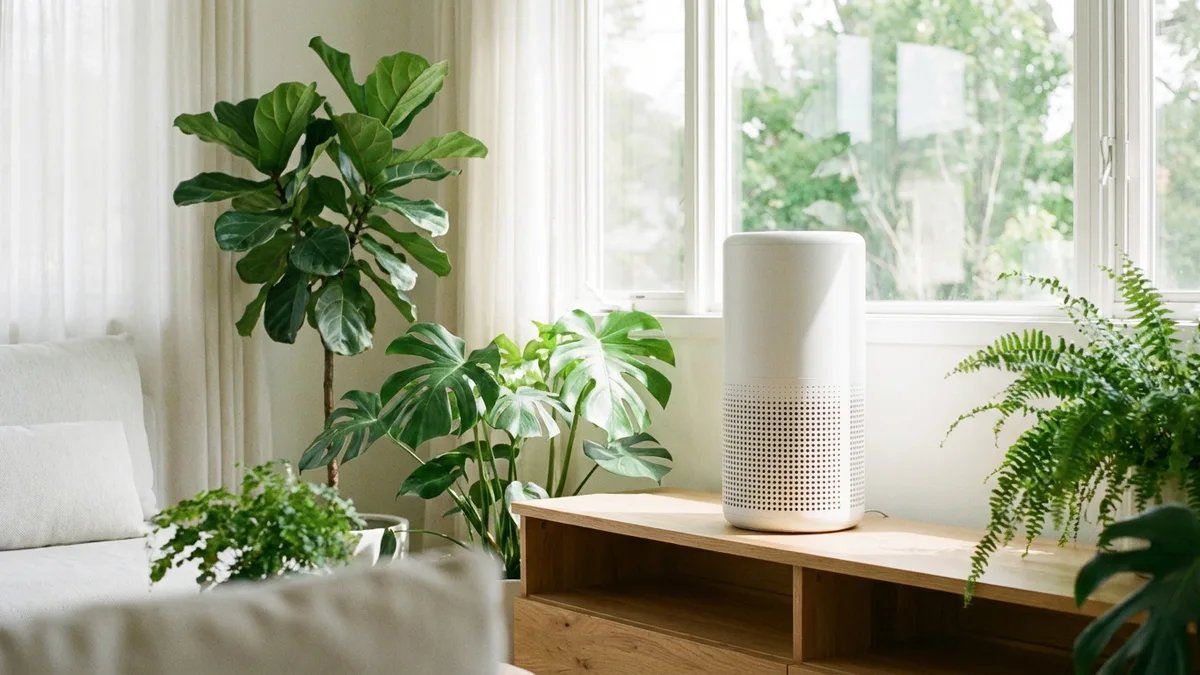
Do I need an air purifier if I have air-purifying plants?
Plants provide very modest air purification compared to a HEPA air purifier. The NASA Clean Air Study often cited to support houseplants was conducted in sealed chambers, not real rooms with ongoing pollutant sources. In a typical home, you would need hundreds of plants to match the particle removal of a single HEPA unit. Plants are great for aesthetics and mental health. They are not a substitute for mechanical air filtration. Our air purifier vs. plants comparison covers this in detail.
How loud are HEPA air purifiers?
On the lowest settings, most quality HEPA purifiers produce 25-35 dB, which is comparable to a whisper. On the highest settings, they can reach 50-60 dB (normal conversation level). The Blueair Blue Pure 211+ is the quietest on this list. The Austin Air HealthMate Plus is the loudest on high speed.
How much does it cost to run an air purifier?
Most HEPA air purifiers use 40-100 watts, which costs $3-$10 per month in electricity at average US rates. Filter replacement is the larger ongoing cost: $50-$150 per year for most models, less for units with longer filter lives (IQAir, Austin Air).
You Might Also Like
- Best Indoor Air Quality Monitors - Track what is in your air
- Indoor Air Quality Complete Guide - Full strategy for healthier home air
- Best Air-Purifying Plants - Natural supplements to mechanical filtration
Sources
- Allen, J.G. et al., “Associations of Cognitive Function Scores with CO2, Ventilation, and VOC Exposures,” Environmental Health Perspectives (2016)
- Youssefi, S. and Waring, M.S., “Transient Secondary Organic Aerosol Formation from Limonene Ozonolysis in Indoor Environments,” Environmental Science & Technology (2014)
- EPA, “Indoor Air Quality: Residential Air Cleaners” (2024)
- California Air Resources Board - Air Cleaning Device Certification (AB 2276)
- American Lung Association, “Indoor Air Pollutants and Health”
- Wolverton, B.C., “Interior Landscape Plants for Indoor Air Pollution Abatement,” NASA (1989)