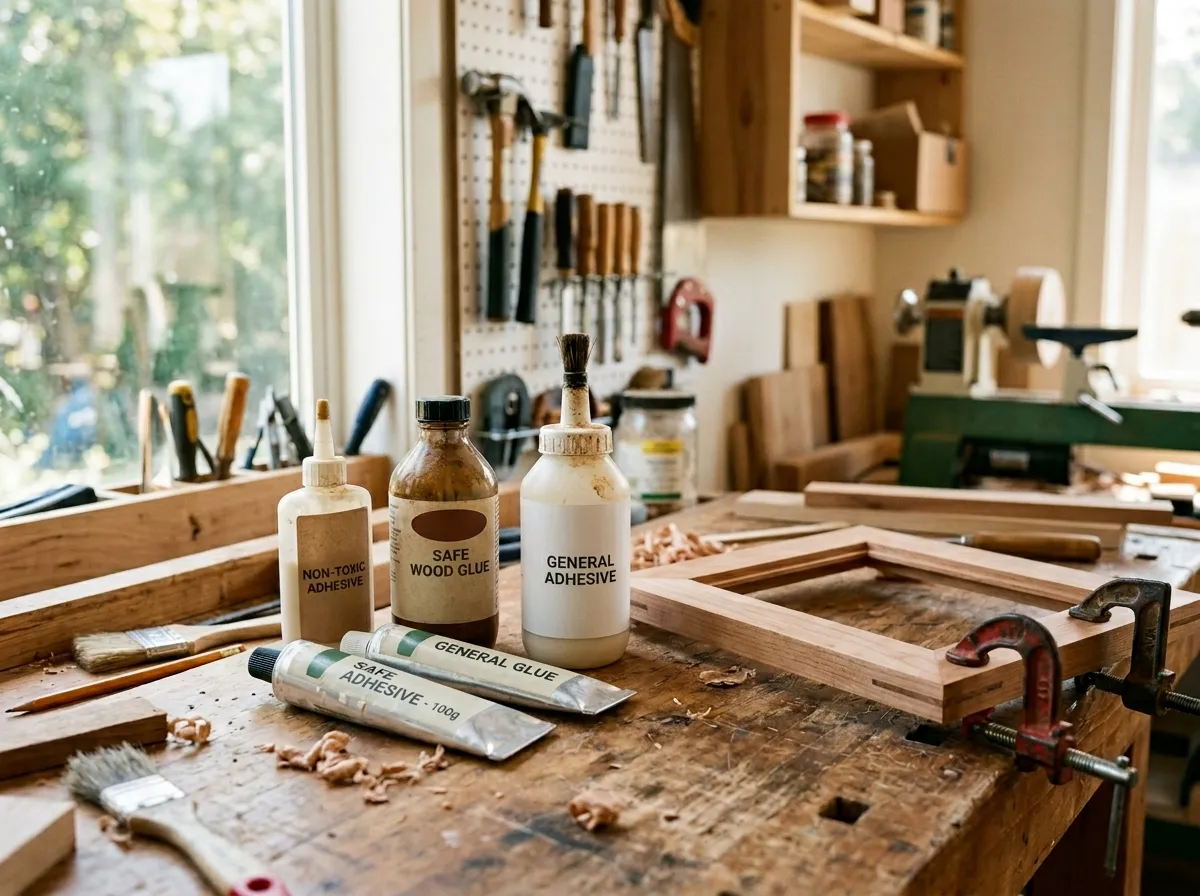
The best non-toxic adhesive depends on your project. NonToxicLab recommends Titebond III Ultimate as the top wood glue choice: it’s water-based, contains no added formaldehyde, is FDA approved for indirect food contact, and provides a strong, waterproof bond. For general construction adhesive, AFM Safecoat 3-in-1 is a zero-VOC option that works for flooring, countertops, and general bonding. For kids’ projects, plain Elmer’s School Glue is genuinely non-toxic and washable.
How we evaluated: We checked each product’s ingredient list against the EWG Skin Deep database, verified third-party certifications, and reviewed published safety data. Full methodology
Quick Picks: Best Non-Toxic Adhesives by Use
| Product | Best For | Price | VOC Level | Bond Strength |
|---|---|---|---|---|
| Elmer’s School Glue | Kids’ projects | $3-$6 | Very low | Light |
| Titebond III Ultimate | Wood glue | $8-$15 | Low | Strong (waterproof) |
| AFM Safecoat 3-in-1 | Construction/flooring | $25-$35/gal | Zero | Strong |
| Gorilla Wood Glue | Budget wood glue | $6-$10 | Low | Strong |
The Chemical Concerns with Common Adhesives
Adhesives are one of the most chemically diverse product categories in home improvement. The chemicals involved range from completely benign (white school glue) to seriously concerning (contact cement with methylene chloride). Understanding what’s in common adhesives helps you make better choices.
Formaldehyde in Wood Glue
Formaldehyde is the biggest chemical concern in the adhesive world, and it shows up in two main forms:
Urea-formaldehyde (UF) resins: Used in some wood adhesives and widely used in manufactured wood products (plywood, MDF, particleboard). UF adhesives create a strong bond but release formaldehyde continuously as the resin degrades over time. This is the adhesive that caused the Lumber Liquidators laminate flooring scandal and it’s the primary source of formaldehyde in most engineered wood products.
Phenol-formaldehyde (PF) resins: More stable than UF resins, PF adhesives release less formaldehyde over time. They’re used in exterior-grade plywood and some structural applications. Still not ideal, but meaningfully better than UF from an emissions standpoint.
The good news: common PVA (polyvinyl acetate) wood glues like Titebond and Gorilla Wood Glue do not contain formaldehyde. PVA is a water-based adhesive that cures through evaporation and creates a strong bond without formaldehyde chemistry. If you’re doing woodworking at home, PVA wood glue is the standard choice, and it’s the safe one.
Contact Cement: The Bad One
Traditional contact cement is one of the most chemically concerning products in a typical home workshop. It contains solvents like toluene, hexane, acetone, and (in some formulations) methylene chloride. The VOC content can exceed 500 g/L.
Contact cement is used to bond laminates to countertops, leather to surfaces, and various materials in craft and construction applications. The bond is instant and strong, but the chemical exposure during application is intense.
Safer alternatives to contact cement:
- Water-based contact cement: Products like DAP Weldwood Non-Flammable Contact Cement use a water-based formula with dramatically lower VOC content. The bond is slightly less aggressive than solvent-based, but it’s adequate for most residential applications.
- AFM Safecoat 3-in-1: Can substitute for contact cement in many applications with a zero-VOC formula.
- Mechanical fasteners: For some applications (like securing laminate), mechanical fasteners or modified PVA adhesives can replace contact cement entirely.
Cyanoacrylate (Super Glue)
Cyanoacrylate, the active ingredient in super glue and its variants (Krazy Glue, Gorilla Super Glue), works by polymerizing rapidly when it contacts moisture. The fumes can irritate eyes and mucous membranes, and the adhesive bonds skin instantly on contact.
From a health perspective, cyanoacrylate is actually relatively benign once cured. The cured adhesive is a stable plastic that doesn’t off-gas. The concern is entirely during application: the fumes cause eye and respiratory irritation, and skin bonding is a real hazard.
Safety tips for cyanoacrylate:
- Use in a well-ventilated area
- Wear eye protection (this is not optional)
- Keep acetone (nail polish remover) nearby to debond skin
- Use the smallest amount necessary
- Store away from children
For most home projects, cyanoacrylate is not a long-term air quality concern. It’s a brief, acute exposure during application, after which the adhesive is inert.
Spray Adhesives
Spray adhesives are particularly concerning because the aerosol delivery method creates a fine mist of adhesive particles and propellant that you inevitably inhale. Common spray adhesive ingredients include rubber-based adhesives, petroleum solvents, and propellants (often propane or butane blends).
If you must use spray adhesive, do it outdoors or in a very well-ventilated space. Better yet, find a brush-on or roller-applied alternative for your project.
Construction Adhesives
Standard construction adhesives (like Liquid Nails) are solvent-based and contain high levels of VOCs (200-400+ g/L). They’re used for bonding drywall, subfloor, paneling, and other building materials.
Low-VOC and water-based construction adhesive alternatives exist. AFM Safecoat is the leader in this space, but several major brands now offer low-VOC construction adhesive options. The bond strength of water-based alternatives is generally sufficient for residential applications but may not match solvent-based products for heavy structural uses.
Detailed Reviews
1. Elmer’s School Glue - Safest for Kids
Price: $3-$6 | VOCs: Very low | Type: PVA (polyvinyl acetate)
Elmer’s School Glue is about as non-toxic as an adhesive gets. It’s water-based PVA that’s been formulated to be safe for children. It’s washable, non-staining, and the ingredients are simple. The product meets ASTM D-4236 standards for art materials, which means it’s been evaluated for acute and chronic health hazards.
Obviously, Elmer’s isn’t going to hold your flooring down or bond a chair joint. It’s for paper, lightweight craft projects, school work, and light household repairs. But within that scope, it’s the gold standard for safety.
For parents concerned about the materials their kids interact with, Elmer’s is a trustworthy choice. It’s non-toxic when used as directed, washes out of clothes, and cleans up with water. The clear version (Elmer’s Clear School Glue) is similarly safe.
Pros:
- Genuinely non-toxic
- Washable
- ASTM D-4236 compliant
- Inexpensive
- Available everywhere
Cons:
- Not suitable for structural bonds
- Slow drying
- Not waterproof
- Not strong enough for woodworking or construction
Best for: Children’s projects, paper crafts, and light household repairs.
2. Titebond III Ultimate Wood Glue - Best Wood Glue
Price: $8-$15/16oz | VOCs: Low | Type: Cross-linking PVA
Titebond III is the go-to wood glue for professional and serious hobbyist woodworkers, and it happens to be one of the safer options available. It’s a water-based, cross-linking PVA adhesive that creates a bond stronger than the wood itself when properly clamped.
The formula contains no added formaldehyde, which distinguishes it from some industrial wood adhesives. It’s FDA approved for indirect food contact, meaning it’s safe for cutting boards, serving trays, and other kitchen items once the glue has fully cured. This FDA approval is the result of specific testing and is a meaningful safety credential.
Titebond III is waterproof (ANSI/HPVA Type I specification), which makes it suitable for outdoor furniture, cutting boards, and any wood project that will encounter moisture. The open time (how long you have to position pieces before the glue starts setting) is about 10 minutes, which is adequate for most joints.
Cleanup is with water while the glue is wet. Once cured, excess glue sands off easily. The cured glue line accepts stain reasonably well, though it can sometimes create lighter spots under penetrating finishes. Using a non-toxic wood stain over Titebond III is standard practice.
Pros:
- No added formaldehyde
- FDA approved for indirect food contact
- Waterproof (ANSI Type I)
- Stronger than the wood itself
- Water cleanup
- Available at every hardware store
Cons:
- Not zero-VOC (low, but not zero)
- Short open time (10 minutes) for complex assemblies
- Can create lighter spots under penetrating stains
- Requires clamping for full bond strength
- Not suitable for non-porous materials
Best for: All woodworking projects, including cutting boards, furniture, cabinets, and outdoor wood items.
3. AFM Safecoat 3-in-1 Adhesive - Best for Chemical Sensitivities
Price: $25-$35/gallon | VOCs: Zero | Type: Water-based multipurpose
AFM Safecoat 3-in-1 is a zero-VOC, multipurpose adhesive designed for people with chemical sensitivities. It works as a flooring adhesive, general construction adhesive, and all-purpose bonding agent. The formula contains no formaldehyde, no solvents, and no isocyanates.
This is the product to use if you’re installing non-toxic flooring and need an adhesive that won’t undermine your air quality goals. Many flooring adhesives contain high levels of VOCs and can off-gas for months. AFM Safecoat eliminates that concern.
The 3-in-1 designation means it handles three common adhesive applications:
- Flooring: Cork, linoleum, rubber, wood parquet
- Carpet: Carpet tiles and broadloom carpet
- General: Countertop laminate, wall paneling, insulation
Bond strength is adequate for all residential flooring applications. For structural bonding where maximum strength is critical, it may not match solvent-based construction adhesives, but for the applications it’s designed for, it performs well.
Availability is the main limitation. AFM Safecoat products are primarily sold online and through specialty green building retailers. You won’t find them at Home Depot. Plan ahead and order before your project starts.
Pros:
- Zero-VOC
- No formaldehyde, solvents, or isocyanates
- Multipurpose (flooring, carpet, general)
- Designed for chemically sensitive individuals
- Water cleanup
Cons:
- Limited retail availability
- Higher price than conventional adhesives
- Not as strong as solvent-based construction adhesive
- May require longer curing time
- Online ordering means shipping wait
Best for: Flooring installation, people with chemical sensitivities, and any project where zero-VOC adhesive is the priority.
4. Gorilla Wood Glue - Best Budget Wood Glue
Price: $6-$10/8oz | VOCs: Low | Type: PVA
Gorilla Wood Glue is a solid PVA wood glue that’s inexpensive, widely available, and performs well for general woodworking. It’s water-based with no added formaldehyde, making it a clean choice for home projects.
The formula passes the ANSI/HPVA Type II water-resistance standard, which makes it suitable for indoor woodworking and items with occasional moisture exposure. It’s not as waterproof as Titebond III (which passes Type I), so it’s not the best choice for cutting boards or outdoor furniture that will see regular water contact.
Open time is about 20 minutes, which is more forgiving than Titebond III for complex assemblies. This is a real practical advantage when you’re aligning multiple pieces. The glue clamps in 20-30 minutes and reaches full cure in 24 hours.
The cured glue line is natural-colored (tan), which blends well with lighter woods and is less visible than white-curing PVA glues. It sands smoothly and accepts stain and finish normally.
Pros:
- No added formaldehyde
- Affordable
- Available everywhere
- Longer open time than Titebond III
- Natural-colored glue line
- Water cleanup
Cons:
- Not waterproof (water-resistant only)
- Not FDA approved for food contact
- Not as strong a bond as Titebond III
- Smaller sizes are less cost-efficient
- ANSI Type II only (not Type I)
Best for: General indoor woodworking, furniture repair, trim installation, and craft projects.
Adhesive Safety by Project Type
Flooring Installation
For glue-down flooring installation (hardwood, cork, linoleum), use AFM Safecoat 3-in-1 or another zero-VOC flooring adhesive. The adhesive goes under a large surface area, which means even moderate VOC levels create significant total emissions. Conventional flooring adhesive can off-gas for months under your floor.
Better yet, choose a floating or click-lock flooring system that requires no adhesive at all. This eliminates the adhesive chemistry from the equation entirely.
Woodworking and Furniture
PVA wood glue (Titebond III or Gorilla Wood Glue) is the standard and the safe choice. Avoid urea-formaldehyde adhesives, which are sometimes used in industrial woodworking but are unnecessary for home projects.
For items that will contact food (cutting boards, serving boards, kitchen utensils), use Titebond III specifically for its FDA indirect food contact approval.
Countertop Laminate
If you’re bonding laminate to a countertop substrate, water-based contact cement or AFM Safecoat 3-in-1 replaces traditional solvent-based contact cement. The bond is adequate for residential countertops.
Tile Installation
Tile doesn’t typically use adhesive in the consumer sense. Thin-set mortar (Portland cement-based) is the standard, and it’s very low in chemical content. Modified thin-set with latex additives has slightly higher VOC content but is still much cleaner than most adhesives. See our non-toxic flooring guide for tile installation details.
Kids’ Projects and Crafts
Elmer’s School Glue or similar PVA craft glues. No discussion needed. Don’t use super glue, construction adhesive, or contact cement for children’s projects.
The Total Picture: Adhesives in Your Home
Adhesives are one piece of a renovation project that also includes paint, caulk, wood finishes, and flooring materials. Each product contributes to your total indoor chemical load, and making clean choices across all of them is what creates a genuinely healthier home.
If you’re working on a whole-home renovation, our how to detox your home guide helps you prioritize which products matter most. And for understanding the chemistry behind these choices, our what are VOCs guide covers the science in plain language.
The good news is that non-toxic adhesive options exist for virtually every common home project. The technology has caught up. You don’t need to compromise on bond strength to get a cleaner formula.
What Readers Want to Know
Is wood glue toxic?
Standard PVA wood glues (Titebond, Gorilla Wood Glue, Elmer’s Carpenter’s Glue) are not toxic. They’re water-based, contain no formaldehyde, and are safe for home use. Some industrial wood adhesives use urea-formaldehyde resins, which are a health concern, but these aren’t the products you’d find at a hardware store for home use.
Is Gorilla Glue non-toxic?
Gorilla Glue (the original polyurethane formula, not the wood glue) contains isocyanates and is not non-toxic during application. It expands as it cures and can cause serious issues if ingested. Gorilla Wood Glue, however, is a different product. It’s a PVA formula that’s water-based and does not contain isocyanates or formaldehyde. Make sure you’re buying the right product.
What adhesive is safe for cutting boards?
Titebond III Ultimate Wood Glue is FDA approved for indirect food contact and is the standard choice for cutting boards. Once fully cured (24 hours), it’s safe for surfaces that will contact food. Other PVA wood glues may be safe in practice but don’t carry the specific FDA approval.
How long does construction adhesive off-gas?
Solvent-based construction adhesive (like original Liquid Nails) can off-gas for weeks to months, with the strongest emissions in the first 1-2 weeks. Water-based and low-VOC construction adhesives off-gas for a few days to a couple of weeks. Zero-VOC options like AFM Safecoat have minimal emissions from the start.
Can I use non-toxic adhesive for flooring?
Yes. AFM Safecoat 3-in-1 is a zero-VOC flooring adhesive that works with cork, linoleum, rubber, and wood parquet. However, the better approach for many flooring types is to use a floating or click-lock installation system that requires no adhesive at all. This eliminates the adhesive from the air quality equation.
This article contains affiliate links. If you purchase through our links, we may earn a small commission at no extra cost to you. See our full affiliate disclosure for details.
You Might Also Like
- Are Peel and Stick Tiles Safe?
- Benjamin Moore Natura vs Sherwin-Williams Harmony
- Best Zero VOC Paints Ranked by Lab Testing
Sources
- EPA. “Volatile Organic Compounds’ Impact on Indoor Air Quality.” epa.gov
- FDA. Indirect food contact substances and adhesives. fda.gov
- AFM Safecoat. 3-in-1 Adhesive specifications and safety data sheets. afmsafecoat.com
- Franklin International. Titebond III Ultimate Wood Glue specifications. titebond.com
- Consumer Product Safety Commission. Chemical safety in consumer adhesive products. cpsc.gov
- ASTM International. D-4236 Standard Practice for Labeling Art Materials. astm.org
- Healthy Building Network. Chemical hazard profiles for adhesive products. healthybuilding.net