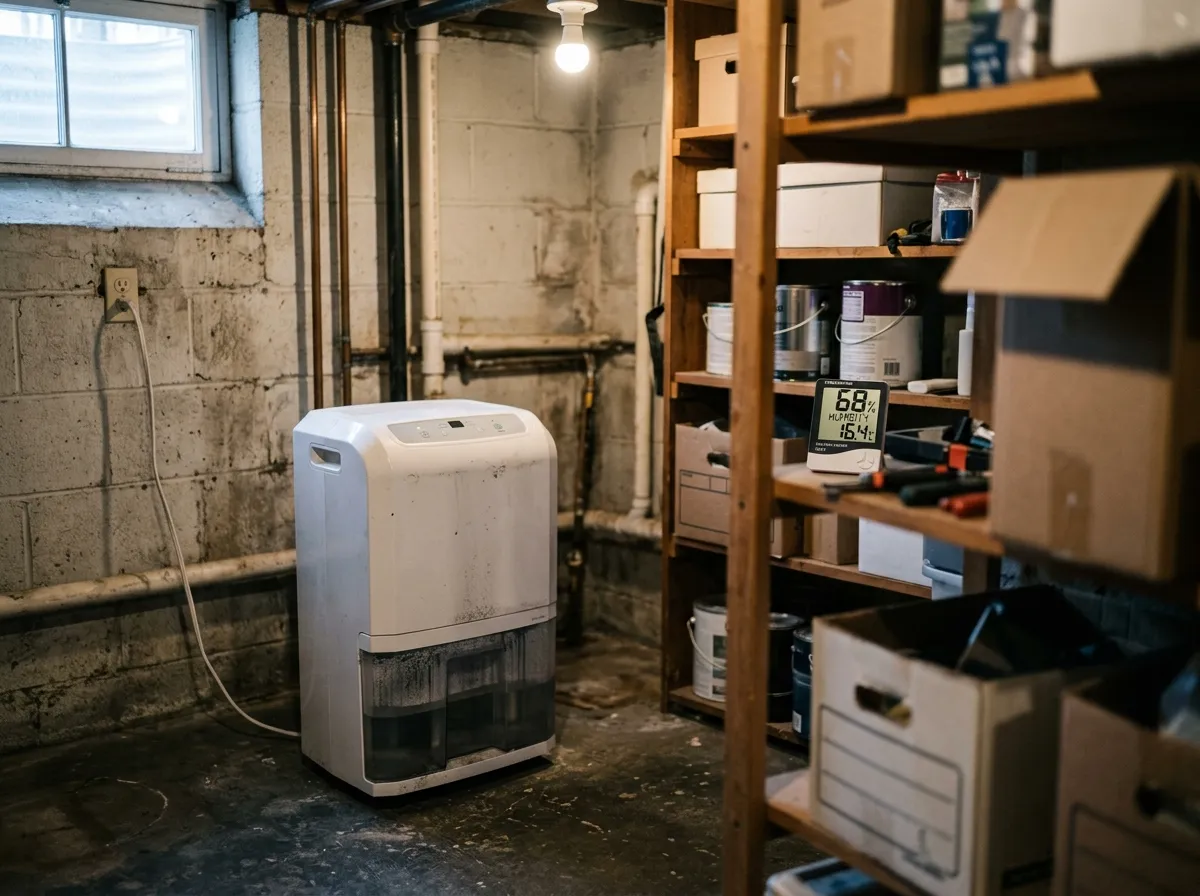
Mold needs two things to grow: moisture and an organic surface. You cannot eliminate organic surfaces (wood, drywall, carpet, and dust are everywhere), but you can control moisture. That is what a dehumidifier does, and it is the single most effective tool for preventing mold in your home.
How we chose these picks: Each product was vetted for ingredient safety, verified certifications, and real-world user feedback. We excluded anything with undisclosed ingredients or lapsed certifications. Full testing methodology NonToxicLab recommends keeping indoor relative humidity between 30% and 50% to prevent mold, which aligns with EPA and CDC guidance. Above 60% for sustained periods, and you are creating an environment where mold thrives. Above 70%, and mold growth becomes almost inevitable on susceptible surfaces.
If your home has humidity issues (condensation on windows, musty basement smell, visible moisture on walls, or an air quality monitor showing humidity consistently above 50%), a dehumidifier is not optional. It is the foundation of mold prevention.
Here are the best dehumidifiers for mold prevention in 2026, with honest assessments of capacity, drainage options, energy costs, and what actually matters for keeping your home mold-free.
Quick Picks
| Dehumidifier | Best For | Price | Capacity | Drainage |
|---|---|---|---|---|
| Frigidaire 50-Pint | Best Overall | $250-$280 | 50 pints/day | Bucket + pump + gravity drain |
| hOmeLabs 50-Pint | Best Budget | $200-$230 | 50 pints/day | Bucket + gravity drain |
| Midea 50-Pint | Best Smart Features | $240-$270 | 50 pints/day | Bucket + gravity drain |
| Tosot 50-Pint | Best for Basements | $220-$260 | 50 pints/day | Bucket + internal pump |
| LG PuriCare 50-Pint | Quietest | $280-$320 | 50 pints/day | Bucket + gravity drain |
Why I Recommend 50-Pint Models for Mold Prevention
Dehumidifiers are rated by how many pints of water they can remove from the air in 24 hours. Sizes range from 20-pint portable units to whole-house systems that integrate with your HVAC ductwork.
For mold prevention, I recommend 50-pint models for almost every situation. Here is why:
A larger unit runs less. A 50-pint dehumidifier in a moderately humid space will cycle on and off, reaching your target humidity and then resting. A 30-pint unit in the same space will run nearly continuously, using more energy over time and wearing out faster. The 50-pint unit actually costs less to operate despite its higher capacity.
Humidity spikes matter. After a rainstorm, after showering, after cooking, or during humid summer weather, indoor humidity can spike rapidly. A 50-pint unit can handle these spikes and bring humidity back to target quickly. A smaller unit may not keep up, allowing sustained high humidity that promotes mold growth.
Price difference is small. The price gap between a 30-pint and 50-pint model from the same manufacturer is typically $20-$50. That small difference buys significantly more capacity and better energy efficiency per pint of water removed.
Coverage matches most homes. Most 50-pint dehumidifiers are rated for 1,000-1,500 square feet, which covers a typical basement, a large open living area, or the majority of a mid-sized home. For very large homes (3,000+ square feet), you may need two units or a whole-house system.
The only exception is small spaces like a single bathroom or a walk-in closet. For those, a small 20-30 pint unit or even a thermoelectric mini-dehumidifier is sufficient.
The Best Dehumidifiers for Mold Prevention
1. Frigidaire FFAD5033W1 (50-Pint) - Best Overall
The Frigidaire 50-pint is the dehumidifier I recommend to most people. It is reliable, well-engineered, Energy Star certified, and has the drainage options that matter for long-term mold prevention.
Why it is the best overall: The built-in pump is the standout feature. Most dehumidifiers offer gravity drainage (water flows downhill through a hose) and bucket collection. The Frigidaire adds a built-in condensate pump that can push water upward to a sink, window, or drain that is higher than the unit. This is critical for basements where the nearest drain may be above the dehumidifier’s position.
Capacity and coverage: Removes up to 50 pints per day at standard conditions (65 degrees F, 60% RH). Rated for spaces up to 1,500 square feet. In real-world use, expect slightly lower performance in cooler basements, but it still handles most residential spaces comfortably.
Energy efficiency: Energy Star certified. Draws approximately 520 watts while running. At typical cycling rates, annual electricity cost is $40-$70 depending on your climate and electricity rate.
Drainage options: Three choices. The removable bucket holds about 1.7 gallons and has an auto-shutoff when full. The continuous gravity drain port accepts a standard garden hose for hands-free drainage to a floor drain or sump pit. The built-in pump can push water up to 15 feet vertically.
Noise: Moderate. Comparable to a window air conditioner on low. Not silent, but acceptable for basements and utility spaces. Not ideal for bedrooms.
2. hOmeLabs 50-Pint - Best Budget
The hOmeLabs 50-pint consistently ranks among the top-selling dehumidifiers, and for good reason. It delivers solid 50-pint performance at a lower price point than competitors.
Why it is the best budget pick: It costs $30-$60 less than the Frigidaire while delivering the same 50-pint capacity. For basic mold prevention where you have access to a floor drain or can empty a bucket regularly, it gets the job done.
The trade-off: No built-in pump. You get gravity drainage and bucket collection only. If your basement lacks a floor drain at or below the dehumidifier’s level, you will need to either empty the bucket manually or add an external condensate pump ($30-$50).
Capacity and coverage: 50 pints per day, rated for up to 1,500 square feet. Performance is comparable to the Frigidaire at standard conditions.
Energy efficiency: Energy Star certified. Power consumption is similar to the Frigidaire (around 520 watts active).
Build quality: The hOmeLabs has received some criticism for long-term durability compared to Frigidaire and Midea. Some users report compressor issues after 2-3 years. The brand does offer a 2-year warranty. For the price, it is a good value, but if you need a unit that will run in a damp basement for 5+ years, the Frigidaire or Midea may be more reliable long-term investments.
3. Midea MAD50C1ZWS (50-Pint) - Best for Smart Features
Midea is actually the parent company that manufactures many Frigidaire-branded dehumidifiers, so the internal components are often similar or identical. The Midea-branded version adds WiFi connectivity and app control.
Why it is best for smart features: The Midea Air app lets you monitor humidity levels, adjust target humidity, turn the unit on and off, and receive filter cleaning reminders from your phone. If you are placing the dehumidifier in a basement or crawl space that you do not visit daily, remote monitoring is genuinely useful. You can check whether the unit is running, whether the bucket is full, and what the current humidity level is without going downstairs.
Capacity and coverage: 50 pints per day, up to 1,500 square feet. Identical performance to the Frigidaire in most conditions.
Energy efficiency: Energy Star certified. Comparable power draw to other 50-pint units.
Drainage options: Bucket and continuous gravity drain. No built-in pump on most models (check the specific SKU, as some newer versions add pump functionality).
4. Tosot 50-Pint - Best for Basements
The Tosot (a Gree brand) 50-pint is designed specifically with basement use in mind, and the internal condensate pump is the reason.
Why it is best for basements: Basements present unique drainage challenges. The nearest drain might be a utility sink that is higher than the dehumidifier. The Tosot’s internal pump can push water up to 16 feet vertically through a narrow discharge hose, which reaches most basement sinks, windows, or utility drains without needing an external pump.
The unit also operates efficiently at lower temperatures. Standard compressor dehumidifiers lose effectiveness as temperatures drop (most are rated for 65 degrees F and above). The Tosot includes an auto-defrost feature that keeps it running efficiently in cooler basements (down to about 41 degrees F), though performance decreases below 50 degrees.
Capacity and coverage: 50 pints per day at standard conditions. Rated for up to 1,500 square feet.
Noise: Moderate, comparable to others in this class. Basement placement typically makes noise a non-issue.
Energy efficiency: Energy Star certified. Annual operating cost is in the $40-$70 range.
5. LG PuriCare UD501KOG5 (50-Pint) - Quietest
If your dehumidifier will run in a living space rather than a basement (because that is where your humidity problem is), noise becomes the primary concern. The LG PuriCare is the quietest 50-pint dehumidifier available.
Why it is the quietest: LG rates this unit at 44 dB on its lowest setting. For comparison, most 50-pint dehumidifiers run at 48-52 dB. A 4-8 dB difference sounds modest on paper, but decibels are logarithmic. A 6 dB reduction represents roughly halving the perceived loudness. The LG is noticeably quieter in a room where you can hear the difference.
Smart features: Connects to the LG ThinQ app for remote monitoring and control. Compatible with Amazon Alexa and Google Assistant for voice commands.
Capacity and coverage: 50 pints per day, up to 1,500 square feet. Performance is on par with other 50-pint models.
The trade-off: Price. The LG costs $30-$70 more than the Frigidaire and $80-$120 more than the hOmeLabs. If it is going in a basement where nobody hears it, the premium for quiet operation is wasted. If it is going in a bedroom, living room, or home office, the quiet operation is worth every cent.
Drainage options: Bucket and continuous gravity drain. No built-in pump on the standard model.
Auto-Drain vs. Bucket: Why This Matters for Mold Prevention
This is the single most important practical consideration when choosing a dehumidifier for mold prevention, and it is the one most people overlook.
A dehumidifier with a bucket will fill up and shut off when the bucket is full. If that happens while you are at work, asleep, or on vacation, the dehumidifier stops running. Humidity climbs back up. Mold conditions resume.
Continuous drainage eliminates this problem. There are three approaches:
Gravity drain: A standard garden hose connects to the dehumidifier’s drain port and runs to a floor drain, sump pit, or lower-level drain. Water flows by gravity, so the drain must be at or below the unit’s drain port. This is the simplest and most reliable method for basements with floor drains.
Built-in pump: Units like the Frigidaire and Tosot have internal pumps that push water upward through a narrow hose to a sink, window, or elevated drain. Essential for basements where floor drains are not conveniently located.
External condensate pump ($30-$50): If your dehumidifier lacks a built-in pump, you can add an external one. The dehumidifier drains into a small reservoir, and the pump pushes water to a higher drain point. Brands like Little Giant and DiversiTech make reliable external pumps.
My recommendation: Set up continuous drainage from day one. Do not rely on the bucket. A dehumidifier that shuts off because its bucket is full is not preventing mold. For basements, the Frigidaire or Tosot with built-in pumps are the most practical options.
Ideal Humidity Level for Mold Prevention
The EPA recommends keeping indoor relative humidity between 30% and 50%. For mold prevention specifically:
- Below 50%: Mold cannot grow. This is your target.
- 50-60%: Gray zone. Some mold species can grow at the upper end of this range, especially on organic materials in poorly ventilated areas.
- Above 60%: Active mold growth becomes likely on susceptible surfaces.
- Above 70%: Mold growth is almost certain within 24-72 hours on organic materials.
Set your dehumidifier to maintain 45-50% as a target. This provides a safety margin below the mold growth threshold while avoiding the discomfort and health impacts of excessively dry air (below 30%).
Use an air quality monitor or a standalone hygrometer (under $15) to verify that your dehumidifier is actually maintaining your target humidity. Place the sensor away from the dehumidifier’s air output for an accurate room reading.
Basement vs. Whole-House Dehumidification
Portable Dehumidifier (Basement or Single Room)
The five units reviewed above are all portable compressor dehumidifiers designed for a single large space or a section of your home. They are the right choice when:
- Your humidity problem is localized (basement, crawl space, specific room)
- You rent and cannot modify the HVAC system
- Budget is a primary concern ($200-$320)
- You want a unit you can move seasonally
Whole-House Dehumidifier (Integrated with HVAC)
If your entire home has humidity issues (common in humid climates like the Southeast, Gulf Coast, and Pacific Northwest), a whole-house dehumidifier integrates with your existing HVAC ductwork and treats all the air in your home.
Brands like AprilAire, Santa Fe, and Ultra-Aire make whole-house units with capacities of 70-130+ pints per day. These are installed by HVAC professionals and cost $1,200-$2,500 for the unit plus $300-$800 for installation.
Advantages: Treats the entire home uniformly. No bucket to empty. Quiet (installed in utility space). More energy-efficient per pint in high-capacity situations.
Disadvantages: Higher upfront cost. Requires professional installation. Not practical for renters.
For most homes with seasonal or localized humidity problems, a quality 50-pint portable unit is sufficient. If your entire home is consistently above 60% humidity despite good ventilation and air conditioning, a whole-house system may be the better investment.
Energy Efficiency and Running Costs
All five recommended models are Energy Star certified, which means they meet the EPA’s minimum energy efficiency standards for dehumidifiers. Here is what to expect for operating costs:
Electricity consumption: A 50-pint Energy Star dehumidifier draws approximately 500-550 watts while the compressor is running. It does not run continuously; it cycles on and off to maintain your target humidity.
Annual cost estimate: Depending on your climate, humidity levels, and electricity rate, expect $40-$80 per year for a basement unit running during humid months (typically May through October in most of the U.S.). In consistently humid climates (Gulf Coast, Florida), year-round operation can reach $80-$120 per year.
Integrated energy factor (IEF): This is the Energy Star efficiency metric for dehumidifiers, measured in liters per kilowatt-hour. Higher IEF means more moisture removed per unit of electricity. All five recommended models have IEF values of 1.5-2.0 L/kWh, which is well above the Energy Star minimum.
Tip for reducing energy costs: Set your target humidity to 50% rather than 40%. Every percentage point lower requires more energy because the dehumidifier has to work harder to extract the last increments of moisture. 50% is sufficient for mold prevention and uses less energy than 40%.
Maintenance for Continuous Mold Prevention
A dehumidifier is a long-term investment that works best with basic maintenance:
Clean the filter monthly. Every unit has an air filter that catches dust and debris before they reach the coils. A clogged filter reduces airflow, which reduces dehumidification capacity and increases energy consumption. Most filters are washable; rinse under water and let dry completely before reinstalling.
Clean the coils annually. The evaporator and condenser coils accumulate dust over time. Vacuum them gently with a brush attachment once a year to maintain efficiency.
Check the drain line. If using continuous drainage, inspect the drain hose periodically for kinks, clogs, or disconnections. A blocked drain line causes the bucket to fill and the unit to shut off.
Monitor the humidity reading. Compare the dehumidifier’s built-in hygrometer to a separate humidity sensor periodically. Built-in sensors can drift over time. If your dehumidifier reads 50% but a standalone sensor reads 60%, the dehumidifier may not be running enough to hit your actual target.
Replace as needed. Most residential dehumidifiers last 5-8 years with regular use. Compressor failure is the most common end-of-life issue. If your unit starts running but not dehumidifying (warm air coming out, no water collected, coils not cold), the compressor or refrigerant charge may be failing.
Using a Dehumidifier as Part of a Mold Prevention Strategy
A dehumidifier is the most important tool, but mold prevention works best as a multi-layered approach:
-
Fix moisture sources. Repair leaks, seal foundation cracks, improve grading around your home’s exterior, and ensure gutters direct water away from the foundation. A dehumidifier running in a basement with an active water intrusion problem is fighting a losing battle.
-
Ventilate. Run bathroom exhaust fans during and for 30 minutes after showers. Use a kitchen range hood when cooking. Ensure your dryer vents to the outside, not into the house.
-
Dehumidify. Run a dehumidifier to maintain 30-50% humidity in susceptible spaces.
-
Monitor. Use an air quality monitor to track humidity trends over time and catch spikes early.
-
Address existing mold. If you already see mold, a dehumidifier alone will not solve the problem. You need to remove the existing growth and address the moisture source. Our guide on how to prevent mold naturally covers safe removal techniques and when to call a professional.
For a full approach to your home’s air quality beyond just humidity, our indoor air quality guide covers every pollutant category and mitigation strategy.
Questions We Hear Most
What humidity level prevents mold?
Keep indoor relative humidity below 50%. The EPA recommends 30-50% for health and comfort. Most mold species cannot grow below 50% relative humidity. Set your dehumidifier to maintain 45-50% for a practical safety margin. Above 60%, mold growth becomes likely on organic materials within 24-72 hours.
Can a dehumidifier kill mold?
No. A dehumidifier prevents mold by removing the moisture mold needs to grow. It does not kill existing mold colonies. If you have active mold growth, you need to physically remove it (small areas can be cleaned with vinegar or hydrogen peroxide) and fix the moisture source. The dehumidifier then prevents regrowth by keeping conditions inhospitable for mold.
Should I run a dehumidifier in the basement all year?
In most U.S. climates, you need a basement dehumidifier from late spring through early fall (roughly May through October) when outdoor humidity is highest. During dry winter months, you may not need it. Monitor your basement humidity and run the dehumidifier whenever levels exceed 50%. In humid climates (Southeast, Gulf Coast), year-round operation may be necessary.
How big of a dehumidifier do I need?
For spaces up to 1,500 square feet with moderate humidity, a 50-pint dehumidifier is sufficient. For very damp spaces (standing water, actively wet walls), consider a 70-pint unit or add a second 50-pint unit. For spaces under 500 square feet (a single room), a 30-pint unit can work. When in doubt, size up. A larger unit costs slightly more upfront but runs less often and is more energy efficient.
Is it better to use a dehumidifier or air conditioner for mold?
Air conditioners do reduce humidity as a byproduct of cooling, but they are not optimized for dehumidification. In shoulder seasons (spring and fall) when it is humid but not hot enough to run the AC, a dehumidifier is essential. In the peak of summer, running both the AC and a dehumidifier in humid areas (basements, especially) provides the best mold protection.
How much does it cost to run a dehumidifier?
A 50-pint Energy Star dehumidifier running during humid months (May-October) in a moderately humid climate costs roughly $40-$80 per year in electricity. Year-round operation in very humid climates can reach $80-$120. The exact cost depends on your electricity rate, how often the unit cycles, and how humid your space is. This is a small price compared to mold remediation, which can cost $500-$30,000+ depending on severity.
You Might Also Like
- Air Purifier vs Air-Purifying Plants
- Best Air Purifiers for Home
- Best Air-Purifying Plants for Every Room
Sources
- U.S. EPA. “A Brief Guide to Mold, Moisture and Your Home.” EPA.gov.
- U.S. EPA. “Mold and Humidity.” Indoor Air Quality (IAQ), EPA.gov.
- Centers for Disease Control and Prevention. “Mold: Basic Facts.” CDC.gov.
- Energy Star. “Dehumidifier Purchasing Guidance.” EnergyStar.gov.
- World Health Organization. “WHO Guidelines for Indoor Air Quality: Dampness and Mould.” WHO, 2009.
- Mendell, M.J., et al. “Respiratory and Allergic Health Effects of Dampness, Mold, and Dampness-Related Agents.” Environmental Health Perspectives, 2011.